Explore all the powerful features Visual Paradigm has to offer
Design software and manage projects effortlessly with an all in one suite – all wrapped up in an integrated environment.
Visual Modeling
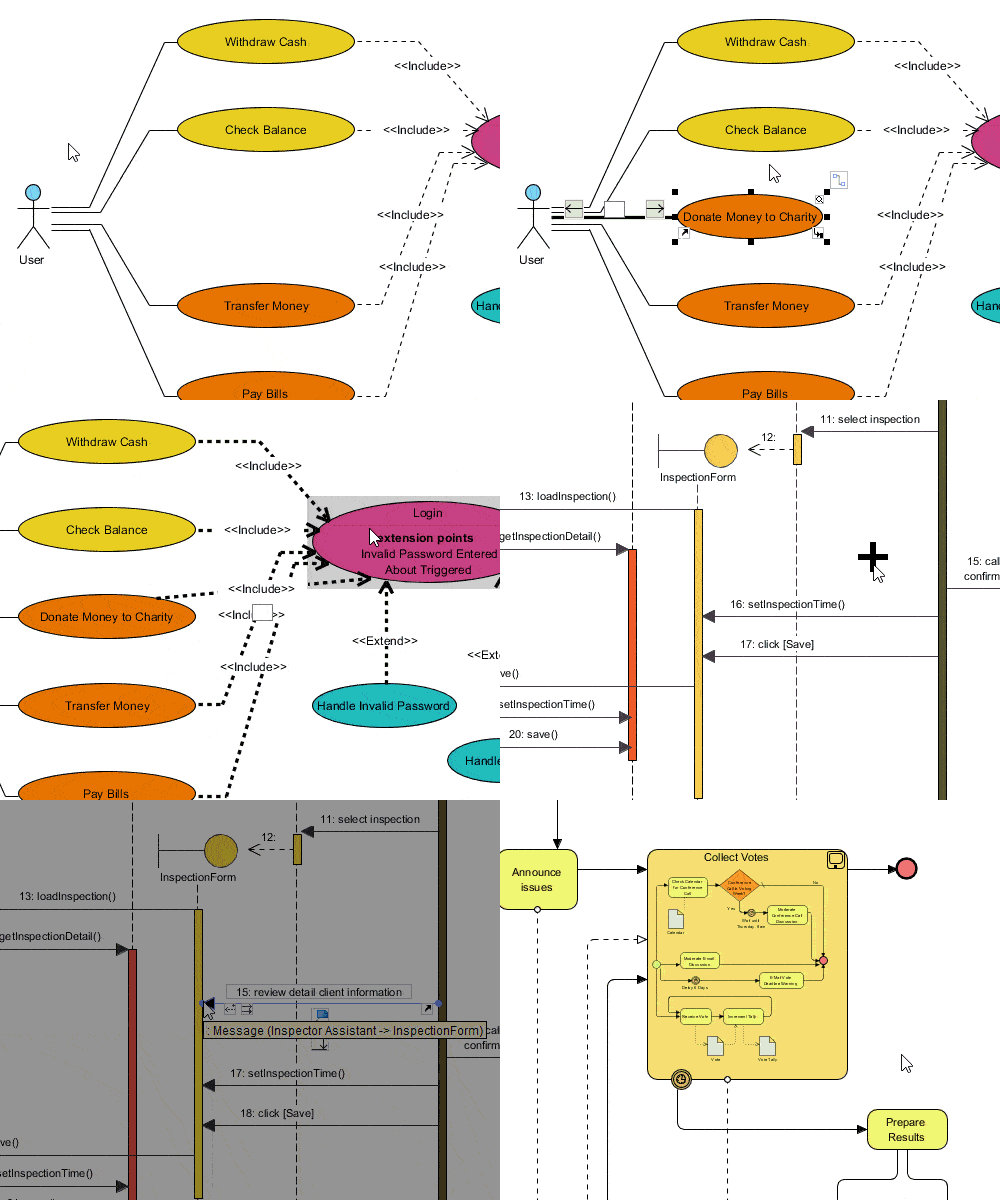
Our powerful visual modeling tools assist you in building and managing your diagrams and model elements effectively:
Enterprise Architecture
Utilize our industry-unique TOGAF ADM lifecycle tool, along with DoDAF, NAF, and MODAF tools, trusted by the world's leading enterprises.
- Process navigation tool that guides you through the ADM phases.
- Actionable steps: Perform ADM activities within our tool, accompanied by guides and clear examples - no training required.
- Extensive range of ADM tools, including ArchiMate, Capability Analysis, and ADM deliverable tools.
- Auto-generated TOGAF deliverables.

Business Analysis & Design
Benefit from our comprehensive suite of business tools designed to enhance your business's efficiency and productivity.
- Strategic Planning: Utilize our process management tool to discover and define your business's strategic goals.
- Process Design: Visualize business workflows with BPMN, document working procedures for activities, and generate high-quality process reports.
- Process Analysis: Study workflows using our process animation tool, and determine optimal resource allocation with our process simulation tool.
- Process Reengineering: Utilize our Reengineering process management tool to document your plan, design new processes, identify gaps, and monitor improvements (KPIs).

Project Management
Maximize your software project outcomes with our comprehensive suite of project management tools.
- A map of project management lifecycle with hotspots to all planning, execution, and control activities. Execute tasks using our built-in management tools and generate reports instantly.
- Utilize our 2D configurable process map to organize management activities efficiently.Access PMBOK and various project management process templates.
- Access a diverse range of management tools, including PERT, roadmap, implementation plan, spider chart, WBS, Fishbone diagrams and more.

Agile & Scrum Development
Full set of agile backlog and process management tools that makes your agile projects more effective.
- User story mapping:
- Drag and drop story creation and arrangement.
- Story estimation tool – Affinity table.
- Sprint backlog management
- Scrum Process Canvas:
Scrum Process Canvas that helps your team manage entire Scrum Project in one page including: all the Scrum roles, events and artifacts. Perform the activities right within the map. Generate Scrum reports in seconds.

Online Diagrams
Zero setup & configuration based on cloud technology for easy diagram creation and team collaboration.
- Convenient drag-and-drop diagram editors
- 100+ diagram types, covering all kinds of business, technical and general diagrams.
- 1000+ diagram templates to help you start quick.
- Web-based – Works well in different web browsers, and in any platform
- The best Visio alternative both in terms of features and pricing
- Embed your diagrams into MS Documents and Presentations for display and quick editing

User Experience Design
Clarify stakeholders' needs with our powerful user experience tools.
- Wireframe tool - Create wireframes to visualize screen flow and screen layout
- Wireflow tool – Visualize the flow of wireframes as a flowchart.
- Wireflow animation - Make your wireflow alive through the animation tool, which makes your presentation way more effective.
- Prototyping tool: demonstrate and confirm your work.

Customer Experience Design
Uncover improvement opportunities through comprehensive analysis of the customer experience. Utilize a Customer Journey Map (CJM) to gain insights into customers' behaviors, thoughts, and feelings across their journey, enabling the development of business plans rooted in customer value.

Code & Database Engineering
Bridge the gap between system design and implementation, with our code and database engineering support.
Code engineering tools:
- Code generation and reversal (for 10+ languages)
- Form sequence diagram from Java
- Hibernate ORM
- Generate/Reverse state machine code
- REST API design and generation
- Export database/DDL from ERD
- Generate ERD from database/DDL

Process Map Designer
Plan and design business operations with our flexible 2D process map designer.
- Matrix-style Process Map editor
- Over 40 business & technical process templates
- Unlimited rows and columns
- Configurable data format: Text, List, Bullet, etc
- Data visualization with charts

Team Collaboration
Let your team work concurrently, collaboratively and smoothly on same projects. Our cloud-based repository keeps your work securely on the cloud and makes it accessible anytime and anywhere.

Powerful Document Builder
Powerful Doc. Composer that enables you to build your report - Drag and drop model elements onto the document editor and that's it! Thousands of element templates are available, and you can even create your own and reuse it in every report.

Modern Diagram-as-Code Tool for Developers
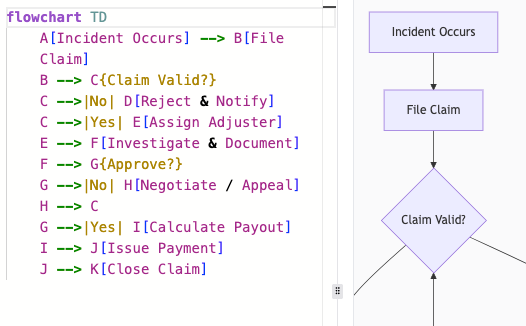
Speed up your technical documentation with Visual Paradigm VPasCode, our built-in diagram-as-code tool. Instead of manually drawing shapes, simply write plain text scripts using PlantUML, Mermaid, or Graphviz to render pixel-perfect system architecture models on the fly. Experience a seamless text to diagram workflow that integrates smoothly into your development process.
Discover the Best Fit for Your Needs
| Feature | Community | Modeler | Standard | Professional | Enterprise |
|---|
| Core Diagramming and Modeling Tool | |||||
|
|
|||||
|
|
|||||
|
|
- | - | - | ||
|
Flowchart
ai
|
|||||
|
Organization chart
Visualize organization structure with an easy-to-use organization chart creator
|
|||||
|
|
|||||
|
BPMN diagram (business process mapping)
Draw BPMN business process diagram for business process modeling.
|
- | ||||
|
Data Flow Diagram (DFD)
Draw Data Flow Diagram (DFD) to represent the information flow among system processes.
|
- | ||||
| - | |||||
| - | |||||
| - | |||||
|
EPC diagram
ai
|
- | ||||
| Advanced Diagramming and Modeling | |||||
|
Mind mapping
ai
|
- | - | |||
| - | - | ||||
| - | - | ||||
|
BMM diagram
Model business visions, strategies, policies and other motivation elements with BMM
|
- | - | - | ||
|
CMMN diagram
CMMN tool for modeling case-oriented business scenarios
|
- | - | - | ||
| Team Collaboration | |||||
|
Collaborative and concurrent modeling
Keep your work in cloud workspace. Work collaboratively and share your work easily.
|
|||||
|
Diagram review and commenting
Share your design online with stakeholder. Collect their comments through the commenting tool.
|
- | ||||
|
Task management
Create and manage project tasks with a professional task management platform.
|
- | ||||
|
Change request management
Submit, initiate, and request approval for changes within independent branches
|
- | - | - | ||
| Model Analysis Tools | |||||
|
Project glossary management
Define and maintain a list of project keywords in a project glossary.
|
- | ||||
| - | - | ||||
| - | - | ||||
| - | - | ||||
|
On-Demand Model ETL
Extract, Transform and Load models with powerful model warehousing tool.
|
- | - | - | ||
| Requirements and UX Design | |||||
|
Textual analysis
Identify domain keywords from problem description. Convert them to model elements on-the-fly.
|
- | ||||
|
Use case description
List the event flow within use cases and document other major properties.
|
- | - | |||
|
UX wireframe
Create wireframes for user experience design.
|
- | - | |||
|
UX storyboard
Organize and present wireframes as stories.
|
- | - | |||
|
UX wireflow
Represent user interactions and workflows with wireflow diagram - flowchart of wireframes
|
- | - | |||
|
UX prototyping tool
Create wireflow and perform prototyping easily and quickly
|
- | - | |||
|
High fidelity mockup tool
Create high fidelity user interface design.
|
- | - | |||
| Documentation and Reporting | |||||
| - | - | ||||
| - | - | ||||
| Code and Database Engineering | |||||
|
Code engineering
Generate source code from UML class model or vice versa.
|
- | - | |||
|
Visual REST API designer
Design RESTful API graphically. Generate API in seconds.
|
- | - | |||
| - | - | ||||
|
- | - | |||
|
Hibernate (ORM)
Enjoy SQL-less programming by designing and generating ORM to use in program development.
|
- | - | |||
| Advanced Modeling and Visualization | |||||
|
Diagram animation
Make your design alive with diagram animation tool.
|
- | - | |||
| - | - | ||||
| - | - | ||||
| - | - | ||||
| - | - | ||||
| - | - | ||||
|
Visual Diff diagram comparison tool
|
- | - | |||
|
Design pattern tool
|
- | - | |||
|
Zachman Framework
Keep project artifacts in an organized manner with Zachman Framework
|
- | - | |||
| - | - | ||||
| Integrations | |||||
| - | - | ||||
| - | - | ||||
| Project Management Tools | |||||
|
Gantt chart
Plan and manage tasks by listing them and visualizing their duration in a Gantt chart.
|
- | - | |||
|
|
- | - | - | ||
|
|
- | - | - | ||
| - | - | - | |||
| - | - | - | |||
| - | - | - | |||
|
Visual file cabinet
Keep your files in a visual file cabinet designed by you
|
- | - | - | ||
| Agile and Scrum Tools | |||||
|
User Story
Manage product backlog and requirements with user stories.
|
- | - | |||
|
User Story Mapping & Agile tools
Full set of agile tools that help you manage scrum projects effectively.
|
- | - | |||
|
Scrum Canvas
A scrum management tool built to help you manage your scrum project - from identifying project vision, through to final product delivery.
|
- | - | |||
|
- | - | |||
|
- | - | |||
| - | - | ||||
|
Project Management Lifecycle Guide-Through
Step-by-step guide-through process for project management, with instructions, samples and tools for incremental deliverables development.
|
- | - | - | ||
| - | - | - | |||
| - | - | - | |||
| Business Analysis and Process Improvement | |||||
|
Customer journey map
Study customers' thoughts and feeling through 2D customer journey map.
|
- | - | |||
|
|
- | - | |||
|
Process map designer
Define business process with a process map designer
|
- | - | |||
| - | - | - | |||
| - | - | - | |||
|
BMM strategic planning Guide-Through
Perform strategic planning with BMM step-by-step, with instructions, samples and document generation tools.
|
- | - | - | ||
|
Business Process Reengineering Canvas
Manage your entire business process reengineering project in one single canvas - from identifying project vision, through to process implementation and performance measurement.
|
- | - | - | ||
| - | - | - | |||
| - | - | - | |||
|
|
- | - | - | ||
|
Radar chart
Easy-to-use Radar Chart software tool to create any kind of radar chart and spider chart.
|
- | - | - | ||
| AI-Powered Features | |||||
| - | - | - | |||
| - | - | - | - | ||
| Enterprise Architecture Frameworks | |||||
|
ArchiMate diagram
Enterprise Architecture with a certified ArchiMate 3.2 enterprise architecture tool.
|
- | - | - | - | |
| - | - | - | - | ||
|
TOGAF ADM Guide-Through
Learn TOGAF visually, navigate the ADM and develop deliverables for each development phase.
|
- | - | - | - | |
| - | - | - | - | ||
|
- | - | - | - | |
|
TOGAF ADM Guide-Through
Learn TOGAF visually, navigate the ADM and develop deliverables for each development phase.
|
- | - | - | - | |
| - | - | - | - | ||
|
DoDAF
Create and manage DoDAF views through DoDAF framework tool, diagram tools and matrix tools.
|
- | - | - | - | |
|
NAF
Create and manage NAF views through NAF framework tool, diagram tools and matrix tools.
|
- | - | - | - | |
|
MODAF
Create and manage MODAF views through MODAF framework tool, diagram tools and matrix tools.
|
- | - | - | - | |
|
Just-in-Time process map
Design and execute development process in a 2-Dimensional process map.
|
- | - | - | - | |
| - | - | - | - | ||
|
Enterprise Model Finder
Speedily search model elements across VP's projects based on cloud server technology.
|
- | - | - | - | |
| Customization and Extensions | |||||
|
Plug-in development
|
|||||
| - | - | - | - | ||
| - | - | - | - | ||
| Feature | Community | Modeler | Standard | Professional | Enterprise |
|---|
| Chatbot | |||||
| - | - | - | |||
|
|
- | - | - | ||
| Software Development | |||||
| - | - | - | |||
| - | - | - | |||
| - | - | - | |||
| - | - | - | |||
| - | - | - | |||
| - | - | - | |||
| - | - | - | |||
| - | - | - | |||
| - | - | - | |||
|
|
- | - | - | ||
| Agile Workflow | |||||
| - | - | - | |||
| Project Management | |||||
| - | - | - | |||
| Process Analysis | |||||
| - | - | - | |||
| - | - | - | |||
| - | - | - | |||
| Strategic Analysis | |||||
| - | - | - | |||
| Content and Visual | |||||
|
|
|||||
| - | - | - | |||
|
|
- | - | - | ||
|
Page Editor
ai
|
- | - | - | ||
| - | - | - | |||
| - | - | - | |||
| - | - | - | |||
| - | - | - | |||
| - | - | - | |||
| - | - | - | |||
| - | - | - | |||
| - | - | - | |||
| - | - | - | |||
| Knowledge Management | |||||
| - | - | - | |||
| Feature | Community | Modeler | Standard | Professional | Enterprise |
|---|
| Software Design Tools | |||||
|
Use case diagram
|
|||||
|
Class diagram
|
|||||
|
Activity diagram
|
|||||
|
Sequence diagram
|
|||||
|
Deployment diagram
|
|||||
|
State machine diagram
|
|||||
|
Component diagram
|
|||||
|
Package diagram
|
|||||
|
Entity Relationship Diagram
|
|||||
|
Hexagonal architecture diagram
|
|||||
|
Data Flow Diagram
|
- | ||||
| - | |||||
| - | |||||
| - | |||||
| - | |||||
|
C4 model
|
- | ||||
|
Functional Flow Block Diagram
|
- | - | |||
| Business Design Tools | |||||
|
BPMN Business Process Diagram
|
- | ||||
| - | |||||
| - | |||||
| - | |||||
| - | |||||
| - | |||||
| - | - | ||||
| - | - | ||||
|
ArchiMate diagram
|
- | - | - | - | |
| Project Management Tools | |||||
| - | |||||
|
Enhanced PERT Chart
|
- | - | |||
| - | - | ||||
| - | - | ||||
|
Work Breakdown Structure
|
- | - | - | ||
|
Resource breakdown structure
|
- | - | - | ||
|
Risk breakdown structure
|
- | - | - | ||
|
Functional decomposition diagram
|
- | - | - | ||
| Flowchart Makers | |||||
|
Flowchart
Represent work flow by drawing flowchart.
|
|||||
|
Swimlane flowchart
|
|||||
|
Cross-Functional flowchart
|
|||||
| - | |||||
|
Audit flowchart
|
- | - | |||
|
Accounting flowchart
|
- | - | |||
| Organizational Chart Tools | |||||
|
Organization Chart
|
|||||
| - | - | ||||
| - | - | ||||
| - | - | ||||
| Quality Control Tools | |||||
| - | |||||
| - | |||||
| - | |||||
| - | - | ||||
| - | - | ||||
| - | - | ||||
| - | - | ||||
| UX Design Tools | |||||
| - | |||||
| - | |||||
| - | |||||
| Floor Plan Designers | |||||
|
Floor plan maker
Design the layout of your office or home.
|
|||||
| Network Diagram Tools | |||||
| Cloud Service Architecture Designers | |||||
|
AWS architecture diagram
Create professional cloud architecture design that aids in communication and IT solution development.
|
|||||
|
Azure architecture diagram
Create professional cloud architecture design that aids in communication and IT solution development.
|
|||||
|
Google Cloud Platform diagram
Create professional cloud architecture design that aids in communication and IT solution development.
|
|||||
|
IBM Cloud architecture diagram
Create professional cloud architecture design that aids in communication and IT solution development.
|
|||||
|
Alibaba Cloud architecture diagram
Create professional cloud architecture design that aids in communication and IT solution development.
|
|||||
|
Huawei Cloud architecture diagram
Create professional cloud architecture design that aids in communication and IT solution development.
|
- | ||||
|
Oracle Cloud Infrastructure diagram
Create professional cloud architecture design that aids in communication and IT solution development.
|
|||||
|
Tencent Cloud architecture diagram
Create professional cloud architecture design that aids in communication and IT solution development.
|
|||||
| Engineering Diagram Tools | |||||
| Mind Mapping Tools | |||||
One Platform. Endless Possibilities.
Start your transformation today with the world's most powerful visual modeling and design suite.