
The Agile Manifesto, created in 2001 by 17 software development pioneers at a ski resort in Snowbird, Utah, revolutionized how teams build software. While the four core values often get the most attention, the 12 Principles provide the practical guidance that turns those values into actionable behaviors.
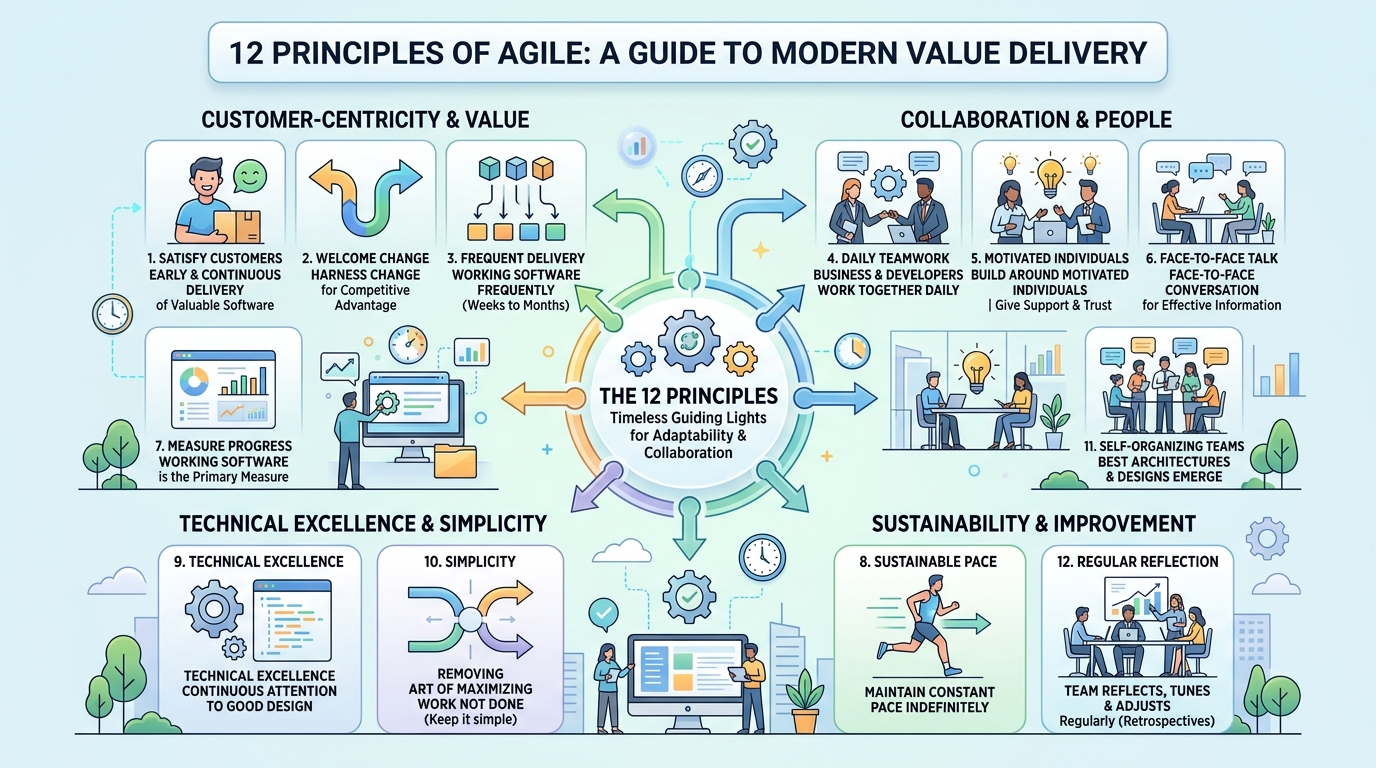
These principles are not rigid rules but timeless guiding lights that emphasize customer focus, adaptability, collaboration, and continuous improvement. They apply far beyond software — to marketing, HR, education, hardware development, and any complex work involving uncertainty.
In this comprehensive guide, you’ll find:
The full list of the 12 principles with the original wording
Deep explanations of the intent behind each
Real-world examples and practical applications
Common challenges and how to overcome them
How they interconnect and support modern Agile practices
Here is the complete, original list from the Agile Manifesto:
Our highest priority is to satisfy the customer through early and continuous delivery of valuable software.
Welcome changing requirements, even late in development. Agile processes harness change for the customer’s competitive advantage.
Deliver working software frequently, from a couple of weeks to a couple of months, with a preference to the shorter timescale.
Business people and developers must work together daily throughout the project.
Build projects around motivated individuals. Give them the environment and support they need, and trust them to get the job done.
The most efficient and effective method of conveying information to and within a development team is face-to-face conversation.
Working software is the primary measure of progress.
Agile processes promote sustainable development. The sponsors, developers, and users should be able to maintain a constant pace indefinitely.
Continuous attention to technical excellence and good design enhances agility.
Simplicity — the art of maximizing the amount of work not done — is essential.
The best architectures, requirements, and designs emerge from self-organizing teams.
At regular intervals, the team reflects on how to become more effective, then tunes and adjusts its behavior accordingly.
Core Idea: Deliver real value quickly and often rather than waiting for a “perfect” final product.
Why It Matters: Early feedback reduces risk and builds trust.
Example: Instead of a 12-month project with one big launch, an e-commerce team releases a minimum viable product (MVP) with basic checkout in 4 weeks, then iterates based on user data.
Application: Use iterative development (sprints) and Minimum Viable Products (MVPs).
Core Idea: Change is inevitable and should be viewed as an opportunity.
Why It Matters: Markets, competitors, and user needs evolve rapidly. Rigid plans become obsolete.
Example: A mobile banking app team adds biometric login late in development after new security regulations and user feedback emerge.
Application: Maintain a flexible product backlog and prioritize ruthlessly.
Core Idea: Short feedback loops accelerate learning and value delivery.
Why It Matters: Frequent releases (ideally 1–4 weeks) expose issues early.
Example: Spotify’s squad model enables small, autonomous teams to deploy features multiple times per week.
Application: Implement Continuous Integration / Continuous Delivery (CI/CD) pipelines.
Core Idea: Break down silos — business stakeholders and technical teams must communicate constantly.
Example: Daily stand-ups or product sync meetings where the Product Owner (business) and developers discuss priorities and trade-offs.
Application: Embed business representatives in cross-functional teams.
Core Idea: People are the most important asset. Provide support and autonomy.
Why It Matters: Motivated, trusted teams outperform micromanaged ones.
Example: Google’s 20% time policy (now evolved) allowed engineers to explore innovative ideas.
Application: Focus on servant leadership, remove impediments, and hire for cultural fit.
Core Idea: The richest information transfer happens through direct interaction.
Modern Adaptation: In distributed teams, use video calls, collaborative tools (Miro, FigJam), and asynchronous video updates.
Example: Pair programming or mob programming sessions drastically reduce misunderstandings.
Application: Minimize reliance on long documents; favor conversations + lightweight documentation.
Core Idea: Documentation, plans, or velocity are secondary — only working, usable software counts.
Example: A dashboard showing “90% complete” is meaningless if the software isn’t in users’ hands and delivering value.
Application: Define clear “Definition of Done” (DoD) that includes tested, integrated, and deployable increments.
Core Idea: Avoid burnout by maintaining a sustainable rhythm long-term.
Why It Matters: Heroic overtime leads to exhaustion, errors, and turnover.
Example: Teams that work consistent 40-hour weeks (with buffer) outperform those with frequent crunch time.
Application: Respect work-life balance and use retrospectives to address unsustainable practices.
Core Idea: Quality is not a phase — it’s ongoing. Good design enables agility.
Example: Regular refactoring, automated testing, and code reviews prevent technical debt from slowing the team.
Application: Adopt practices like Test-Driven Development (TDD), clean code, and architecture spikes.
Core Idea: Eliminate unnecessary work. “What is the simplest thing that could possibly work?”
Example: Building only the core three features instead of ten “nice-to-haves” for the first release.
Application: Ruthless prioritization and YAGNI (“You Aren’t Gonna Need It”) principle.
Core Idea: The best solutions emerge from empowered teams, not top-down directives.
Example: Cross-functional teams decide their own implementation approach and task breakdown during sprint planning.
Application: Leadership sets vision and constraints, then steps back.
Core Idea: Continuous improvement through inspect-and-adapt cycles.
Example: At the end of every sprint, the team discusses “What went well? What didn’t? What to improve?” and implements one or two action items.
Application: Hold blameless retrospectives and track improvement metrics over time.
Customer-Centricity (Principles 1, 2, 3, 7)
Collaboration & People (Principles 4, 5, 6, 11)
Technical Discipline (Principles 9, 10)
Sustainability & Improvement (Principles 8, 12)
These principles reinforce each other. For instance, frequent delivery (3) enables welcoming change (2) and measuring real progress (7).
Resistance to Change: Start small with pilot teams and show quick wins.
Distributed Teams: Leverage modern tools while preserving rich communication.
Scaling Issues: Use frameworks like SAFe or LeSS thoughtfully, without losing the spirit.
Misinterpretation: Treat principles as a mindset, not a checklist.
The 12 Principles Behind the Agile Manifesto remain as relevant today as in 2001 — perhaps even more so in our fast-changing world. They shift the focus from processes and contracts to people, value, adaptability, and relentless improvement.
Mastering these principles doesn’t mean blindly following Scrum or Kanban rituals. It means cultivating an organizational culture that prioritizes customer delight, trusts its people, and continuously learns.
By internalizing and living these principles, teams don’t just deliver software faster — they deliver better outcomes, higher quality, and more satisfied stakeholders.
Actionable Next Step: Pick one or two principles that your team struggles with most. Discuss them in your next retrospective and identify one concrete experiment to try in the coming sprint.
These principles are living guidance. Revisit them regularly — they have the power to transform not just how you work, but how your organization thinks about value creation.
Would you like a downloadable PDF version, a one-page summary/cheat sheet, examples tailored to non-software teams, or a comparison with modern frameworks like Scrum, Kanban, or OKRs? Let me know how I can help you apply these principles further!

