
Welcome! If you are just starting to learn the Unified Modeling Language (UML), you might occasionally hear people talk about the "UML Specification" or the "Metamodel." These terms sound incredibly intimidating, but the core concepts are actually very easy to understand.
This tutorial will walk you through Section 2: Structural Simplification of the Specification. We will break down exactly what changed in UML version 2.5 and why it makes learning and using UML much easier for everyone.
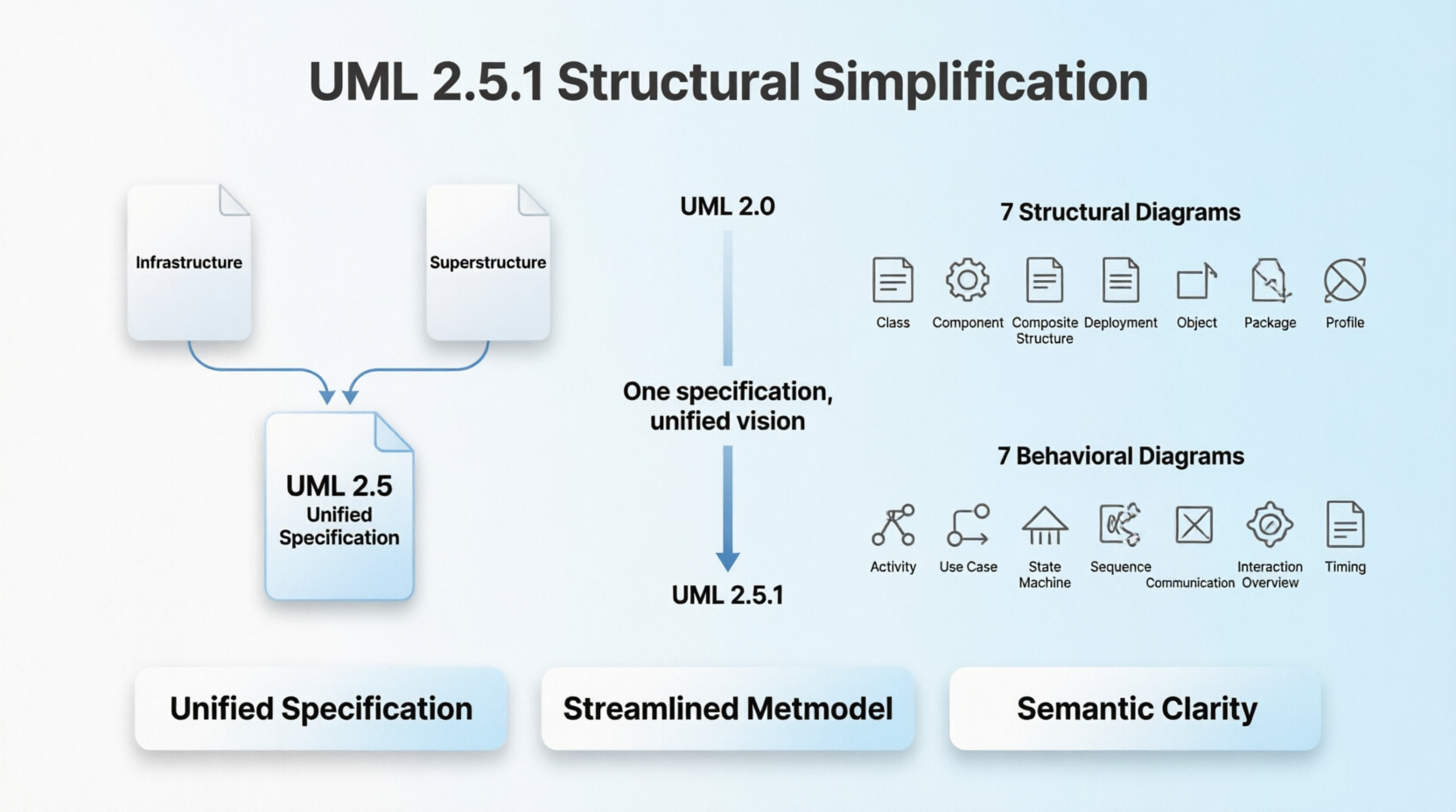
Before we dive in, let’s translate the technical jargon into plain English:
The Specification: Think of this as the Official Rulebook for UML. It tells you exactly what every line, shape, and arrow means.
The Metamodel: If a "model" is a blueprint of a house, a "metamodel" is the rulebook for how to draw blueprints. It defines the core building blocks (like "a class must be a rectangle") and how they can connect.
A Package: In UML, a package is just a folder used to group related concepts together so the rulebook stays organized.
Now that we know the vocabulary, let’s look at the two major simplifications in UML 2.5.
Prior to version 2.5, the official UML Rulebook (the Specification) was split into two separate, massive books.
Imagine you just bought a complex LEGO set.
Book 1 (The Infrastructure): This book explains the chemistry of the plastic, the physics of how the studs lock together, and the deep mathematical rules of the system.
Book 2 (The Superstructure): This book contains the actual instructions on how to build the Millennium Falcon.
If you are trying to build the ship and you encounter a weird piece, you have to stop, put down Book 2, open Book 1, read about the physics of the plastic, and then go back to Book 2. It is frustrating, confusing, and slows you down!
In the old UML, Infrastructure was the deep technical foundation (the math/physics), and Superstructure was the actual diagrams you draw (the building instructions). Tool makers and students had to constantly flip back and forth between the two books to understand a single concept.
With UML 2.5, the Object Management Group (OMG) said, "This is too complicated. Let's combine them."
They merged the Infrastructure and Superstructure into one single, cohesive book. Now, when you look up how a "Class Diagram" works, all the foundational rules and the drawing instructions are right there on the same page.
Even if you aren't writing software to build UML tools, this merge means the rules you are learning are more consistent. You won't find situations where the "foundation rules" contradict the "diagram rules" because they are now written together in one unified voice. It drastically lowers the "cognitive overhead" (brain power) required to learn the language.
To understand this, we need to look at how the UML Rulebook organizes its concepts using Packages (folders).
Imagine you are looking for a specific photo on your computer. In the old, un-streamlined UML metamodel, finding a concept was like navigating a ridiculously deep, nested folder structure:
My Computer > C: Drive > Users > Admin > Documents > UML > Metamodel > Core > Elements > Behaviors > Actions > ControlFlow > ... > "Action"
You had to click through endless sub-folders (nested definitions) just to find the basic rule for a simple concept. This "indirection" (taking the long way around) made the specification bloated and hard for software tools to process efficiently.
In UML 2.5, the architects looked at this messy folder structure and applied a simple philosophy: A mature standard should become simpler over time, not more complex.
They "flattened" the structure. They took all those secondary, deeply buried sub-folders and imported them directly into the main, top-level folder.
Now, finding that same concept looks like this:
My Computer > UML > "Action"
The package structure was significantly compressed. Instead of navigating through five layers of sub-packages, the concepts are directly accessible from the top-level UML package.
When the underlying "folders" of the rulebook are simplified, the language itself becomes less rigid and easier to extend. For you as a learner or designer, this means the diagrams you create are based on a cleaner, less contradictory foundation. It also means that the software tools you use (like Lucidchart, StarUML, or Visual Paradigm) can process and render your diagrams faster and more accurately, because their underlying code doesn't have to navigate a maze of nested rules.
When you look at the changes in Section 2 of the UML 2.5 specification, a clear theme emerges: Simplicity is the ultimate sophistication.
2.1 took two confusing books and merged them into one clear manual.
2.2 took a messy, deeply nested filing cabinet and organized it into a clean, easily accessible desktop.
As a beginner, you don't need to memorize the metamodel or the package structures. You just need to know that the people who maintain UML are actively working to remove the clutter. This ensures that UML remains a practical, user-friendly tool for designing software, rather than an overly academic puzzle.

