Introduction
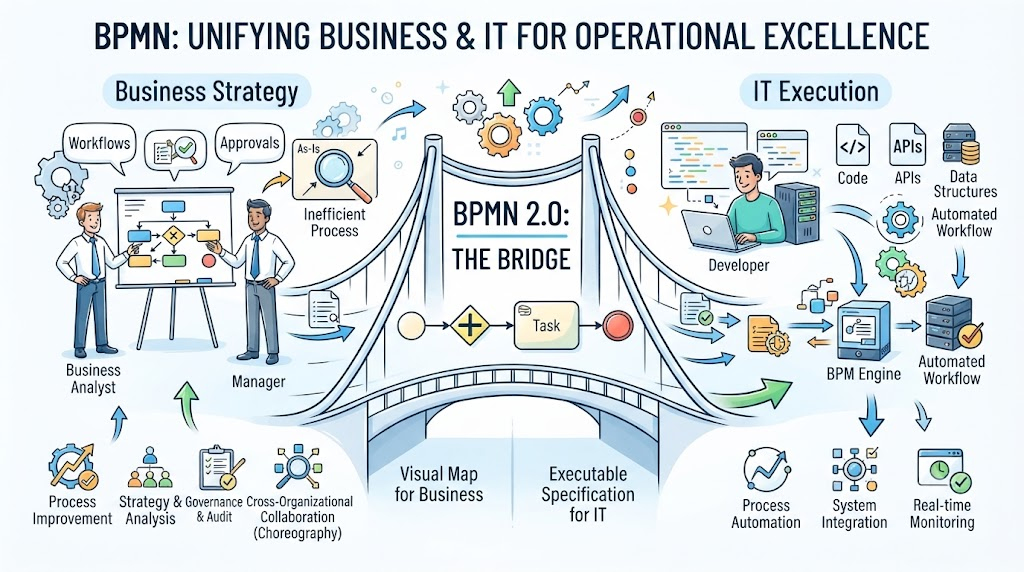
In today’s hyper-competitive and digitally driven landscape, an organization’s ability to execute its operations efficiently is often the single greatest determinant of its success. Yet, for decades, a fundamental disconnect has existed between the business leaders who define organizational strategy and the technical teams tasked with implementing it. Business leaders think in terms of workflows, approvals, and exceptions; developers think in terms of code, APIs, and data structures. This communication gap frequently results in misaligned projects, fragile processes, and costly delays.
Enter Business Process Model and Notation (BPMN) . More than just an upgraded flowchart, BPMN is the global, standardized language—recognized by the Object Management Group (OMG) and ISO—designed specifically to bridge this divide. It provides a visual vocabulary that is intuitive enough for business analysts to map out operational workflows, yet precise and robust enough for developers to execute those workflows directly within automation engines.
This guide aims to serve as a high-level comprehensive overview of BPMN. We will explore its foundational concepts and core building blocks, examine its profound benefits for organizational agility, identify the key stakeholders who rely on it, and dive into the practical use cases that demonstrate its transformative power. Whether you are looking to refine a single internal process or orchestrate complex interactions across global supply chains, understanding BPMN is the first step toward turning your business strategy into operational reality.
What is BPMN?
BPMN (Business Process Model and Notation) is an open standard, maintained by the Object Management Group (OMG) and ratified by ISO (ISO/IEC 19510:2013) . It provides a graphical representation of business processes in a diagram—a Business Process Diagram—which is based on a flowcharting technique designed for easy readability and technical precision .
The core idea is simple: a BPMN diagram is both a visual map for business users and an executable specification for IT systems .

BPMN 2.0: The Bridge Between Business and IT
BPMN 2.0 represents a major evolution from its earlier versions. While BPMN 1.0 was primarily a visual notation for modeling, version 2.0 introduced execution semantics and a standardized XML format. This means a process model created in BPMN 2.0 can be directly executed by a BPM (Business Process Management) engine, making the bridge between process design and implementation seamless .
Core Components of BPMN
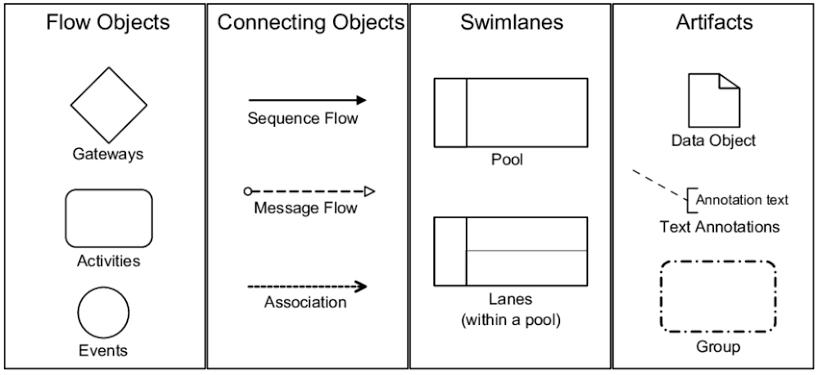
BPMN diagrams are built from four primary categories of elements :
1. Flow Objects
These are the main elements defining the behavior of a process.
-
Events (Represented by Circles): Things that "happen" during a process. They trigger, interrupt, or end a process flow.
-
Start Event: Indicates the beginning of a process.
-
End Event: Marks the completion of a process or a specific flow path.
-
Intermediate Event: Occurs between the start and end, indicating a delay, a message receipt, or a timer trigger.
-
Activities (Represented by Rounded Rectangles): The work or tasks that are performed.
-
Task: A single, atomic unit of work (e.g., "Send Invoice," "Approve Loan").
-
Sub-Process: A larger activity that contains its own process logic, allowing for hierarchical modeling.
-
Gateways (Represented by Diamonds): Used to control the flow of the process, such as branching, splitting, and merging paths.
-
Exclusive Gateway: Splits the flow into one of several paths based on a condition.
-
Parallel Gateway: Splits the flow into multiple concurrent paths.
-
Inclusive Gateway: Splits the flow into one or more paths based on conditions.
2. Data
This element allows the model to show what data is created, read, or updated during the process. It includes data objects, data inputs, and data outputs.
3. Connecting Objects
These are the arrows that link flow objects together to define the sequence and communication of the process.
-
Sequence Flow: Shows the order in which activities and events are performed.
-
Message Flow: Shows the flow of messages between different participants or pools (e.g., between a customer and a company).
4. Swimlanes
These are used to organize activities by roles or responsibilities.
-
Pools: Represent a major participant in the process (e.g., a whole organization).
-
Lanes: Sub-divisions within a pool, often used to show different departments or roles (e.g., "Accounting," "Sales").
Who Uses BPMN?
BPMN is intentionally designed to be the language that connects the entire process lifecycle .
-
Business Users & Analysts: They use BPMN to create models, analyze inefficiencies, and communicate requirements. It helps them visualize the "as-is" and design the "to-be" process .
-
IT Professionals & Developers: They use the BPMN 2.0 XML specification to implement and configure the process in a BPM engine. The process model itself becomes the blueprint for execution .
-
Process Managers: They use BPMN models to monitor and control the process's performance in real-time, identifying bottlenecks and areas for improvement .
-
Executives and Stakeholders: They use high-level BPMN diagrams to understand the end-to-end flow and make strategic decisions .
Why BPMN Matters: Key Benefits
1. A Common Language
BPMN serves as a standard notation, eliminating the communication gap between business stakeholders (who plan the work) and technical teams (who implement it). This ensures everyone is on the same page .
2. Clarity and Transparency
A well-designed BPMN diagram is highly intuitive. Unlike traditional flowcharts, BPMN allows for the clear representation of exception flows (like errors or cancellations) using boundary events, making the process easier to understand and audit .
3. Vendor Neutrality and Portability
As an open standard, BPMN protects you from vendor lock-in. Your process logic is portable across different BPM suites and runtimes, giving you flexibility .
4. Executability
BPMN 2.0's execution semantics allow the model to be directly run by a process engine, automating the process. The model becomes the code, reducing the need for manual translation .
5. Governance and Audit
Every decision path in a process is documented by default within the model. This makes it easier to ensure regulatory compliance and create an automatic audit trail .
Key Use Cases
1. Process Improvement (As-Is vs. To-Be Modeling)
Before implementing changes, organizations model their current process ("as-is") to identify inefficiencies. They then use BPMN to design an improved future state ("to-be").
-
Real-World Example: A bank used BPMN to analyze its manual, in-branch queuing system. The "as-is" model revealed long queues and dissatisfaction due to a lack of remote number retrieval. They then designed a "to-be" process incorporating a digital, real-time queue system .
2. Process Automation and Execution
BPMN is the standard for executable workflows in modern BPM platforms. It orchestrates tasks, integrates with web services, and manages complex business logic.
-
Real-World Example: In software-defined car manufacturing, automotive OEMs use BPMN to orchestrate complex test and diagnostic workflows. Interdisciplinary teams—engineers, testers, and workers—use executable BPMN models to streamline testing procedures and integrate with car diagnostics APIs .
3. Cross-Organizational Collaboration (Choreography)
BPMN uses pools and message flows to show interactions between different organizations or departments, such as in a supply chain.
-
Real-World Example: A company can model the entire order-to-cash process, showing interactions between its own departments and external suppliers or customers, ensuring clear communication and a shared understanding of the interaction sequence .
4. Strategy and Analysis
BPMN models provide a foundation for advanced business analysis.
-
Activity-Based Costing (ABC): By recording process data (e.g., costs and time) on BPMN models, managers can accurately determine the true cost of delivering a product or service .
-
Simulation: BPMN models can be used to simulate "what-if" scenarios, testing process capacity, identifying bottlenecks, and validating improvements before costly implementation .
Conclusion
BPMN is far more than a diagramming tool or a passing industry trend; it is a strategic imperative for the modern, agile enterprise. By establishing a common, executable language, it effectively dismantles the traditional silos between business strategy and IT execution, ensuring that every stakeholder—from the C-suite to the developer—operates from a single, unified source of truth.
The true power of BPMN 2.0 lies in its duality: it offers the clarity and transparency needed for effective governance and continuous improvement, while simultaneously providing the execution semantics required for full-scale automation. Whether utilized for mapping "as-is" processes to identify bottlenecks, simulating future "to-be" workflows, or orchestrating complex cross-organizational choreographies, BPMN empowers organizations to move from static documentation to dynamic, data-driven management.
Ultimately, adopting BPMN is an investment in resilience and adaptability. In a world where business conditions change rapidly, organizations that can visualize, analyze, and adapt their processes with speed and precision will always hold a competitive advantage. By mastering BPMN, you are not just learning a notation—you are building the blueprint for operational excellence.