Introduction
For years, Unified Modeling Language (UML) has battled a reputation for being rigid, time-consuming, and inherently "Waterfall." In fast-paced software development, heavy upfront documentation often falls by the wayside, leading to architectural drift, knowledge silos, and misaligned teams. However, a paradigm shift is underway. By combining the iterative, value-driven principles of Agile and Scrum with the transformative power of Artificial Intelligence, UML modeling is no longer a bottleneck—it is a catalyst for speed and clarity.
This guide explores the foundational differences between Agile and Scrum, and demonstrates how AI-powered features are redefining model-driven development. We will examine how comprehensive platforms like Visual Paradigm turn static diagrams into living, breathing assets that keep pace with your sprints, complete with key concepts and practical PlantUML examples to illustrate this modern workflow.
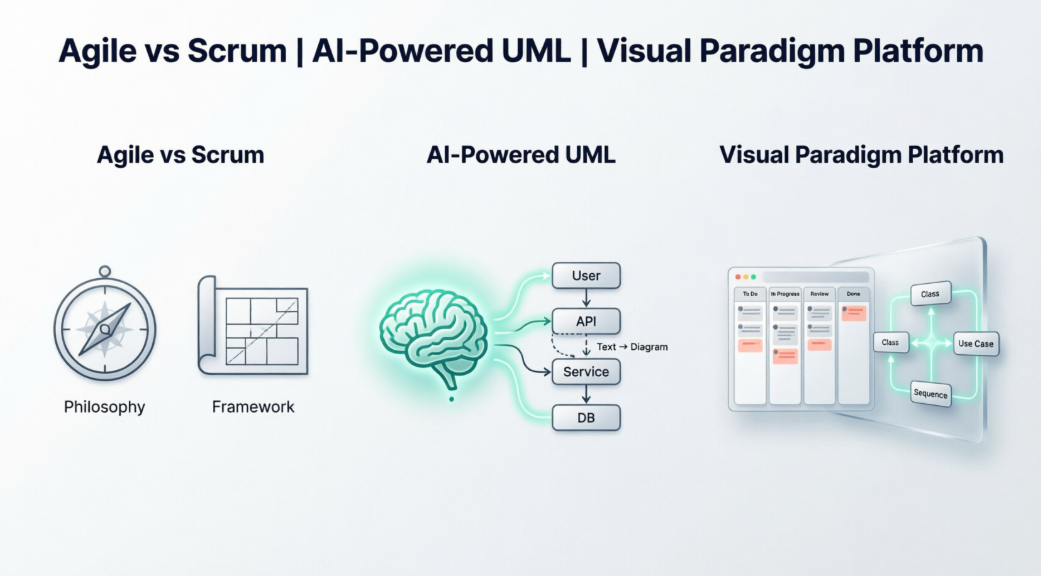
1. Agile Process vs. Scrum
While often used interchangeably, they exist at different levels of abstraction:
- Agile Process (The Philosophy): Agile is a broad mindset and set of values outlined in the Agile Manifesto. It emphasizes iterative development, customer collaboration, responding to change over following a rigid plan, and delivering working software frequently. It is the "what" and "why."
- Scrum (The Framework): Scrum is a specific, lightweight framework used to implement Agile principles. It provides the "how" through defined roles (Scrum Master, Product Owner, Developers), artifacts (Product Backlog, Sprint Backlog, Increment), and events (Sprint, Daily Standup, Sprint Review, Sprint Retrospective).
- Analogy: Agile is the philosophy of "eating healthy," while Scrum is a specific diet plan like the "Mediterranean Diet" that helps you achieve it.
2. Why UML Modeling Can Be Extremely Agile with AI-Powered Features
Traditionally, UML modeling was criticized for being "waterfall-ish"—heavy, time-consuming, and prone to becoming outdated the moment code was written. AI changes this paradigm entirely, making UML truly Agile:
- Natural Language to Diagram: AI can instantly translate user stories or plain-text requirements into draft UML diagrams (Class, Sequence, Activity), eliminating the blank-canvas paralysis and saving hours of manual drawing.
- Living Documentation (Auto-Sync): AI-powered reverse engineering can continuously analyze code commits and automatically update UML diagrams to reflect the current state of the codebase, ensuring models never become obsolete.
- Intelligent Suggestions: AI can analyze a partially drawn diagram and suggest missing relationships, potential design pattern implementations, or edge cases (e.g., "You forgot an 'alt' fragment for failed login in this sequence diagram").
- Just-Enough Modeling: AI allows teams to generate high-fidelity models in seconds, encouraging the Agile principle of creating only the documentation necessary to facilitate understanding and communication, rather than exhaustive upfront design.
3. How Visual Paradigm Helps as a Complete Platform
Visual Paradigm (VP) is uniquely positioned to bridge the gap between Agile management and rigorous system modeling, especially with its recent AI integrations:
- VP AI Assistant: Allows users to generate UML diagrams, ERDs, or flowcharts directly from text prompts. It can also summarize complex diagrams into plain English for stakeholders.
- Integrated Agile Project Management: VP includes built-in Agile boards (Scrum/Kanban), backlog management, and sprint tracking. You can link a User Story on the board directly to its corresponding UML diagram.
- Round-Trip Engineering: VP supports bi-directional code engineering for languages like Java, C#, Python, and more. Change the UML, and the code skeleton updates; change the code, and the UML reflects it.
- Collaboration & Version Control: Real-time collaboration features and integration with Git, Jira, and Confluence ensure that developers, architects, and product owners are always looking at the same, up-to-date source of truth.
4. Key Concepts and Examples
- Concept: Just-Enough Modeling
Example: Instead of modeling the entire enterprise architecture upfront, a team uses AI in Visual Paradigm to generate a single Sequence Diagram for the "Checkout" user story right before Sprint Planning.
- Concept: Living Documentation
Example: A developer adds a new validateToken() method to the AuthService class in Java. Visual Paradigm’s AI detects this commit and automatically adds the corresponding method and relationship to the Class Diagram overnight.
- Concept: Model-Driven Agile
Example: The Product Owner writes a user story. The AI generates a draft Activity Diagram. The team refines it during refinement, and VP automatically generates the boilerplate code and Jira sub-tasks from the diagram nodes.
5. Diagram Example: AI-Assisted Agile UML Workflow (PlantUML)
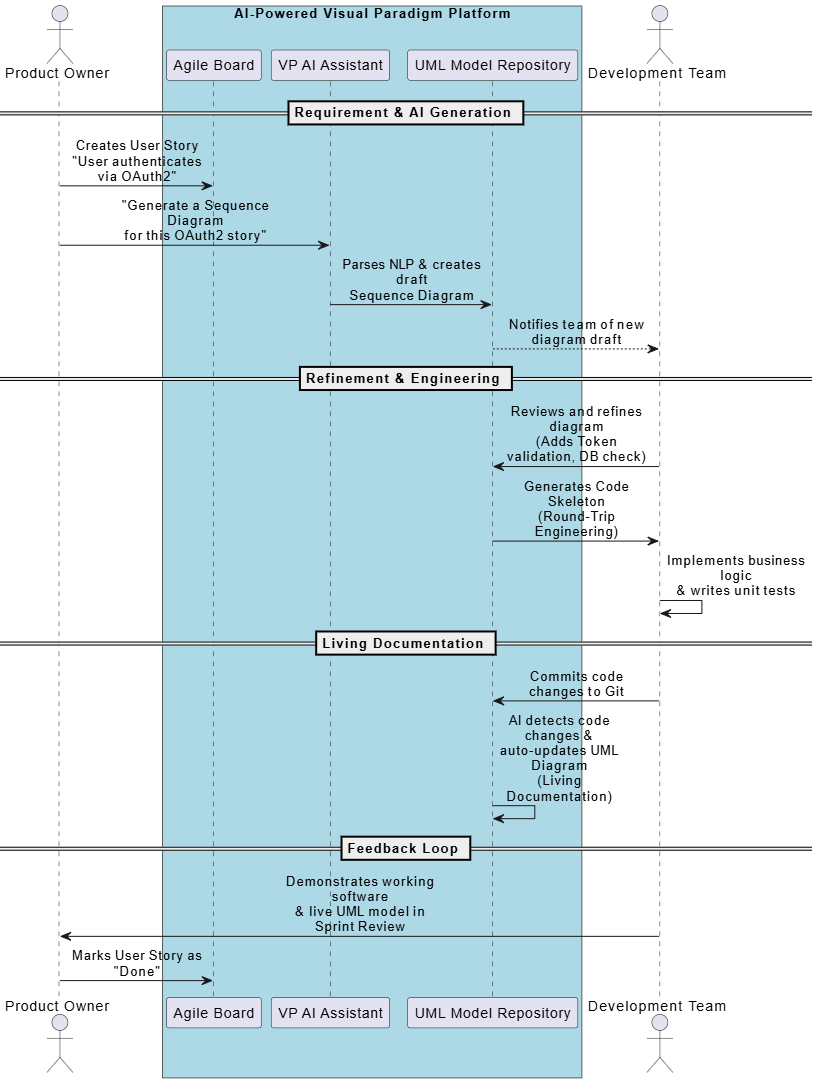
Below is a Sequence Diagram written in PlantUML that visualizes how a team leverages AI and Visual Paradigm to maintain an Agile, model-driven workflow.
@startuml
skinparam maxMessageSize 150
skinparam defaultTextAlignment center

actor "Product Owner" as PO
box "AI-Powered Visual Paradigm Platform" #LightBlue
  participant "Agile Board" as Board
  participant "VP AI Assistant" as AI
  participant "UML Model Repository" as Repo
end box
actor "Development Team" as Dev

== Requirement & AI Generation ==
PO -> Board: Creates User Story\n"User authenticates via OAuth2"
PO -> AI: "Generate a Sequence Diagram\nfor this OAuth2 story"
AI -> Repo: Parses NLP & creates draft\nSequence Diagram
Repo --> Dev: Notifies team of new diagram draft

== Refinement & Engineering ==
Dev -> Repo: Reviews and refines diagram\n(Adds Token validation, DB check)
Repo -> Dev: Generates Code Skeleton\n(Round-Trip Engineering)
Dev -> Dev: Implements business logic\n& writes unit tests

== Living Documentation ==
Dev -> Repo: Commits code changes to Git
Repo -> Repo: AI detects code changes &\nauto-updates UML Diagram\n(Living Documentation)

== Feedback Loop ==
Dev -> PO: Demonstrates working software\n& live UML model in Sprint Review
PO -> Board: Marks User Story as "Done"

@enduml
Conclusion
The perceived dichotomy between agile delivery speed and architectural rigor is a thing of the past. By clearly understanding the distinct roles of the Agile philosophy and the Scrum framework, teams can better leverage modern tooling to their advantage. AI-powered UML modeling, particularly within an all-in-one ecosystem like Visual Paradigm, eliminates the historical friction of traditional diagramming.
It empowers teams to practice "just-enough" modeling, ensures living documentation through intelligent round-trip engineering, and fosters seamless, real-time collaboration between product owners, architects, and developers. Ultimately, embracing this AI-driven, model-centric approach does more than just improve your documentation—it makes your entire Agile delivery pipeline smarter, more transparent, and highly resilient to change.