
In the ever-evolving landscape of software engineering, technology stacks change rapidly. A system built today in a specific programming language or framework may become obsolete tomorrow. Historically, this has made software reuse incredibly difficult, as developers are often forced to reverse-engineer legacy code to adapt it to new platforms.
Model Driven Architecture (MDA) offers a powerful solution to this challenge by shifting the focus from code-centric development to model-centric design. At the heart of MDA is the Platform Independent Model (PIM). By capturing the essence of a system without tying it to a specific technology, PIMs unlock unprecedented levels of system reuse, portability, and longevity. This guide explores the core concepts of PIMs, their primary benefits for system reuse, and provides visual examples of how they operate within an MDA framework.
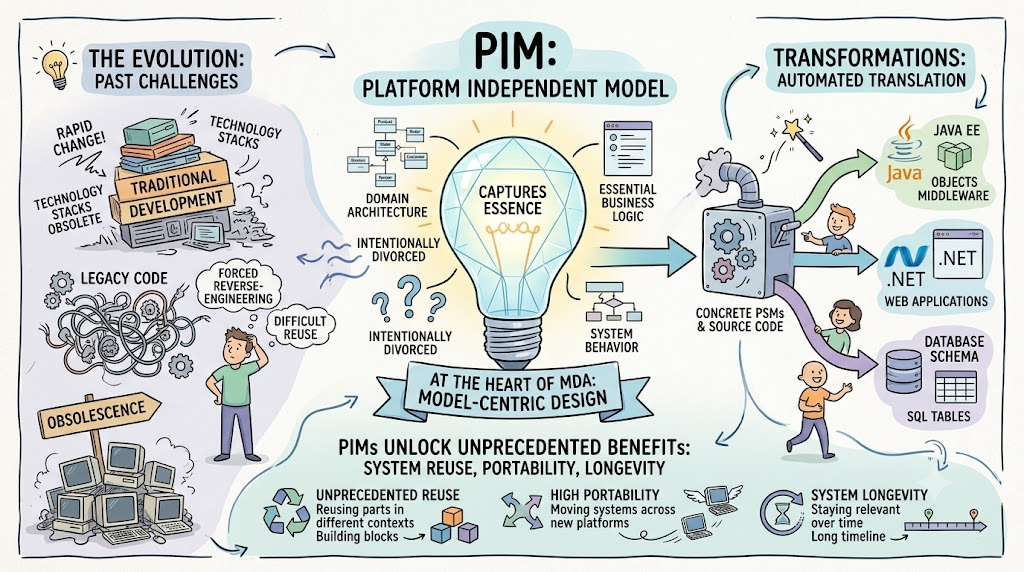
To fully understand the value of PIMs, it is essential to define the foundational terminology of the MDA framework:
Model Driven Architecture (MDA): An object-oriented software engineering methodology developed by the Object Management Group (OMG). It separates business logic from platform details by using models as the primary artifacts of the development process.
Platform Independent Model (PIM): A high-level, abstract representation of a system. It captures the core business logic, domain architecture, and essential system behavior while being intentionally divorced from any specific implementation language, middleware, or operating system.
Platform Specific Model (PSM): A concrete, detailed model that combines the PIM with the specific technical details of a target platform (e.g., Java EE, .NET, HTML5, or a specific database schema).
Transformations: The automated or semi-automated processes that translate a generic PIM into one or more concrete PSMs, and eventually into executable source code.
Using PIMs within an MDA framework provides several distinct advantages that fundamentally improve how software is designed, maintained, and reused.
PIMs capture a system's design in a purely generic manner. Because they are intentionally divorced from concerns such as implementation language and platform, they allow the essential logic and business rules of the system to be preserved in their purest form. This ensures that the core intellectual property of the software can be reused regardless of the specific technology stack required for a given deployment.
Because PIMs are technology-agnostic, they can be transformed into multiple, separate Platform Specific Models (PSMs) tailored for different environments. For example, if a business needs to reimplement an application—such as migrating a legacy desktop application from Java Swing to a modern HTML web interface or a .NET ecosystem—it is vastly simpler if the original design was modeled as a PIM. Developers can simply generate a new PSM for the target platform rather than attempting the arduous task of reverse-engineering existing source code.
Software design is inherently more reusable and durable than specific source code. Code is fragile; it breaks when compilers update or libraries deprecate. By using PIMs, teams can reuse the high-level architecture and logic across different projects and over long periods. Even if the underlying coding languages change entirely over a decade, the PIM remains a valid, reusable asset.
Manual translation of models to code is error-prone. However, because UML 2.0 provides a formally structured and interoperable meta-model, PIMs are strictly machine-readable. This mathematical precision allows specialized tools to interpret the generic model and automatically transform it into different specific systems. This facilitates highly efficient, consistent reuse through automation, drastically reducing manual coding efforts.
Source code is inherently microscopic; it focuses strictly on software implementation and often lacks the context of how a system is used, deployed, or integrated. PIMs provide the higher-level abstract views necessary for stakeholders, architects, and business analysts to understand the system. This macro-level perspective makes it much easier to reuse the design in new business contexts, as the overarching system goals remain clear and unobscured by syntactic code details.
Below are PlantUML diagrams illustrating the MDA transformation process and the abstraction levels of PIMs versus PSMs.
This diagram illustrates how a single Platform Independent Model is fed into an automated transformation engine to generate multiple Platform Specific Models for different target environments.
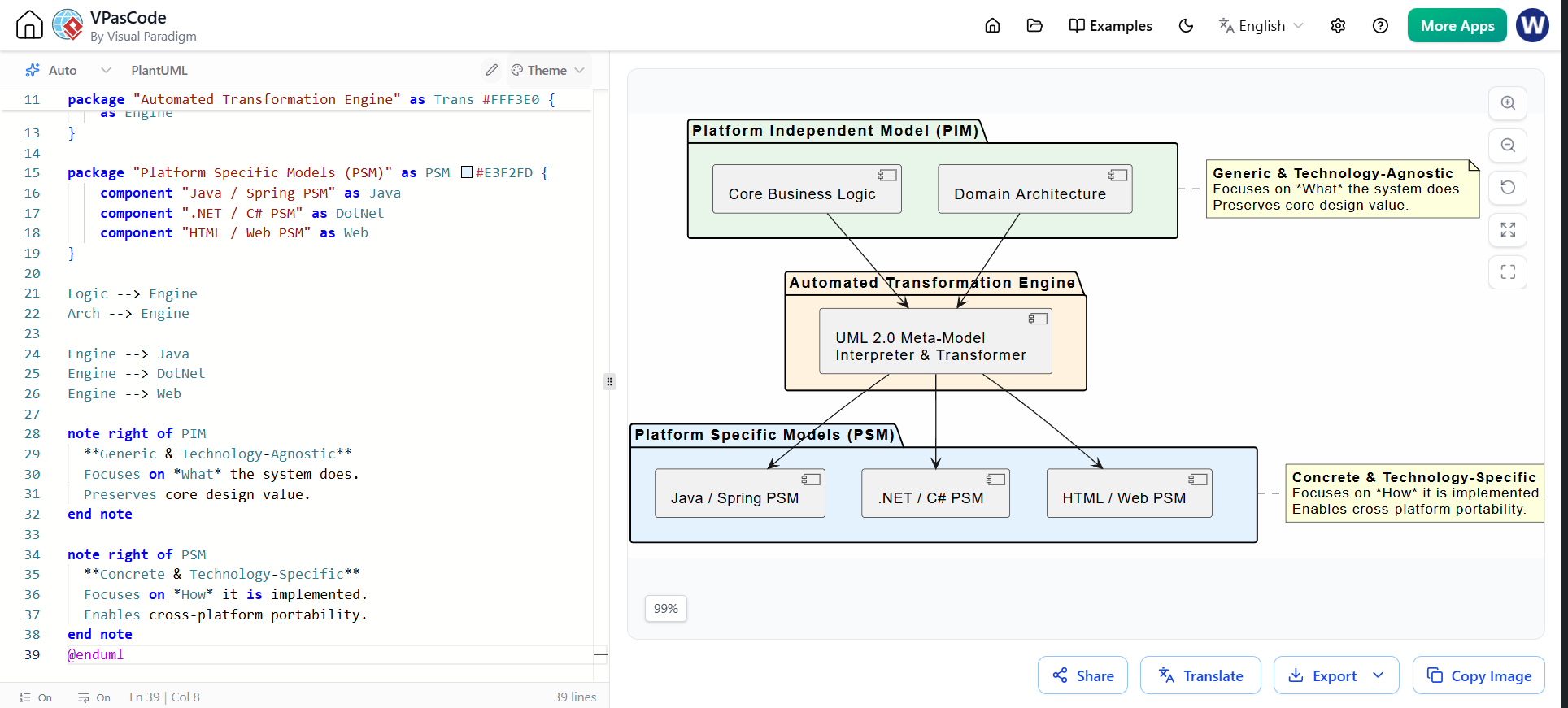
@startuml
skinparam backgroundColor #FEFEFE
skinparam componentStyle uml2
skinparam shadowing false

package "Platform Independent Model (PIM)" as PIM #E8F5E9 {
    component "Core Business Logic" as Logic
    component "Domain Architecture" as Arch
}

package "Automated Transformation Engine" as Trans #FFF3E0 {
    component "UML 2.0 Meta-Model\nInterpreter & Transformer" as Engine
}

package "Platform Specific Models (PSM)" as PSM #E3F2FD {
    component "Java / Spring PSM" as Java
    component ".NET / C# PSM" as DotNet
    component "HTML / Web PSM" as Web
}

Logic --> Engine
Arch --> Engine

Engine --> Java
Engine --> DotNet
Engine --> Web

note right of PIM
  **Generic & Technology-Agnostic**
  Focuses on *What* the system does.
  Preserves core design value.
end note

note right of PSM
  **Concrete & Technology-Specific**
  Focuses on *How* it is implemented.
  Enables cross-platform portability.
end note
@enduml
This diagram highlights the "Bigger Picture" abstraction of a PIM and demonstrates the portability benefit mentioned in the text (e.g., moving from a Java Swing desktop app to an HTML web app without reverse-engineering).
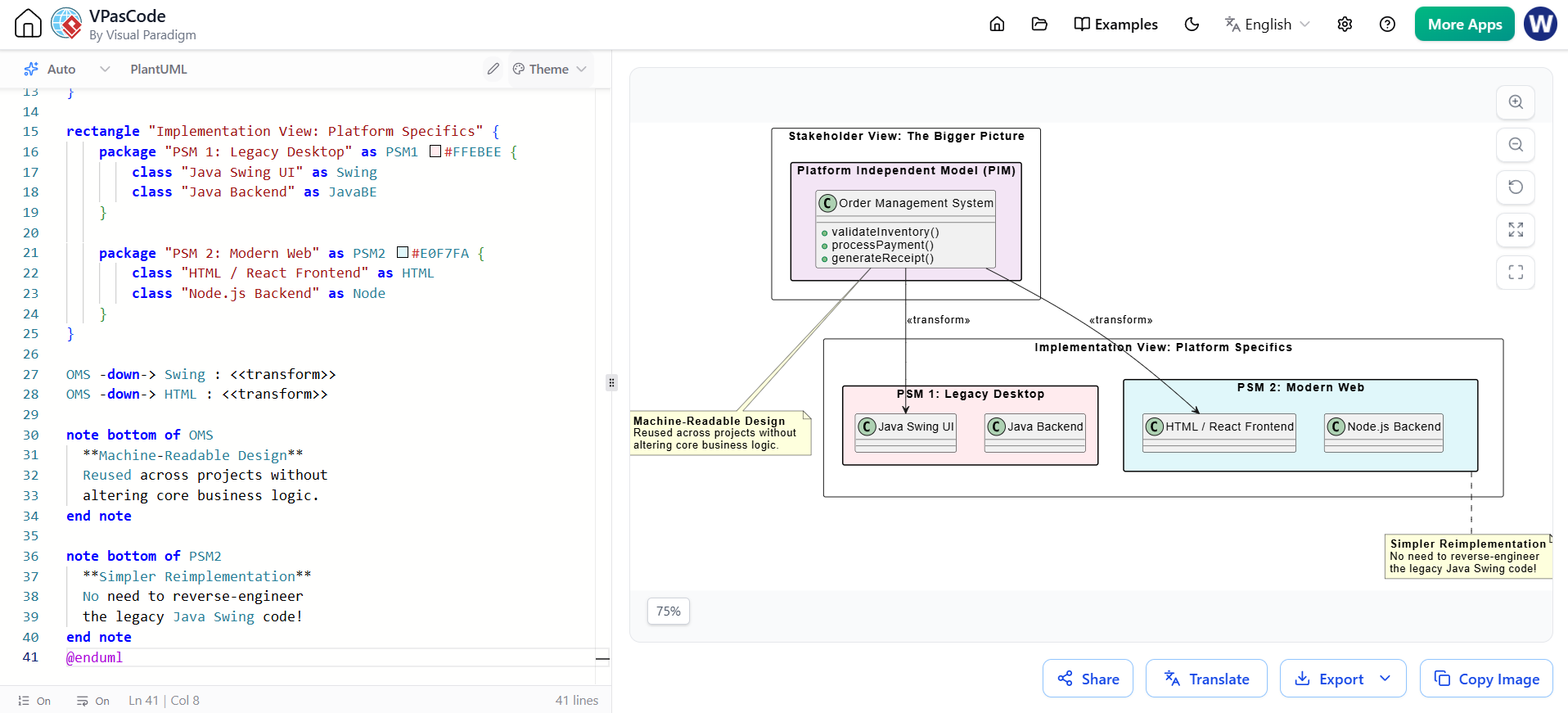
@startuml
skinparam packageStyle rectangle
skinparam shadowing false

rectangle "Stakeholder View: The Bigger Picture" {
    package "Platform Independent Model (PIM)" as PIM_Pkg #F3E5F5 {
        class "Order Management System" as OMS {
            + validateInventory()
            + processPayment()
            + generateReceipt()
        }
    }
}

rectangle "Implementation View: Platform Specifics" {
    package "PSM 1: Legacy Desktop" as PSM1 #FFEBEE {
        class "Java Swing UI" as Swing
        class "Java Backend" as JavaBE
    }

    package "PSM 2: Modern Web" as PSM2 #E0F7FA {
        class "HTML / React Frontend" as HTML
        class "Node.js Backend" as Node
    }
}

OMS -down-> Swing : <<transform>>
OMS -down-> HTML : <<transform>>

note bottom of OMS
  **Machine-Readable Design**
  Reused across projects without
  altering core business logic.
end note

note bottom of PSM2
  **Simpler Reimplementation**
  No need to reverse-engineer
  the legacy Java Swing code!
end note
@enduml
The transition from code-centric development to model-centric design represents a mature evolution in software engineering. By leveraging Platform Independent Models (PIMs) within a Model Driven Architecture (MDA), organizations can decouple their most valuable asset—their business logic and system design—from the fleeting nature of specific technology stacks.
The benefits are clear: PIMs allow for generic system capture, seamless portability across platforms, and the preservation of design value over time. Furthermore, the machine-readable nature of UML 2.0 enables automated transformations, ensuring that the "bigger picture" of the system architecture is maintained and easily adaptable. Ultimately, adopting PIMs future-proofs software investments, ensuring that today's design can effortlessly become tomorrow's implementation, regardless of what new technologies emerge.

