
In today's rapidly evolving software landscape, clear architectural communication is no longer a luxury—it's a necessity. As systems grow in complexity, teams struggle to maintain shared understanding across developers, architects, product owners, and stakeholders. The C4 model emerges as a powerful solution: a hierarchical, developer-friendly framework that breaks down software architecture into four intuitive abstraction levels. When combined with modern AI-powered tooling like Visual Paradigm, the C4 model transforms from a theoretical concept into a practical, collaborative workflow that accelerates design, documentation, and onboarding.
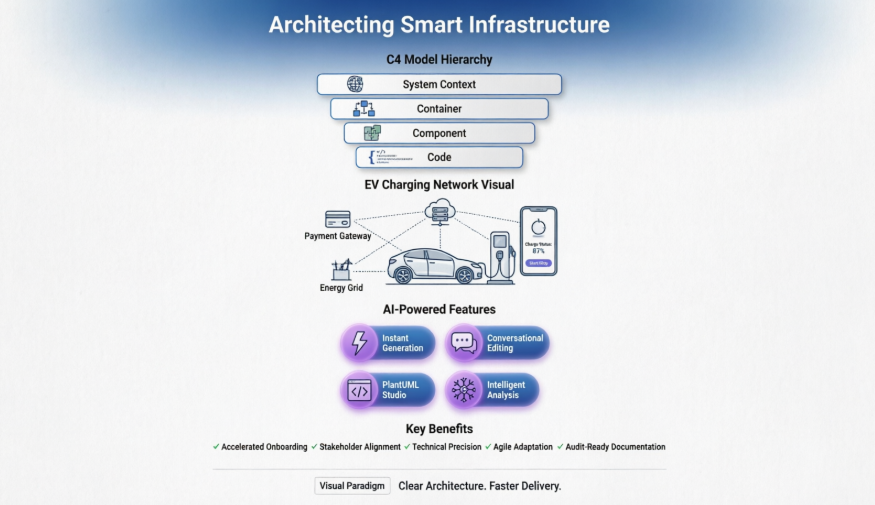
This case study explores how the C4 model, implemented through Visual Paradigm's intelligent features, can be applied to a real-world scenario: designing a city-wide Smart EV Charging Network. We'll walk through each abstraction level—from high-level system context down to implementation details—demonstrating how AI-assisted diagram generation streamlines the architectural process while maintaining precision and clarity. Whether you're leading a green-tech initiative or modernizing legacy infrastructure, this guide offers actionable insights for leveraging visual architecture to drive successful outcomes.
The C4 model visual paradigm is a hierarchical, developer-friendly framework for diagramming software architecture, comprising four abstraction levels: System Context, Containers, Components, and Code. It offers a standardized way to visualize system structures, fostering clear communication, onboarding, and documentation among teams using tools like Visual Paradigm.
The paradigm is tool-independent, but Visual Paradigm provides specific templates, drag-and-drop elements, and AI-powered generation for creating these diagrams efficiently.
Context: A city-wide network of Electric Vehicle (EV) chargers needs a management system.
Requirements:
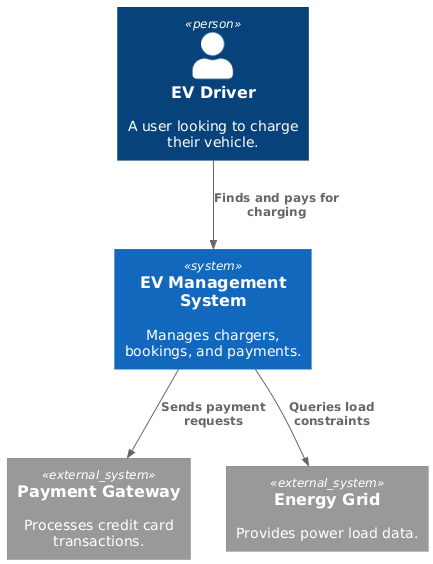
Shows the high-level scope of the EV Management System.
PlantUML Code
@startuml
!include https://raw.githubusercontent.com/plantuml-stdlib/C4-PlantUML/master/C4_Component.puml

Person(driver, "EV Driver", "A user looking to charge their vehicle.")
System(ev_system, "EV Management System", "Manages chargers, bookings, and payments.")
System_Ext(payment_gw, "Payment Gateway", "Processes credit card transactions.")
System_Ext(energy_grid, "Energy Grid", "Provides power load data.")

Rel(driver, ev_system, "Finds and pays for charging")
Rel(ev_system, payment_gw, "Sends payment requests")
Rel(ev_system, energy_grid, "Queries load constraints")
@enduml
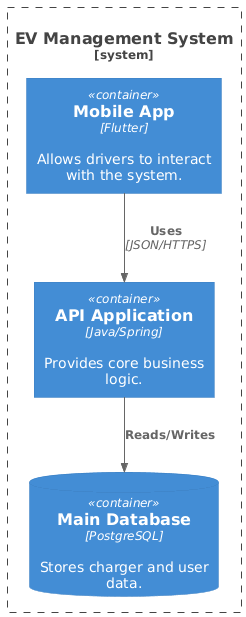
Breaks down the system into high-level technical building blocks.
PlantUML Code
@startuml
!include https://raw.githubusercontent.com/plantuml-stdlib/C4-PlantUML/master/C4_Component.puml

System_Boundary(ev_boundary, "EV Management System") {
    Container(mobile_app, "Mobile App", "Flutter", "Allows drivers to interact with the system.")
    Container(api_app, "API Application", "Java/Spring", "Provides core business logic.")
    ContainerDb(database, "Main Database", "PostgreSQL", "Stores charger and user data.")
}

Rel(mobile_app, api_app, "Uses", "JSON/HTTPS")
Rel(api_app, database, "Reads/Writes")
@enduml
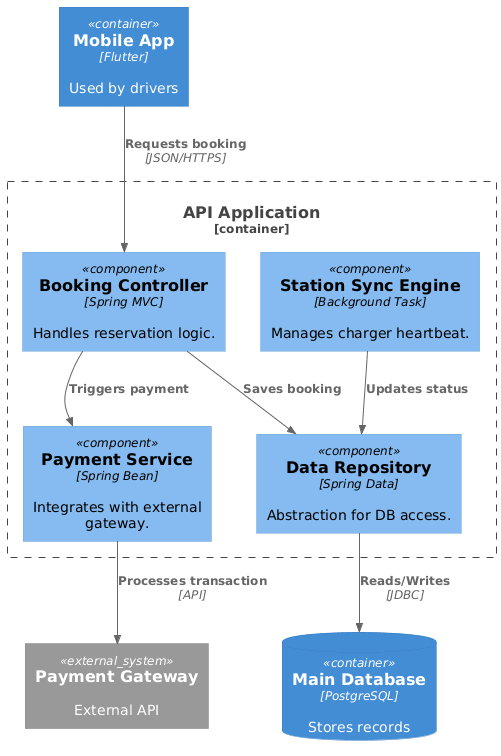
Drills into the API Application container to show internal logic.
PlantUML Code
@startuml
!include https://raw.githubusercontent.com/plantuml-stdlib/C4-PlantUML/master/C4_Component.puml

' Define external elements to fix the isolation
Container(mobile_app, "Mobile App", "Flutter", "Used by drivers")
ContainerDb(database, "Main Database", "PostgreSQL", "Stores records")
System_Ext(payment_gw, "Payment Gateway", "External API")

Container_Boundary(api_boundary, "API Application") {
Component(booking_comp, "Booking Controller", "Spring MVC", "Handles reservation logic.")
Component(payment_comp, "Payment Service", "Spring Bean", "Integrates with external gateway.")
Component(station_sync, "Station Sync Engine", "Background Task", "Manages charger heartbeat.")
Component(repo, "Data Repository", "Spring Data", "Abstraction for DB access.")
}

' Logical Flow
Rel(mobile_app, booking_comp, "Requests booking", "JSON/HTTPS")
Rel(booking_comp, payment_comp, "Triggers payment")
Rel(payment_comp, payment_gw, "Processes transaction", "API")
Rel(booking_comp, repo, "Saves booking")
Rel(station_sync, repo, "Updates status")
Rel(repo, database, "Reads/Writes", "JDBC")
@endumlVisualizes the internal implementation details of the Booking Controller component.
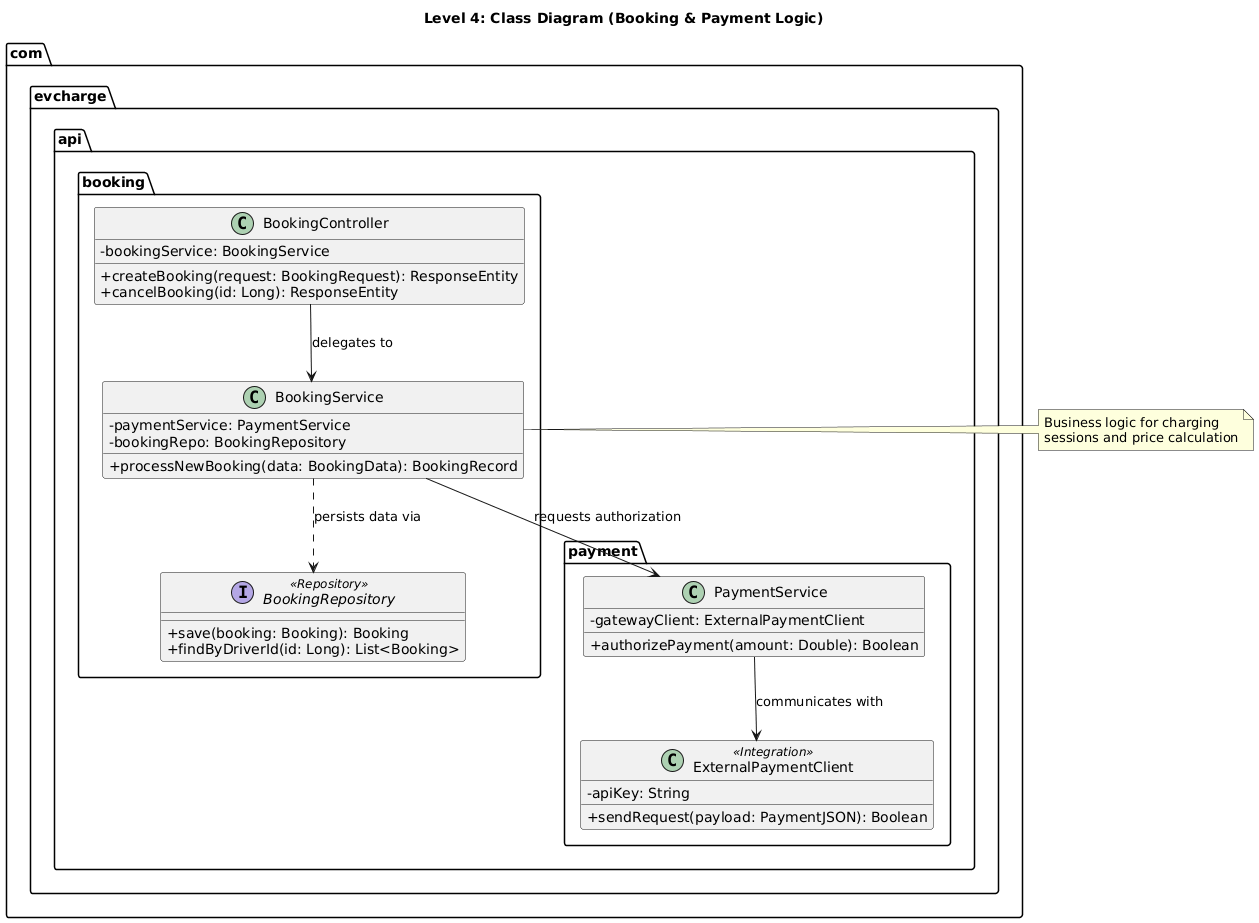
@startuml
title Level 4: Class Diagram (Booking & Payment Logic)

' Layout settings
skinparam ClassAttributeIconSize 0

package "com.evcharge.api.booking" {
class BookingController {
-bookingService: BookingService
+createBooking(request: BookingRequest): ResponseEntity
+cancelBooking(id: Long): ResponseEntity
}

class BookingService {
-paymentService: PaymentService
-bookingRepo: BookingRepository
+processNewBooking(data: BookingData): BookingRecord
}

interface BookingRepository <<Repository>> {
+save(booking: Booking): Booking
+findByDriverId(id: Long): List<Booking>
}
}

package "com.evcharge.api.payment" {
class PaymentService {
-gatewayClient: ExternalPaymentClient
+authorizePayment(amount: Double): Boolean
}

class ExternalPaymentClient <<Integration>> {
-apiKey: String
+sendRequest(payload: PaymentJSON): Boolean
}
}

' Relationships mirroring L3 logic
BookingController --> BookingService : "delegates to"
BookingService --> PaymentService : "requests authorization"
BookingService ..> BookingRepository : "persists data via"
PaymentService --> ExternalPaymentClient : "communicates with"

note right of BookingService
Business logic for charging
sessions and price calculation
end note

@endumlYou can generate these views using the AI-Powered C4 PlantUML Studio by navigating to Tools > AI Diagram Generation. The AI instantly converts your natural language descriptions into this structured PlantUML code.
Visual Paradigm provides comprehensive support for the C4 model through dedicated modeling tools and advanced AI-powered features that automate the creation of architectural views. You can generate complete, multi-layered C4 suites from simple text descriptions, bypassing the manual setup of complex structures.
The platform integrates several intelligent tools designed to streamline architectural documentation:
Visual Paradigm supports all six essential views of the C4 methodology:
Applying the C4 model with Visual Paradigm's AI capabilities delivered measurable value to the Smart EV Charging Network initiative:
✅ Accelerated Onboarding: New team members could grasp system boundaries and data flows within hours, not weeks, thanks to clear, layered diagrams.
✅ Stakeholder Alignment: Non-technical stakeholders engaged meaningfully with System Context diagrams, reducing requirement ambiguities early.
✅ Technical Precision: Developers used Component and Code diagrams as living documentation, reducing integration errors during sprint cycles.
✅ Agile Adaptation: When requirements shifted—such as adding solar integration—the AI chatbot allowed rapid diagram updates without manual redrawing.
✅ Audit-Ready Documentation: Generated PlantUML code enabled version control integration, ensuring architectural decisions were traceable and reproducible.
The hierarchical nature of the C4 model ensured that every audience received the right level of detail: executives saw strategic interactions, architects reviewed container boundaries, and developers implemented against precise component contracts.
The Smart EV Charging Network case study demonstrates that modern software architecture demands more than just technical correctness—it requires clarity, collaboration, and adaptability. By adopting the C4 model through Visual Paradigm's AI-powered platform, teams can transform abstract requirements into living, navigable architectural artifacts that serve everyone from product owners to backend engineers.
The true power lies not just in generating diagrams, but in creating a shared language for system design. With AI handling the heavy lifting of diagram creation and maintenance, architects and developers can focus on what matters most: solving complex problems, delivering value to users, and building resilient systems for a sustainable future.
Whether you're designing green infrastructure, fintech platforms, or enterprise SaaS products, the combination of C4 modeling and intelligent tooling offers a proven path to architectural excellence. Start with a simple description, let AI generate your first diagram, and watch your system's story unfold—one clear, collaborative layer at a time.

