
In today's rapidly evolving business landscape, organizations face unprecedented challenges: digital disruption, agile transformation, cybersecurity threats, and the need for continuous innovation. Enterprise Architecture (EA) has emerged as a critical discipline for aligning technology strategy with business objectives, yet many organizations struggle to implement EA frameworks that are both rigorous and adaptable.
Enter TOGAF® 10—the latest evolution of The Open Group Architecture Framework. Designed for the modern enterprise, TOGAF 10 represents a paradigm shift from rigid methodology to flexible, configurable guidance. This comprehensive case study explores how a mid-sized financial services organization, "FinTrust Global," successfully leveraged TOGAF 10 to drive a multi-year digital transformation initiative. Through this real-world lens, we examine the framework's core components, practical application strategies, and measurable business outcomes—providing enterprise architects, IT leaders, and business stakeholders with actionable insights for their own architecture journeys.
FinTrust Global is a regional financial services provider with 5,000+ employees, operating across North America and Europe. Facing competitive pressure from fintech disruptors and evolving customer expectations, leadership initiated a strategic digital transformation program in 2023. The goal: modernize legacy systems, enhance customer experience, improve operational agility, and strengthen risk management—while maintaining regulatory compliance.
Prior to TOGAF 10 adoption, FinTrust's architecture efforts were fragmented:
Siloed teams using disparate methodologies
Inconsistent documentation and deliverables
Difficulty aligning IT investments with business strategy
Limited governance for architecture decisions
The Enterprise Architecture team evaluated multiple frameworks and selected TOGAF 10 for its:
Modular structure separating enduring concepts from evolving guidance
Enhanced practical guidance via the TOGAF Series Guides
Built-in support for Agile, digital transformation, and security architecture
Free availability for non-commercial internal use
Activities:
Secured executive sponsorship and established an Architecture Governance Board
Trained core team on TOGAF 10 Fundamental Content, focusing on the Architecture Development Method (ADM)
Configured the Enterprise Metamodel to reflect FinTrust's business domains, data entities, and technology standards
Selected initial TOGAF Series Guides: Digital Technology Adoption, Integrating Risk and Security, and Enabling Enterprise Agility
Key Deliverables:
Architecture Vision document outlining transformation scope and success metrics
Stakeholder map and communication plan
Customized Architecture Content Framework aligned with FinTrust's delivery lifecycle
Applying the ADM Cycle:
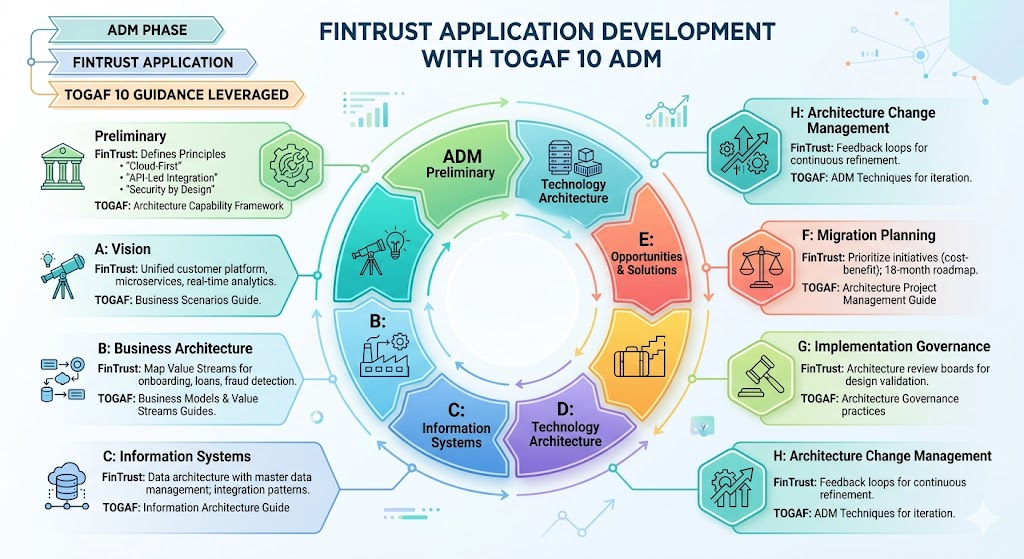
| ADM Phase | FinTrust Application | TOGAF 10 Guidance Leveraged |
|---|---|---|
| Preliminary | Defined architecture principles: "Cloud-First," "API-Led Integration," "Security by Design" | Architecture Capability Framework |
| A: Vision | Developed target state: unified customer platform, microservices architecture, real-time analytics | Business Scenarios Guide |
| B: Business Architecture | Mapped value streams for customer onboarding, loan processing, and fraud detection | Business Models & Value Streams Guides |
| C: Information Systems | Designed data architecture with master data management; selected integration patterns | Information Architecture Guide |
| D: Technology Architecture | Evaluated cloud providers; defined containerization strategy (Kubernetes) | Technology Architecture & Microservices Guides |
| E: Opportunities & Solutions | Prioritized initiatives using cost-benefit analysis; created 18-month roadmap | Architecture Project Management Guide |
| F: Migration Planning | Developed phased migration plan with risk mitigation strategies | Risk Integration Guide |
| G: Implementation Governance | Established architecture review boards for solution design validation | Architecture Governance practices |
| H: Architecture Change Management | Implemented feedback loops for continuous architecture refinement | ADM Techniques for iteration |
Practical Adaptations:
Agile Integration: Ran ADM cycles in 6-week sprints, aligning with product team ceremonies
Security by Design: Embedded security architecture activities throughout all ADM phases, not as a separate layer
Stakeholder Engagement: Used Architecture Viewpoints to tailor communications for executives, developers, and compliance teams
Expansion Activities:
Extended TOGAF adoption to business units via "Architecture Champion" program
Integrated TOGAF Content Framework with Jira and Confluence for living documentation
Leveraged the Organization Mapping guide to clarify decision rights between central EA and domain teams
Established metrics dashboard tracking architecture conformance, technical debt reduction, and time-to-market improvements
| Metric | Baseline (Pre-TOGAF) | Post-Implementation (24 Months) | Improvement |
|---|---|---|---|
| Time to launch new digital product | 9-12 months | 4-6 months | ~50% faster |
| Architecture decision cycle time | 6-8 weeks | 2-3 weeks | ~65% reduction |
| System integration defects | 22% of releases | 8% of releases | ~64% reduction |
| Stakeholder satisfaction (EA services) | 3.2/5.0 | 4.6/5.0 | +44% |
| Regulatory audit findings | 15 major findings/year | 3 minor findings/year | 80% reduction |
Qualitative Outcomes:
Strategic Alignment: Business leaders now actively participate in architecture reviews, ensuring technology investments directly support growth objectives
Risk Resilience: Proactive security architecture reduced incident response time by 70% during a simulated cyberattack exercise
Talent Development: TOGAF certification program upskilled 35+ architects; improved retention in the EA team
Innovation Enablement: Standardized APIs and microservices patterns accelerated proof-of-concept development for AI/ML use cases
✅ Start with Business Outcomes: Anchor architecture work to measurable business value—not technical elegance
✅ Configure, Don't Customize: Use TOGAF Series Guides to adapt the framework; avoid over-engineering the metamodel
✅ Governance as Enablement: Position architecture reviews as collaborative design sessions, not gatekeeping checkpoints
✅ Invest in Communication: Tailor architecture artifacts to audience needs—executives need roadmaps; developers need patterns
✅ Embrace Iteration: Treat the ADM as a learning cycle; refine approaches based on feedback and changing conditions
⚠️ Common Pitfalls to Avoid:
Boiling the ocean: Start with a high-impact, bounded scope (e.g., one value stream) before enterprise-wide rollout
Documentation overload: Focus on "just enough" architecture; leverage automated tools for living documentation
Siloed adoption: Ensure business, data, application, and technology architects collaborate from day one
TOGAF 10 is more than a framework—it is an evolving ecosystem designed to empower organizations to navigate complexity with confidence. As demonstrated by FinTrust Global's journey, successful implementation hinges not on rigid adherence to methodology, but on thoughtful configuration, stakeholder collaboration, and a relentless focus on business value.
The modular structure of TOGAF 10—separating enduring Fundamental Content from rapidly evolving Series Guides—provides the stability needed for long-term architecture governance while enabling agility to respond to emerging technologies and market shifts. For enterprise architects, this means less time debating framework mechanics and more time delivering solutions that matter.
Looking ahead, the principles embodied in TOGAF 10—adaptability, practicality, and business alignment—will only grow in importance. As organizations continue to blur the lines between business strategy and digital execution, the ability to architect with purpose, govern with clarity, and evolve with intention becomes a core competitive advantage. TOGAF 10 provides the compass; the journey belongs to those willing to walk it.
The TOGAF® Standard, 10th Edition | The Open Group: Official resource describing the TOGAF Standard as a proven Enterprise Architecture methodology used by leading organizations to improve business efficiency, featuring modular structure with Fundamental Content and Series Guides.
TOGAF® Standard, 10th Edition Downloads | The Open Group: Provides free download access for non-commercial use, licensing options, and registration instructions for the TOGAF Standard, 10th Edition documentation.
Comprehensive Guide to TOGAF Standard, 10th Edition | Visual Paradigm: Detailed overview of TOGAF 10's structure, key changes from version 9.2, and practical guidance for adoption and implementation.
TOGAF Certification Portfolio | The Open Group: Outlines certification paths, learning resources, and credentialing options based on the TOGAF Standard, 10th Edition for architecture professionals.

