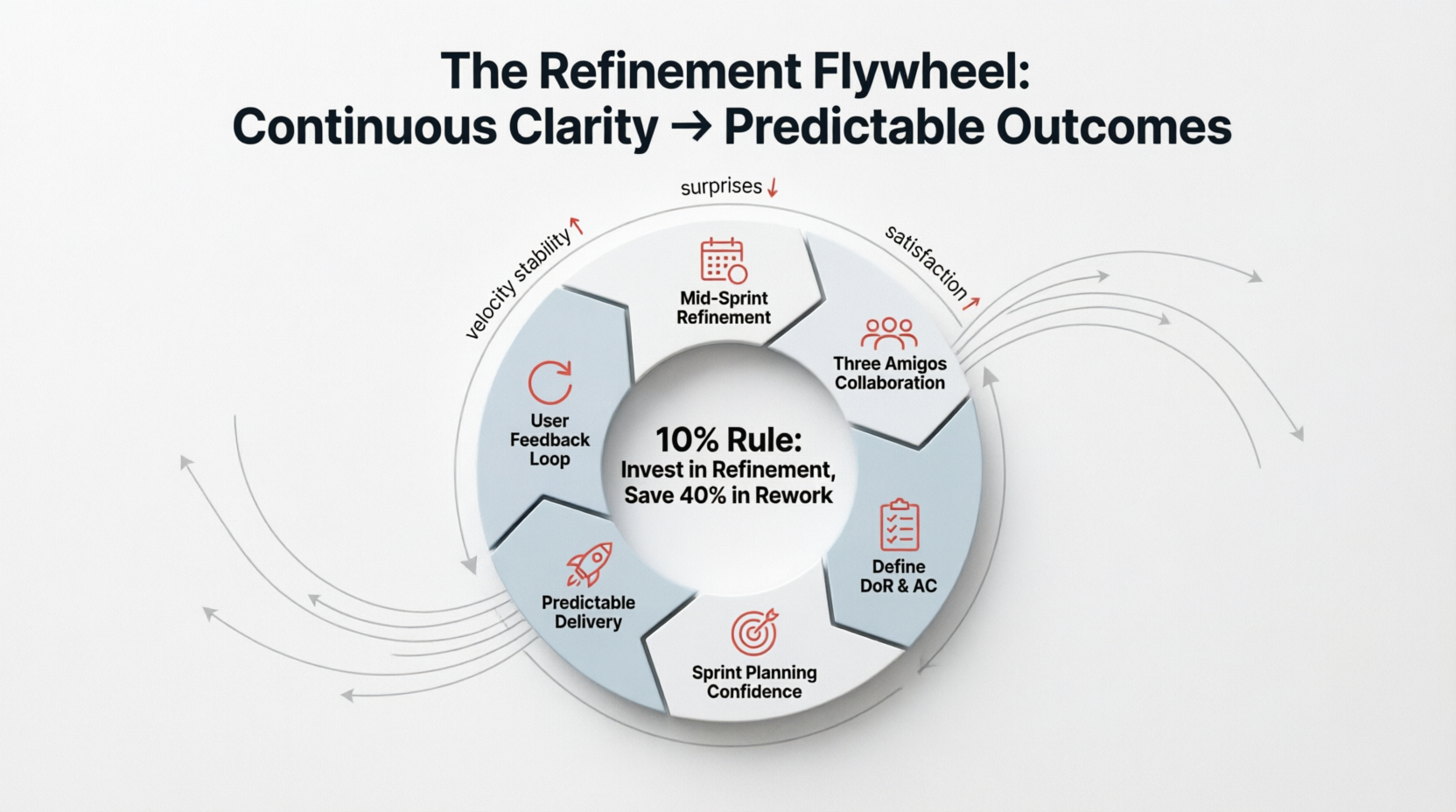
In Agile development, a chaotic backlog is the fastest route to unpredictable sprints, missed deadlines, and team burnout. Many teams treat backlog grooming as a last-minute box-checking exercise right before Sprint Planning. But the truth is, Product Backlog Refinement is the lifeblood of a healthy, predictable Agile team. It is not merely a meeting; it is a continuous, collaborative discipline that transforms vague aspirations into actionable, sprint-ready commitments.
When done correctly, refinement bridges the gap between strategic vision and tactical execution. It aligns the Product Owner’s business priorities with the engineering team’s technical reality, surfaces hidden dependencies early, and builds shared understanding before a single line of code is written. This guide walks you through the core principles, practical techniques, real-world examples, and common pitfalls of effective backlog refinement. By the end, you’ll have a actionable playbook to keep your backlog DEEP, your team aligned, and your delivery predictable.
Refinement is the ongoing process of moving backlog items from a raw, high-level state (Epics) to a "Ready" state that can be confidently pulled into Sprint Planning. Two pillars support this process: the DEEP Framework and the Definition of Ready (DoR).
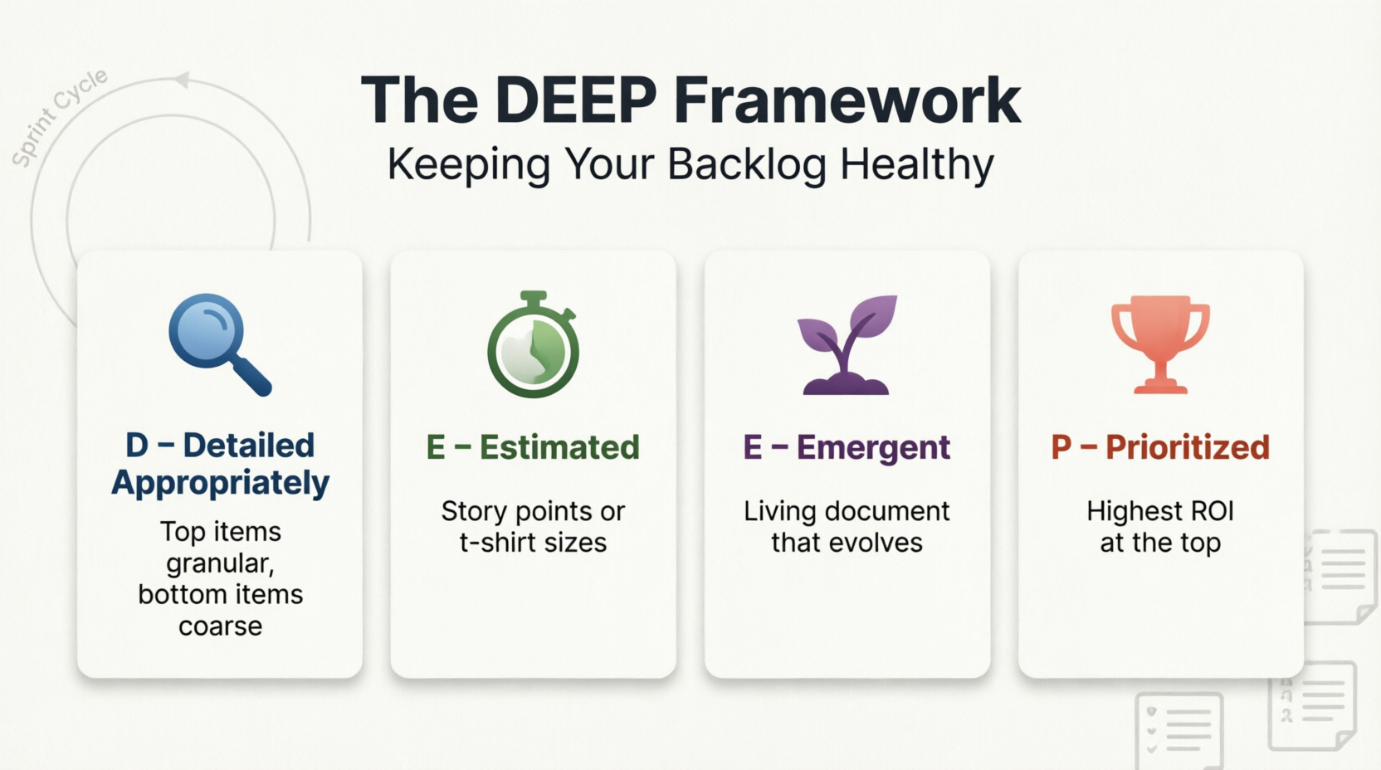
| Principle | What It Means | Practical Example |
|---|---|---|
| Detailed Appropriately | Top items (next 1–2 sprints) are granular. Lower items remain coarse to avoid wasted effort on likely changes. | Top: "As a mobile user, I want push notifications for order status so I don't have to refresh the app." Bottom: "Implement enterprise-wide notification routing architecture." |
| Estimated | The team provides relative sizing (Story Points, T-shirt sizes) for top items to forecast capacity and complexity. | A team uses Planning Poker and converges on 5 points for "Password Reset Flow" after discussing edge cases like expired tokens. |
| Emergent | The backlog is a living document. It evolves based on user feedback, market shifts, and technical discovery. | Analytics show only 2% of users export PDF reports. The PO deprioritizes "Multi-format Export" in favor of "CSV Performance Optimization." |
| Prioritized | The PO maintains strict ordering. Highest ROI / business value always sits at the top. | Using WSJF (Weighted Shortest Job First), "Checkout Abandonment Recovery" (High Value, Low Effort) jumps above "Admin Dashboard Revamp." |
A shared team agreement that answers: "When is this story ready to enter a sprint?" Without DoR, Sprint Planning becomes a guessing game.
Standard DoR Checklist:
Example: DoR Pass vs. Fail
Refinement is a progression. Let's walk through a complete lifecycle using a real-world scenario.
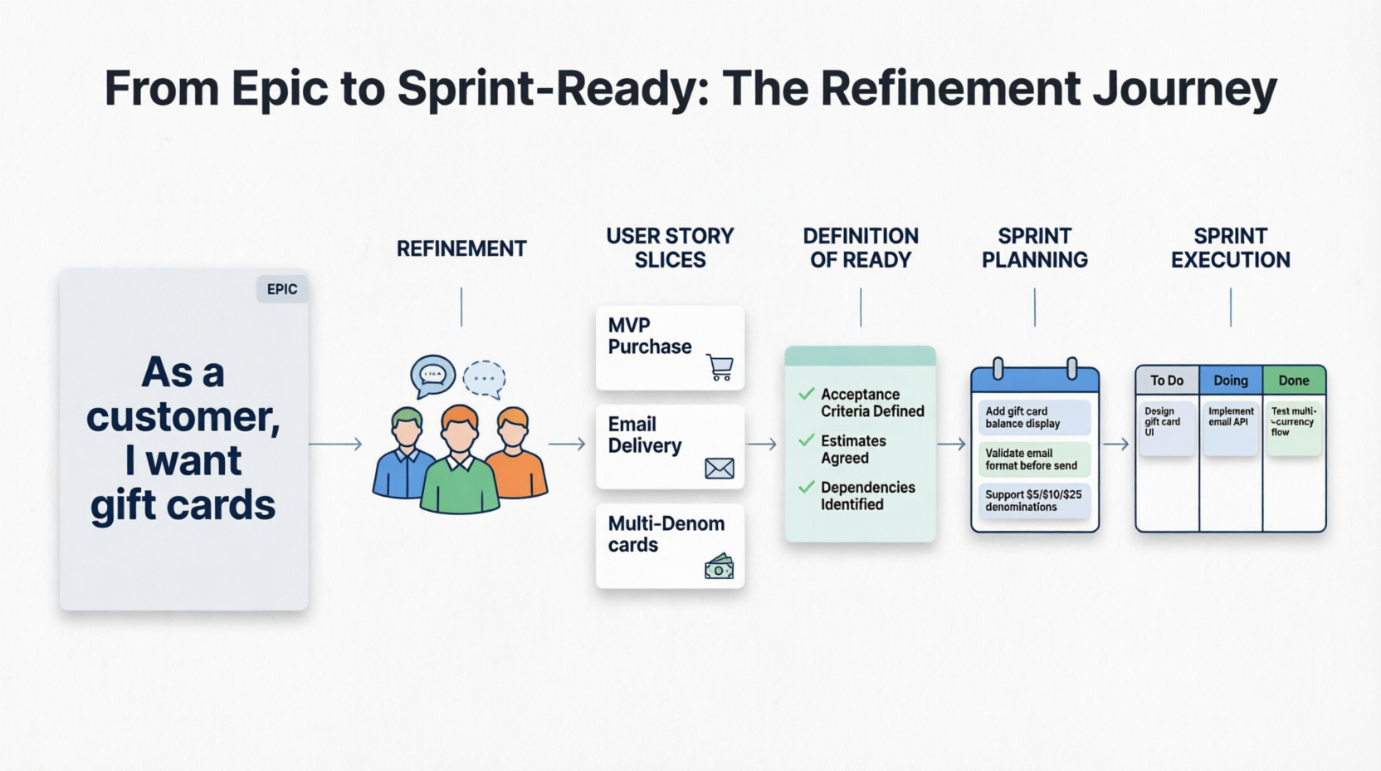
Every major initiative starts as an Epic—a large body of work that must be broken down.
Epic: As a customer, I want to purchase and send gift cards to friends.
This violates the Small principle of INVEST (Independent, Negotiable, Valuable, Estimable, Small, Testable). It's too heavy for a single sprint.
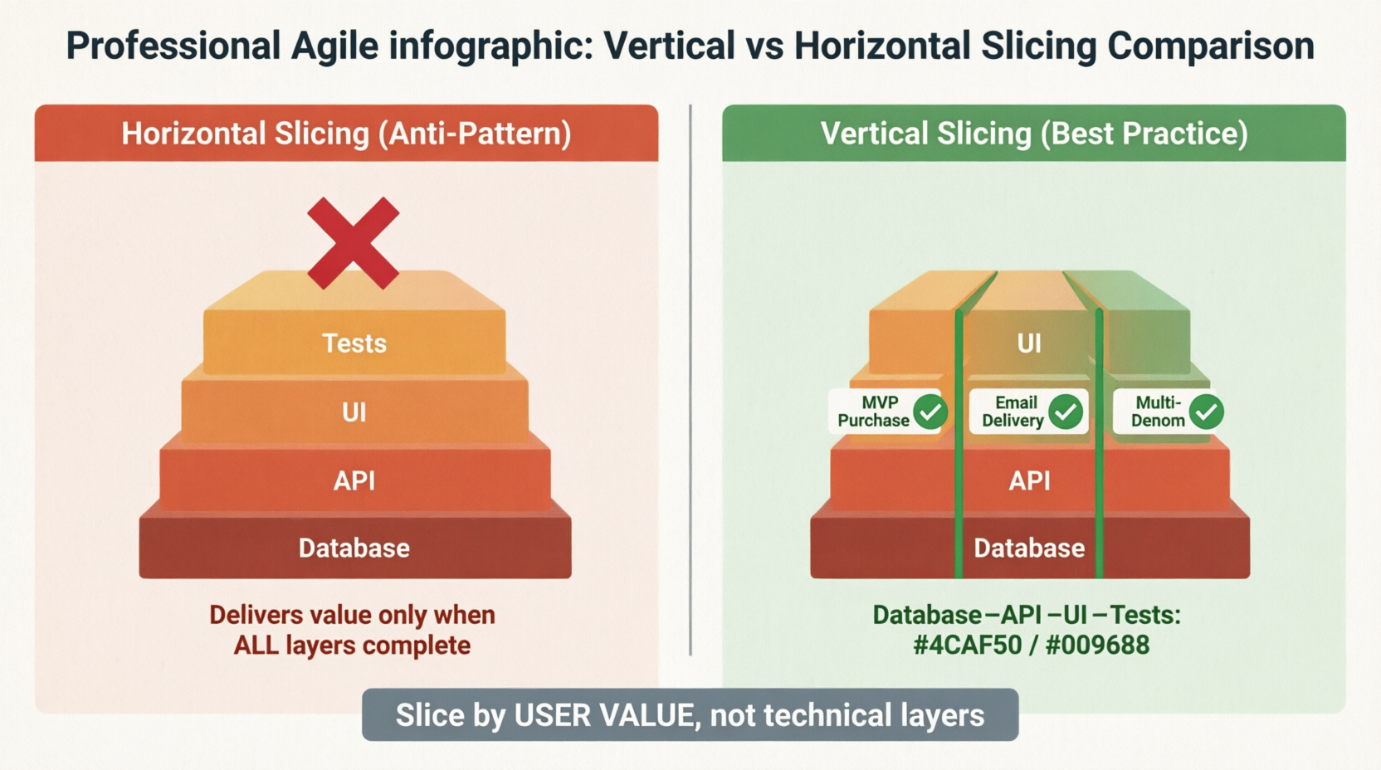
Amateur teams slice horizontally (by technical layer: DB, API, UI, Tests). Agile teams slice vertically (by user value). Each slice delivers a working, testable increment.
| Backlog Item (Vertical Slice) | Description | Initial Est. | Delivered Value |
|---|---|---|---|
| MVP Purchase | Buy a $10 gift card via credit card. | 5 pts | Customers can buy a basic gift card immediately. |
| Email Delivery | System emails the code to the recipient. | 13 pts | Recipients receive usable codes; no physical mail needed. |
| Multi-Denom | Allow $25, $50, $100 options. | 13 pts | Matches customer purchasing habits; increases AOV. |
| Custom Graphics | Upload an image/theme for the card. | 8 pts | Enhances gifting experience; marketing differentiation. |
The most effective refinement happens when the Product Owner, Developer, and Tester discuss a story together. This session surfaces hidden assumptions and aligns on success criteria.
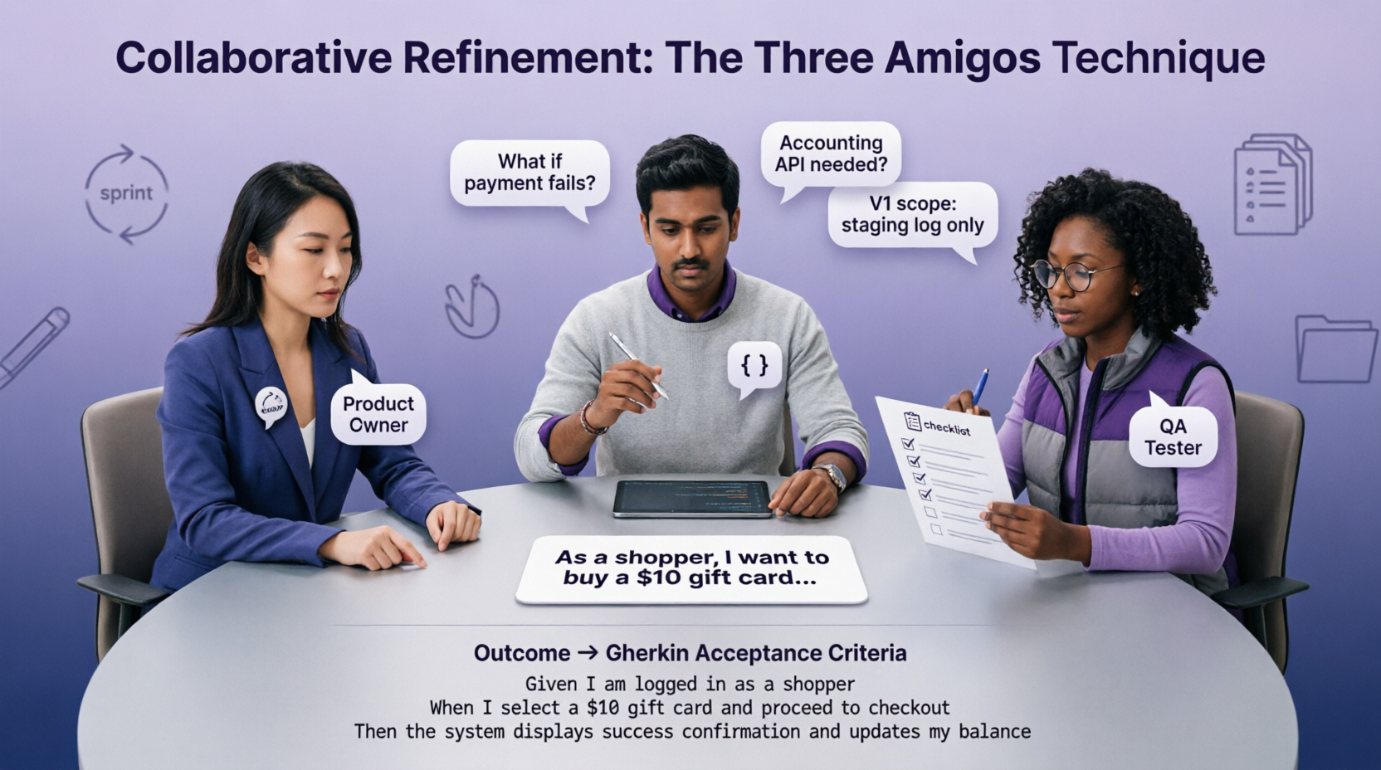
Sample Dialogue for "MVP Purchase":
Outcome: Gherkin-Style Acceptance Criteria
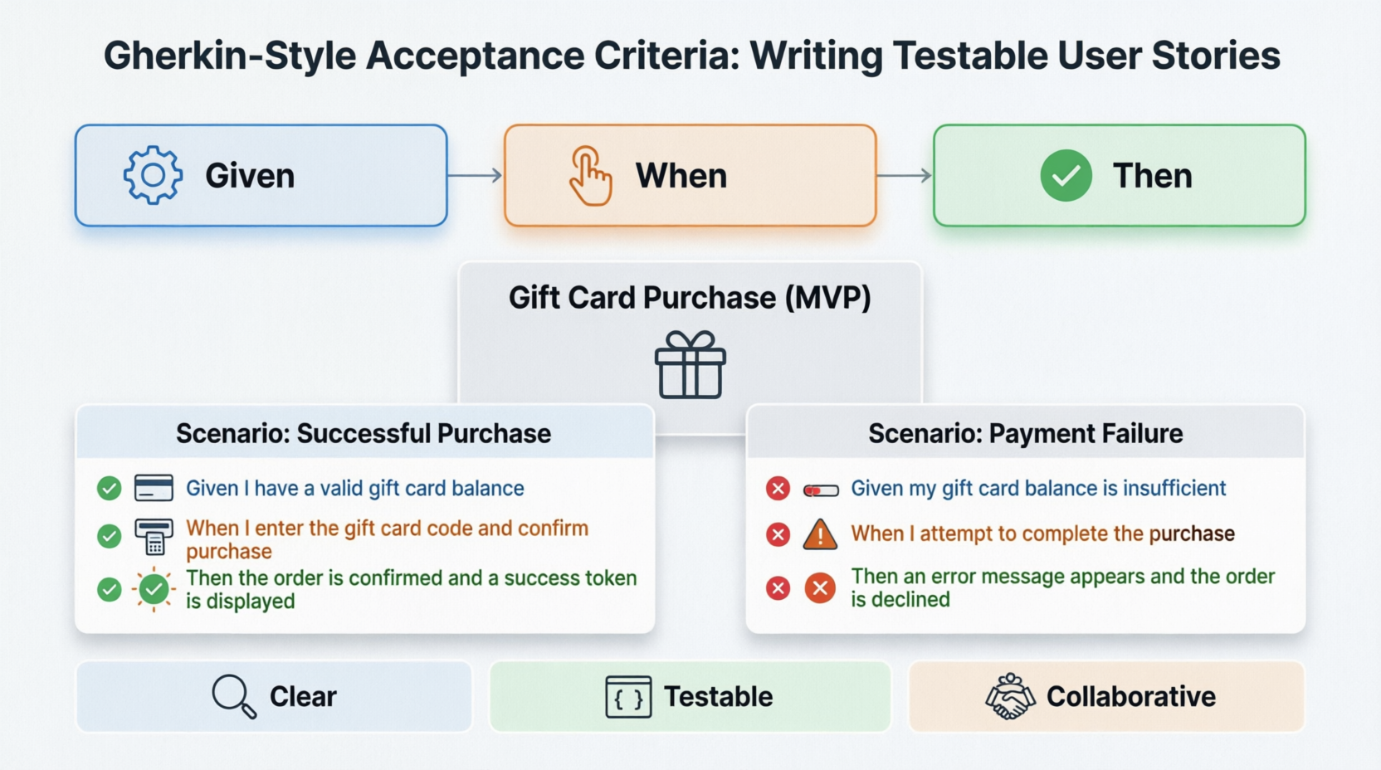
Feature: Gift Card Purchase (MVP)
  Scenario: Successful purchase
    Given I am on the gift card checkout page
    And I select the $10 denomination
    When I enter valid credit card details and submit
    Then the payment gateway returns a "Success" token
    And the confirmation page displays a unique 16-digit code
    And an order record is saved to the staging table

  Scenario: Payment failure
    Given I enter invalid or declined payment details
    When I submit the purchase
    Then I see a "Payment Declined" error message
    And no gift card code is generated
    And I am not charged
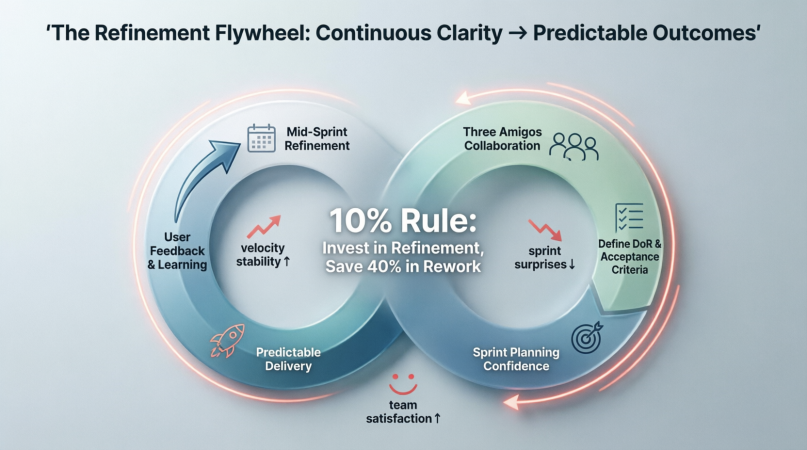
Refinement thrives on rhythm, discipline, and psychological safety. Adopt these practices to keep your process lean and effective.
| Practice | How to Implement | Real-World Example |
|---|---|---|
| Follow the 10% Rule | Cap refinement at ~10% of total team capacity. Prevents analysis paralysis. | 5 devs × 40 hrs/week = 200 hrs. Max 20 hrs/week spent refining. Schedule one 2-hr session + async comments. |
| The "Parking Lot" & Spikes | If a discussion exceeds 15 mins without resolution, park it. Assign a Spike (time-boxed research). | Team debates webhook retry limits. PO parks it. Dev assigned: "Spike: Test Stripe webhook retry behavior. Timebox: 4 hrs. Return with recommendation." |
| Mid-Sprint Cadence | Refine 3–5 days before Sprint Planning. Gives PO time to gather missing info. | Sprint runs Mon–Fri (2 weeks). Refinement scheduled for Thursday of Week 1. Planning on Monday of Week 3. |
| Involve the Whole Team | Siloed refinement misses edge cases. QA spots test gaps; devs spot tech debt; PO clarifies value. | A QA engineer notices the "Custom Graphics" story lacks file size limits. Team adds AC: "Max 5MB, PNG/JPG only." |
| Use Story Mapping | Visualize user journeys horizontally (activities) and vertically (slices/releases). | Team maps "Gift Card" journey: Select → Pay → Deliver → Redeem → Track. Identifies "Redeem" as V2, pushes to bottom. |
Even well-intentioned teams fall into refinement traps. Recognize and neutralize these early.
| Anti-Pattern | Symptoms | Impact | Cure |
|---|---|---|---|
| 👻 "Ghost" Backlogs | Items sit untouched for 3+ months. | Wastes mental RAM, inflates backlog size, hides true priorities. | Archive anything >90 days old without movement. Re-evaluate quarterly. |
| 📜 The "Rubber Stamp" | Team nods through estimates without reading AC. | "Sprint Shock": work is 2–3× harder than estimated. | Force Planning Poker. Require at least one question per story before voting. |
| 🏗️ Waterfall-in-Disguise | Defining every pixel, API contract, and DB schema 6 months out. | Defeats Agile adaptability. High rework when reality diverges. | Embrace Just-in-Time elaboration. Keep bottom 50% of backlog at Epic/Feature level. |
| 🕳️ The Refinement Black Hole | Sessions run 2+ hours with no decisions or next steps. | Team exhaustion, meeting avoidance, delayed planning. | Set a hard timebox. Use a facilitator. End with clear owners & due dates for open questions. |
| 📊 Estimation Obsession | Debating 3 vs 5 points for 30 minutes. | Shifts focus from value delivery to mathematical perfection. | Remind team: points are for forecasting, not performance metrics. If stuck, pick higher number, add Spike, move on. |
Backlog refinement is not a bureaucratic hurdle; it is your team’s insurance policy against chaos. When you consistently apply the DEEP framework, enforce a clear Definition of Ready, slice vertically for early value, and collaborate across disciplines, you transform your backlog from a wish list into a strategic execution engine.
The most successful Agile teams don’t wait for clarity—they create it through deliberate, time-boxed refinement. They treat their backlog as a living conversation, not a static document. They know that 10% of their capacity spent upfront saves 40% of their capacity in rework, context-switching, and sprint fallout.
Reflection for your team: Are you refining to plan, or planning to refine? How is your current process evolving high-level features into sprint-ready commitments? If you’re still experiencing sprint surprises, missed dependencies, or estimation debates that derail meetings, it’s time to reset your refinement rhythm. Start small: pick one upcoming epic, run a Three Amigos session, define your DoR, and measure the difference in planning confidence and delivery predictability.
The path to predictable Agile delivery isn’t found in perfect plans—it’s forged in disciplined, continuous refinement.