
Enterprise Architecture (EA) is often criticized for being overly theoretical, producing dense documentation that rarely translates into tangible business value. However, when applied correctly, the TOGAF Standard provides a rigorous framework for aligning IT strategy with business goals. The heart of this alignment lies in the Architecture Development Method (ADM) and its specific outputs: Deliverables.
While artifacts (diagrams, matrices) describe the architecture, deliverables are the contractually agreed-upon work products that drive decision-making, secure funding, and guide implementation. This case study follows "GlobalFin Corp," a fictional mid-sized financial services company undergoing a digital transformation. By walking through each phase of the TOGAF ADM, we will illustrate exactly what each deliverable looks like in practice, transforming abstract concepts into concrete examples.
Background: GlobalFin Corp is a regional bank struggling with legacy mainframe systems, siloed customer data, and slow time-to-market for new digital banking features.
Strategic Goal: Launch a unified "Digital-First" banking platform within 18 months to improve customer retention by 20% and reduce operational costs by 15%.
Architecture Team: Led by Chief Architect Sarah Chen, tasked with using TOGAF 10 to guide the transformation.
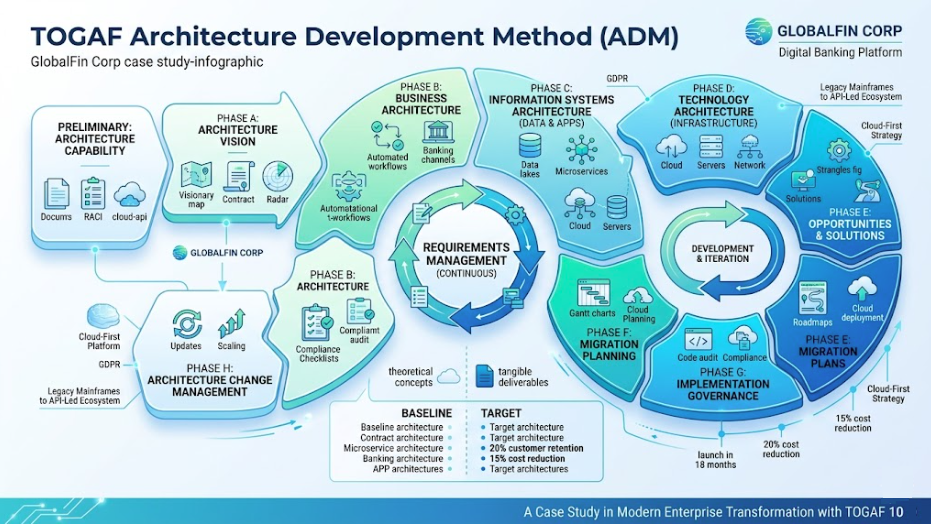
Before starting the transformation, Sarah’s team must define how they will work.
Definition: Guiding rules for architecture design.
Example: "Cloud-First Strategy": All new applications must be designed for cloud deployment unless specific regulatory constraints require on-premise hosting. "Data as an Asset": Customer data must be centralized and accessible via API to all authorized channels.Definition: Storage system for architecture assets.
Example: A structured SharePoint/Confluence site with folders for "Reference Models," "Standards Information Base," and "Governance Log," integrated with ArchiMate modeling tools.Definition: Roles and responsibilities.
Example: An RACI chart defining that the CIO is Accountable for architecture approval, the Enterprise Architect is Responsible for design, and Business Unit Heads are Consulted for requirements.Definition: Customized TOGAF adaptation.
Example: GlobalFin decides to skip detailed "Technology Architecture" deep-dives for non-critical internal tools, focusing rigorous ADM cycles only on customer-facing platforms.Definition: Strategic context.
Example: Driver: Regulatory pressure for open banking. Goal: Achieve PSD2 compliance by Q3. Principle: Security by Design.Definition: Formal authorization.
Example: A signed document from the CIO authorizing the "Digital Banking Platform" project, allocating $500k for the initial architecture phase and defining the success criteria.Sarah defines the scope and gets buy-in.
Definition: High-level aspirational view.
Example: A one-page visual roadmap showing the transition from "Siloed Legacy Systems" to a "Unified API-Led Ecosystem," highlighting key benefits: 30% faster feature release, single customer view, and mobile-first experience.Definition: Contract between architecture team and stakeholders.
Example: A document stating: "The architecture team will deliver baseline and target architectures for Retail Banking within 12 weeks. Stakeholders agree to provide subject matter experts for 10 hours/week."Definition: Strategy for stakeholder engagement.
Example: Bi-weekly steering committee updates for executives; monthly town halls for engineering teams; weekly Slack updates for project managers.Definition: Evaluation of current skills/tools.
Example: Assessment reveals a gap in API management skills. Recommendation: Hire two API architects and train existing staff on AWS Cloud services.Defining how the business will operate.
Definition: Baseline vs. Target business structure.
Example:
Baseline: Branch-centric model with manual loan approvals.
Target: Digital-first model with automated AI-driven loan underwriting and omnichannel support.Definition: Functional/non-functional business needs.
Example: Functional: System must support real-time balance checks. Non-Functional: Loan approval process must complete within 5 minutes for 95% of cases.Definition: Strategic plan for business transition.
Example: Q1: Retrain branch staff for advisory roles. Q2: Pilot automated underwriting in one region. Q3: Full rollout.Designing the Data and Application layers.
Definition: Baseline vs. Target systems.
Example:
Baseline: 12 separate customer databases across credit cards, savings, and loans.
Target: Single Customer Data Lake with microservices for each banking product.Definition: Technical requirements for systems.
Example: Data: Must comply with GDPR right-to-be-forgotten. Application: Microservices must communicate via RESTful APIs with <100ms latency.Definition: Transition steps for systems.
Example: Month 1-3: Build Customer Data Lake. Month 4-6: Migrate Savings module. Month 7-9: Migrate Loans module.Definition: Reusable components.
Example: A standardized "Customer Identity Service" ABB that can be reused by Mobile App, Web Portal, and Branch Systems.Defining the underlying infrastructure.
Definition: Baseline vs. Target infrastructure.
Example:
Baseline: On-premise data center with physical servers.
Target: Hybrid cloud using AWS for compute and Azure for active directory integration.Definition: Infrastructure requirements.
Example: Availability: 99.99% uptime. Security: All data encrypted at rest and in transit using AES-256.Definition: Infrastructure migration plan.
Example: Phase 1: Lift-and-shift non-critical apps to AWS. Phase 2: Refactor core banking engine for cloud-native deployment.Identifying how to build it.
Definition: High-level implementation strategy.
Example: Choose a "Strangler Fig" pattern: gradually replace legacy functions with new microservices rather than a big-bang replacement.Definition: Specific technologies/products.
Example: Selecting Kafka for event streaming, React for frontend, and Spring Boot for backend services.Definition: Intermediate states.
Example: Transition State 1: Legacy core remains, but new mobile app connects via an API Gateway that wraps legacy calls. Transition State 2: Core loans migrated, savings still legacy.Definition: Oversight framework.
Example: Establish an Architecture Review Board (ARB) that meets weekly to review code commits against architectural standards.Definition: Project-level details.
Example: Detailed Gantt chart linking specific sprints to architecture milestones.Finalizing the plan.
Definition: Detailed resource/timeline plan.
Example: A MS Project file detailing: "Week 1-4: Setup AWS Environment. Week 5-8: Develop Identity Service. Resources: 3 DevOps Engineers, 2 Backend Developers."Definition: Detailed oversight approach.
Example: Define KPIs for governance: "Zero critical security vulnerabilities in production," "100% API documentation coverage."Definition: Final specs for reusable components.
Example: Finalized API specification for the "Payment Processing ABB" including error handling codes and rate limits.Definition: Formal change to scope.
Example: Stakeholders request adding "Cryptocurrency Wallet" support. A change request is filed to assess impact on timeline and budget.Overseeing the build.
Definition: Evaluation against standards.
Example: Audit reveals that the new mobile app is storing session tokens locally instead of using secure enclave. Result: Non-compliant. Remediation required before launch.Definition: Modifications due to findings.
Example: Due to the security finding above, a change request is issued to update the security architecture and delay launch by 2 weeks.Definition: Actual deployed components.
Example: The live "Identity Service" running on AWS EKS, version 1.0, with monitoring enabled.Managing post-launch changes.
Definition: Revised documentation.
Example: Updating the Architecture Definition Document to reflect the new cryptocurrency wallet component added after launch.Definition: Ongoing change submissions.
Example: Request to upgrade Kafka version to 3.0 for performance improvements.Definition: Updated agreements.
Example: Renewing the SLA with the cloud provider to include stricter penalty clauses for downtime.Definition: New cycle initiation.
Example: Business wants to expand into international markets. A new Request for Architecture Work is issued to start a new ADM cycle for "Global Expansion Architecture."Definition: Updated needs.
Example: During Phase G, regulators introduce new data residency laws. Requirement updated: "All EU customer data must remain in Frankfurt AWS region."Definition: Analysis of changes.
Example: Assessment shows that data residency change requires re-architecting the data lake partitioning strategy, impacting Phase C and D deliverables, adding 4 weeks to the timeline.The TOGAF ADM is not merely a documentation exercise; it is a disciplined approach to managing complexity and risk. As demonstrated in the GlobalFin Corp case study, each deliverable serves a specific purpose:
By treating these deliverables as living contracts rather than static documents, organizations can ensure that their enterprise architecture remains relevant, compliant, and directly tied to business value. The true power of TOGAF lies not in the framework itself, but in the clarity and discipline its deliverables bring to the chaotic process of digital transformation.

