
The software engineering landscape is currently experiencing a paradigm shift. The proliferation of Large Language Models (LLMs) and AI-powered code generators has dramatically accelerated the pace of implementation. However, this newfound speed has introduced a critical paradox: while machines can write code faster than ever, human capacity to specify, verify, and maintain complex system architectures has not scaled proportionally.
Many organizations that adopted an "AI-first, code-only" approach quickly found themselves drowning in technical debt. AI-generated code, while syntactically correct, often lacks semantic consistency, architectural alignment, and deep domain context. The result is a fragmented codebase where the "why" and "how" of the system are lost in a sea of automated boilerplate.
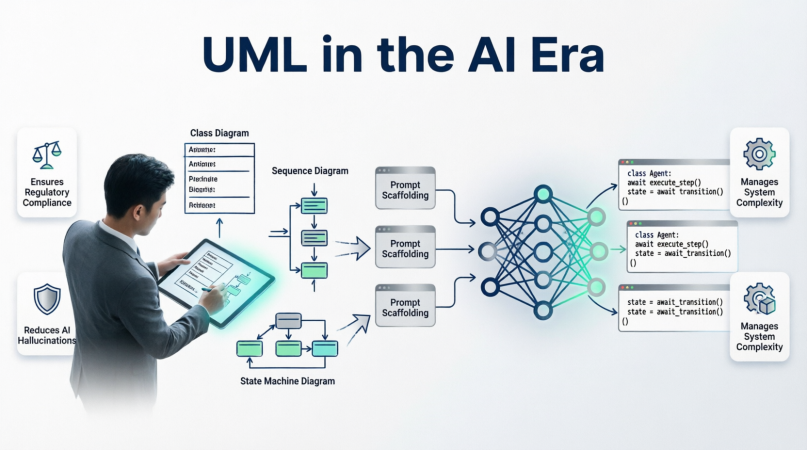
This case study explores how NovaTech Financial, a mid-sized global fintech company, successfully navigated this paradox. By rejecting the notion that UML is a relic of the past, NovaTech revitalized the Unified Modeling Language (UML) to serve as the crucial "human-in-the-loop" mechanism. This comprehensive case study details how they leveraged UML not just for documentation, but as a strategic tool to manage complexity, ensure regulatory compliance, and act as precise "prompt scaffolding" for their AI development pipelines.
Company: NovaTech Financial (Global Payment Processing & Retail Banking)
Challenge: Migrating a 12-year-old monolithic core banking system to a microservices architecture while integrating AI coding assistants to meet aggressive time-to-market deadlines.
Solution: Implementing a modern, lightweight UML strategy (utilizing PlantUML and Visual Paradigm) to govern architecture, guide AI code generation, and satisfy strict financial regulatory audits.
Outcome: 40% reduction in AI-generated code rework, 100% success in regulatory compliance audits, and a 30% decrease in new developer onboarding time.
NovaTech Financial faced immense pressure to decompose its legacy monolith into cloud-native microservices to support new open-banking APIs. To accelerate the massive refactoring effort, the engineering leadership rolled out AI coding assistants across all agile squads.
Initially, velocity spiked. However, within three months, severe issues emerged:
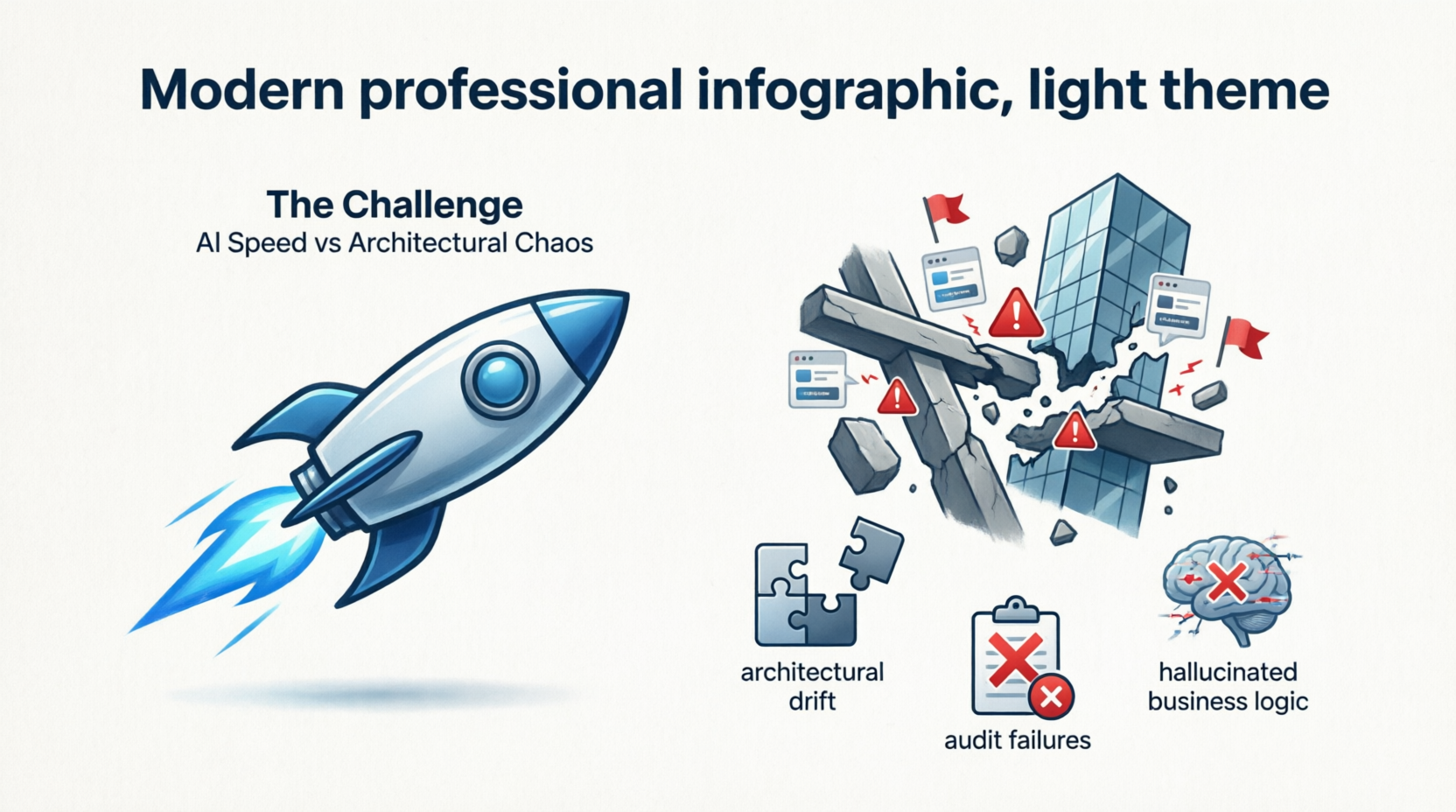
Architectural Drift: Different AI tools suggested varying design patterns for similar problems, leading to inconsistent microservice boundaries.
Hallucinated Business Logic: AI models occasionally misinterpreted vague natural language prompts, generating code that bypassed critical financial transaction validation rules.
Audit Failures: In a highly regulated industry, regulators require proof of system behavior and state transitions. Raw code and AI chat logs were insufficient for compliance audits.
Leadership realized that without a formalized, standardized visual language to define human intent, the AI was optimizing for local code correctness at the expense of global system integrity.
Instead of abandoning AI, NovaTech decided to constrain and guide it using a modernized UML approach. They adopted the principle of "just enough UML," focusing on agility and tooling integration rather than heavyweight documentation.
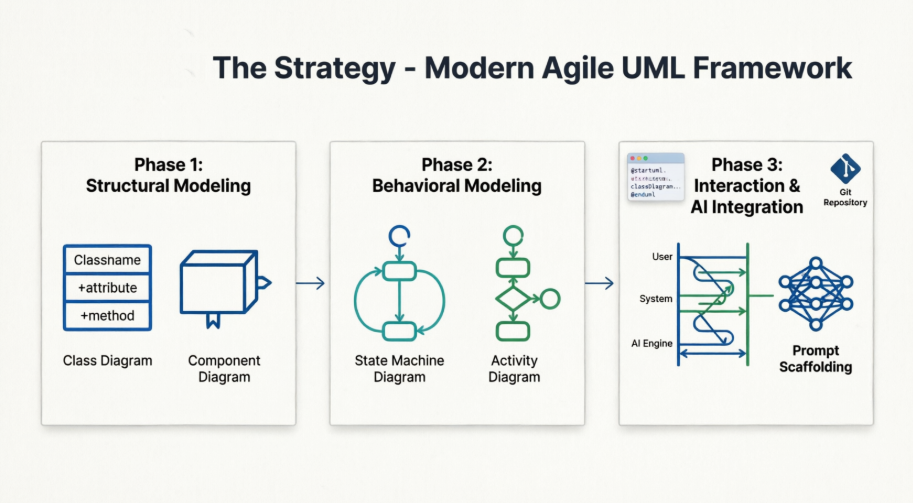
To halt architectural drift, the enterprise architecture team utilized Component and Package Diagrams to define the target microservices topology.
They mapped out clear bounded contexts, API gateways, and database schemas.
Class Diagrams were used to establish a unified domain model (e.g., standardizing the definition of a Transaction, Ledger, and User across all services).
Tooling: They used PlantUML, allowing architects to write diagrams as code. These .puml files were committed directly to the Git repositories, ensuring the architectural blueprints were version-controlled and lived alongside the code.
To satisfy regulatory requirements and clarify complex business logic, teams turned to behavioral diagrams.
State Machine Diagrams were meticulously crafted to model the exact lifecycle of a financial transaction (e.g., Initiated -> Pending Verification -> Cleared -> Settled -> Failed). This eliminated ambiguity about how edge cases (like network timeouts during a transfer) should be handled.
Activity Diagrams were used to map out the anti-money laundering (AML) check workflows, ensuring all regulatory steps were visually verified before a single line of code was written.
This was the most transformative phase. Instead of prompting the AI with vague text like, "Write a service to process a wire transfer," developers changed their workflow.
Developers created Sequence Diagrams detailing the exact step-by-step interactions between the API Gateway, the Transaction Service, the Fraud Detection Service, and the Database.
These PlantUML sequence diagrams were then fed into the LLM context window as "prompt scaffolding."
The Result: The AI was forced to adhere strictly to the predefined interaction flow. It no longer hallucinated extra steps or missed critical error-handling callbacks. The AI acted as a highly efficient translator, converting the precise UML semantics into syntactically perfect code.
By integrating UML into their AI-augmented workflow, NovaTech Financial realized profound benefits across multiple dimensions of their business:
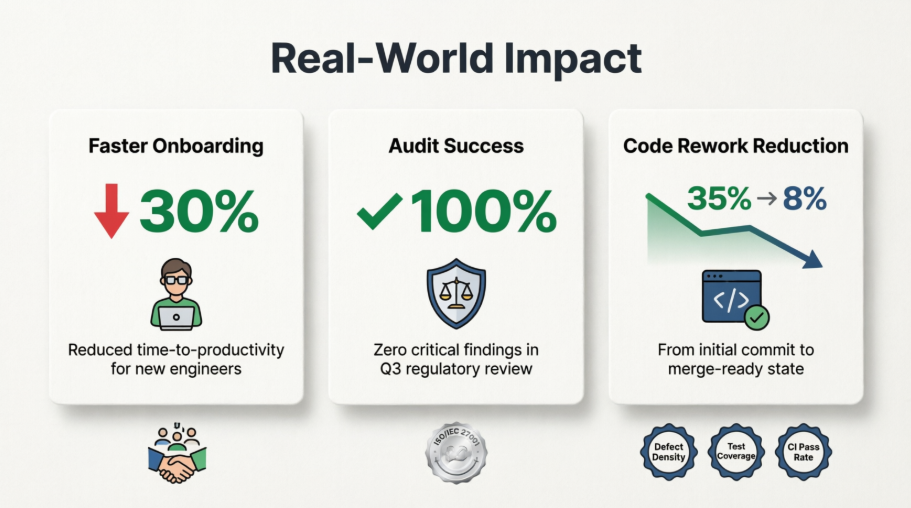
When new developers joined the agile squads, they no longer had to reverse-engineer thousands of lines of AI-generated code to understand the system. They simply reviewed the living PlantUML diagrams in the repository.
Impact: Time-to-first-commit for new hires dropped by 30%. Furthermore, Product Owners and non-technical stakeholders could easily review Use Case and Activity Diagrams during sprint planning, bridging the communication gap between business and IT.
During their annual compliance review, financial regulators required proof that the new microservices handled transaction states securely and adhered to data retention policies.
Impact: NovaTech provided the formal State Machine and Component Diagrams alongside traceability matrices. The auditors praised the clarity of the documentation, noting that the visual models provided a level of assurance that raw code repositories could not. The audit was passed with zero critical findings.
By shifting the cognitive load from "writing code" to "designing models," the quality of the AI-generated output improved exponentially.
Impact: The code review rejection rate for AI-generated pull requests fell from 35% to under 8%. Because the UML diagrams enforced strict interface contracts and interaction flows, the AI-generated code was architecturally sound on the first pass.
The journey of NovaTech Financial underscores a vital truth about the modern software engineering landscape: AI is a powerful engine, but it requires a precise steering wheel.
The narrative that UML is obsolete in the age of agile and AI is fundamentally flawed. As this case study demonstrates, UML has not been replaced; rather, its role has evolved. It is no longer just a documentation tool for the end of the development cycle; it is a proactive design and communication tool that sits at the very beginning of the AI pipeline.
By providing a standardized, unambiguous visual language, UML solves the "intent bottleneck" that plagues AI-driven development. It allows human architects to manage complexity, ensures regulatory traceability, and provides the exact structural scaffolding that LLMs need to generate high-quality, consistent code.
Ultimately, UML beats other modeling tools because it standardizes thinking about systems at a level of abstraction that both humans and machines can leverage. In an era where anyone can generate code, the true differentiator is the ability to design robust, scalable, and comprehensible systems. Mastering UML—paired with modern, code-friendly tools like PlantUML—is no longer just a legacy skill; it is the ultimate multiplier for success in the AI era.

