
In UML (Unified Modeling Language) and systems analysis, Use Cases are the cornerstone of capturing functional requirements. Traditionally, business analysts and system architects focus heavily on the basic course of action—often called the "sunny-day scenario." This is the ideal path where the user behaves exactly as expected, inputs valid data, and the system responds perfectly.
However, designing only for the sunny day leaves systems vulnerable. To build robust, secure, and resilient software, we must exhaustively challenge our use case flows from the perspective of a malicious user. By anticipating how an attacker might intentionally break rules, bypass logic, or inject invalid data, we can design secure alternate flows before a single line of code is written. This guide explores the methodology for challenging use cases, transforming potential security vulnerabilities into measurable, managed system behaviors.
To effectively challenge a use case, it is essential to understand the core concepts that bridge standard functional modeling and security-focused "abuse case" modeling.
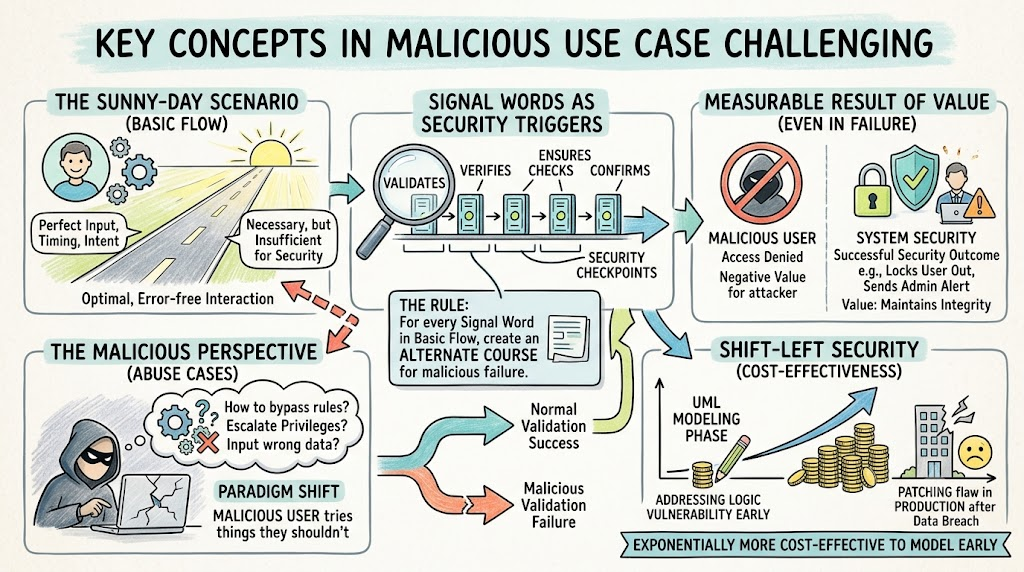
The basic course of action represents the optimal, error-free interaction between an actor and the system. It assumes perfect input, perfect timing, and perfect user intent. While necessary for understanding core business value, it is insufficient for defining system boundaries and security constraints.
This requires a paradigm shift in thinking. Instead of asking, "How does the user achieve their goal?", you must ask, "How can the user break the system, bypass rules, or achieve a goal they shouldn't?" A malicious user is defined as someone who "tries things he or she shouldn't just to see what might happen." This includes looking for ways to bypass intended logic, escalate privileges, or input data that shouldn't be there.
In use case narratives, specific verbs act as hidden security checkpoints. Words like validates, verifies, ensures, checks, and confirms indicate that the system is evaluating a condition.
The Rule: For every signal word in the basic flow, there must be a corresponding alternate course detailing what happens if that validation fails due to malicious intent.
A use case must never end in an undefined state, a system crash, or an infinite loop, even when triggered by a malicious actor. When a malicious action is handled, the use case must still conclude with a measurable result of value. For the malicious user, this result is negative (e.g., access denied), but for the system, it is a successful security outcome (e.g., "The system locks the user out and sends an email to the system administrator").
The primary goal of being exhaustive during the UML modeling phase is to capture interesting, edge-case, and security behaviors early. Addressing a logic vulnerability during the design phase via an updated use case specification is exponentially more cost-effective than patching a security flaw in production after a data breach.
To systematically challenge a use case flow, follow this exhaustive process for every sentence in the basic course of action.
Break the basic flow down to the atomic level. Read each sentence and ask: "What can the actor do differently—or wrong—at this point?"
Example: "The user enters their shipping address." -> Challenge: What if they enter a script tag? What if they enter an address in a country the system doesn't ship to? What if they leave it blank?
Put yourself in the shoes of an attacker. Look for ways to bypass intended logic.
Example: "The system calculates the total price based on the quantity." -> Challenge: What if the user intercepts the web request and changes the quantity to a negative number to get a refund? What if they change the price to $0.00 before sending it to the server?
Ask: "What can go wrong internally at this point?" as a result of the user's suspicious actions. Malicious inputs often cause cascading internal failures, such as database deadlocks, memory exhaustion, or unauthorized data exposure.
Example: "The system retrieves the user's profile." -> Challenge: What if the user modifies their session token to request another user's profile (Insecure Direct Object Reference)?
Highlight every signal word (validates, verifies, ensures). Map each one to a specific Alternate Flow in your UML model.
Basic Flow: "The system validates that the user has sufficient funds."
Alternate Flow: "If validation fails because the user manipulated the client-side balance check, the system aborts the transaction, flags the account for fraud review, and logs the IP address."
Basic Flow Sentence: "The system verifies the applied discount code and ensures it is applied to the correct items."
Malicious Challenge: The user applies a "First Time Buyer" discount code to an existing account, or applies a 100% off code to a restricted item (like gift cards).
Resulting Alternate Flow: The system detects the rule violation, removes the discount, displays a warning, and if the user attempts to bypass the UI to force the discount, the system voids the cart and alerts the fraud team.
Basic Flow Sentence: "The user uploads a new profile picture, and the system validates the file format and size."
Malicious Challenge: The user uploads a malicious executable disguised as an image, or an image with an excessively large resolution to cause a Denial of Service (DoS) via memory exhaustion.
Resulting Alternate Flow: The system rejects the file, quarantines the suspicious payload, temporarily suspends the user's upload privileges, and generates a security incident ticket.
Below are three UML diagrams demonstrating how to model these concepts visually.
In UML, a malicious action can be modeled as an "Abuse Case" that extends the primary use case.
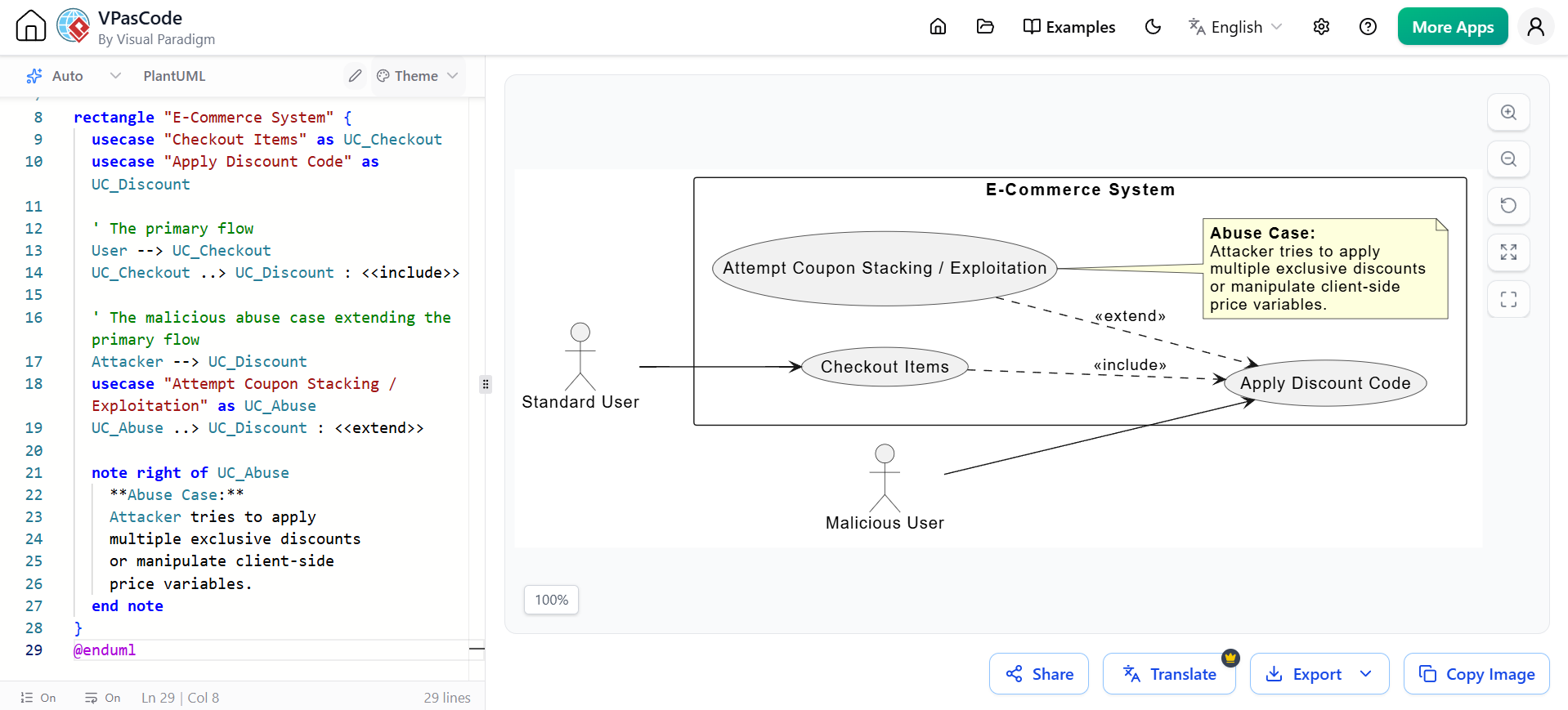
@startuml
left to right direction
skinparam packageStyle rectangle

actor "Standard User" as User
actor "Malicious User" as Attacker

rectangle "E-Commerce System" {
  usecase "Checkout Items" as UC_Checkout
  usecase "Apply Discount Code" as UC_Discount

  ' The primary flow
  User --> UC_Checkout
  UC_Checkout ..> UC_Discount : <<include>>

  ' The malicious abuse case extending the primary flow
  Attacker --> UC_Discount
  usecase "Attempt Coupon Stacking / Exploitation" as UC_Abuse
  UC_Abuse ..> UC_Discount : <<extend>>

  note right of UC_Abuse
    **Abuse Case:**
    Attacker tries to apply
    multiple exclusive discounts
    or manipulate client-side
    price variables.
  end note
}
@enduml
Activity diagrams are excellent for showing the branching logic when a "signal word" validation fails due to malicious input.
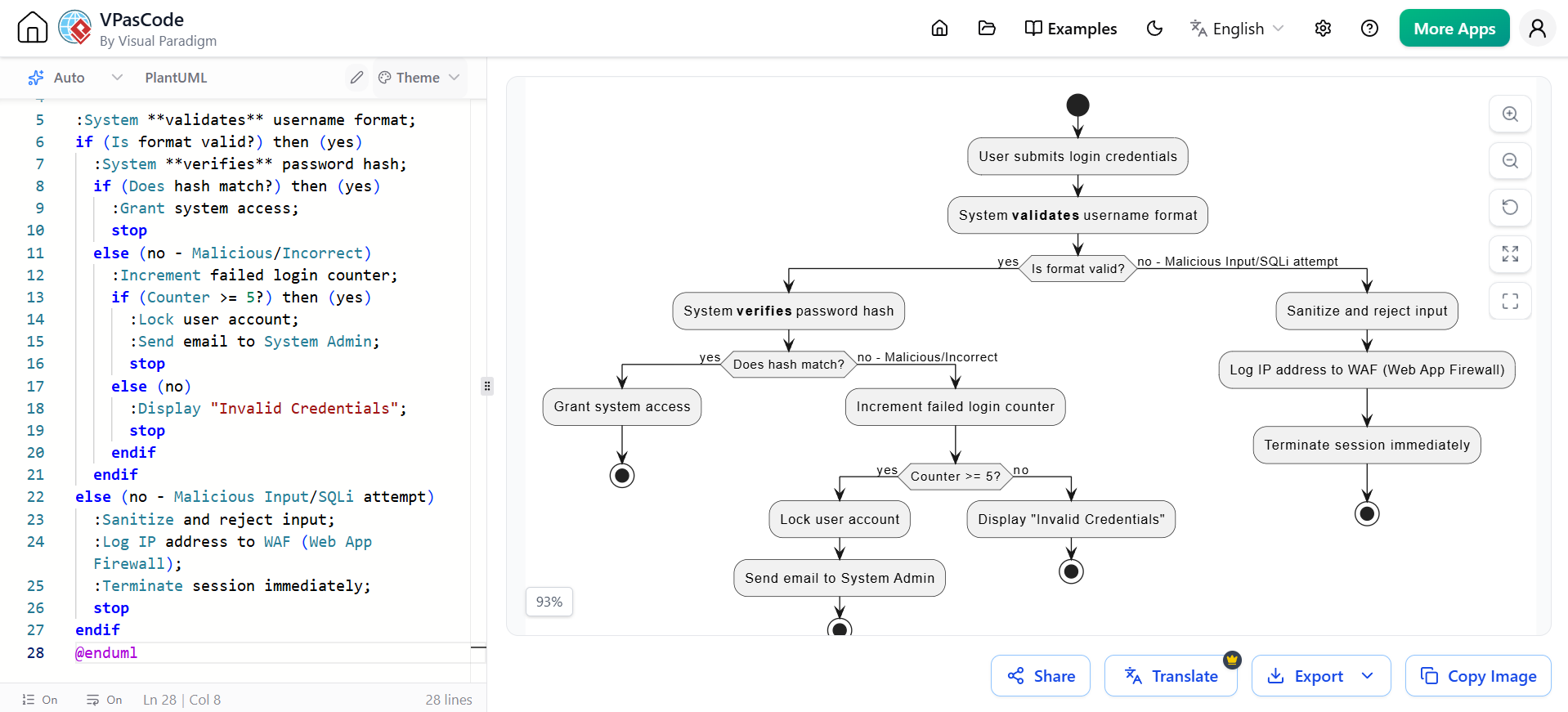
@startuml
start
:User submits login credentials;

:System **validates** username format;
if (Is format valid?) then (yes)
  :System **verifies** password hash;
  if (Does hash match?) then (yes)
    :Grant system access;
    stop
  else (no - Malicious/Incorrect)
    :Increment failed login counter;
    if (Counter >= 5?) then (yes)
      :Lock user account;
      :Send email to System Admin;
      stop
    else (no)
      :Display "Invalid Credentials";
      stop
    endif
  endif
else (no - Malicious Input/SQLi attempt)
  :Sanitize and reject input;
  :Log IP address to WAF (Web App Firewall);
  :Terminate session immediately;
  stop
endif
@enduml
Sequence diagrams illustrate the exact message flow and internal system responses when a malicious actor triggers an internal failure condition.
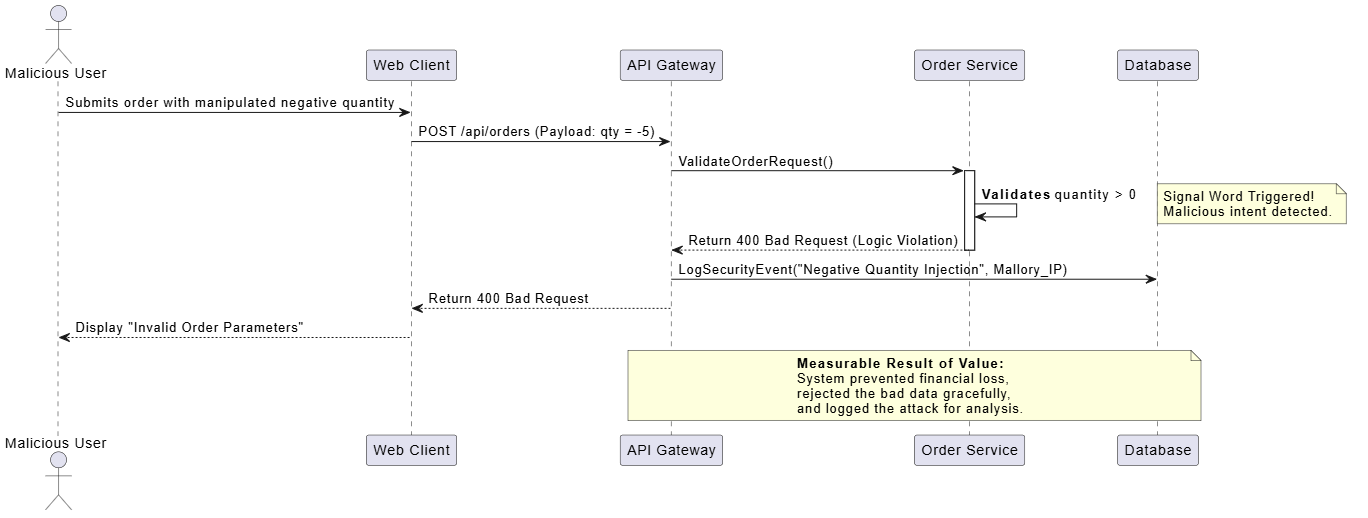
@startuml
actor "Malicious User" as Mallory
participant "Web Client" as Client
participant "API Gateway" as API
participant "Order Service" as OrderSvc
participant "Database" as DB

Mallory -> Client: Submits order with manipulated negative quantity
Client -> API: POST /api/orders (Payload: qty = -5)

API -> OrderSvc: ValidateOrderRequest()
activate OrderSvc

OrderSvc -> OrderSvc: **Validates** quantity > 0
note right: Signal Word Triggered!\nMalicious intent detected.

OrderSvc --> API: Return 400 Bad Request (Logic Violation)
deactivate OrderSvc

API -> DB: LogSecurityEvent("Negative Quantity Injection", Mallory_IP)
API --> Client: Return 400 Bad Request

Client --> Mallory: Display "Invalid Order Parameters"

note over API, DB
  **Measurable Result of Value:**
  System prevented financial loss,
  rejected the bad data gracefully,
  and logged the attack for analysis.
end note
@enduml
Challenging a use case flow for a malicious user is not about pessimism; it is about rigorous engineering. By exhaustively examining every sentence of the basic course of action, adopting the mindset of an attacker, and paying close attention to signal words like validates and verifies, architects can uncover hidden vulnerabilities before they become expensive liabilities. Ensuring that every malicious action results in a measurable, secure outcome transforms potential system failures into robust defensive mechanisms.
To effectively implement this methodology, proper tooling is essential. Visual Paradigm is highly recommended for this task. It provides a comprehensive suite for UML modeling, allowing teams to seamlessly create Use Case, Activity, and Sequence diagrams. More importantly, Visual Paradigm's robust use case specification editor makes it easy to document basic flows alongside complex malicious alternate flows, ensuring complete traceability between your sunny-day scenarios and your security-driven abuse cases. By leveraging Visual Paradigm, teams can collaboratively challenge their designs, ensuring that security and resilience are built into the very foundation of the system architecture.

