
In modern enterprise architecture, one of the most persistent challenges is ensuring that day-to-day IT operations and business processes are directly aligned with high-level organizational goals. The ArchiMate 3.2 Specification addresses this gap by introducing the Strategy Layer. Sitting elegantly between the Motivation Layer (the "why") and the Core Layers (the "how"), the Strategy Layer acts as the crucial bridge between high-level intent and operational execution.
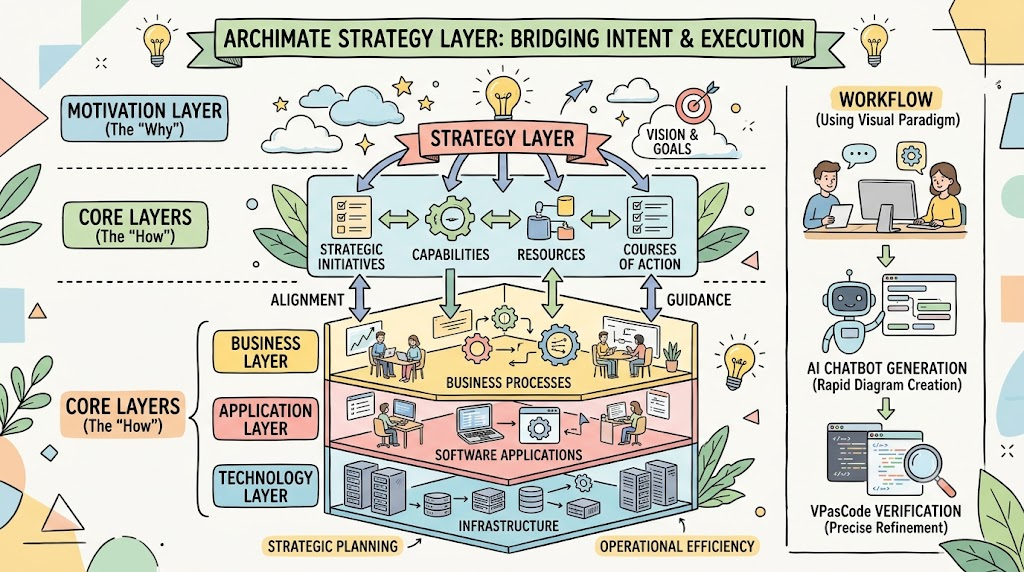
This comprehensive guide explores how Strategy elements connect to the Core Layers (Business, Application, and Technology). Furthermore, it provides a practical workflow for modeling these connections using Visual Paradigm, leveraging its AI Chatbot for rapid diagram generation and Visual Paradigm's VPasCode for precise verification and refinement.
The Strategy Layer is specifically designed to model the strategic direction and choices of an enterprise. While the Core Layers define how the enterprise operates, the Strategy Layer defines what the enterprise intends to achieve and how much it is willing to invest.
To maintain architectural clarity, the preferred ArchiMate layer order from top to bottom is:
By strictly adhering to this top-down hierarchy, architects can trace every piece of infrastructure back to a strategic capability, ensuring no "orphan" technologies exist in the enterprise.
To effectively model the Strategy Layer, architects must understand its four core elements:
The true power of the Strategy Layer is unlocked when it is connected to the Core Layers. This connection is primarily handled through Realization, Assignment, and Influence relationships.
Strategy behavior elements (Capabilities and Value Streams) are realized by the internal behavior of the core layers:
Strategy structure elements (Resources) are realized by the active or passive structure elements of the core layers:
Strategy elements do not exist in a vacuum; they influence or realize Motivation elements (like Outcomes and Goals). This creates a top-down influence path that ensures every technical component in the Technology layer is ultimately aligned with a strategic business outcome.
To bring these concepts to life, we utilize Visual Paradigm. The recommended workflow involves using the Visual Paradigm AI Chatbot to generate the initial diagram structure, and then verifying/refining the code in the VPasCode editor.
Use the Visual Paradigm AI Chatbot with a prompt similar to this:
"Generate an ArchiMate 3.2 PlantUML diagram showing a Strategy Capability named 'Digital Claims Handling' and a Strategy Resource named 'Automated Processing System'. Realize the capability with a Business Process 'Process Digital Claim'. Serve the business process with an Application Service 'Claims API Service', which is realized by an Application Component 'Claims Core App'. Finally, assign the Application Component to a Technology Node 'Cloud Server Cluster'. Use top-to-bottom layout."
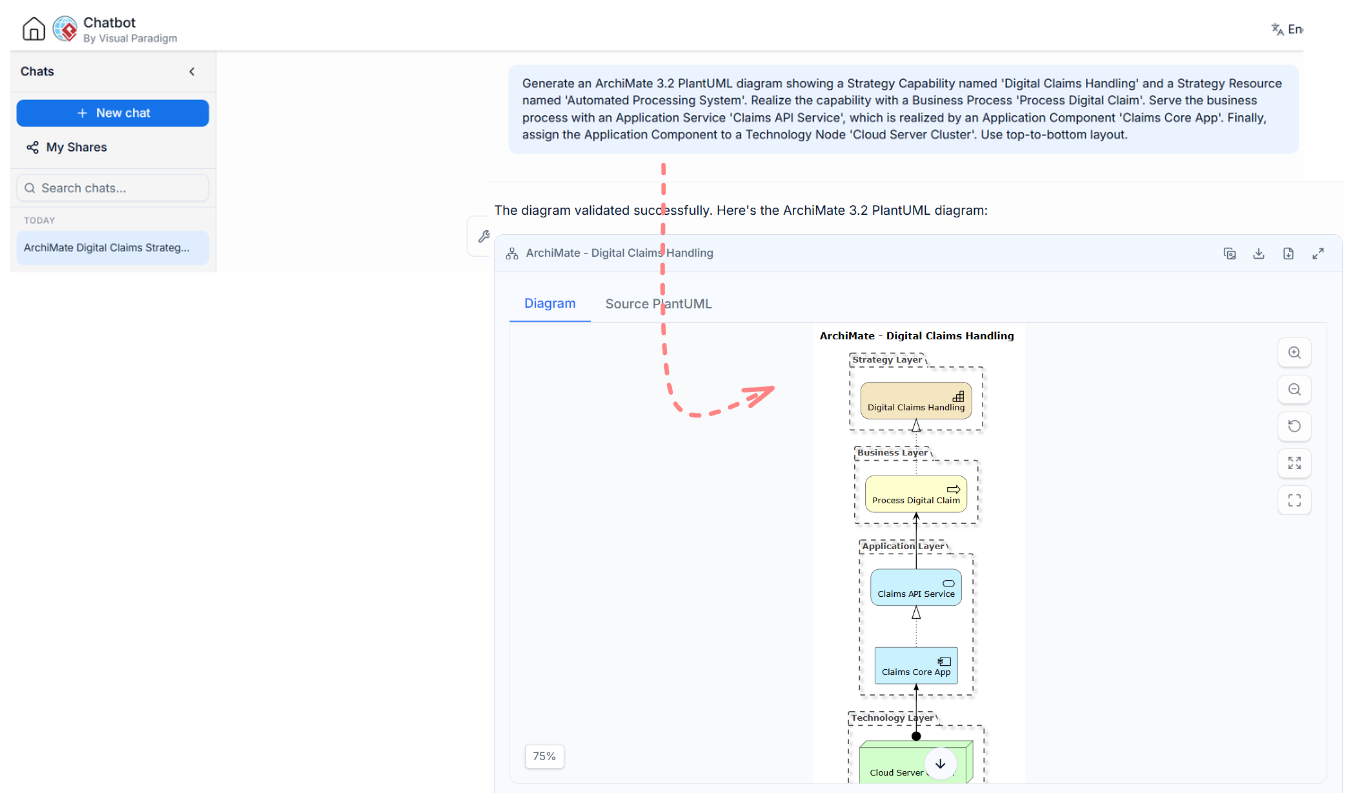
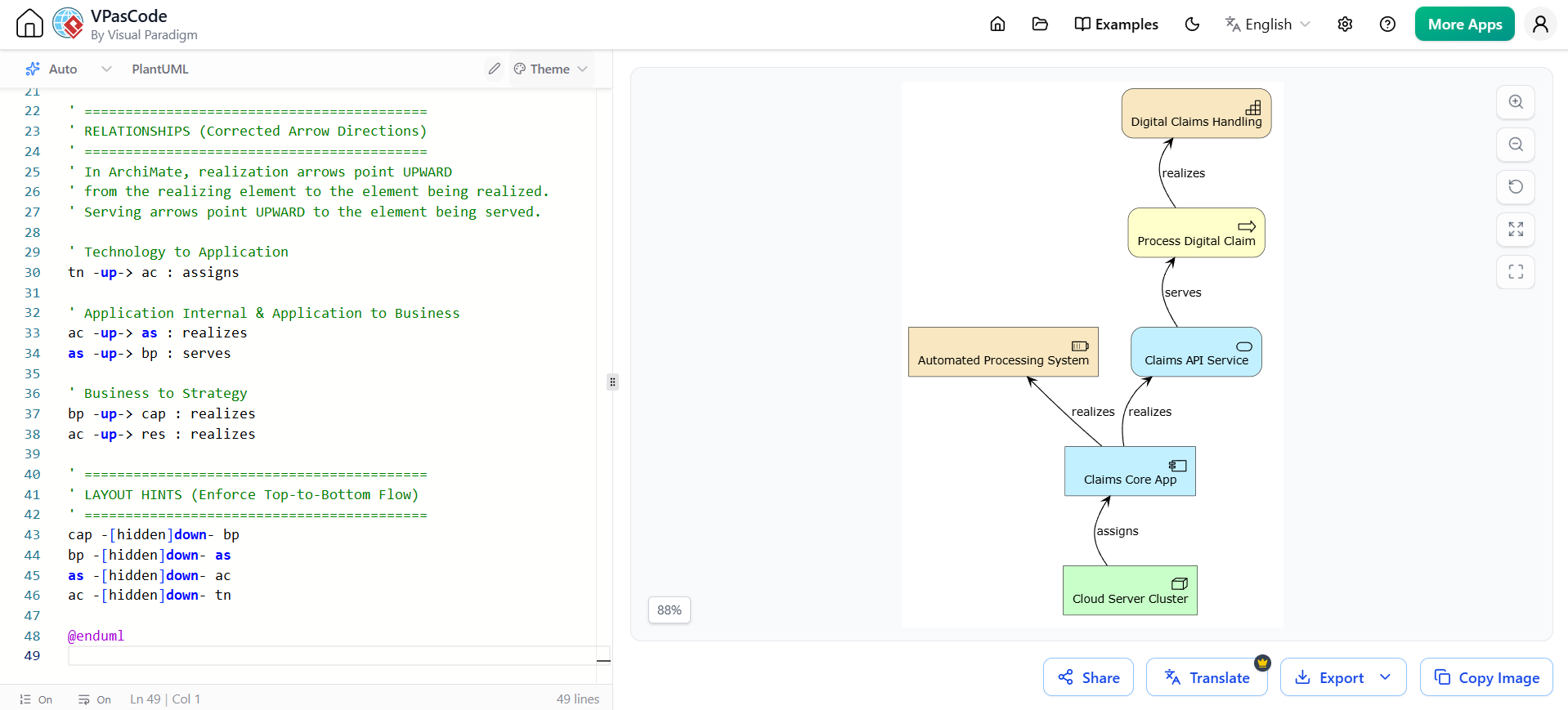
Once the AI generates the initial code, open the VPasCode editor in Visual Paradigm to verify the syntax, ensure correct ArchiMate relationship directions, and enforce the layout.
Below is the verified, production-ready VPasCode (PlantUML) for this architecture:
@startuml
!include <archimate/Archimate>

' ==========================================
' LAYERS DEFINITION (Correct Top-Down Order)
' ==========================================

' 1. Strategy Layer (Top)
Strategy_Capability(cap, "Digital Claims Handling")
Strategy_Resource(res, "Automated Processing System")

' 2. Business Layer
Business_Process(bp, "Process Digital Claim")

' 3. Application Layer
Application_Service(as, "Claims API Service")
Application_Component(ac, "Claims Core App")

' 4. Technology Layer (Bottom)
Technology_Node(tn, "Cloud Server Cluster")

' ==========================================
' RELATIONSHIPS (Corrected Arrow Directions)
' ==========================================
' In ArchiMate, realization arrows point UPWARD
' from the realizing element to the element being realized.
' Serving arrows point UPWARD to the element being served.

' Technology to Application
tn -up-> ac : assigns

' Application Internal & Application to Business
ac -up-> as : realizes
as -up-> bp : serves

' Business to Strategy
bp -up-> cap : realizes
ac -up-> res : realizes

' ==========================================
' LAYOUT HINTS (Enforce Top-to-Bottom Flow)
' ==========================================
cap -[hidden]down- bp
bp -[hidden]down- as
as -[hidden]down- ac
ac -[hidden]down- tn

@enduml
Tip for Visual Paradigm Users: If the layout appears cluttered after generation, use the hidden link hints (-[hidden]down-) at the bottom of the script to force the PlantUML engine to respect the strict vertical layering of the ArchiMate framework.
Looking for a powerful, free diagram-as-code tool? Effortlessly render PlantUML, Mermaid, Graphviz, and 20+ programming languages in real time—powered by instant AI error fixing and automatic format detection.
To assist architects in quickly identifying the correct relationships, refer to the following mapping table based on the ArchiMate 3.2 Specification:
| Strategy Element | Core Layer Target | Relationship Type | Source Reference |
|---|---|---|---|
| Capability | Business Process / Function | Realization | ArchiMate 3.2 Spec |
| Value Stream | Business Process | Realization | ArchiMate 3.2 Spec |
| Resource (Human) | Business Actor / Role | Realization | ArchiMate 3.2 Spec |
| Resource (IT) | Application Component / Node | Realization | ArchiMate 3.2 Spec |
| Resource (Passive) | Data Object / Artifact | Realization | ArchiMate 3.2 Spec |
| Course of Action | Capability / Resource | Realization | ArchiMate 3.2 Spec |
| Capability / Value Stream | Goal / Outcome (Motivation) | Influence / Realization | ArchiMate 3.2 Spec |
The introduction of the Strategy Layer in ArchiMate 3.2 was a landmark evolution in enterprise architecture, providing a standardized vocabulary to articulate what a business intends to do before defining how it will be executed. By properly linking Strategy elements to the Business, Application, and Technology layers through Realization and Influence relationships, organizations can achieve unprecedented traceability.
Utilizing modern tooling like Visual Paradigm, combined with the efficiency of the AI Chatbot and the precision of VPasCode, architects can rapidly prototype, verify, and maintain these complex strategic models. Ultimately, mastering this integration ensures that every line of code written and every server provisioned is directly contributing to the strategic success of the enterprise.

