
For over two decades, Model-Driven Architecture (MDA) stood as a promising yet elusive ideal in software engineering. Originally championed by the OMG in the early 2000s, MDA promised to decouple business logic from technical implementation, allowing architects to design once and deploy everywhere. However, the paradigm consistently stumbled under the weight of manual round-trip engineering, rigid template-based code generators, and a steep learning curve that alienated agile teams. By the 2010s, MDA had largely been relegated to niche enterprise documentation rather than active development pipelines.
Fast forward to 2026, and the landscape has fundamentally shifted. The advent of large language models, semantic code synthesis, and intelligent compilers has solved the historic synchronization bottleneck. MDA is no longer a static, waterfall-heavy artifact; it has evolved into a living, bidirectional, and AI-augmented engineering framework. This case study explores how artificial intelligence has resurrected MDA, transforming it from a theoretical abstraction into a practical, agile, and governable delivery engine. We examine the technological pipeline, agile integration, risk mitigation, and the critical human oversight mechanisms that define the modern AI-MDA hybrid paradigm.
The traditional MDA workflow was characterized by friction. Architects would spend weeks drafting UML diagrams, only to hand them off to developers who manually translated them into code. Any change in requirements meant navigating a broken "round-trip" process, where model updates and code modifications constantly fell out of sync. This resulted in stale documentation, duplicated effort, and widespread architect burnout.
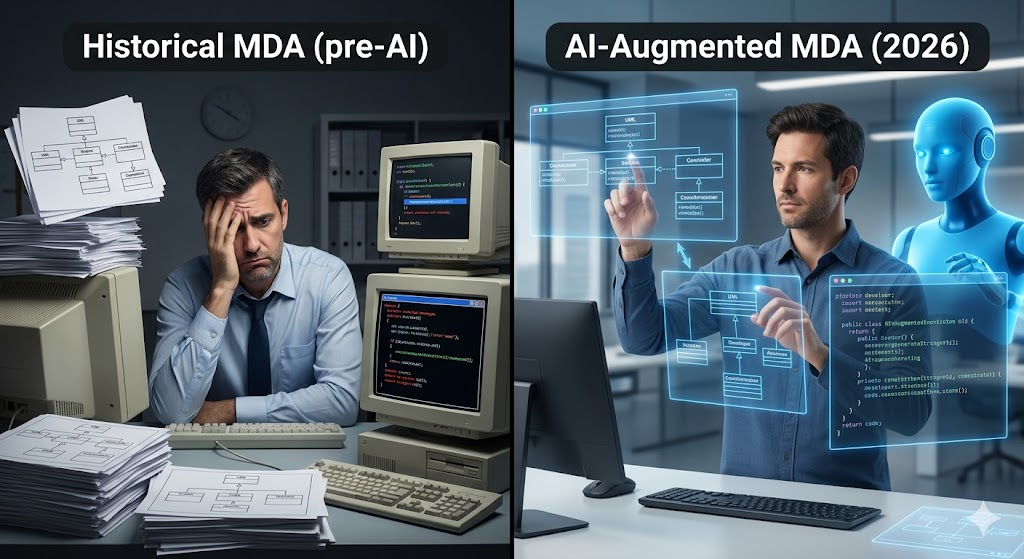
The 2026 AI-augmented paradigm eliminates this friction through real-time, semantic bidirectional synchronization. Developers no longer toggle between disconnected IDEs and modeling tools. Instead, they interact with fluid, holographic model interfaces where structural changes instantly propagate to underlying codebases. An ambient AI co-pilot continuously parses intent, resolves dependencies, and generates production-ready scaffolding on the fly. The model is no longer a static blueprint; it is a live, executable specification that drives development at the speed of thought, restoring the original promise of MDA while removing its historical overhead.
At the heart of the modern MDA framework lies the AI Model Compiler, a semantic transformation engine that replaces rigid XSLT or template-based generators. The pipeline begins with the Platform Independent Model (PIM), a high-fidelity representation of business logic, domain entities, and behavioral contracts, completely agnostic of underlying infrastructure.
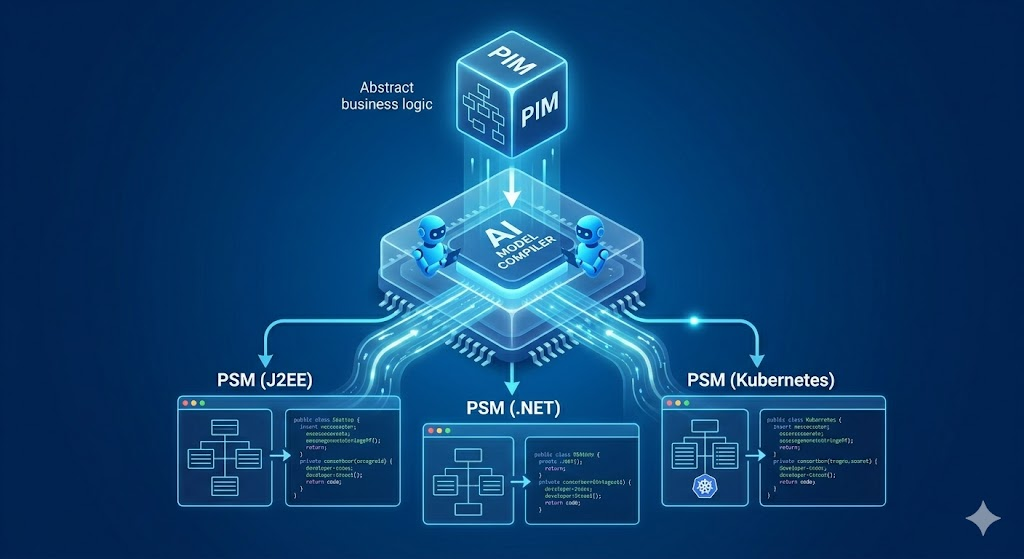
When the PIM is fed into the AI Model Compiler, the system leverages contextual reasoning and cross-platform knowledge graphs to optimize the transformation flow. Rather than producing a single output, the compiler intelligently branches the abstract logic into multiple Platform Specific Models (PSMs) tailored to distinct deployment targets. In a single compilation cycle, the same business domain can be accurately rendered into:
PSM (J2EE): Optimized enterprise microservices with standardized dependency injection and transaction management.
PSM (.NET): Native cloud-ready services leveraging modern C# patterns and async pipelines.
PSM (Kubernetes): Infrastructure-as-code manifests, service mesh configurations, and scaling policies.
This multi-target transformation ensures architectural consistency across heterogeneous environments while drastically reducing platform-specific boilerplate and integration debt.
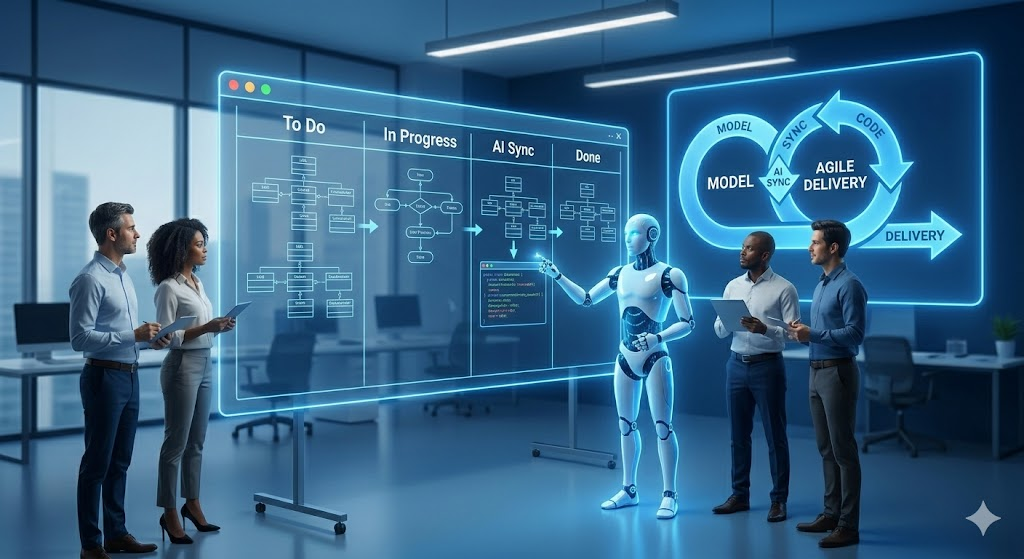
Historically, MDA was criticized for being incompatible with Agile methodologies. Heavy upfront modeling clashed with iterative delivery, and long compilation cycles broke sprint rhythms. The 2026 paradigm bridges this gap by embedding MDA directly into Agile workflow tooling.
Modern sprint boards no longer track isolated user stories or manual code tasks. Instead, they visualize simplified UML components flowing through dynamic columns: To Do, In Progress, AI Sync, and Done. As product owners and developers adjust model relationships or business rules, a luminous AI agent instantly analyzes the delta, propagates changes across dependent modules, and generates corresponding implementation tasks. This creates a recursive delivery loop: MODEL → AI SYNC → CODE → AGILE DELIVERY. Teams can now iterate on architectural designs with the same velocity as feature development, ensuring that the system's structural integrity evolves in lockstep with business requirements without sacrificing sprint predictability.
The AI-MDA hybrid model delivers transformative benefits but introduces novel failure modes that engineering leaders must actively manage.
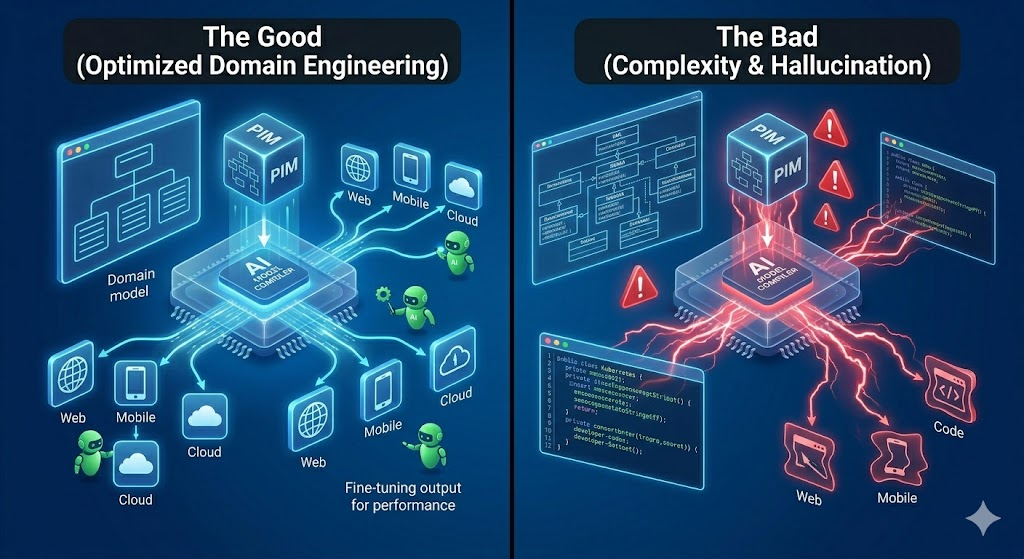
The Good: Optimized Domain Engineering
When applied to well-scoped, logically coherent domains, AI-driven MDA excels. A clean, simplified domain model can be instantly propagated across web, mobile, and cloud touchpoints. Green AI optimization agents fine-tune output for performance, security, and resource efficiency, ensuring that cross-platform consistency is maintained without manual reconciliation. The result is a highly maintainable, polyglot codebase that mirrors business intent with mathematical precision.
The Bad: Complexity & Hallucination
The risks emerge when models become over-abstracted or logically convoluted. Dense, entangled UML diagrams can overwhelm the compiler's semantic reasoning, leading to unstable transformations. In these scenarios, the AI may "hallucinate" implementation details, generating syntactically correct but functionally flawed code, or creating circular dependencies that leak into production. Unchecked complexity triggers chaotic code generation, distorted architectural boundaries, and silent runtime failures. Recognizing these warning signs is critical to preventing technical debt accumulation.
To harness the power of AI-MDA while mitigating hallucination risks, organizations must implement robust governance frameworks. The 2026 standard revolves around a Human-in-the-Loop (HITL) architecture integrated directly into the CI/CD pipeline.
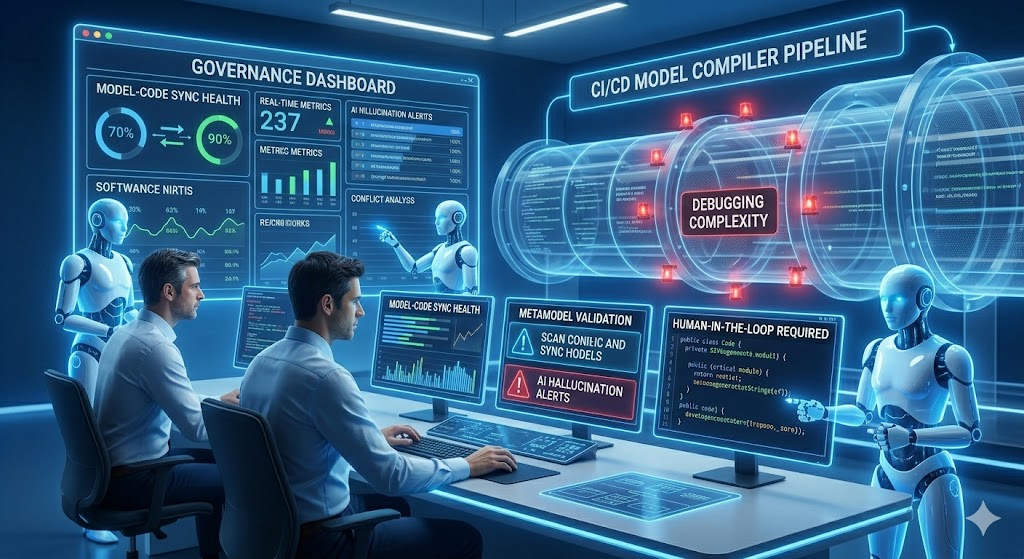
Engineering leads operate from centralized governance dashboards that monitor real-time pipeline health. Key oversight metrics include:
Model-Code Sync Health: Tracks divergence rates between abstract specifications and deployed artifacts.
Metamodel Validation: Ensures that generated PSMs adhere to strict architectural contracts and compliance standards.
Critical Path Overrides: Flags high-risk transformation nodes where AI confidence drops, automatically pausing deployment and requiring manual architect review.
The CI/CD Model Compiler Pipeline visualizes data flow from parsing to deployment, with intelligent alerting systems highlighting debugging complexity hotspots. By enforcing validation gates and maintaining human oversight at critical junctions, teams preserve the speed of AI automation while guaranteeing the reliability and security expected in enterprise-grade software delivery.
The resurrection of Model-Driven Architecture in 2026 is not merely a technological upgrade; it represents a fundamental rethinking of how software is conceived, constructed, and maintained. By replacing rigid, manual translation layers with intelligent, bidirectional AI synchronization, MDA has shed its historical baggage and emerged as a cornerstone of modern agile engineering. The transformation pipeline now delivers unprecedented cross-platform consistency, while iterative model-sync loops align architectural design with rapid business delivery.
However, the power of AI-generated architecture demands rigorous governance. Organizations that succeed will be those that treat the AI compiler as a powerful co-pilot rather than an autonomous black box. By implementing strict metamodel validation, monitoring sync health, and enforcing human-in-the-loop protocols at critical complexity thresholds, engineering leaders can harness AI's generative capabilities while safeguarding against hallucination and architectural drift. As we move deeper into the AI-augmented era, the fusion of human domain expertise and machine-driven precision will define the next generation of resilient, scalable, and truly model-driven software ecosystems.

