
In modern software development, maintaining a clear, accurate, and up-to-date representation of a system's architecture is just as critical as writing the code itself. Unified Modeling Language (UML) serves as the industry standard for visualizing this architecture. However, a persistent challenge in software design is the drift between the high-level design models and the low-level implementation (source code).
To solve this, software engineers utilize two complementary techniques: Forward Engineering and Reverse Engineering. Together, these processes ensure that a system's abstract model and its concrete codebase remain perfectly synchronized throughout the software development lifecycle. This guide explores these techniques, their underlying concepts, and how modern tooling leverages them to treat UML as a true software blueprint.
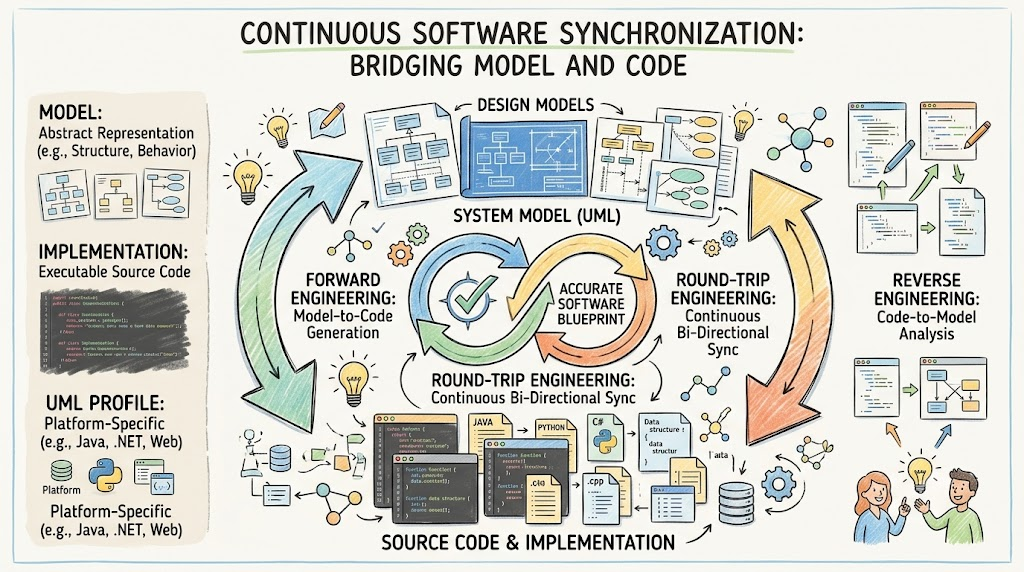
Before diving into the specific engineering processes, it is essential to understand the foundational terminology used in UML-driven development:
Model: An abstract, visual representation of a system's structure, behavior, and requirements.
Implementation: The actual, executable source code that makes the software run.
Forward Engineering: The process of moving from a model to code.
Reverse Engineering: The process of moving from code back to a model.
Round-Trip Engineering (Synchronization): The continuous, bi-directional process of keeping the model and the code in sync as the project evolves.
UML Profile: A customization of standard UML tailored for a specific platform, technology, or methodology (e.g., J2EE, .NET), allowing tools to generate platform-specific code.
Reverse engineering is the process of extracting the design of a system from its implementation. It involves analyzing existing source code to automatically generate corresponding UML diagrams (such as class, sequence, or component diagrams).
The primary goal of reverse engineering is to create visual models from legacy or existing source code. This helps stakeholders, new team members, and architects understand the system's complex structure and behavior without having to manually read and decipher thousands of lines of code. It is invaluable for documentation, refactoring, and onboarding.
While source code is highly precise regarding what the system does, it often lacks the "bigger picture" of how and why the system is used, or how it is deployed in a broader environment. Consequently, relying solely on reverse-engineered code can be difficult and inefficient for high-level tasks, such as reusing core architecture components or porting an entire application to a new technology platform. For these macro-level tasks, starting with a top-down model is usually superior.
Forward engineering is the process of transforming a UML model into executable code. It is the traditional "top-down" approach to software development, where the design dictates the implementation.
In a standard workflow, forward engineering involves generating portions of the code (like class skeletons, interfaces, and database schemas) from detailed UML specifications. Developers then fill in the specific business logic and implementation details manually within the generated code files.
In a more rigorous "degree" of UML utilization, the model is treated not just as a sketch, but as the primary source of truth. Every aspect of the system is meticulously modeled. Because formal languages like UML 2.0 are machine-readable and can be just as precise as a programming language, advanced tools can go directly from the model to a fully executable system without requiring manual code intervention.
The true power of forward and reverse engineering is realized when they are combined to use UML as a blueprint.
When UML is used as a blueprint, teams provide exhaustive, detailed specifications using UML tools. Forward and reverse engineering are then utilized in a continuous loop (Round-Trip Engineering) to ensure synchronization:
When the code changes, reverse engineering updates the model.
When the model changes, forward engineering updates the code.
This prevents the common industry problem of "design rot," where documentation becomes obsolete the moment the code is updated.
The complexity of modern software requires more than just basic code generation. This is where UML Profiles and specialized tooling come into play.
Automation: A tool can use a specific profile (such as a J2EE or Spring Boot profile) to understand the target architecture.
Complex Generation: Instead of just generating basic classes, the tool can automatically generate the complex medley of classes, configuration files, and deployment descriptors required for a specific framework.
Continuous Sync: These tools keep the model and code in perfect sync as the project evolves, handling the boilerplate and framework-specific code while developers focus on core business logic.
Below are PlantUML examples illustrating the workflows and architectural concepts of forward and reverse engineering.
This activity diagram illustrates the continuous loop of synchronization between the design model and the source code.
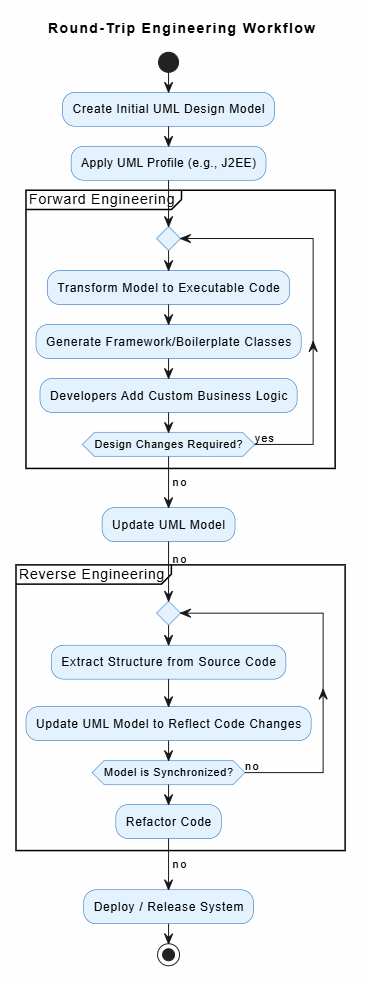
@startuml

title Round-Trip Engineering Workflow

skinparam backgroundColor #FEFEFE
skinparam activityBackgroundColor #E3F2FD
skinparam activityBorderColor #1565C0

start

:Create Initial UML Design Model;

:Apply UML Profile (e.g., J2EE);

partition "Forward Engineering" {
    repeat
        :Transform Model to Executable Code;
        :Generate Framework/Boilerplate Classes;
        :Developers Add Custom Business Logic;
    repeat while (Design Changes Required?) is (yes)
    ->no;
}

:Update UML Model;
->no;

partition "Reverse Engineering" {
    repeat
        :Extract Structure from Source Code;
        :Update UML Model to Reflect Code Changes;
    repeat while (Model is Synchronized?) is (no)
    :Refactor Code;
    ->no;
}

:Deploy / Release System;

stop

@enduml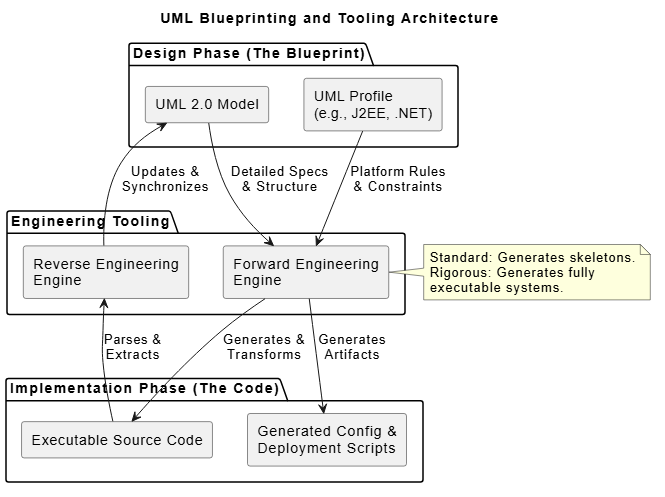
This component diagram demonstrates how UML profiles and engineering tools act as the bridge between the abstract design and the concrete implementation.
@startuml
title UML Blueprinting and Tooling Architecture
skinparam componentStyle rectangle

package "Design Phase (The Blueprint)" {
  [UML 2.0 Model] as model
  [UML Profile\n(e.g., J2EE, .NET)] as profile
}

package "Implementation Phase (The Code)" {
  [Executable Source Code] as code
  [Generated Config &\nDeployment Scripts] as config
}

package "Engineering Tooling" {
  [Forward Engineering\nEngine] as fwd
  [Reverse Engineering\nEngine] as rev
}

model --> fwd : Detailed Specs\n& Structure
profile --> fwd : Platform Rules\n& Constraints
fwd --> code : Generates &\nTransforms
fwd --> config : Generates\nArtifacts

code --> rev : Parses &\nExtracts
rev --> model : Updates &\nSynchronizes

note right of fwd
  Standard: Generates skeletons.
  Rigorous: Generates fully
  executable systems.
end note
@enduml
Forward and reverse engineering are the vital mechanisms that bridge the gap between software design and implementation. While reverse engineering is excellent for extracting structure and understanding existing codebases, it is limited by code's inability to convey the "bigger picture" of system deployment and usage. Conversely, forward engineering allows teams to drive implementation directly from high-level designs, reaching a level of precision where UML itself can act as a programming language.
By leveraging modern tooling and UML Profiles, development teams can implement true "blueprinting." This round-trip engineering approach ensures that models and code remain in perfect synchronization, reducing technical debt, improving system maintainability, and allowing architects to focus on high-level design rather than getting lost in the weeds of manual code generation. Ultimately, mastering these techniques is essential for building scalable, well-documented, and robust software systems.

