
In modern Enterprise Architecture, aligning high-level business vision with day-to-day operational execution is one of the most critical challenges organizations face. The ArchiMate Strategy Layer was specifically designed to solve this problem. It models the strategic direction an enterprise chooses, how it structures its core capabilities, and where it intends to deploy its resources.
Acting as the direct bridge between the Motivation Layer (why we change) and the Business, Application, and Technology Layers (how we execute), the Strategy layer ensures that every IT investment and business process is directly tied to overarching corporate goals. This guide provides a comprehensive overview of the core concepts, relationships, and practical modeling techniques for the ArchiMate Strategy layer, complete with ArchiMate-PlantUML examples.
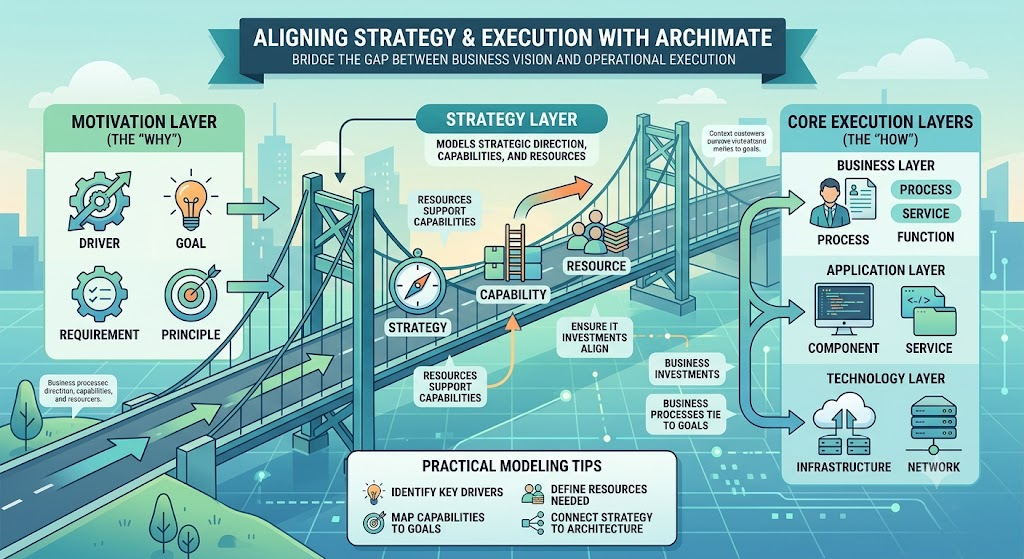
ArchiMate defines four primary strategic elements to model an organization's long-term planning, capabilities, and resource management. Understanding these elements is the foundation of strategic modeling.
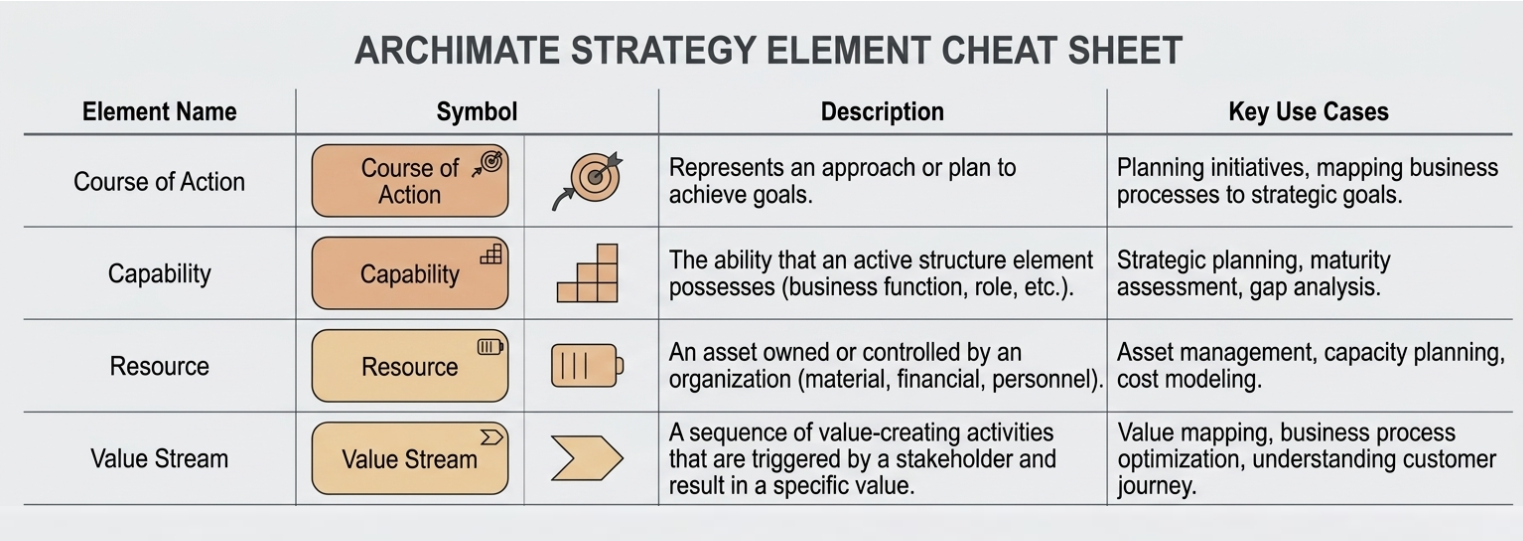
Definition: An asset owned or controlled by an individual or organization.
Purpose: Resources represent the raw inputs and assets available to the enterprise. They can be tangible (e.g., Data Centers, Funding, Hardware) or intangible (e.g., Brand Reputation, Intellectual Property, Proprietary Algorithms).
Examples: Cloud Infrastructure Budget, Data Science Team, Customer Database.
Definition: An ability that an active structure element (such as an organization, person, or system) possesses.
Purpose: Capabilities focus on what the enterprise can do, rather than how it physically does it. They are stable over time and are typically mapped into a hierarchical Capability Map.
Examples: Predictive Analytics Management, Online Payment Processing, Identity Verification.
Definition: An approach or plan for configuring and deploying resources and capabilities to achieve a strategic goal.
Purpose: This element represents the actual strategies, tactics, or strategic initiatives the business undertakes. It is the "plan" that puts resources and capabilities to work.
Examples: Migrate to a Cloud-Native Architecture, Outsource Legacy IT Operations, Launch Hyper-Personalized Marketing.
Definition: A sequence of value-creating steps that chunks together capabilities to deliver an overall end-product or service to a stakeholder.
Purpose: Value streams focus on the high-level, end-to-end flow of value across the business, ignoring organizational silos to show how the customer or stakeholder experiences value.
Examples: Prospect-to-Customer onboarding, Claim-to-Settlement lifecycle, Order-to-Cash.
To construct a valid and logical strategy viewpoint, Enterprise Architects use foundational structural and behavioral relationships. These relationships connect strategy elements to each other and to other ArchiMate layers.
Resource $\rightarrow$ assigned to / serves $\rightarrow$ Capability: Resources give power and enablement to a Capability. (e.g., A "Data Science Team" serves "Predictive Analytics").
Capability $\rightarrow$ realizes $\rightarrow$ Value Stream: Capabilities are grouped and utilized to execute specific steps within a value stream.
Course of Action $\rightarrow$ configures / structures $\rightarrow$ Capability / Resource: A strategic initiative dictates how resources are allocated and how capabilities are enhanced or deployed.
Course of Action $\rightarrow$ realizes $\rightarrow$ Goal: Bridges the Strategy layer up to the Motivation layer, showing how a specific initiative achieves a high-level business goal.
Capability $\rightarrow$ is realized by $\rightarrow$ Business Processes / Application Functions: Bridges the Strategy layer down to the execution layers, showing which actual business processes or IT systems perform the strategic capability.
Below are two standard strategic patterns expressed in ArchiMate-PlantUML syntax. You can compile these scripts using any standard PlantUML engine (such as the PlantUML Web Server, VS Code extensions, or Confluence plugins) to generate visual architecture diagrams.
This diagram traces how a defined Course of Action configures organizational Capabilities, which are in turn backed and empowered by specific enterprise Resources. It also shows the upward bridge to a Motivation Goal.
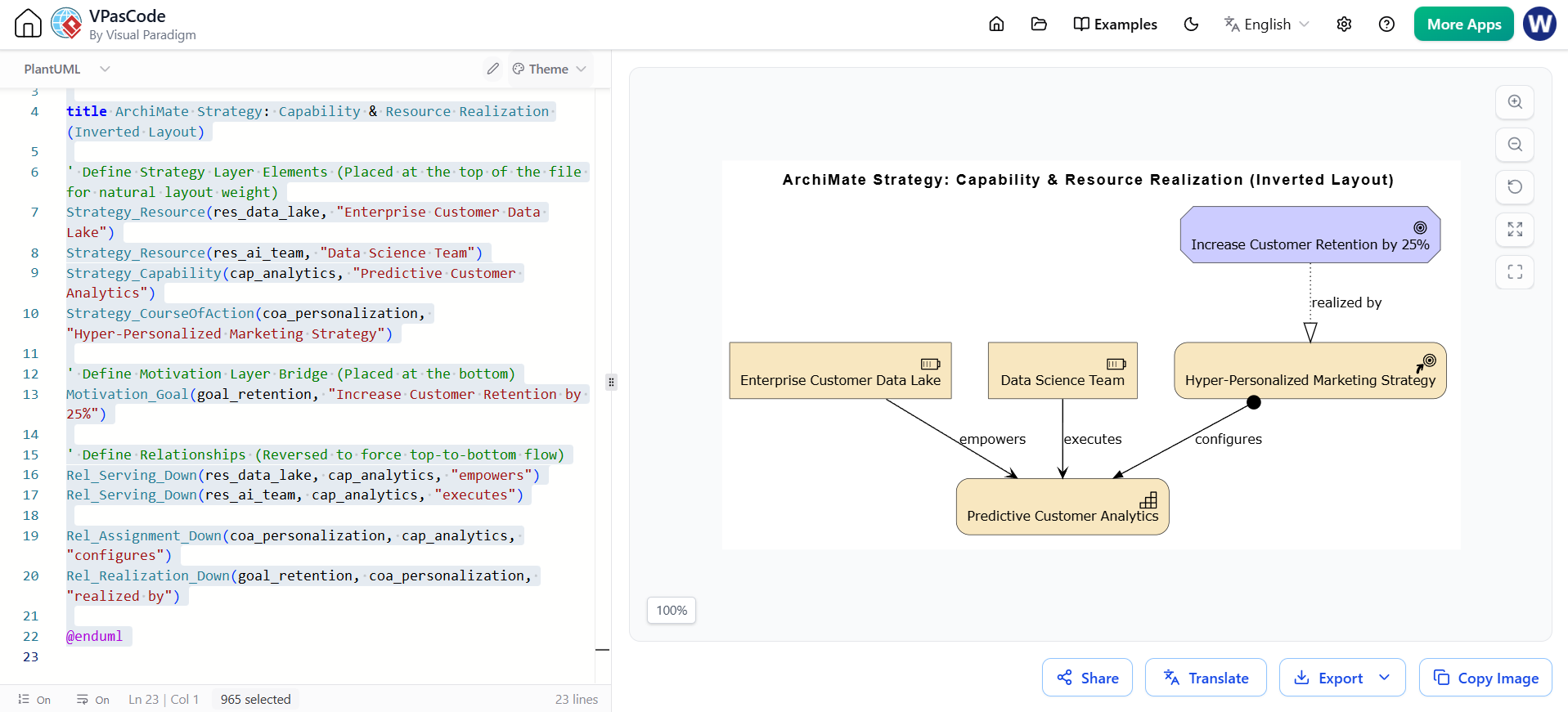
@startuml
!include <archimate/ArchiMate>

title ArchiMate Strategy: Capability & Resource Realization (Inverted Layout)

' Define Strategy Layer Elements (Placed at the top of the file for natural layout weight)
Strategy_Resource(res_data_lake, "Enterprise Customer Data Lake")
Strategy_Resource(res_ai_team, "Data Science Team")
Strategy_Capability(cap_analytics, "Predictive Customer Analytics")
Strategy_CourseOfAction(coa_personalization, "Hyper-Personalized Marketing Strategy")

' Define Motivation Layer Bridge (Placed at the bottom)
Motivation_Goal(goal_retention, "Increase Customer Retention by 25%")

' Define Relationships (Reversed to force top-to-bottom flow)
Rel_Serving_Down(res_data_lake, cap_analytics, "empowers")
Rel_Serving_Down(res_ai_team, cap_analytics, "executes")

Rel_Assignment_Down(coa_personalization, cap_analytics, "configures")
Rel_Realization_Down(goal_retention, coa_personalization, "realized by")

@enduml
This diagram illustrates a cross-functional Value Stream and shows how discrete, cross-organizational Capabilities map into specific stages of that stream. This is highly useful for identifying capability gaps in end-to-end customer journeys.
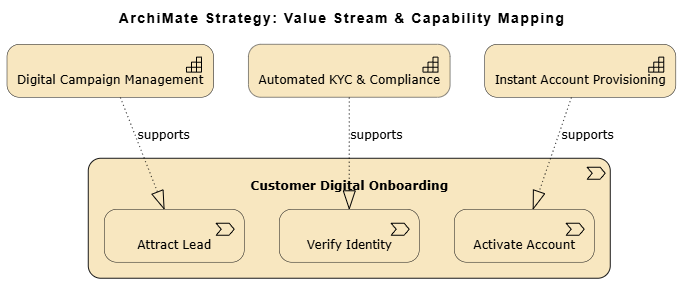
@startuml
!include <archimate/ArchiMate>

title ArchiMate Strategy: Value Stream & Capability Mapping

' Define Value Stream (Composed of stages)
Strategy_ValueStream(vs_onboarding, "Customer Digital Onboarding") {
    Strategy_ValueStream(vss_attract, "Attract Lead")
    Strategy_ValueStream(vss_verify, "Verify Identity")
    Strategy_ValueStream(vss_activate, "Activate Account")
}

' Define Strategic Capabilities
Strategy_Capability(cap_marketing, "Digital Campaign Management")
Strategy_Capability(cap_kyc, "Automated KYC & Compliance")
Strategy_Capability(cap_provision, "Instant Account Provisioning")

' Map Capabilities to Value Stream Stages
Rel_Realization(cap_marketing, vss_attract, "supports")
Rel_Realization(cap_kyc, vss_verify, "supports")
Rel_Realization(cap_provision, vss_activate, "supports")

@enduml
To ensure your Strategy models remain effective, clear, and aligned with ArchiMate standards, adhere to the following best practices:
Avoid Over-Specification: Strategy elements must remain high-level and abstract. Do not replace Capabilities with exact Business Processes, and do not replace Resources with exact Software Applications. If you find yourself modeling database schemas or specific UI workflows, you have crossed into the Application/Technology layers.
Keep Capability Names Abstract: Use a standardized naming convention for capabilities, typically the format [Noun] + [Management/Ability] (e.g., Logistics Management, Identity Verification, Payment Processing). Avoid using active verbs, which belong in the Business Process layer.
Use Capabilities as Anchor Points: Capabilities are the most stable elements in the Strategy layer. Use them as your anchor points. When modeling the Business layer later, ensure your Business Actors and Business Functions explicitly realize these strategic capabilities to maintain traceability.
Separate Value Streams from Processes: A Value Stream represents what value is created and in what sequence, not how it is done. Keep the stages of a value stream focused on stakeholder value (e.g., "Verify Identity") rather than operational tasks (e.g., "Run background check script").
The ArchiMate Strategy Layer is an indispensable tool for modern Enterprise Architects. By formally modeling Resources, Capabilities, Courses of Action, and Value Streams, organizations can transform abstract executive visions into structured, actionable plans.
More importantly, this layer provides the crucial connective tissue between the "Why" of business motivation and the "How" of IT and operational execution. By adhering to the core concepts, utilizing standard relationships, and following established modeling best practices, architects can ensure that every technological investment and business process is directly driving the strategic goals of the enterprise.

