
In today’s fast-paced digital landscape, the ability to adapt quickly to changing market demands and customer feedback is no longer a luxury—it is a survival skill. Enter Agile. Originally born from the Agile Manifesto in 2001, this philosophy revolutionized software development by prioritizing individuals, interactions, and customer collaboration over rigid, heavy-handed processes.
However, a common misconception in the tech industry is that "Agile" is a single, monolithic methodology. In reality, Agile is a broad mindset, and teams rely on specific frameworks to bring that mindset to life. Whether you are a lean startup building your first Minimum Viable Product (MVP) or a Fortune 500 enterprise coordinating hundreds of developers across multiple time zones, there is an Agile framework tailored to your unique needs.
This comprehensive guide breaks down the six core Agile frameworks and methodologies: Scrum, Kanban, Extreme Programming (XP), Lean, SAFe, and LeSS. By exploring their summaries, key concepts, and real-world applications, you will gain the insights needed to select, implement, and optimize the right approach for your team.
Agile is not a single methodology, but a mindset supported by various frameworks and methodologies. Choosing the right one depends on your team size, industry, product complexity, and organizational culture.
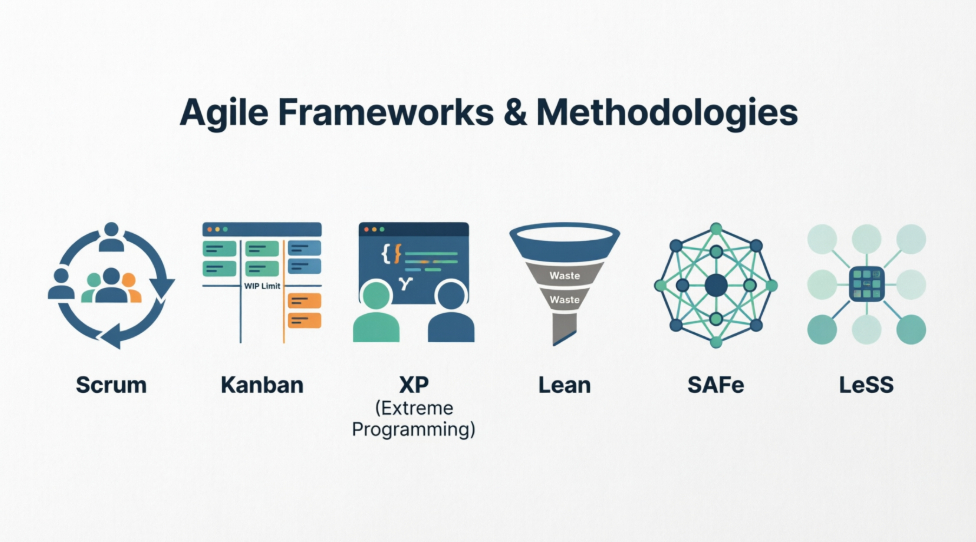
Below is a detailed breakdown of the six most prominent Agile frameworks, including summaries, key concepts, and real-world examples.
Summary: Scrum is the most popular Agile framework. It is an iterative, incremental approach that breaks work into fixed-length iterations called "Sprints" (typically 1–4 weeks). It relies on highly defined roles, events, and artifacts to ensure transparency and continuous improvement.
Key Concepts:
Real-World Example: A mobile app development team commits to building a "User Profile" feature over a 2-week sprint. They plan the work on Monday, sync daily for 15 minutes, demo the working feature to stakeholders on the final Friday, and then hold a retrospective to discuss how to improve their testing process for the next sprint.
Summary: Kanban is a visual workflow management methodology focused on continuous delivery without overburdening the team. Unlike Scrum, it does not use fixed-length iterations; instead, it focuses on optimizing the flow of work.
Key Concepts:
Real-World Example: An IT Helpdesk or DevOps team uses a Kanban board. They set a WIP limit of 3 for the "In Progress" column. If a developer finishes a task, they pull a new high-priority server alert from the backlog. If the "Testing" column hits its WIP limit, developers stop coding new features and help clear the testing bottleneck.
Summary: XP is an Agile framework that emphasizes technical excellence and high-quality software. While Scrum focuses on management practices, XP focuses heavily on engineering practices to accommodate changing requirements and reduce defects.
Key Concepts:
Real-World Example: A fintech startup building a payment gateway uses XP. Before writing the code for a new transaction algorithm, two developers sit together (Pair Programming) to write a failing automated test (TDD). They write the simplest code to pass the test, then immediately merge it into the main branch, triggering an automated CI pipeline to ensure no existing financial calculations were broken.
to ensure no existing financial calculations were broken.
--- are broken.
Summary: Derived from the Toyota Production System (Lean Manufacturing), this methodology focuses on optimizing efficiency and maximizing customer value by ruthlessly eliminating "waste" (anything that does not add value to the end customer).
Key Concepts:
Real-World Example: A SaaS company maps its deployment pipeline and realizes that code sits in a "Pending Security Review" queue for 5 days (waste). They empower the development team by integrating automated security scanning (SAST) directly into the CI/CD pipeline, reducing the wait time from 5 days to 5 minutes and delivering value faster.
Summary: SAFe is a highly structured, comprehensive framework designed to scale Agile practices across large enterprises (hundreds or thousands of employees). It provides a rigid hierarchy to align multiple Agile teams with business strategy.
Key Concepts:
Real-World Example: A global bank with 500 software engineers wants to modernize its core banking system. They organize the engineers into 5 Scrum teams, forming one Agile Release Train (ART). Every 10 weeks, all 5 teams, business stakeholders, and the RTE gather for a 2-day PI Planning event to map out dependencies and commit to a unified set of objectives for the next quarter.
Summary: LeSS is a minimalist, lightweight framework for scaling Scrum. Instead of adding new roles and processes (like SAFe), LeSS scales Scrum by removing complexity, adhering strictly to the core principles of a single Scrum framework applied to multiple teams.
Key Concepts:
Real-World Example: An e-commerce company grows from 1 Scrum team to 4. Instead of creating middle management or splitting the product into four separate backlogs, they implement LeSS. All 4 teams pull work from the same Product Backlog managed by one Product Owner. At the end of the 2-week sprint, they hold a joint review and a joint retrospective to solve a cross-team issue regarding shared API documentation.
| Framework | Primary Focus | Best For... | Iteration Style | Key Metric / Artifact |
|---|---|---|---|---|
| Scrum | Process & Team Dynamics | Teams needing structure, predictability, and regular feedback. | Fixed-length Sprints (1-4 wks) | Sprint Backlog, Velocity |
| Kanban | Flow & Efficiency | Support teams, maintenance, or teams with constantly shifting priorities. | Continuous Flow (No fixed sprints) | Cycle Time, WIP Limits |
| XP | Technical Excellence | Teams building complex, high-risk software requiring zero defects. | Very short iterations (1-2 wks) | Automated Tests, Pairing |
| Lean | Value & Waste Reduction | Organizations wanting to optimize their entire value delivery pipeline. | Continuous / Flow-based | Value Stream Map, Lead Time |
| SAFe | Enterprise Alignment | Large corporations (100+ devs) needing strict alignment with business strategy. | Program Increments (8-12 wks) | PI Objectives, ARTs |
| LeSS | Lightweight Scaling | Organizations scaling Scrum that want to avoid heavy bureaucracy. | Fixed-length Sprints (synced) | One Product Backlog |
Scale Carefully: Only adopt SAFe or LeSS when you have multiple teams (usually 3+) struggling to coordinate on a single product. Choose LeSS if you want to keep it lightweight; choose SAFe if the enterprise requires strict governance, portfolio management, and heavy alignment.
Navigating the landscape of Agile frameworks can seem daunting, but understanding the unique strengths of each methodology demystifies the process. As we have explored, Scrum offers structured iteration for predictable delivery, Kanban optimizes continuous flow for shifting priorities, XP ensures technical excellence, Lean ruthlessly eliminates waste, and SAFe and LeSS provide distinct pathways for scaling these practices across large organizations.
However, the most critical takeaway is that there is no "silver bullet" in Agile. The best framework is not the most popular one; it is the one that aligns with your team’s specific culture, product complexity, and organizational goals. Furthermore, adopting a framework is not about rigidly following a rulebook—it is about embracing the underlying Agile mindset.
If you are just starting out, pick the framework that best fits your current reality, measure your results, and continuously inspect and adapt your processes. Don't be afraid to blend practices (like adding XP engineering standards to a Scrum management framework) to suit your needs. Ultimately, Agile is not a destination you arrive at, but a continuous journey of improvement. By selecting the right methodology and fostering a culture of collaboration, your team can consistently deliver exceptional value to your customers.

