
The Unified Modeling Language (UML) did not emerge as a single, pre-planned invention. Instead, it evolved through the consolidation of competing object-oriented (OO) modeling methodologies, rigorous industry standardization, and continuous collaborative refinement. Understanding UML's historical trajectory clarifies why the language is structured the way it is today, how it transitioned from a proprietary concept to an ISO standard, and why UML 2.0 represents a fundamental architectural shift rather than a simple version bump.
In the early 1990s, software engineering was fragmented. Numerous books on OO modeling were published, each introducing its own graphical notation and methodology. The industry lacked a unified standard, leading to interoperability issues and steep learning curves. Key foundational contributions that later formed the backbone of UML included:
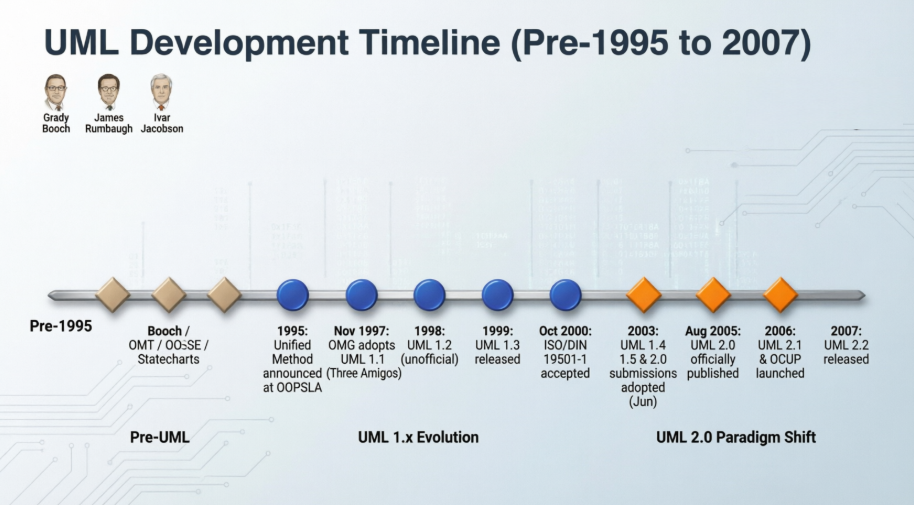
Booch Method: Developed by Grady Booch, focusing on object design and notation.
OMT (Object Modeling Technique): Created by James Rumbaugh, emphasizing object, dynamic, and functional modeling.
OOSE (Object-Oriented Software Engineering): Pioneered by Ivar Jacobson, introducing use cases and requirements engineering.
Statecharts: Introduced by David Harel (1987), which provided a formal visual framework for modeling complex reactive systems and state-dependent behavior.
The decisive turning point occurred at the OOPSLA Conference in 1995, where Grady Booch and Jim Rumbaugh announced the merger of their respective methodologies into a Unified Method. This initiative quickly evolved into a language-focused approach, becoming the Unified Modeling Language (UML), explicitly distinguishing itself as a notation and semantics system rather than a prescriptive development methodology.
UML 0.8 & 0.9: Ivar Jacobson soon joined Booch and Rumbaugh, forming the legendary trio known in software engineering as the "Three Amigos." Their collaboration produced UML 0.8 and UML 0.9 (1996), establishing the core vocabulary and diagram types.
OMG Adoption (1997): Recognizing the need for an industry-backed standard, the authors submitted UML to the Object Management Group (OMG). On November 17, 1997, OMG officially accepted it, releasing UML 1.1. This marked UML's transition from an academic/commercial hybrid to an open industry standard.
The UML 1.x series (versions 1.2 through 1.5) was characterized by corrections, refinements, and incremental extensions rather than architectural changes. Key milestones during this period include:
UML 1.2 (1998): Initially remained unofficial due to a legal dispute, highlighting early challenges in standardization.
UML 1.3 (1999) & UML 1.4 (2001): Introduced structural improvements and better tool interoperability.
ISO Recognition (October 19, 2000): UML was formally accepted as an international standard under ISO/DIN 19501-1, cementing its global legitimacy.
Supporting Standards: During this era, OMG obtained copyright to UML and developed complementary standards like the Object Constraint Language (OCL) (contributed by IBM) and XML Metadata Interchange (XMI) to enable model exchange between tools.
UML 1.5 (2003): The final release of the 1.x branch, serving as the baseline before a major overhaul.
UML 2.0 was not a routine update; it represented a fundamental review and redesign of the entire language. The OMG extensively reworked:
The official specification
The underlying metamodel architecture
The overall scope and coverage of modeling constructs
Key Dates:
June 2003: Submissions for UML 2.0 were conclusively selected and adopted by OMG.
August 2005: UML Version 2.0 was officially published as the final specification.
This shift enabled UML to scale from simple software design to complex systems engineering, business process modeling, and executable model generation.
Following the 2.0 release, UML entered a phase of stabilization, professionalization, and continuous evolution:
UML 2.1 (2006) & UML 2.2 (2007): Addressed ambiguities, improved metamodel consistency, and refined diagram semantics.
OCUP Certification: The OMG launched the OMG-Certified UML Professional (OCUP) program to establish standardized competency levels (Fundamental, Intermediate, Advanced) and ensure practitioners could reliably apply the specification.
Community-Driven Development: The language transitioned from being heavily shaped by its original creators to being maintained by a broad coalition of industry experts, academics, and tool vendors.
While the early versions of UML bore the strong imprint of the Three Amigos (Booch, Rumbaugh, Jacobson), modern UML is a highly collaborative standard. The specification explicitly integrates concepts from numerous contributors, including:
David Harel: Statecharts and hierarchical state modeling.
Bran Selic, Conrad Bock, and James Odell: Pivotal figures in shaping UML 2.0's metamodel, activity semantics, and real-time/enterprise extensions.
IBM & OMG RTF Teams: Contributed OCL, XMI, and rigorous specification drafting.
| Year/Milestone | Event / Version |
|---|---|
| Pre-1995 | Booch Method, OMT, OOSE, and Harel's Statecharts develop independently |
| 1995 | OOPSLA Conference: Booch & Rumbaugh announce "Unified Method" |
| 1996 | UML 0.8 (Booch/Rumbaugh) → UML 0.9 ("Three Amigos") |
| Nov 1997 | OMG officially accepts UML → UML 1.1 released |
| 1998 | UML 1.2 (remained unofficial initially due to lawsuit) |
| 1999 | UML 1.3 released |
| Oct 2000 | ISO acceptance as ISO/DIN 19501-1 |
| 2001 | UML 1.4 released |
| 2003 | UML 1.5 released; UML 2.0 submissions adopted by OMG (June) |
| Aug 2005 | UML 2.0 officially published/final |
| 2006 | UML 2.1 released; OCUP certification program expands |
| 2007 | UML 2.2 projected/released |
The history of UML is a story of convergence, standardization, and architectural maturation. What began as a merger of three competing OO methodologies in 1995 evolved into an ISO-recognized, OMG-maintained industry standard capable of modeling everything from software architectures to complex business processes. The transition from UML 1.x to UML 2.0 marked the language's coming-of-age, introducing a robust metamodel and expanding its applicability across disciplines. Today, UML stands as a testament to collaborative software engineering, continuously refined by a global community of practitioners, researchers, and tool developers.
For the official UML specification, historical documents, and certification details, visit: http://www.omg.org/uml/

