
In the realm of software engineering and system modeling, understanding the foundational building blocks of object-oriented design is crucial for creating robust and scalable applications. At the very heart of this paradigm lie two fundamental concepts: the class and the object. While they are deeply interconnected, they serve distinctly different purposes in the architecture of a system.
This guide aims to provide a comprehensive breakdown of what classes and objects are, how they relate to one another, and the primary differences that distinguish them in both theory and visual modeling (UML). Whether you are designing a complex software architecture or simply learning the ropes of system modeling, mastering the distinction between these two concepts is your first step toward success.
Before diving into the differences, it is essential to clearly define what a class and an object are within the context of system design.
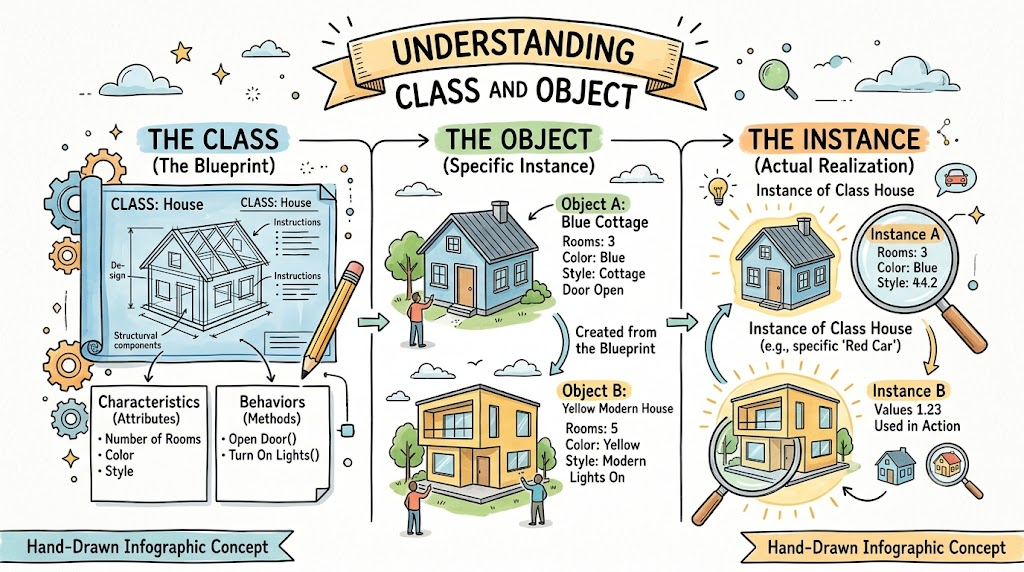
The Class: A class is defined as a broad collection of things or concepts that share the exact same characteristics. It acts as a categorical blueprint, defining the common traits and behaviors that all members of that collection will possess.
The Object: An object is an individual, specific thing or concept that exists within that collection. If the class is the category, the object is the actual item.
The Instance: In technical terminology, when an object belongs to a specific class, it is frequently referred to as an instance of that class. (e.g., If "Vehicle" is the class, a specific red car is an instance of that class).
Here are two clear examples that illustrate the relationship between Classes (the blueprints) and Objects/Instances (the specific items).
To help you visualize both concepts, each example contains the PlantUML code for a Class Diagram (showing the structure) and an Object Diagram (showing concrete instances with real values).
This example uses a SmartLight class. The class defines what every smart light has (brightness, color, power state), while the object diagram shows two actual lights in a home with their current, real-time settings.
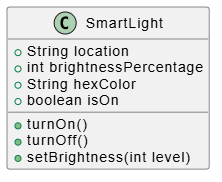
@startuml
class SmartLight {
    + String location
    + int brightnessPercentage
    + String hexColor
    + boolean isOn
    + turnOn()
    + turnOff()
    + setBrightness(int level)
}
@enduml
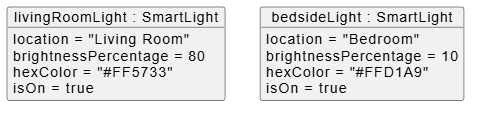
@startuml
object "livingRoomLight : SmartLight" as lr {
    location = "Living Room"
    brightnessPercentage = 80
    hexColor = "#FF5733"
    isOn = true
}

object "bedsideLight : SmartLight" as bed {
    location = "Bedroom"
    brightnessPercentage = 10
    hexColor = "#FFD1A9"
    isOn = true
}
@enduml
This example uses an Item class. The class defines the basic attributes of any product on a shelf. The object diagram shows three specific items currently sitting in a user's digital shopping cart.
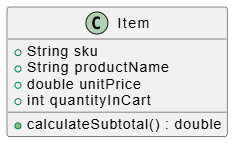
@startuml
class Item {
    + String sku
    + String productName
    + double unitPrice
    + int quantityInCart
    + calculateSubtotal() : double
}
@enduml

@startuml
object "headphones : Item" as hp {
    sku = "SKU-9982"
    productName = "Wireless Headphones"
    unitPrice = 149.99
    quantityInCart = 1
}

object "usbCable : Item" as usb {
    sku = "SKU-1024"
    productName = "USB-C Cable (6ft)"
    unitPrice = 12.50
    quantityInCart = 2
}
@endumlHere is the PlantUML code for both the Class Diagram (the blueprint of the ATM system) and its corresponding Object Diagram (representing a concrete transaction scenario in action).
This diagram defines the structural rules, relationships, attributes, and methods of the entities inside an ATM ecosystem (Bank, ATM, Cards, Accounts, and Transactions).
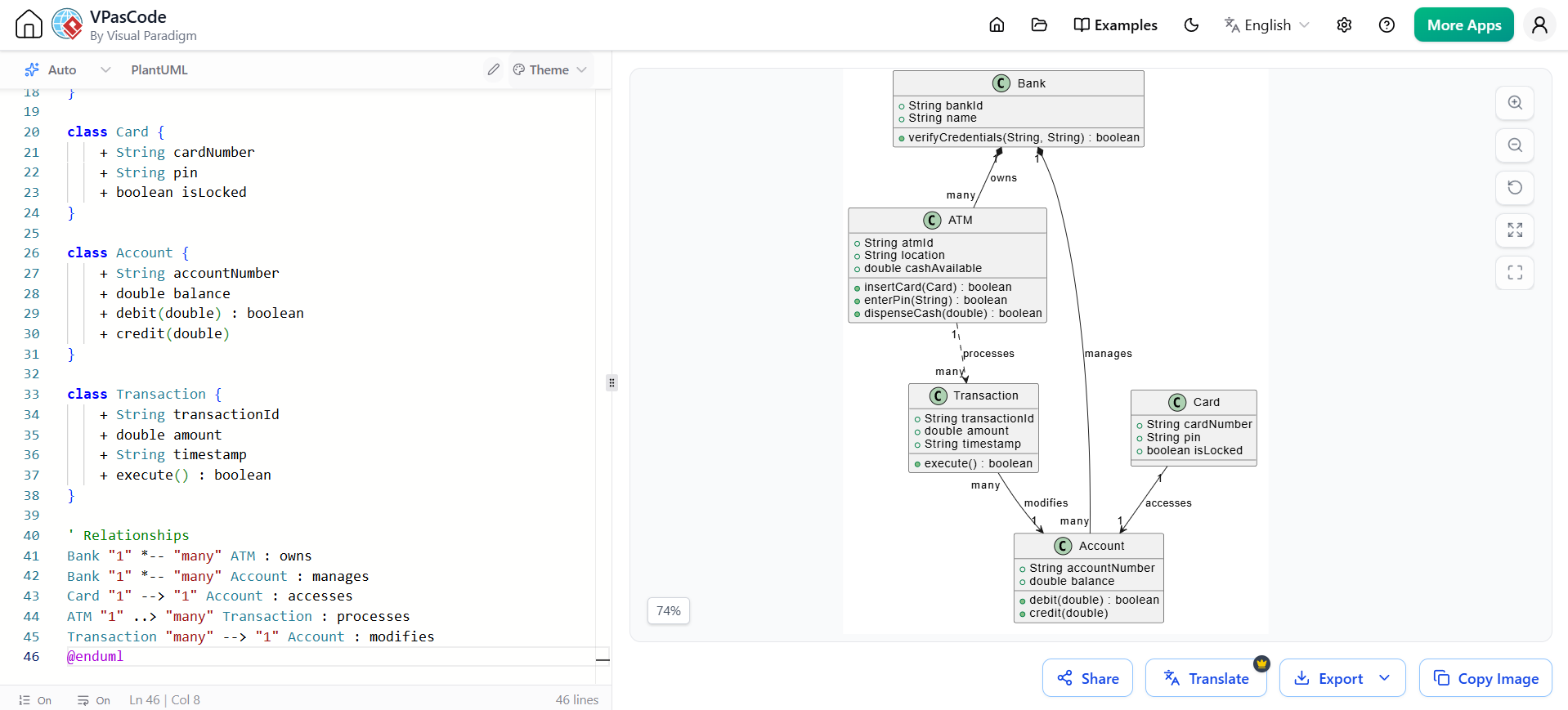
@startuml
skinparam monochrome false

class Bank {
    + String bankId
    + String name
    + verifyCredentials(String, String) : boolean
}

class ATM {
    + String atmId
    + String location
    + double cashAvailable
    + insertCard(Card) : boolean
    + enterPin(String) : boolean
    + dispenseCash(double) : boolean
}

class Card {
    + String cardNumber
    + String pin
    + boolean isLocked
}

class Account {
    + String accountNumber
    + double balance
    + debit(double) : boolean
    + credit(double)
}

class Transaction {
    + String transactionId
    + double amount
    + String timestamp
    + execute() : boolean
}

' Relationships
Bank "1" *-- "many" ATM : owns
Bank "1" *-- "many" Account : manages
Card "1" --> "1" Account : accesses
ATM "1" ..> "many" Transaction : processes
Transaction "many" --> "1" Account : modifies
@enduml
This diagram shows a snapshot of a real-life scenario: John Doe withdrawing $100.00 from a Chase Bank ATM on Broadway using his linked debit card.
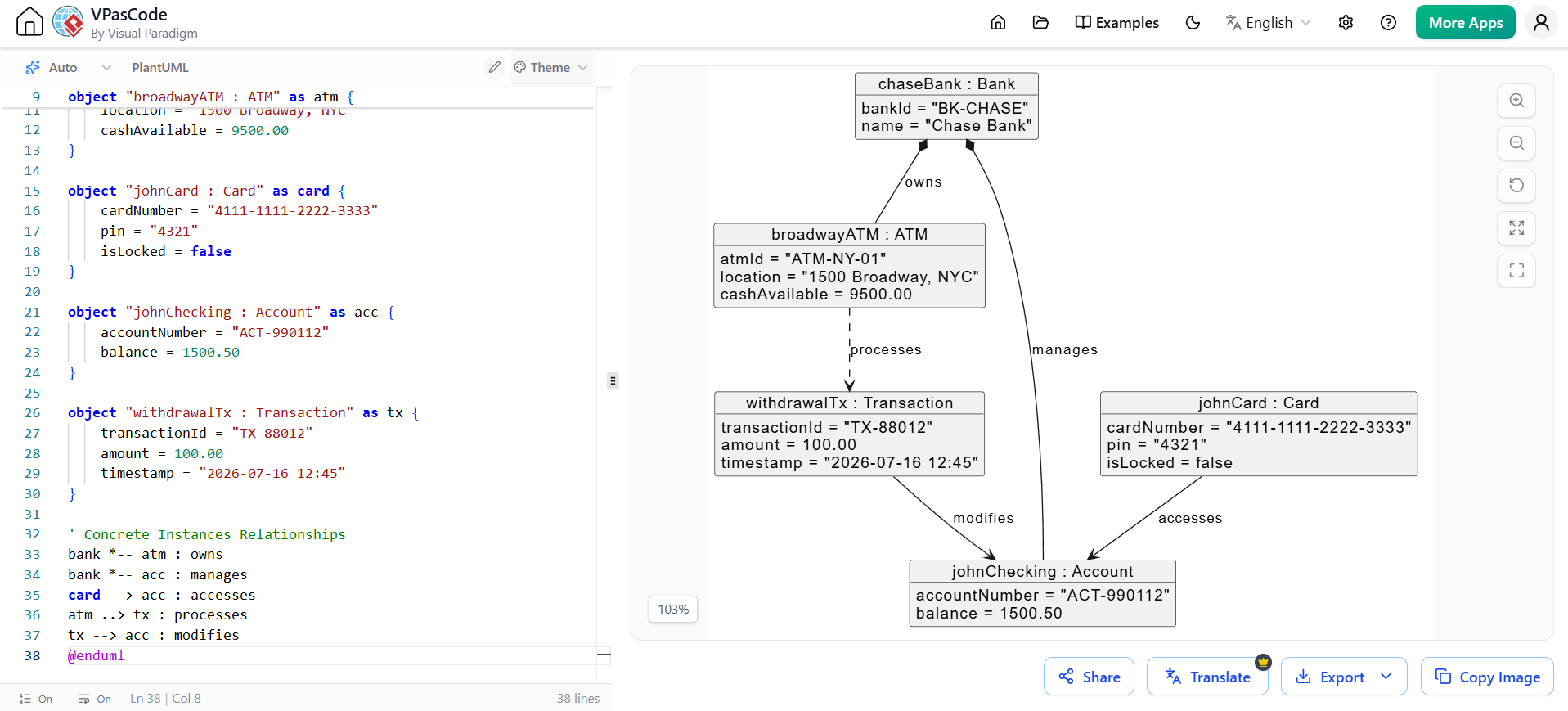
@startuml

object "chaseBank : Bank" as bank {
    bankId = "BK-CHASE"
    name = "Chase Bank"
}

object "broadwayATM : ATM" as atm {
    atmId = "ATM-NY-01"
    location = "1500 Broadway, NYC"
    cashAvailable = 9500.00
}

object "johnCard : Card" as card {
    cardNumber = "4111-1111-2222-3333"
    pin = "4321"
    isLocked = false
}

object "johnChecking : Account" as acc {
    accountNumber = "ACT-990112"
    balance = 1500.50
}

object "withdrawalTx : Transaction" as tx {
    transactionId = "TX-88012"
    amount = 100.00
    timestamp = "2026-07-16 12:45"
}

' Concrete Instances Relationships
bank *-- atm : owns
bank *-- acc : manages
card --> acc : accesses
atm ..> tx : processes
tx --> acc : modifies
@enduml
While classes and objects are two sides of the same coin, they differ significantly in their nature, data handling, and visual representation. Below are the four primary distinctions between the two.
The most fundamental philosophical difference between a class and an object lies in their level of reality within a system.
Class (Abstraction): A class serves as an abstraction. It is a conceptual template or blueprint that exists in the design phase. It does not hold real-world data itself; rather, it defines what data could be held.
Object (Manifestation): An object is the concrete manifestation of that abstraction. It is the realization of the class blueprint, brought to life during the execution of a program.
The way classes and objects handle data and operations is distinctly different.
Class (Defines Structure): A class defines the structural and behavioral framework. It dictates the attributes (data slots) and operations (services or methods) that are shared by all its members. It sets the rules for what data is allowed.
Object (Holds Specific Data): While the class defines the slots for data, each individual object typically has specific, different values assigned to those attributes. For example, a User class might define an attribute for Age, but Object A might have an age value of 25, while Object B has an age value of 30.
In Unified Modeling Language (UML) and system design, classes and objects are used in different types of diagrams to convey different types of information.
Class Diagrams: Classes appear primarily on class diagrams. These diagrams are used to show the structural relationships and the overall static architecture of a system. They map out how different categories of objects interact and inherit from one another.
Object Diagrams: Objects appear primarily on object diagrams. Unlike class diagrams, object diagrams capture "snapshots" of a system's state at a particular, specific point in time during its execution. They are used to visualize complex, real-time relationships between instantiated objects.
To easily distinguish between a conceptual class and a concrete object, UML employs specific visual notations for their respective diagram boxes.
Class Notation: In a class box, the name of the class is written in boldface type. This immediately signals to the reader that they are looking at an abstract blueprint.
Object Notation: In an object box, the contents of the top compartment are underlined to distinguish it from a class. Furthermore, the naming convention in this compartment typically includes the specific object name, followed by a colon, and then the class name it belongs to (e.g., myCar : Vehicle).
| Feature | Class | Object (Instance) |
|---|---|---|
| Nature | Abstraction (Blueprint) | Concrete Manifestation (Reality) |
| Data Role | Defines attributes and operations | Holds specific, individual data values |
| Primary Diagram | Class Diagram (Structural relationships) | Object Diagram (State snapshots in time) |
| UML Notation | Name in boldface | Name and class underlined (object : Class) |
In summary, the relationship between a class and an object is the relationship between a template and its physical realization. A class is the vital abstraction that defines the shared characteristics, attributes, and operations of a concept. An object is the concrete manifestation of that class, breathing life into the abstraction by holding specific data values at a given moment in time.
Understanding these distinctions is not merely an academic exercise; it is a practical necessity. By knowing how to properly define classes and instantiate objects—and by knowing how to accurately represent them using UML class and object diagrams—developers and system architects can design clearer, more efficient, and highly organized software systems. Ultimately, mastering the interplay between the abstract class and the concrete object is the cornerstone of successful object-oriented design.

