
In the world of software engineering, the gap between a business requirement and a functional application is often bridged by effective modeling. For complex systems like event ticketing, where relationships between customers, events, and inventory are intricate, a visual blueprint is essential. This case study explores the design of a Theater Booking System using a UML Class Diagram. By analyzing the provided diagram, we will uncover how object-oriented principles—such as inheritance, multiplicity, and constraints—are applied to create a robust, maintainable, and efficient system architecture.
The diagram provided represents the backend structure of a ticketing application. The primary goal of this system is to manage the lifecycle of a booking, from a customer initiating a reservation to the specific allocation of seats for a performance.
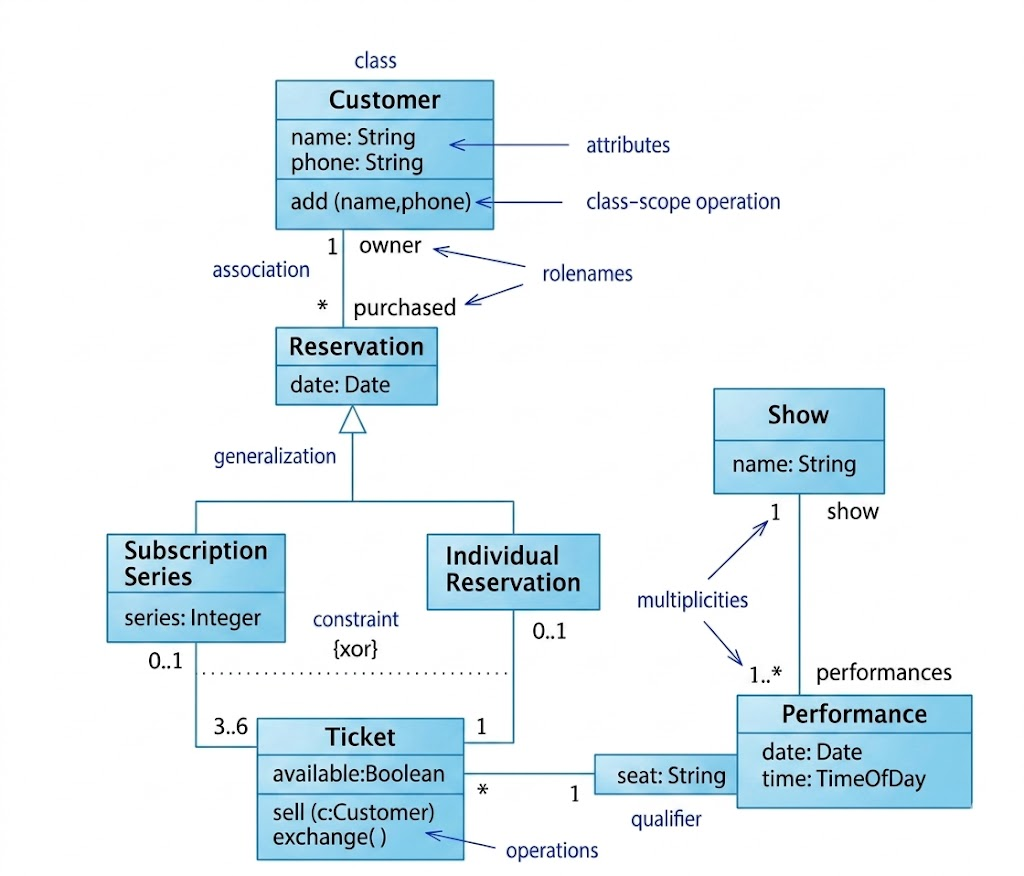
The system is composed of five primary entities (Classes):
Customer: The user interacting with the system.
Reservation: A container for a booking request.
Ticket: The actual proof of entry.
Performance: A specific showing of a play or event.
Show: The overarching production (e.g., "The Phantom of the Opera").
The diagram utilizes Generalization (Inheritance) to handle different types of bookings efficiently.
Abstract Parent: The class Reservation is italicized, indicating it is an Abstract Class. It cannot be instantiated directly. It holds common attributes like date: Date.
Concrete Children:
Individual Reservation: Represents a one-off purchase.
Subscription Series: Represents a bundle of tickets (e.g., a season pass). It includes a specific attribute series: Integer.
Why this matters: This allows the system to treat all bookings as "Reservations" polymorphically, while still allowing specific logic for subscriptions (like enforcing a minimum number of tickets).
The lines connecting the classes define the "business rules" of the theater:
Customer to Reservation: A customer (1) can own many (*) reservations. The role names owner and purchased clarify the direction of the relationship.
Show to Performance: A Show (1) consists of one or more (1..*) Performances. This ensures a show cannot exist without at least one scheduled performance.
Performance to Ticket: A Performance has many (*) tickets associated with it. Conversely, a specific Ticket belongs to exactly (1) performance.
The diagram enforces strict data integrity through constraints:
The {xor} Constraint: There is a dashed line connecting Subscription Series and Individual Reservation to the Ticket class with the constraint {xor}.
Meaning: A ticket must belong to either a Subscription Series or an Individual Reservation. It cannot be both, nor can it be neither.
Multiplicity Ranges:
The line between Subscription Series and Ticket has a multiplicity of 3..6. This enforces a business rule that a subscription package must contain between 3 and 6 tickets.
A unique feature in this diagram is the Qualifier box labeled seat: String attached to the association between Ticket and Performance.
Function: This indicates that within the context of a specific Performance, the seat string acts as a key to find the Ticket.
Efficiency: Instead of searching through all tickets for a performance, the system can look up a ticket instantly using Performance Object + Seat Number.
Based on this diagram, developers should follow these guidelines when coding the system:
Nouns vs. Verbs:
Ensure Class names are Nouns (Ticket, Show).
Ensure Operations are Verbs (sell(), exchange()). The Ticket class includes a sell(c:Customer) operation, which likely handles the logic of assigning the ticket to a customer.
Visibility Modifiers:
Although not explicitly marked with + or - in the image, standard practice suggests keeping attributes like available: Boolean private and providing public getters/setters or methods to modify them.
Handling Abstract Classes:
In code (e.g., Java or C#), the Reservation class should be marked abstract. The factory pattern might be used to decide whether to instantiate an IndividualReservation or a SubscriptionSeries object based on user input.
Navigability:
The arrows indicate navigability. For instance, the arrow from Ticket to Performance implies that a Ticket object knows which Performance it belongs to, but a Performance object might hold a collection of Tickets rather than knowing the specific details of every single ticket object immediately (unless navigated via the qualifier).
The UML Class Diagram provided serves as a powerful blueprint for a Theater Reservation System. It moves beyond simple data storage by defining complex relationships, such as the mutually exclusive nature of ticket types ({xor}) and the efficient lookup of seats via Qualifiers.
By modeling the system this way, the development team ensures that:
Data Integrity is maintained: Invalid states (like a ticket being both individual and subscription-based) are prevented by design.
Scalability is achieved: New types of reservations can be added as children of the Reservation class without breaking existing code.
Communication is clear: Stakeholders can understand the logic (e.g., "Subscriptions must have 3-6 tickets") directly from the visual model.
This case study demonstrates that a well-crafted UML diagram is not just a drawing; it is the architectural foundation upon which reliable software is built.

