
In an era where software powers everything from pacemakers to power grids, the stakes of development have never been higher. Yet, a persistent myth in the tech industry suggests that rigorous planning stifles innovation and that "moving fast and breaking things" is the only path to success. This guide challenges that notion by exploring the engineering necessity of modeling.
Just as civil engineers would never attempt to construct a skyscraper without detailed blueprints, software architects must recognize that modeling is a proven and well-accepted engineering technique. It is not about creating bureaucratic documentation; it is about managing complexity, mitigating risk, and ensuring that the systems we build are robust, scalable, and maintainable. By moving from the ad-hoc "dog house" approach to the rigorous standards required for "high rise" software systems, organizations can avoid catastrophic failures and build products that stand the test of time.
The level of modeling required for a project is directly proportional to its complexity and the cost of failure. Understanding this spectrum is crucial for selecting the right engineering practices.
If you want to build a dog house, you can start with a pile of lumber and basic tools. You can finish in a few hours with no prior planning. If it fails, you simply start over; the risk is low. In software terms, this represents a quick prototype or a small internal tool where speed is prioritized over structure.
Building a house for a family requires detailed planning and blueprints. You need to think through traffic flow, lighting, and plumbing before laying the foundation. This planning allows for better estimates of time and materials and facilitates teamwork among electricians, plumbers, and carpenters. Similarly, medium-sized software projects require architectural decisions to ensure different modules integrate smoothly.
For a high-rise office building, starting without blueprints would be "infinitely stupid". Because the cost of failure is high and multiple stakeholders (investors, tenants, city planners) are involved, extensive planning and communication through models are mandatory.
The Software Parallel: Curiously, many software organizations attempt to build "high rises" but approach them as if they were "knocking out a dog house". When a project grows due to its own success but lacks consideration for architecture and tools, it eventually collapses of its own weight. Technical debt accumulates, bugs become unmanageable, and the system becomes impossible to extend.
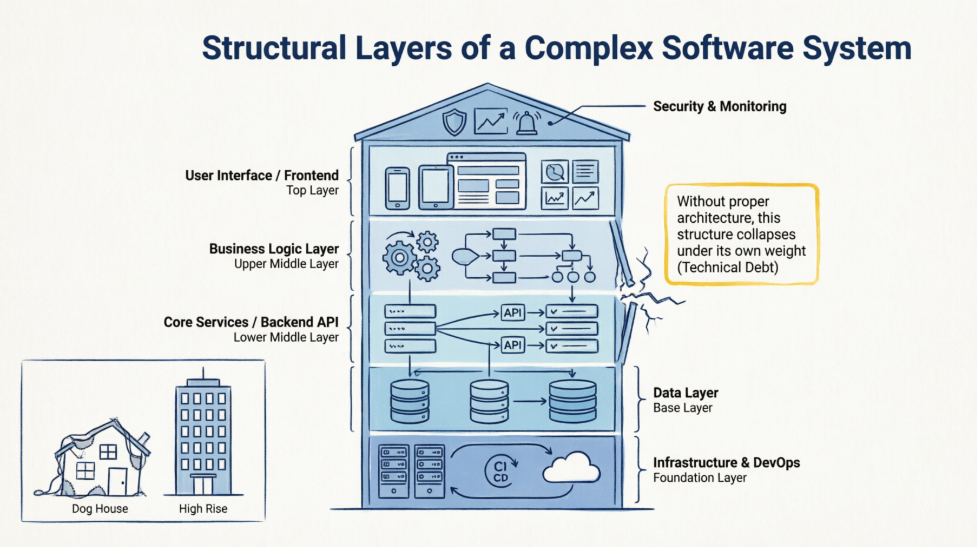
Figure 1: A conceptual blueprint illustrating the structural layers of a complex software system.
Blueprints are not just "beautiful documents"; they are functional tools that achieve four primary aims in software engineering:
Visualization: They help stakeholders visualize a system as it is or as they want it to be. This shared vision aligns developers, product managers, and business leaders.
Specification: They permit the precise, unambiguous specification of a system's structure and behavior. This reduces misunderstandings during implementation.
Construction: They provide a template that guides the actual construction (coding) of the system. Developers know exactly what interfaces to build and how components interact.
Documentation: They document the critical design decisions made during the development process. This is invaluable for onboarding new team members and maintaining the system years later.
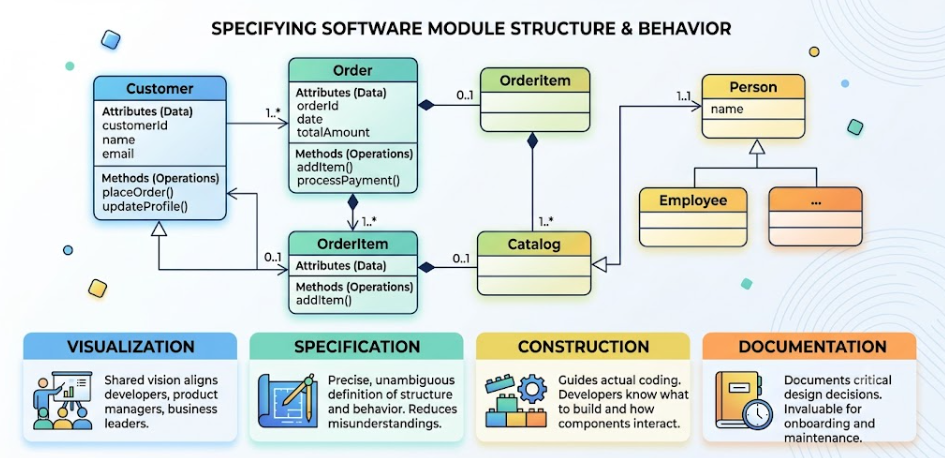
Figure 2: An example of a UML class diagram used to specify the structure of a software module.
To create effective blueprints, software architects should follow these established principles:
The models you choose profoundly influence how a problem is attacked and how a solution is shaped. For instance, an object-oriented view is often superior for crafting resilient architectures compared to a purely algorithmic focus. Choosing the right abstraction layer can mean the difference between a flexible system and a rigid one.
Every model can be expressed at different levels of detail. Sometimes you need a 30,000-foot view for investors to understand the business value; other times, you must get down to the "bits" to specify cross-system interfaces for developers. Knowing when to zoom in and when to zoom out is a key skill.
The best models have a clear connection to reality. If a model is divorced from the real world—a common "Achilles heel" in older structured analysis techniques—the system as conceived and the system as built will diverge over time. Models must be living artifacts that evolve with the code.
No single model is sufficient for a nontrivial system. To understand a complex architecture, you need five interlocking views:
Use Case View: Captures the requirements from the user's perspective.
Design View: Captures the vocabulary of the problem space, including classes and objects.
Process View: Models concurrency, synchronization, and performance aspects.
Implementation View: Addresses the physical realization of the system, including source code organization.
Deployment View: Focuses on the hardware topology and how software components are distributed across servers.
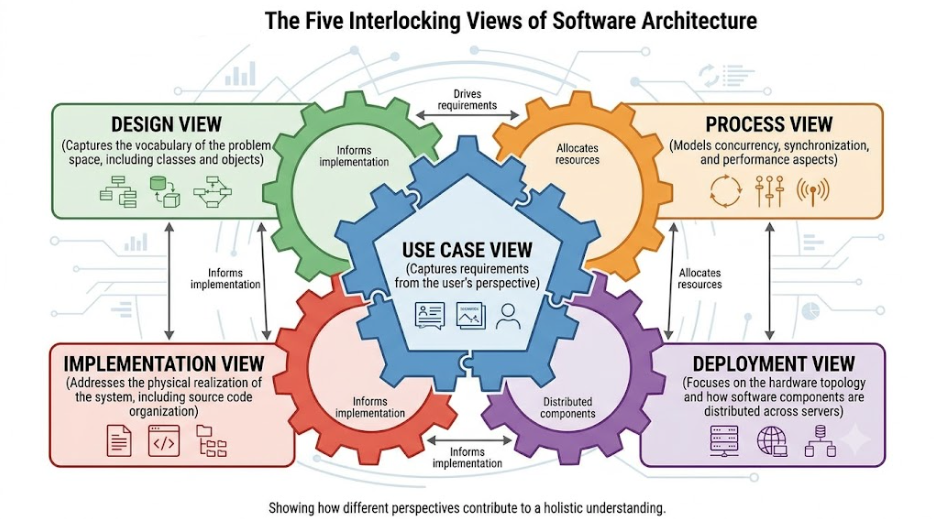
Figure 3: The five interlocking views of software architecture, showing how different perspectives contribute to a holistic understanding.
The larger and more complex a system becomes, the more important modeling becomes because human intellect has limits in comprehending total complexity. Blueprints allow developers to "divide and conquer" by focusing on one aspect of a system at a time.
While you might think you don't need to model today, as your system evolves, you may regret that decision after it is too late. Investing in modeling is not an overhead; it is an insurance policy against chaos. By adopting the rigorous practices of high-rise engineering, software teams can build systems that are not only functional but also resilient, scalable, and ready for the future.
The Unified Modeling Language User Guide: A comprehensive guide to UML, the standard language for specifying, visualizing, constructing, and documenting the artifacts of software systems.
Applying UML and Patterns: An Introduction to Object-Oriented Analysis and Design: This book introduces object-oriented analysis and design concepts, emphasizing the use of UML for modeling complex systems.
Software Architecture in Practice: Explores the importance of architectural decisions and how modeling helps manage complexity in large-scale software projects.
Clean Architecture: A Craftsman's Guide to Software Structure and Design: Discusses the principles of designing software systems that are independent of frameworks, UI, databases, and external agencies, highlighting the role of modeling in achieving this independence.

