
In the realm of object-oriented software design, bridging the gap between abstract system requirements and concrete code architecture can be a significant challenge. Enter the CRC (Class-Responsibility-Collaboration) card—a deceptively simple, low-tech tool that has remained a cornerstone of agile and object-oriented design for decades.
CRC cards transform the often-intimidating process of system design into an interactive, collaborative, and highly visual exercise. By using physical index cards and role-playing, development teams and stakeholders can collectively map out system behavior, identify necessary classes, and define how those classes interact. This guide explores the mechanics, principles, and advantages of CRC role-play sessions, demonstrating how this humble technique lays the groundwork for robust software architecture.
To understand the power of CRC sessions, it is essential to grasp the three foundational elements that make up the acronym:
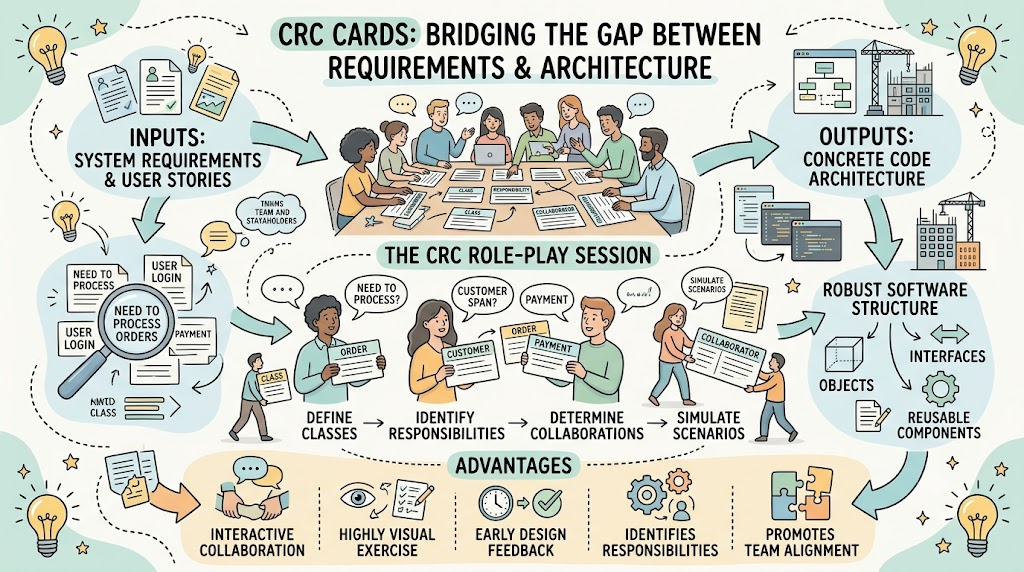
Class: Represents a blueprint or a specific "object" within the system domain. In a CRC session, a class is represented by a physical index card, with the class name written at the top.
Responsibility: Defines what an object knows (its attributes/state) or what it does (its behaviors/methods). Responsibilities are the obligations an object has to fulfill when requested.
Collaboration: Acknowledges that an object rarely works in isolation. When an object cannot fulfill a responsibility on its own, it must collaborate with (send a message to) another object. Collaborations are listed on the right side of the CRC card.
The true magic of CRC cards happens during the role-play session. Rather than drawing diagrams on a whiteboard, participants physically enact the system's behavior.
Each team member takes on the identity of a specific object within the system. They hold the physical CRC card representing their object. If a scenario requires a "Customer," "Rental Clerk," and "Bike," three participants will hold those respective cards.
The group selects a specific use case scenario (e.g., "Issue a bike" in a rental system) and "walks through" it step-by-step. As the scenario progresses, the group identifies the specific tasks that must be performed to move the scenario forward.
For every task identified during the walkthrough, the group debates and decides which object is most logically suited to handle it. Once agreed upon, that task is written as a responsibility on the left side of that object's CRC card.
If the "actor" holding a card realizes they cannot fulfill a responsibility with their current knowledge or capabilities, they must ask for help. The group identifies which other class the object must collaborate with to get the job done. This collaborating class is written on the right side of the CRC card.
During the role-play, the team may realize that a necessary responsibility cannot be logically assigned to any of the current objects. When this gap is identified, the team creates a new physical card, names a new object (and therefore a new class), and assigns the responsibility to it.
To ensure the resulting design is clean, maintainable, and adheres to object-oriented best practices, teams should follow these guiding principles during the session:
Responsibility Limits: To prevent "god classes" and ensure high cohesion, a common rule of thumb is that no class should have more than three or four responsibilities. If a card is overflowing with text, the class is likely doing too much and needs to be split.
Minimized Messaging: A primary goal of the session is to minimize the number and complexity of the messages passed between objects. Fewer collaborations generally lead to lower coupling and a more efficient, easily testable system architecture.
Information Hiding: Objects should only know what they absolutely need to know to fulfill their responsibilities. They should not be burdened with the internal workings of their collaborators.
Transition to Formal Models: CRC cards are a discovery and design tool, not a final documentation artifact. Once the roles and responsibilities are stabilized through role-play, the results must be translated into formal interaction diagrams (such as UML sequence or collaboration diagrams) to serve as a precise roadmap for programmers.
Why use physical index cards in an era of advanced modeling software? The benefits are both psychological and practical:
Stakeholder Accessibility: Because the cards use plain text rather than formal UML notation or complex syntax, they are easily understood by non-technical clients, product owners, and end-users. This fosters true cross-functional collaboration.
Simplicity and Focus: The physical size of the cards (typically 10 cm x 15 cm) strictly limits the amount of information that can be written. This physical constraint forces developers to keep classes small, cohesive, and focused on high-level goals.
Low "Scrap" Cost: Because the cards are informal and take seconds to create, it is psychologically easy for a team to explore alternative designs, realize they aren't working, and throw the cards away without feeling they have wasted significant effort.
Discovery Tool: The physical act of role-playing often uncovers edge cases, missing classes, or overlooked attributes that might have been missed during traditional noun-verb analysis or abstract whiteboard sessions.
As mentioned in the design principles, the final step of a CRC session is to formalize the discovered interactions into UML diagrams. Below are PlantUML examples based on the "Issue bike" scenario discussed in the role-play process.
A sequence diagram is excellent for showing the chronological flow of messages between the objects identified during the CRC session.
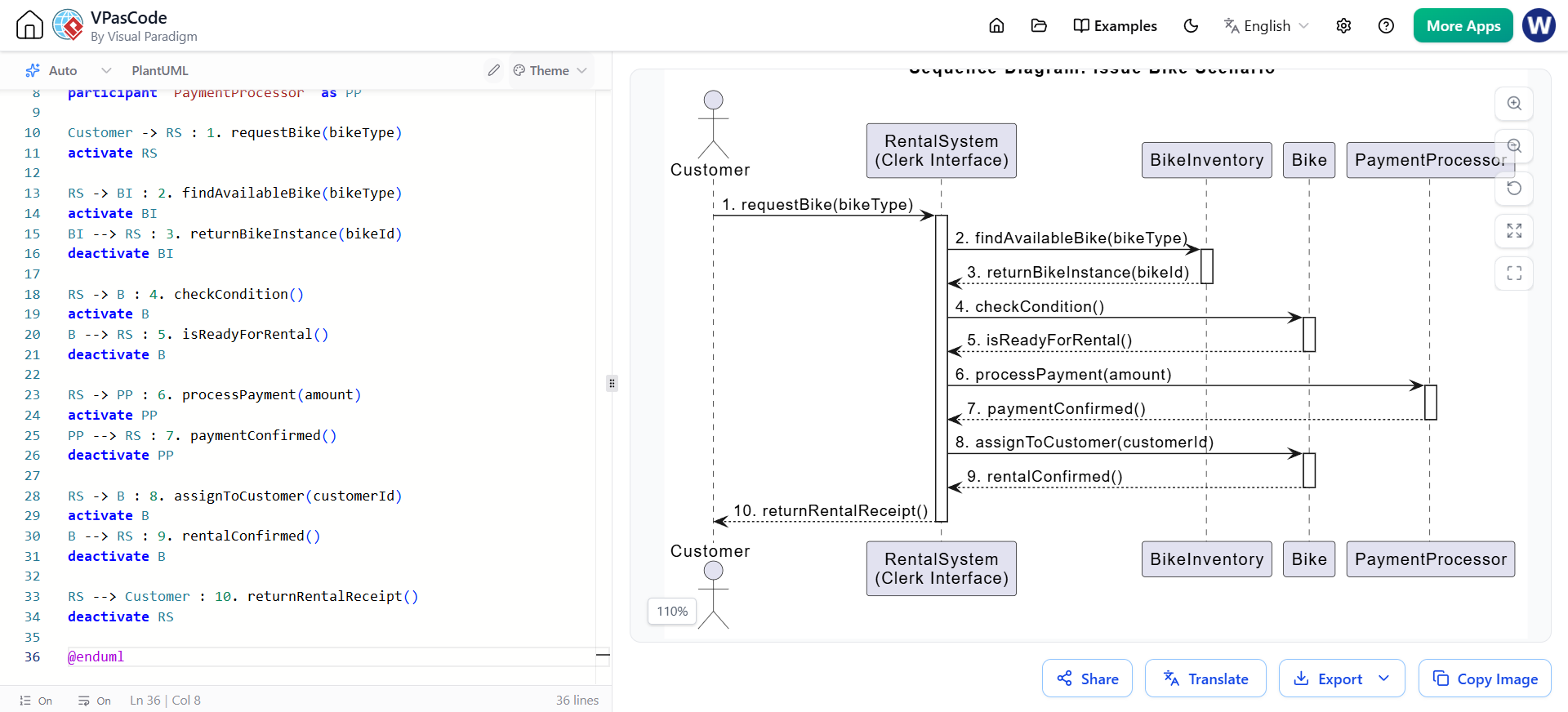
@startuml
title Sequence Diagram: Issue Bike Scenario

actor Customer
participant "RentalSystem\n(Clerk Interface)" as RS
participant "BikeInventory" as BI
participant "Bike" as B
participant "PaymentProcessor" as PP

Customer -> RS : 1. requestBike(bikeType)
activate RS

RS -> BI : 2. findAvailableBike(bikeType)
activate BI
BI --> RS : 3. returnBikeInstance(bikeId)
deactivate BI

RS -> B : 4. checkCondition()
activate B
B --> RS : 5. isReadyForRental()
deactivate B

RS -> PP : 6. processPayment(amount)
activate PP
PP --> RS : 7. paymentConfirmed()
deactivate PP

RS -> B : 8. assignToCustomer(customerId)
activate B
B --> RS : 9. rentalConfirmed()
deactivate B

RS --> Customer : 10. returnRentalReceipt()
deactivate RS

@enduml
A communication diagram focuses on the structural relationships and the specific messages exchanged between the collaborating objects, highlighting the "Collaboration" aspect of the CRC cards.
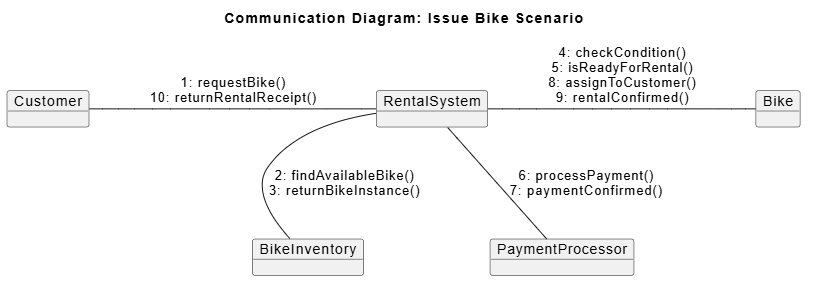
@startuml
title Communication Diagram: Issue Bike Scenario

' Increase horizontal and vertical spacing between nodes
skinparam nodesep 120
skinparam ranksep 80

object Customer
object "RentalSystem" as RS
object "BikeInventory" as BI
object "Bike" as B
object "PaymentProcessor" as PP

' Layout links
Customer -right- RS : 1: requestBike()\n10: returnRentalReceipt()
RS -right- B : 4: checkCondition()\n5: isReadyForRental()\n8: assignToCustomer()\n9: rentalConfirmed()

RS -down- BI : 2: findAvailableBike()\n3: returnBikeInstance()
RS -down- PP : 6: processPayment()\n7: paymentConfirmed()

' Force horizontal separation between bottom nodes
BI -right[hidden]- PP

@enduml
CRC (Class-Responsibility-Collaboration) card role-play sessions prove that sometimes the simplest tools are the most effective. By stripping away the complexity of formal modeling languages and focusing on the physical enactment of system scenarios, teams can rapidly prototype object-oriented designs.
The constraints of the physical cards enforce good design principles—such as high cohesion and low coupling—while the inclusive nature of the role-play ensures that both technical and non-technical stakeholders share a unified vision of the system. Ultimately, CRC sessions serve as the perfect bridge between abstract business requirements and concrete, formalized UML architecture, ensuring that the resulting software is both robust and deeply aligned with user needs.

