
Strategic planning often begins with a SWOT Analysis—a foundational tool for assessing Strengths, Weaknesses, Opportunities, and Threats. However, while SWOT is excellent for diagnosis, it often stops short of prescription. Many teams find themselves stuck with a list of factors but no clear path forward.
This is where TOWS Analysis comes in. TOWS is the natural evolution of SWOT, transforming static observations into dynamic, actionable strategies by systematically cross-referencing internal and external factors.
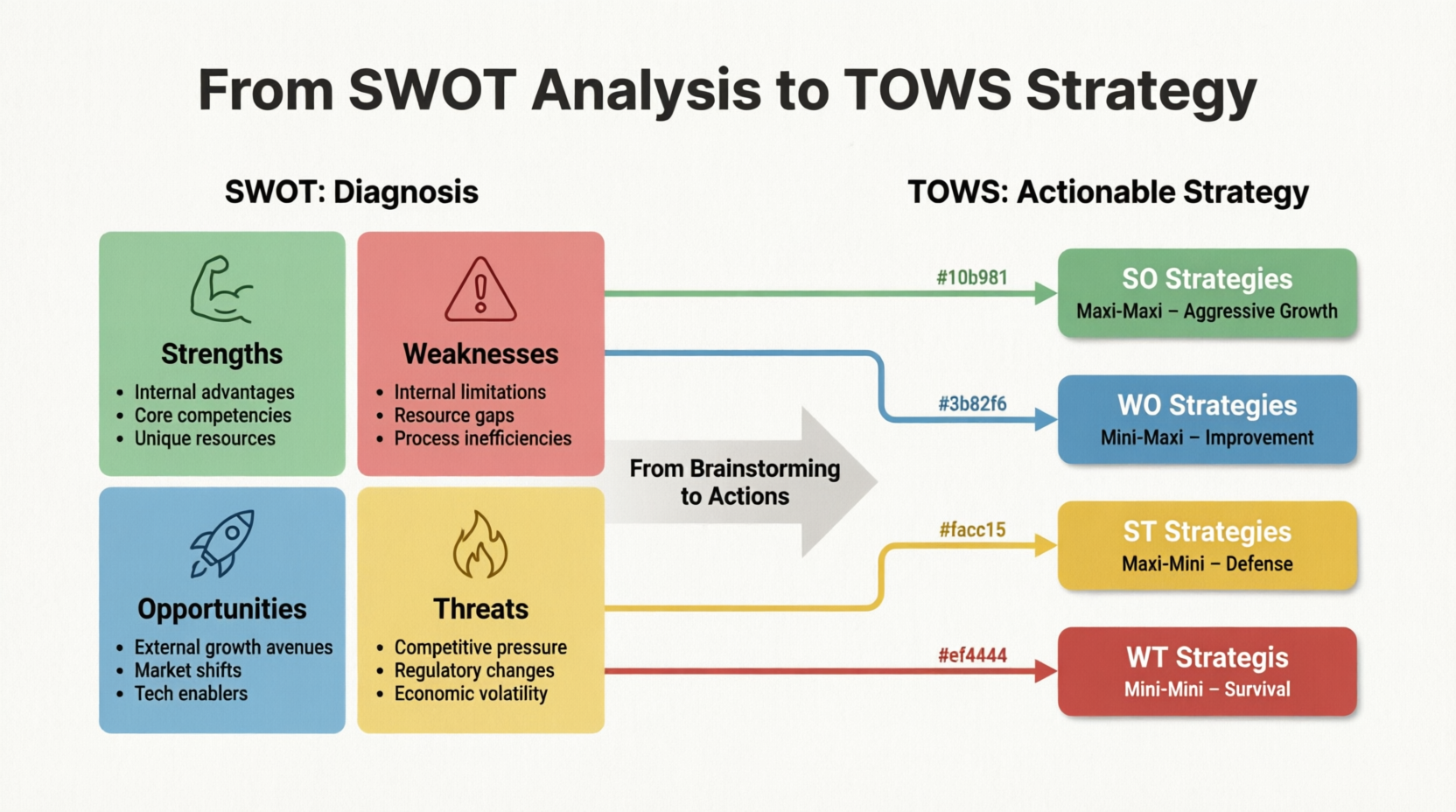
This guide will walk you through the journey from SWOT brainstorming to TOWS action plans, complete with visual examples using Mermaid code.
SWOT helps you categorize factors into four quadrants:
Internal Factors: Strengths (S) and Weaknesses (W) – Things you can control.
External Factors: Opportunities (O) and Threats (T) – Things happening in the market/environment.
The Limitation: SWOT is often a "list-making" exercise. It identifies what is happening but doesn’t inherently tell you what to do about it.
TOWS takes the same four elements but forces interaction between them. It asks: "How can we use our Strengths to capitalize on Opportunities?" or "How can we minimize Weaknesses to avoid Threats?"
By crossing Internal vs. External and Helpful vs. Harmful, TOWS generates four distinct strategic directions:
| Strategy Type | Combination | Goal | Mindset |
|---|---|---|---|
| SO Strategies | Strengths + Opportunities | Maxi-Maxi | Aggressive Growth |
| WO Strategies | Weaknesses + Opportunities | Mini-Maxi | Improvement & Turnaround |
| ST Strategies | Strengths + Threats | Maxi-Mini | Defense & Diversification |
| WT Strategies | Weaknesses + Threats | Mini-Mini | Survival & Damage Control |
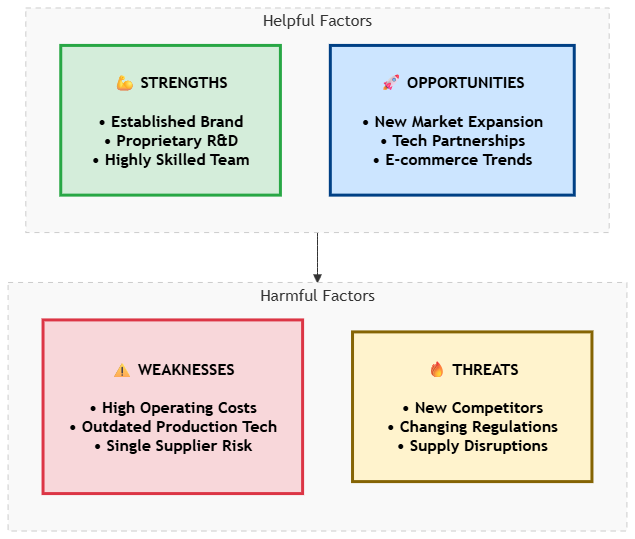
Before we build strategies, we need a clear SWOT baseline. Below is a Mermaid diagram illustrating a standard SWOT analysis for a hypothetical tech company. Notice how it separates "Helpful" and "Harmful" factors but keeps them isolated.
graph TB
%% --- Structural layout to force a 2x2 grid ---
LeftColumn --> RightColumn

subgraph LeftColumn [Helpful Factors]
    direction TB
    STRENGTHS[💪 STRENGTHS<br><br>• Established Brand<br>• Proprietary R&D<br>• Highly Skilled Team]
    OPPORTUNITIES[🚀 OPPORTUNITIES<br><br>• New Market Expansion<br>• Tech Partnerships<br>• E-commerce Trends]
end

subgraph RightColumn [Harmful Factors]
    direction TB
    WEAKNESSES[⚠️ WEAKNESSES<br><br>• High Operating Costs<br>• Outdated Production Tech<br>• Single Supplier Risk]
    THREATS[🔥 THREATS<br><br>• New Competitors<br>• Changing Regulations<br>• Supply Disruptions]
end

%% --- Visual Design Styling ---
style LeftColumn fill:#f9f9f9,stroke:#cccccc,stroke-width:1px,stroke-dasharray: 5 5;
style RightColumn fill:#f9f9f9,stroke:#cccccc,stroke-width:1px,stroke-dasharray: 5 5;

style STRENGTHS fill:#d4edda,stroke:#28a745,stroke-width:3px,border-radius:10px;
style WEAKNESSES fill:#f8d7da,stroke:#dc3545,stroke-width:3px,border-radius:10px;
style OPPORTUNITIES fill:#cce5ff,stroke:#004085,stroke-width:3px,border-radius:10px;
style THREATS fill:#fff3cd,stroke:#856404,stroke-width:3px,border-radius:10px;

%% --- Text Color adjustments for readability ---
classDef whiteText color:#000000,font-weight:bold,font-family:Arial;
class STRENGTHS,WEAKNESSES,OPPORTUNITIES,THREATS whiteText;
Key Takeaway from SWOT: You now have a clear inventory. But notice there are no arrows connecting these boxes. That’s the gap TOWS fills.
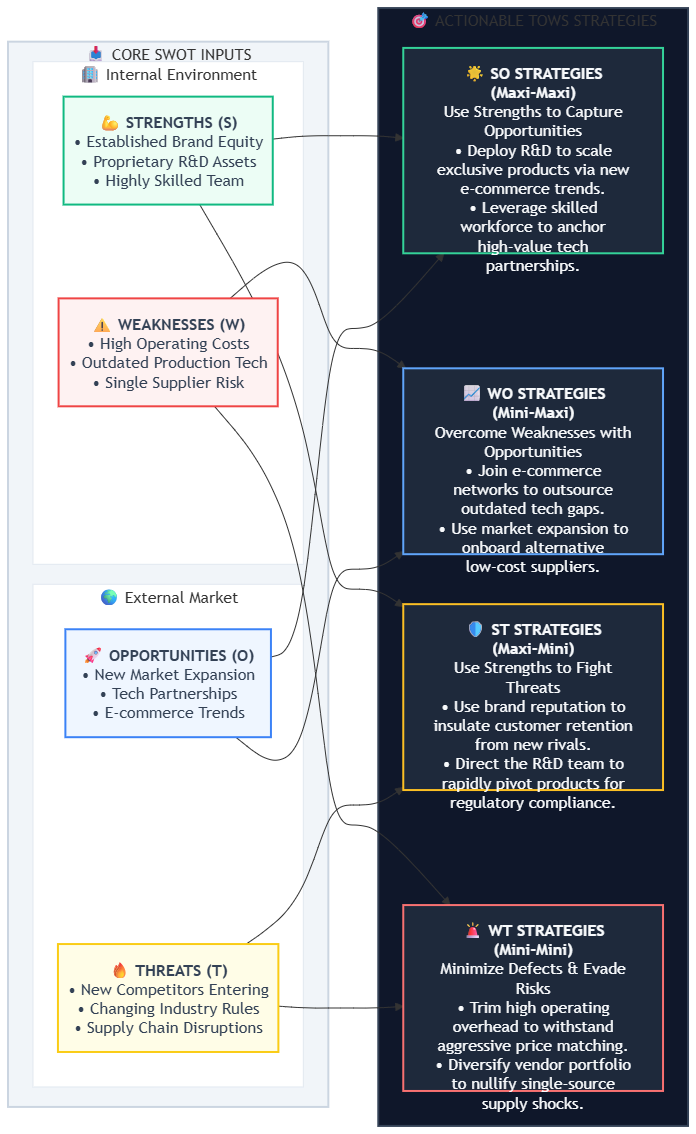
TOWS analysis creates a logical flow from inputs (SWOT) to outputs (Strategies). It explicitly links internal capabilities with external realities.
Concept: Use your internal strengths to take full advantage of external opportunities.
Example: "Deploy proprietary R&D assets to scale exclusive products via new e-commerce trends."
When to use: When the market is favorable and you are well-positioned. This is your "Offense" strategy.
Concept: Overcome internal weaknesses by leveraging external opportunities.
Example: "Join e-commerce networks to outsource outdated tech gaps."
When to use: When you see a market opening but lack the internal capacity to seize it alone. This is your "Improvement" strategy.
Concept: Use internal strengths to minimize or avoid external threats.
Example: "Use brand reputation to insulate customer retention from new rivals."
When to use: When the market is hostile, but you have strong defenses. This is your "Defense" strategy.
Concept: Minimize weaknesses and avoid threats. This is often about damage control or survival.
Example: "Trim high operating overhead to withstand aggressive price matching."
When to use: When you are vulnerable internally and facing external pressure. This is your "Survival" strategy.
The following Mermaid diagram illustrates how TOWS connects the SWOT inputs to actionable strategies. Notice the directional arrows showing the logical derivation of each strategy type.
graph LR
    %% --- Subgraph Containers for Visual Grouping ---
    subgraph INPUTS [📥 CORE SWOT INPUTS]
        direction TB

        %% Internal Factors Box
        subgraph INTERNAL [🏢 Internal Environment]
            S["<b>💪 STRENGTHS (S)</b><br>• Established Brand Equity<br>• Proprietary R&D Assets<br>• Highly Skilled Team"]
            W["<b>⚠️ WEAKNESSES (W)</b><br>• High Operating Costs<br>• Outdated Production Tech<br>• Single Supplier Risk"]
        end

        %% External Factors Box
        subgraph EXTERNAL [🌍 External Market]
            O["<b>🚀 OPPORTUNITIES (O)</b><br>• New Market Expansion<br>• Tech Partnerships<br>• E-commerce Trends"]
            T["<b>🔥 THREATS (T)</b><br>• New Competitors Entering<br>• Changing Industry Rules<br>• Supply Chain Disruptions"]
        end
    end

    subgraph STRATEGIES [🎯 ACTIONABLE TOWS STRATEGIES]
        direction TB

        SO["<p align='left'><b>🌟 SO STRATEGIES (Maxi-Maxi)</b><br><i>Use Strengths to Capture Opportunities</i><br>• Deploy R&D to scale exclusive products via new e-commerce trends.<br>• Leverage skilled workforce to anchor high-value tech partnerships.</p>"]

        WO["<p align='left'><b>📈 WO STRATEGIES (Mini-Maxi)</b><br><i>Overcome Weaknesses with Opportunities</i><br>• Join e-commerce networks to outsource outdated tech gaps.<br>• Use market expansion to onboard alternative low-cost suppliers.</p>"]

        ST["<p align='left'><b>🛡️ ST STRATEGIES (Maxi-Mini)</b><br><i>Use Strengths to Fight Threats</i><br>• Use brand reputation to insulate customer retention from new rivals.<br>• Direct the R&D team to rapidly pivot products for regulatory compliance.</p>"]

        WT["<p align='left'><b>🚨 WT STRATEGIES (Mini-Mini)</b><br><i>Minimize Defects & Evade Risks</i><br>• Trim high operating overhead to withstand aggressive price matching.<br>• Diversify vendor portfolio to nullify single-source supply shocks.</p>"]
    end

    %% --- Logic Flow Connections ---
    S --> SO
    O --> SO

    W --> WO
    O --> WO

    S --> ST
    T --> ST

    W --> WT
    T --> WT

    %% --- High-End Visual Design & Color Palettes ---

    %% Background Containers
    style INPUTS fill:#f1f5f9,stroke:#cbd5e1,stroke-width:2px,color:#0f172a
    style INTERNAL fill:#ffffff,stroke:#e2e8f0,stroke-width:1px
    style EXTERNAL fill:#ffffff,stroke:#e2e8f0,stroke-width:1px
    style STRATEGIES fill:#0f172a,stroke:#334155,stroke-width:2px,color:#ffffff

    %% Input Nodes (Clean Pastel Accents)
    style S fill:#ecfdf5,stroke:#10b981,stroke-width:2px
    style W fill:#fef2f2,stroke:#ef4444,stroke-width:2px
    style O fill:#eff6ff,stroke:#3b82f6,stroke-width:2px
    style T fill:#fffde7,stroke:#facc15,stroke-width:2px

    %% Action Nodes (Dark-Theme Premium Corporate Aesthetic)
    style SO fill:#1e293b,stroke:#34d399,stroke-width:2px
    style WO fill:#1e293b,stroke:#60a5fa,stroke-width:2px
    style ST fill:#1e293b,stroke:#fbbf24,stroke-width:2px
    style WT fill:#1e293b,stroke:#f87171,stroke-width:2px

    %% Font Styling and Formatting Classes
    classDef darkText color:#334155,font-family:'Segoe UI',Helvetica,sans-serif,font-size:13px;
    classDef lightText color:#f8fafc,font-family:'Segoe UI',Helvetica,sans-serif,font-size:13px;

    class S,W,O,T darkText;
    class SO,WO,ST,WT lightText;
You cannot build good TOWS strategies on weak SWOT data. Ensure your SWOT items are:
Specific: Avoid vague terms like "good culture." Use "high employee retention rate."
Evidence-Based: Back up claims with data where possible.
Prioritized: Focus on the top 3-5 items in each quadrant. Too many items lead to analysis paralysis.
Don’t just guess. Create a matrix:
List Strengths down the left side.
List Opportunities across the top.
For each cell, ask: "How can this Strength help us capture this Opportunity?"
Repeat for all four combinations (SO, WO, ST, WT).
Not all TOWS-derived strategies are equal. Use criteria like:
Feasibility: Can we actually do this?
Impact: How much value will this create?
Urgency: Does this need to happen now?
Each TOWS strategy should become a project or initiative with:
Clear owners
Timelines
KPIs for success
Involve Cross-Functional Teams: Different perspectives reveal hidden connections between SWOT elements.
Be Honest About Weaknesses: Sugar-coating weaknesses leads to ineffective WO and WT strategies.
Iterate: TOWS is not a one-time exercise. Revisit it quarterly as market conditions change.
Use Visual Tools: As shown in the Mermaid examples, visualizing the flow from SWOT to TOWS helps stakeholders understand the logic behind strategic choices.
Confuse Internal and External: Strengths/Weaknesses are inside your control. Opportunities/Threats are outside. Mixing them up breaks the TOWS logic.
Create Too Many Strategies: Focus on the top 2-3 strategies per quadrant. More than 12 total initiatives is usually unmanageable.
Ignore WT Strategies: Even if they seem defensive, WT strategies are critical for risk mitigation. Ignoring them can leave you exposed.
Treat TOWS as Static: Markets change. A strength today might be a weakness tomorrow. Keep your TOWS analysis living and breathing.
| Scenario | Recommended Tool | Why? |
|---|---|---|
| Initial market assessment | SWOT | Quick diagnosis of current state. |
| Annual strategic planning | TOWS | Generates actionable initiatives from the SWOT baseline. |
| Crisis management | TOWS (Focus on WT) | Helps identify immediate damage control actions. |
| New product launch | TOWS (Focus on SO/WO) | Identifies how to leverage strengths or fix weaknesses for market entry. |
| Competitive response | TOWS (Focus on ST) | Helps deploy strengths to counter specific competitive threats. |
SWOT is the map; TOWS is the compass. By moving from simple categorization to strategic cross-referencing, you transform passive observations into active plans. The Mermaid diagrams provided above illustrate this transition visually, showing how isolated factors become interconnected strategies.
Whether you’re a product manager like Alex Johnson looking to refine roadmaps, or a leader guiding organizational strategy, adopting the TOWS framework ensures that your strategic planning doesn’t just identify problems—it solves them.
Next Step: Take your current SWOT analysis and spend 30 minutes building a TOWS matrix. You’ll likely discover 2-3 high-impact strategies you hadn’t considered before.

