
In today's fast-paced digital transformation landscape, business process modeling has become a cornerstone of organizational efficiency, compliance, and strategic planning. Business Process Model and Notation (BPMN) stands as the global standard for visually representing complex workflows, enabling stakeholders across technical and non-technical domains to collaborate effectively. Yet, despite the widespread adoption of BPMN, a persistent challenge remains: the time-intensive, manual effort required to translate conceptual process narratives into compliant, visually coherent diagrams.
While developer-friendly "Diagram-as-Text" frameworks like PlantUML and Mermaid.js have democratized technical documentation through simple declarative syntax, the enterprise process modeling space has lagged behind. The gap between natural language descriptions and production-ready BPMN diagrams represents a significant bottleneck for business analysts, process architects, and digital transformation teams.
This case study explores the structural and technical reasons behind this disparity, examines why traditional text-to-diagram approaches falter with BPMN's complexity, and presents a groundbreaking solution: Visual Paradigm's AI-powered Natural Language Processing engine that transforms plain-English process descriptions into fully modeled, standards-compliant Business Process Diagrams—instantly.
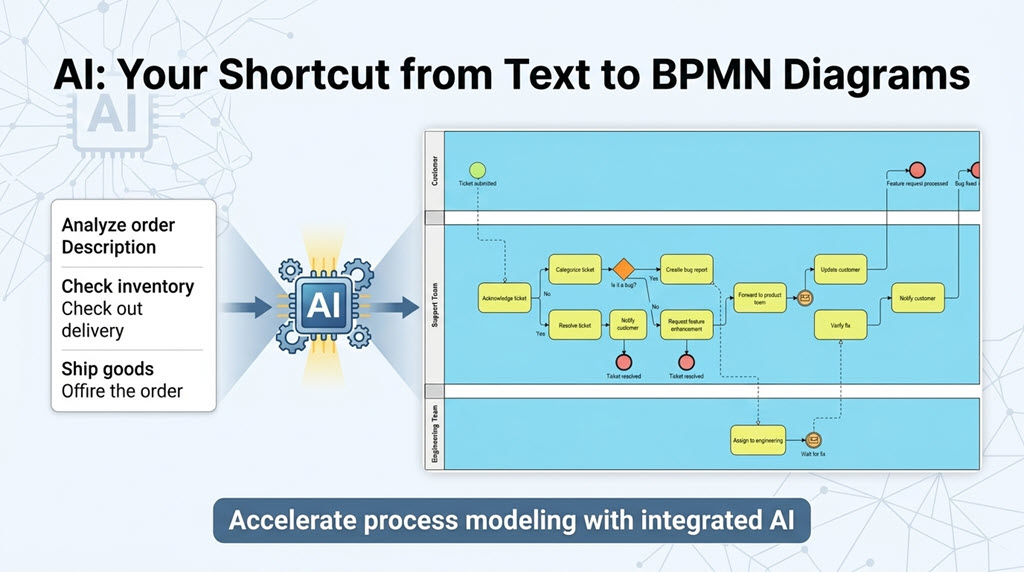
Text-to-diagram (or "Diagram-as-Text") frameworks like PlantUML and Mermaid.js have revolutionized software documentation. Developers can easily write a few lines of declarative text to instantly render intricate sequence diagrams, flowcharts, and architecture frameworks.
Yet, when it comes to the Business Process Model and Notation (BPMN) standard, the market falls surprisingly quiet. Only a very small handful of specialized enterprise platforms support native text-to-BPMN generation.
The primary culprit behind this shortage is layout complexity, with the notorious engineering challenges of the BPMN swimlane leading the charge.
Traditional flowcharts map single-threaded logic moving down or across a single canvas. BPMN, conversely, is an multi-dimensional matrix of semantics, geometry, and operational scope.
In BPMN, pools represent independent organizations, and swimlanes represent internal roles or departments.
Text-to-diagram engines rely heavily on graph-layout engines (like Graphviz dot). These engines excel at positioning nodes hierarchically but fail under BPMN's strict alignment rules:
A standard flowchart uses few shapes. BPMN includes dozens of highly specific variations: message start events, timer boundary conditions, error intermediate events, and compensation tasks. Representing these combinations cleanly via text syntax while maintaining correct visual proportions is incredibly difficult to standardize.
Because of these structural bottlenecks, standard text-to-diagram tools generally offer no support or only heavily compromised implementations of BPMN:
| Feature | Standard Diagram-as-Text (e.g., Mermaid) | Pure BPMN Specification Requirements |
|---|---|---|
| Primary Focus | Simple flowcharts, sequences, and markdown integration. | Formal, audit-ready enterprise process compliance. |
| Swimlane Capabilities | Rough visual columns; limited cross-boundary routing logic. | Strict geometric containment with explicit pool interactions. |
| Symbol Depth | Basic shapes (rectangles, diamonds, circles). | Dozens of event, gateway, and artifact variations. |
| Layout Outcome | Visually chaotic when processes scale linearly. | Clean, readable, and highly standardized matrix views. |
To circumvent the limitations of traditional text script parsing, Visual Paradigm leverages an entirely different architectural approach: AI-powered Natural Language Processing (NLP) mapped directly to its underlying modeling engine.
Instead of forcing users to learn a complicated, custom declarative text language, Visual Paradigm allows users to input plain-English procedural descriptions. The system processes the text and instantly instantiates a fully modeled Business Process Diagram.
To utilize text-to-BPMN generation in the application:

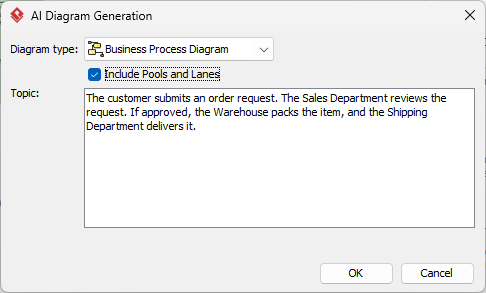
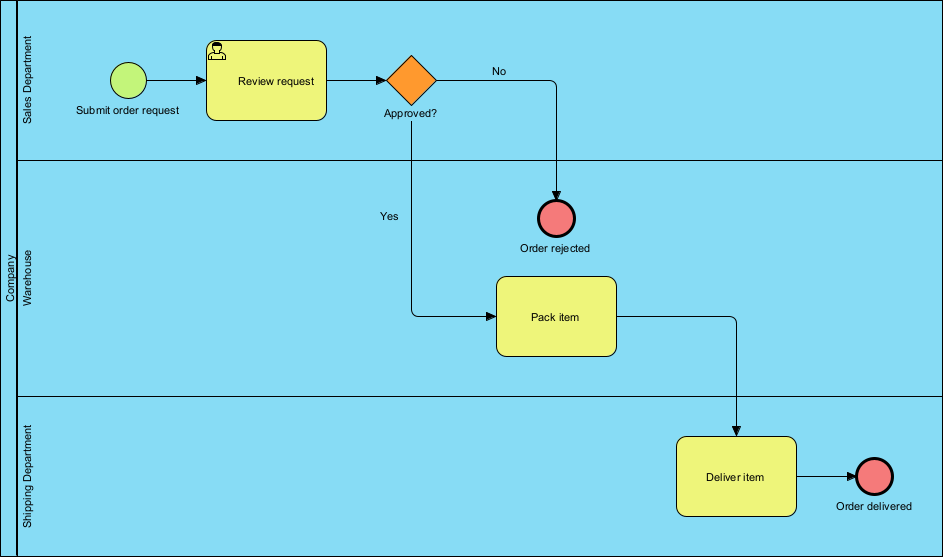
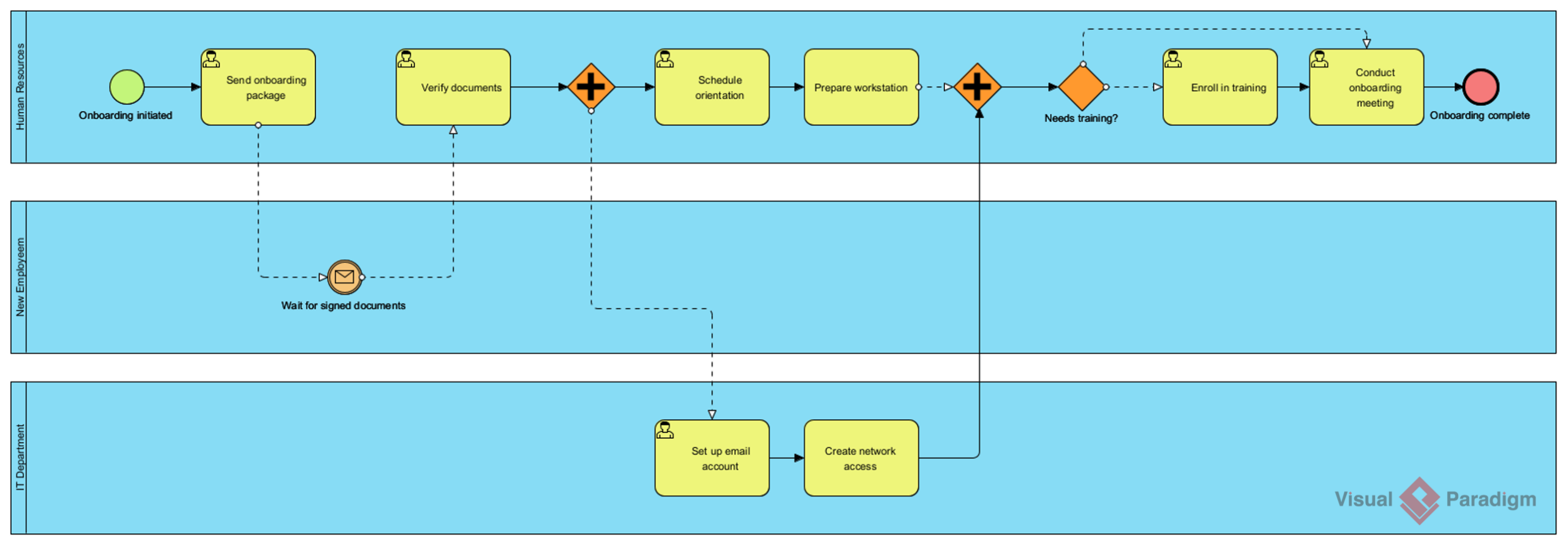
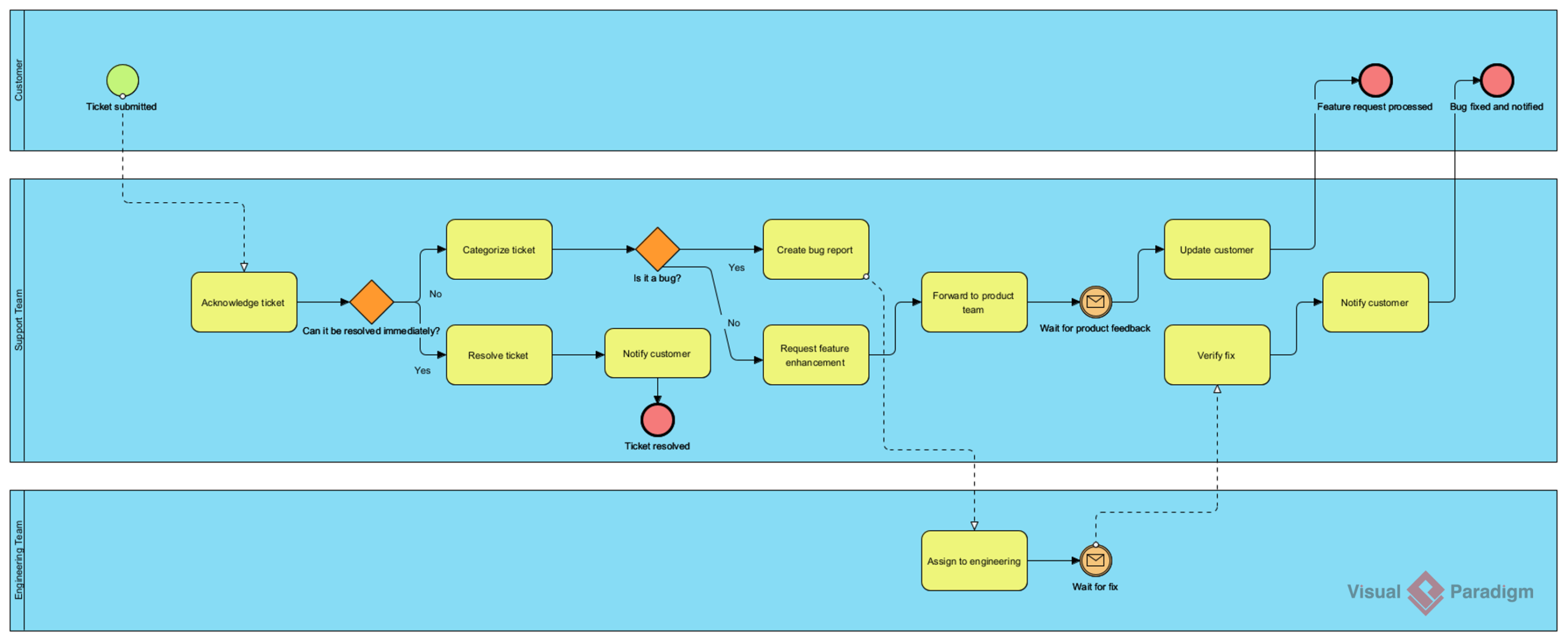
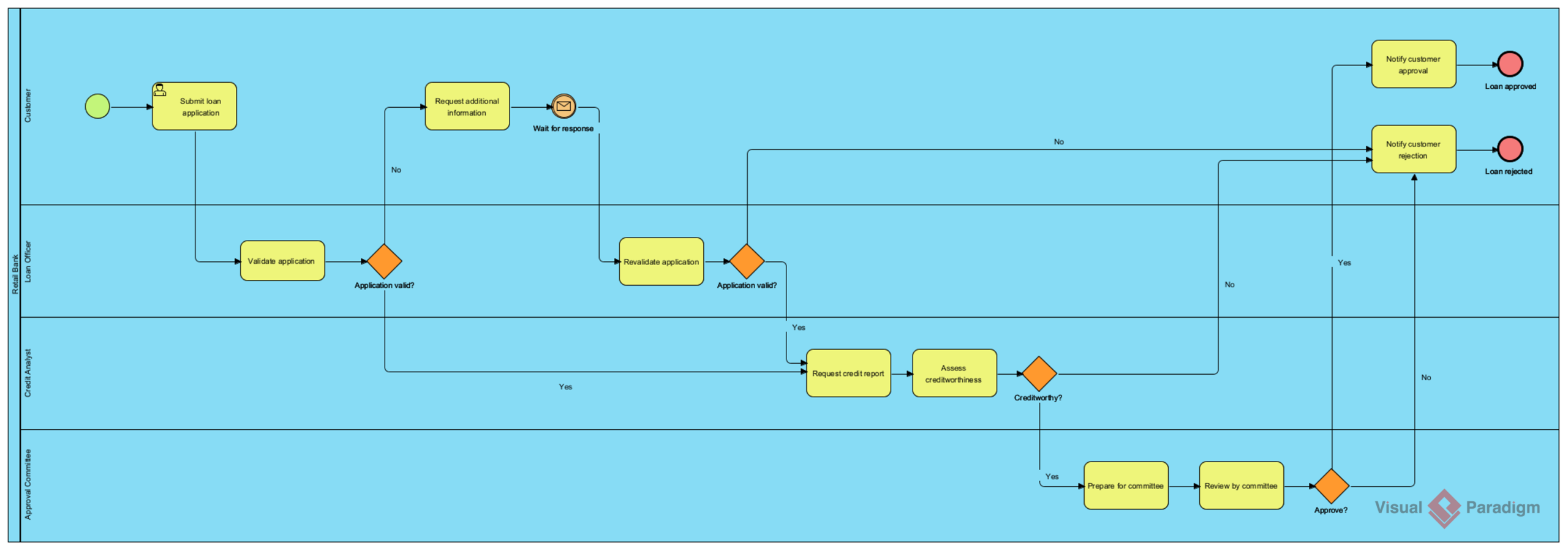
Listed below are more Business Process Diagram generated with AI, using Visual Paradigm Desktop.
Prompt: An employee onboarding process in a mid-sized company.
Prompt: A customer support ticket resolution process for a SaaS company.
Prompt: A loan application and approval process in a retail bank.
To learn more about the technical capabilities and various use cases, please visit our AI Diagram Generation landing page.
Download the latest version of Visual Paradigm today and start using the most advanced AI BPMN tool on the market.
The journey from conceptual process narrative to compliant, enterprise-ready BPMN diagram has long been hindered by the inherent complexity of the BPMN specification itself. Traditional text-to-diagram approaches, while transformative for software architecture documentation, simply were not designed to handle the multi-dimensional geometry, strict routing constraints, and symbolic richness that BPMN demands. This "invisible wall" has left business analysts and process architects relying on manual, time-intensive modeling workflows—slowing innovation and limiting agility in digital transformation initiatives.
Visual Paradigm's AI-powered BPMN generation capability represents a paradigm shift. By leveraging advanced Natural Language Processing mapped directly to a robust semantic modeling engine, the platform bypasses the limitations of declarative scripting entirely. Users can now describe processes in plain English and receive instantly generated, standards-compliant Business Process Diagrams—complete with properly contained swimlanes, intelligently routed sequence flows, and correctly positioned BPMN symbols. The result is not just a static image, but a fully interactive, editable, and simulation-ready process model.
For organizations seeking to accelerate process documentation, improve cross-functional alignment, and empower citizen modelers, this AI-driven approach removes the traditional barriers to BPMN adoption. It transforms process modeling from a specialized technical skill into an accessible, collaborative activity—freeing teams to focus on what truly matters: analyzing, optimizing, and innovating upon the workflows that drive business value. As AI continues to mature and integrate with enterprise tooling, solutions like Visual Paradigm's AI BPMN generator signal a new era where the gap between idea and implementation narrows dramatically, unlocking unprecedented speed and clarity in business process management.

