
A transformation programme can have a persuasive target operating model, a funded technology roadmap, and committed delivery teams, yet still fail when decisions are made architecture by architecture rather than across the enterprise. Siloed thinking creates misalignment between business goals and IT execution, leading to costly rework and unmanaged risk.
The TOGAF Architecture Development Method (ADM) provides a disciplined way to address this problem. However, in today’s fast-paced digital landscape, relying on theory alone is not enough. Modern enterprise architects must combine the structured governance of TOGAF ADM with the visual standardization of ArchiMate, accelerated by Artificial Intelligence (AI), and executed through robust tooling like Visual Paradigm.
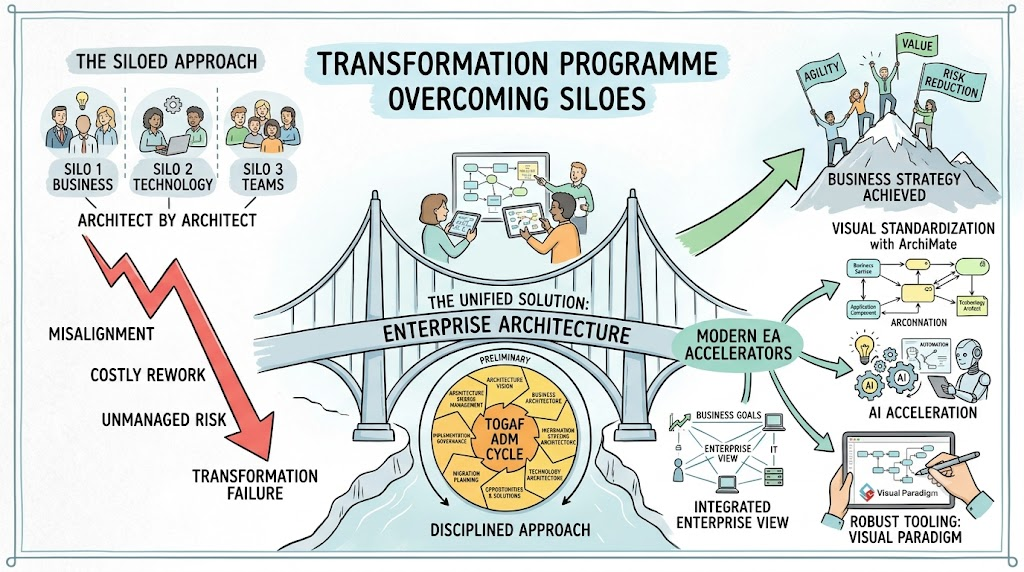
This comprehensive guide explores how to integrate these four pillars—Method (TOGAF), Language (ArchiMate), Intelligence (AI), and Tooling (Visual Paradigm)—to define a target state, assess gaps, and govern change effectively across the enterprise.
The ADM sits at the centre of the TOGAF Standard. It structures architecture work into a continuous cycle of connected phases. Its practical purpose is to help an organisation answer demanding questions: What business outcomes are required? Which capabilities will support them? What constraints must be respected? How will implementation remain aligned?
Crucially, the ADM is a circular process. Enterprise architecture is never "completed and filed away." Markets change, regulations evolve, and new technologies emerge. Architecture must be maintained as a managed, continuous capability.
Below is a detailed breakdown of the ADM phases, enhanced with how ArchiMate visualizes the work, and how AI and Visual Paradigm accelerate and govern the process.

Before developing an architecture, the organisation must decide how architecture will operate. This phase defines principles, governance, roles, standards, and the level of tailoring required.
ArchiMate Integration: Define standard ArchiMate viewpoints and modeling conventions to ensure all architects speak the same visual language from day one.
AI & Visual Paradigm: Use Visual Paradigm’s framework customization wizards to tailor the TOGAF metamodel to your specific organizational needs. AI can analyze historical project data to recommend optimal governance cadences and identify potential skill gaps in the architecture team.
Phase A establishes the case for change, defining scope, expected value, and key stakeholders. The output is a clear vision that avoids being too broad or too technical.
ArchiMate Integration: Use the Motivation aspect of ArchiMate to map Stakeholders, Drivers, Assessments, Goals, and Requirements. This visually links business pain points to high-level objectives.
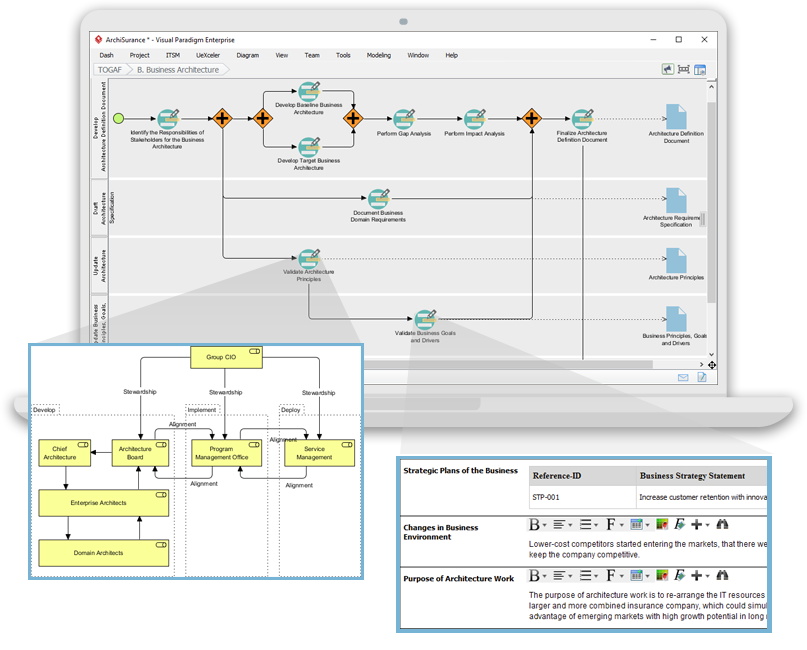
AI & Visual Paradigm: Leverage Visual Paradigm’s AI assistant to draft initial architecture vision documents based on raw stakeholder interview transcripts. AI can also perform sentiment analysis on stakeholder feedback to highlight hidden risks or misaligned expectations early in the cycle.
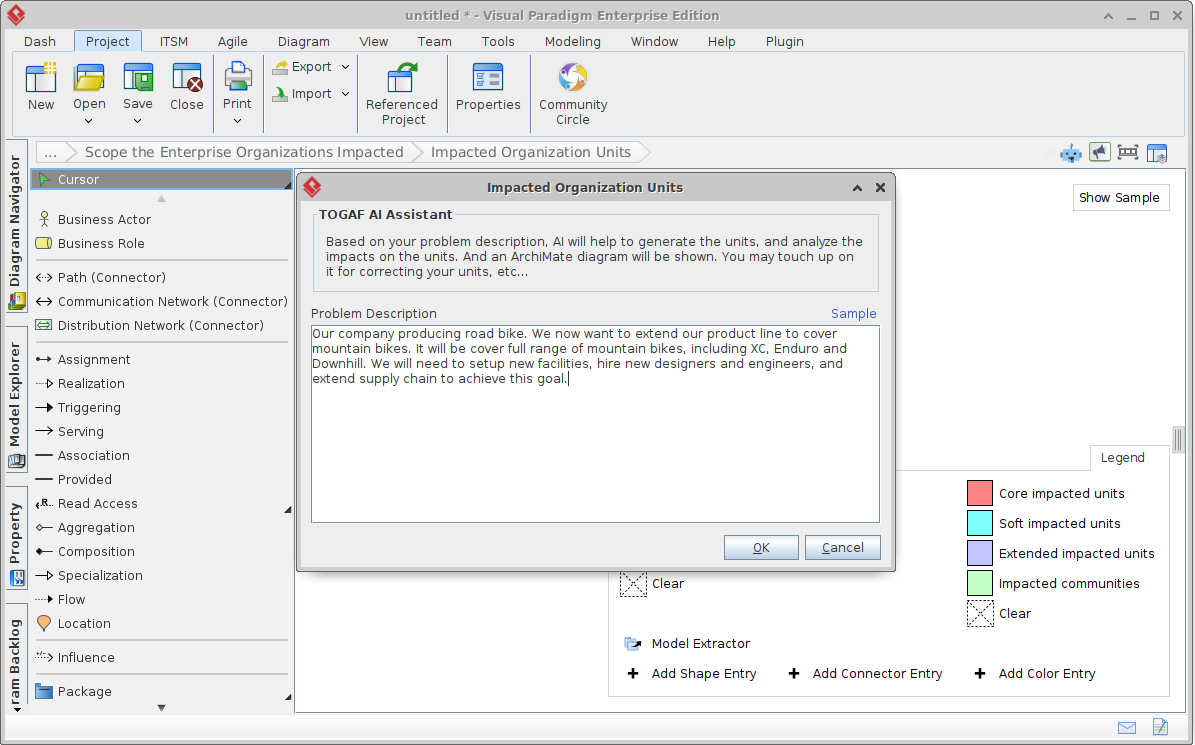
These phases develop the core domains: Business (B), Information Systems/Data & Application (C), and Technology (D). They must be considered together to trace dependencies.
ArchiMate Integration:
Phase B (Business): Map the Business Layer (Value Streams, Business Processes, Services, and Actors).
Phase C (Info Systems): Map the Application Layer (Application Components, Interfaces) and the data structures supporting them.
Phase D (Technology): Map the Technology Layer (Nodes, Devices, Networks, Infrastructure Services).
AI & Visual Paradigm: This is where Visual Paradigm shines. Architects use its intuitive drag-and-drop ArchiMate canvas to build these layers. AI steps in to perform automated consistency checks—ensuring, for example, that every Business Service in Phase B is supported by an Application Component in Phase C, and hosted on a Technology Node in Phase D. AI can also suggest optimal technology stacks based on industry best practices and historical success rates.
Phase E (Opportunities and Solutions) turns architecture into work packages. Phase F (Migration Planning) prioritizes these into an implementation and migration plan, balancing ideal targets with commercial and operational realities.
ArchiMate Integration: Utilize the Implementation and Migration extension to visualize Work Packages, Plateaus (transition states), and Deliverables.
AI & Visual Paradigm: Visual Paradigm allows you to link ArchiMate models directly to project management tools (like Jira or MS Project). AI can analyze the transition plateaus to predict resource bottlenecks, optimize the sequencing of work packages based on dependency constraints, and forecast the ROI of different migration paths.
Phase G (Implementation Governance) ensures delivery choices align with the architecture. Phase H (Architecture Change Management) monitors change requests post-implementation to determine if a new ADM cycle is needed.
ArchiMate Integration: Maintain a "living" architecture repository. As-built models are updated to reflect the actual deployed state, creating a digital twin of the enterprise.
AI & Visual Paradigm: Visual Paradigm’s model-based governance allows for automated compliance reviews. When a development team proposes a design change, AI can instantly run an impact analysis across the ArchiMate models to show which business processes or technology nodes will be affected, ensuring proportionate and rapid governance without slowing down delivery.
Operating at the centre of the ADM, requirements management ensures decisions remain linked to business needs.
AI & Visual Paradigm: Instead of static spreadsheets, Visual Paradigm centralizes requirements, linking them directly to ArchiMate model elements. AI can automatically trace requirements through the architecture, flagging "orphaned" requirements that lack technical implementation, or identifying conflicting constraints before they reach the delivery teams.
TOGAF is designed to be tailored. A global enterprise will use the ADM differently than a growing startup. However, tailoring should not mean removing the difficult parts. Skipping stakeholder alignment or migration planning may yield short-term speed but guarantees long-term rework.
How Visual Paradigm Supports Tailoring:
Visual Paradigm allows organizations to define a "Minimum Viable Architecture" engagement. You can configure the tool to enforce only the necessary governance gates and artifact templates for a specific project's risk profile. This ensures the method remains proportionate, understood by practitioners, and consistently applied where it matters most.
The ADM, ArchiMate, and AI tools deliver better results when supported by skilled practitioners. Capability building must extend beyond enterprise architects to include product managers, business analysts, and security leaders.
Training a cross-functional group creates a consistent understanding of principles and deliverables, reducing friction between strategy and implementation. Combining recognized certification knowledge (such as TOGAF and ArchiMate certifications) with scenario-based learning in Visual Paradigm allows teams to apply the method to their own live change portfolios. The tool acts as a sandbox for professional development, turning theoretical knowledge into practical, organizational muscle memory.
The TOGAF Architecture Development Method provides the vital discipline required to align business outcomes with technology execution. However, in a complex modern enterprise, methodology alone is insufficient.
By integrating ArchiMate, organizations gain a universal visual language that bridges the gap between technical complexity and business comprehension. By injecting AI into the workflow, architects transition from manual modelers to strategic advisors, leveraging predictive insights and automated consistency checks. Finally, by anchoring the entire process in a robust tooling environment like Visual Paradigm, organizations transform abstract architectural concepts into actionable, governed, and traceable delivery roadmaps.
The ADM is most useful when it becomes part of how leaders make investment and change decisions. By combining the structured wisdom of TOGAF with the visual clarity of ArchiMate and the accelerating power of AI-driven Visual Paradigm tooling, organizations can start with a live business priority, apply the exact level of rigor it requires, and use the resulting architecture to make every subsequent decision clearer than the last.

