
In the complex landscape of software engineering, two of the most common causes of project failure are unchecked scope creep and inadequate system testing. While the Unified Modeling Language (UML) is often viewed strictly as a visual diagramming tool for software architecture, its true power lies in its ability to act as a comprehensive management and quality assurance framework.
At the heart of this framework is the Use Case. By focusing on tangible user value, use cases serve as the foundational bridge between initial business requirements, project scope management, and final quality assurance. This guide explores how leveraging UML—specifically through the lens of use cases and the UML Testing Profile—enables teams to accurately track progress, maintain schedule flexibility, and "close the loop" between design and testing.
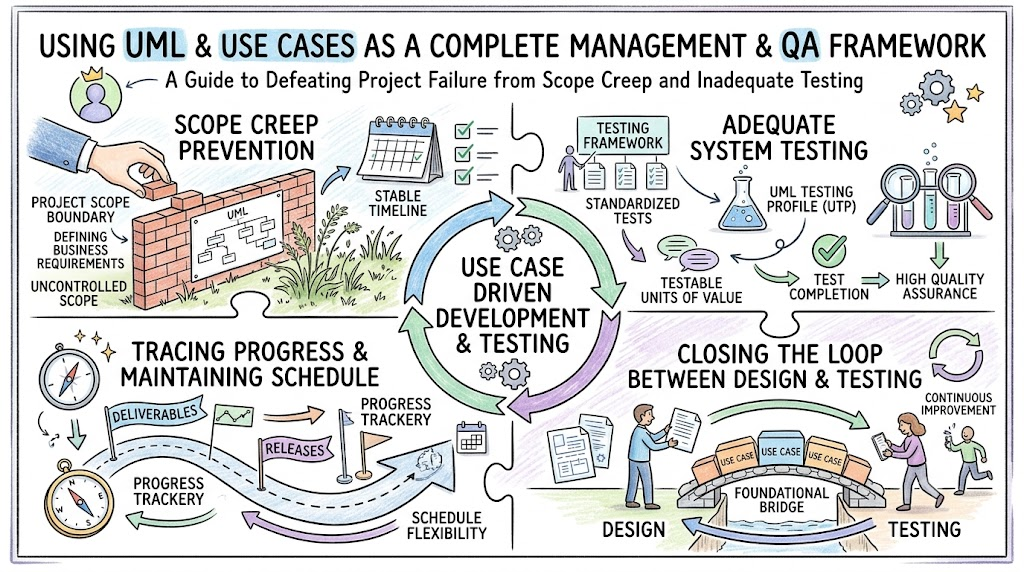
Before diving into the mechanics of scope and testing management, it is essential to understand the core concepts that drive this methodology:
Use Cases: Textual and visual descriptions of how a user interacts with a system to achieve a specific goal. They represent discrete, testable units of functional value.
Scope Creep: The uncontrolled expansion of product or project scope without adjustments to time, budget, and resources. Use cases combat this by strictly defining what is "in" and "out" of the project.
Pass/Fail Criteria: Explicit, measurable conditions defined within a use case that determine whether the system's behavior is acceptable.
UML Testing Profile (UTP): A standardized extension of UML maintained by the Object Management Group (OMG) that provides specific stereotypes and templates for modeling tests.
OOSE (Object-Oriented Software Engineering): The historical methodology developed by Ivar Jacobson (one of the "Three Amigos" who created UML) which originally introduced the concept of using use cases to drive the entire development and testing lifecycle.
UML helps project managers and development teams maintain strict control over a project's scope by shifting the focus from abstract technical tasks to tangible user value.
Once use cases are identified, they are not all created equal. Teams must prioritize them based on business value and technical risk.
Distribution: High-priority use cases are distributed to specific teams or individuals. Because a use case encapsulates a complete slice of functional value (from UI to database), it prevents the siloing of work and ensures teams are delivering end-to-end features.
Risk Mitigation: High-risk use cases are tackled early in the project lifecycle, allowing the team to resolve architectural bottlenecks before scaling up development.
Traditional project management often tracks progress by the percentage of completion of abstract tasks (e.g., "Database is 50% done"). UML offers a much more accurate metric.
Binary Completion: Because each use case represents a completed piece of functional requirement, progress is binary: a use case is either fully implemented and tested, or it is not.
Velocity Measurement: Project managers can accurately track progress and forecast delivery dates based on the sheer number of use cases delivered per sprint or iteration.
No project goes exactly according to plan. When schedule delays occur, UML provides a structured way to adapt without sacrificing the core product.
Jettisoning Low-Value Features: By referring back to the prioritized use case model, stakeholders can easily identify which use cases to jettison or delay.
Value Preservation: This ensures that the highest-value, most critical features are delivered to the customer first, while lower-priority "nice-to-have" features are pushed to future releases.
UML provides a seamless bridge between initial requirements and the final quality assurance process, ensuring that what is built is exactly what was requested.
Use cases are widely considered the optimal starting point for building test cases and procedures.
Natural Framework: Because use cases precisely capture what a user wants from the system (including the "happy path" and alternate/error flows), they provide a natural, logical framework for verifying if those needs have been met.
Traceability: Every test case can be traced directly back to a specific use case, ensuring 100% test coverage of the defined scope.
For a use case to be an effective requirement, it must be testable.
Shared Understanding: Use cases must include clearly defined pass/fail criteria (often called Acceptance Criteria). This ensures that developers know exactly what to build, testers know exactly what to verify, and users know exactly what to expect.
Objective QA: This removes ambiguity from the QA process, replacing subjective opinions with objective, verifiable conditions.
For advanced technical testing, UML offers specialized tools to integrate modeling directly with code-level testing frameworks.
UML Testing Profile (UTP): Maintained by the OMG, the UTP provides standardized mappings to common testing frameworks. For example, a UML <<TestCase>> can be directly mapped to a JUnit test class in Java-based systems, allowing model-driven test generation.
Closing the Loop (OOSE): In historical contexts, the Object-Oriented Software Engineering (OOSE) approach heavily influenced UML by designing the test model specifically to "close the loop." In OOSE, use cases do not just drive design; they directly drive the development of system tests, ensuring that the testing phase is a direct validation of the initial requirements.
Below are PlantUML code examples illustrating how UML models scope, testing flows, and framework mapping.
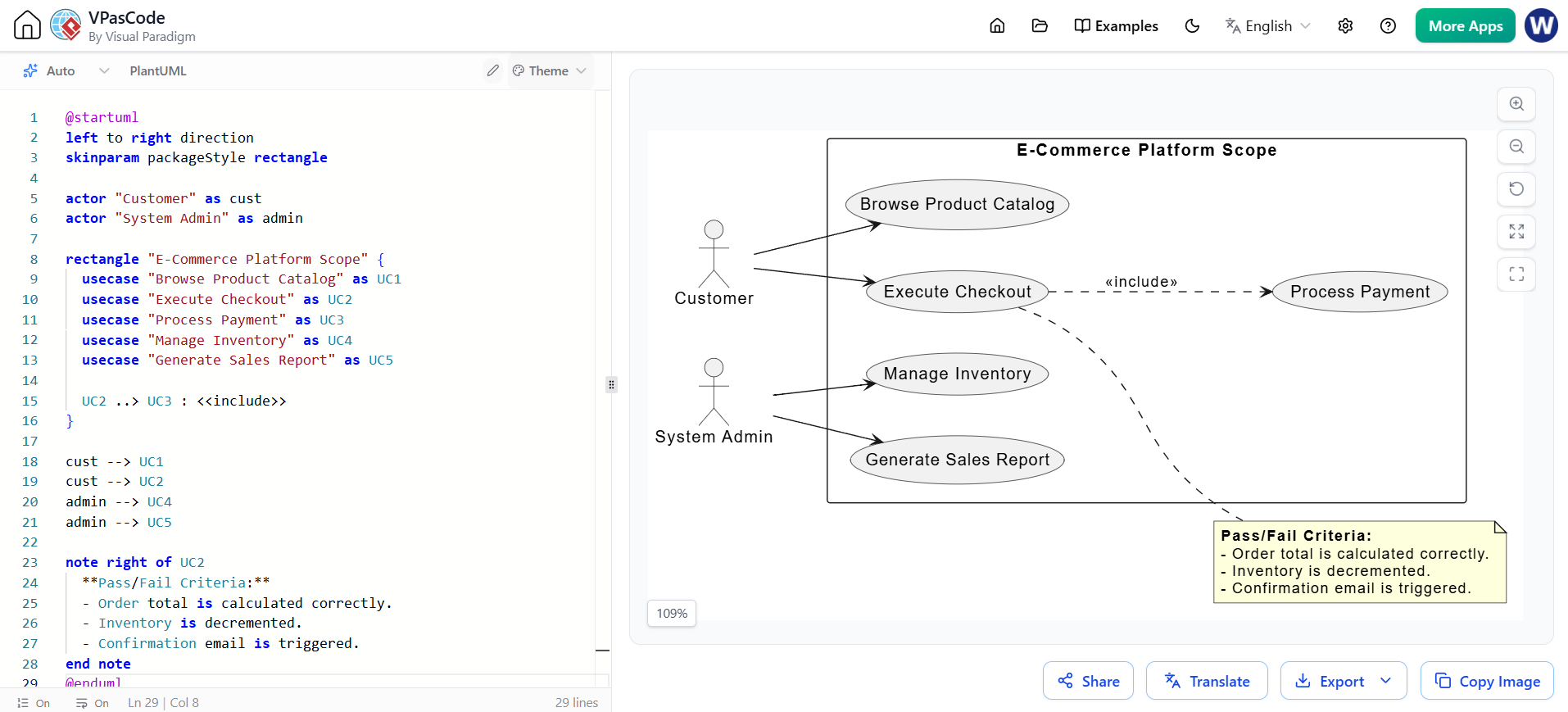
This diagram illustrates how use cases define the boundaries of the system and map actors to specific functional requirements, forming the basis for workload assignment.
@startuml
left to right direction
skinparam packageStyle rectangle

actor "Customer" as cust
actor "System Admin" as admin

rectangle "E-Commerce Platform Scope" {
  usecase "Browse Product Catalog" as UC1
  usecase "Execute Checkout" as UC2
  usecase "Process Payment" as UC3
  usecase "Manage Inventory" as UC4
  usecase "Generate Sales Report" as UC5

  UC2 ..> UC3 : <<include>>
}

cust --> UC1
cust --> UC2
admin --> UC4
admin --> UC5

note right of UC2
  **Pass/Fail Criteria:**
  - Order total is calculated correctly.
  - Inventory is decremented.
  - Confirmation email is triggered.
end note
@enduml
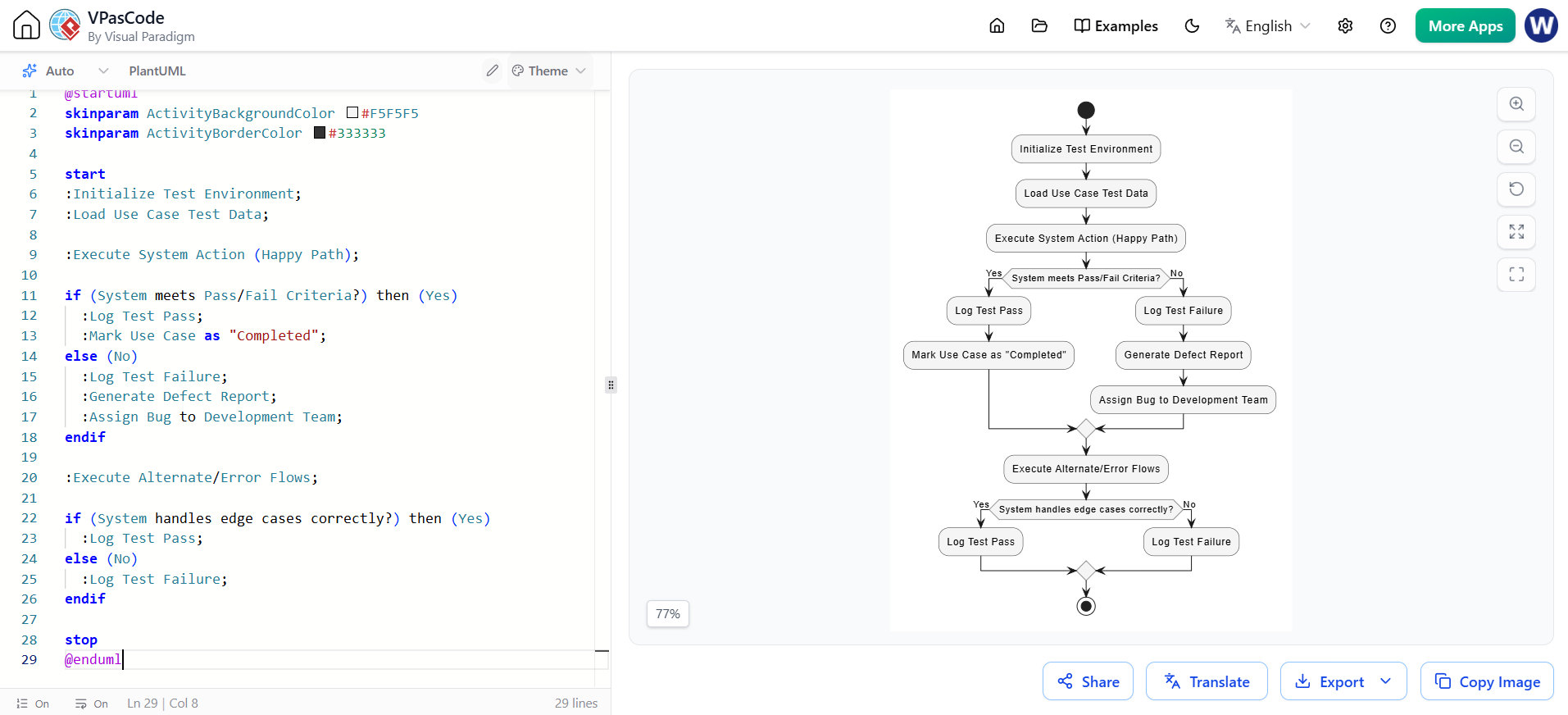
This diagram demonstrates how a use case is translated into a testing procedure, highlighting the decision points based on the defined Pass/Fail criteria.
@startuml
skinparam ActivityBackgroundColor #F5F5F5
skinparam ActivityBorderColor #333333

start
:Initialize Test Environment;
:Load Use Case Test Data;

:Execute System Action (Happy Path);

if (System meets Pass/Fail Criteria?) then (Yes)
  :Log Test Pass;
  :Mark Use Case as "Completed";
else (No)
  :Log Test Failure;
  :Generate Defect Report;
  :Assign Bug to Development Team;
endif

:Execute Alternate/Error Flows;

if (System handles edge cases correctly?) then (Yes)
  :Log Test Pass;
else (No)
  :Log Test Failure;
endif

stop
@enduml
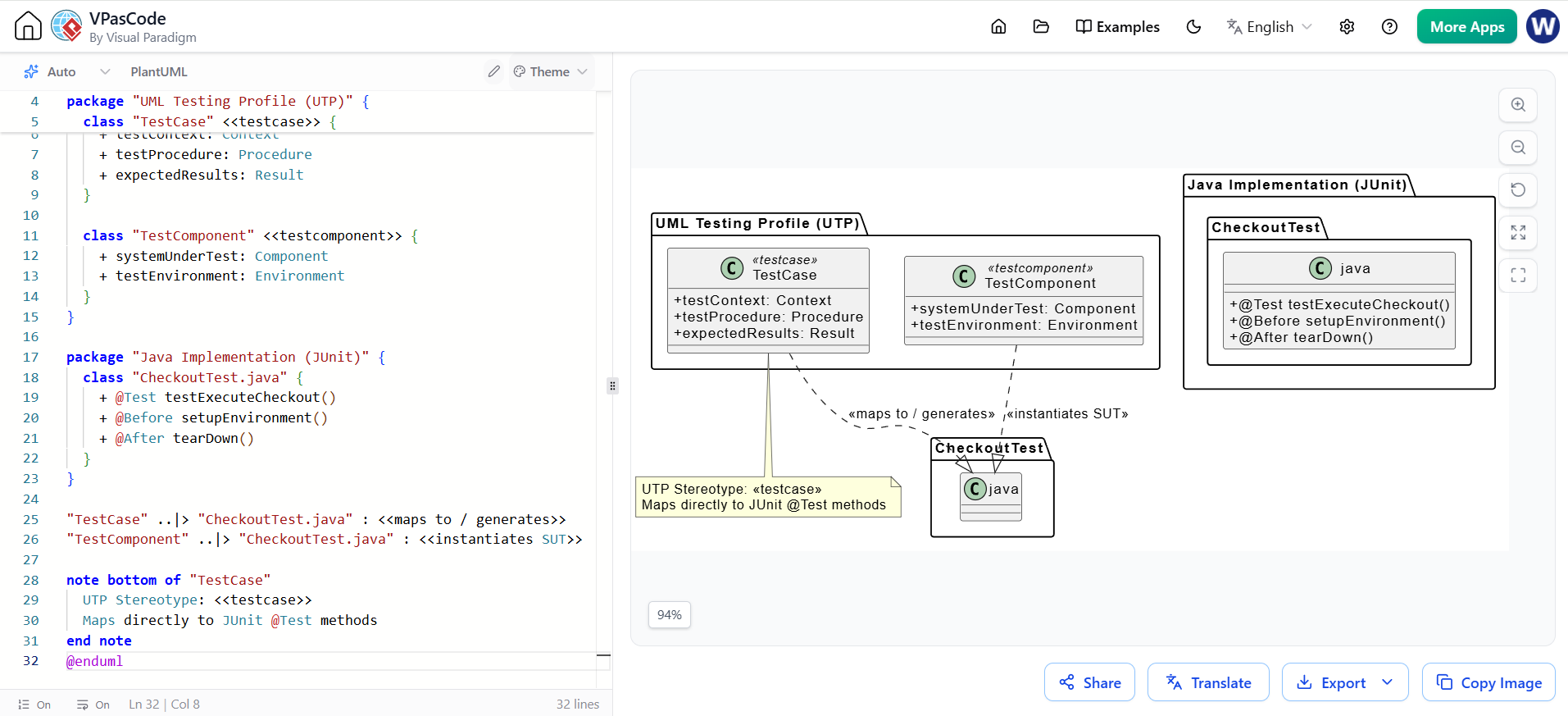
This diagram illustrates the UML Testing Profile (UTP) and how UML test models map directly to Java-based testing frameworks like JUnit, "closing the loop" from model to code.
@startuml
skinparam classAttributeIconSize 0

package "UML Testing Profile (UTP)" {
  class "TestCase" <<testcase>> {
    + testContext: Context
    + testProcedure: Procedure
    + expectedResults: Result
  }

  class "TestComponent" <<testcomponent>> {
    + systemUnderTest: Component
    + testEnvironment: Environment
  }
}

package "Java Implementation (JUnit)" {
  class "CheckoutTest.java" {
    + @Test testExecuteCheckout()
    + @Before setupEnvironment()
    + @After tearDown()
  }
}

"TestCase" ..|> "CheckoutTest.java" : <<maps to / generates>>
"TestComponent" ..|> "CheckoutTest.java" : <<instantiates SUT>>

note bottom of "TestCase"
  UTP Stereotype: <<testcase>>
  Maps directly to JUnit @Test methods
end note
@enduml
The Unified Modeling Language is far more than a static collection of architectural diagrams; it is a dynamic framework for managing the entire software delivery lifecycle. By anchoring project management and quality assurance in Use Cases, teams can transform abstract requirements into tangible, trackable, and testable units of work.
Through structured workload assignment, binary progress tracking, and the strategic triaging of features, UML keeps project scope firmly in check. Simultaneously, by utilizing defined pass/fail criteria, the UML Testing Profile, and the historical best practices of OOSE, organizations can "close the loop" between design and testing. Ultimately, mastering UML use cases empowers teams to deliver high-value, rigorously tested software on time and within budget, turning the chaos of software development into a predictable, manageable engineering discipline.

