
In the realm of engineering—whether civil, mechanical, or electrical—no one builds a skyscraper, a car, or a circuit board without first creating a detailed blueprint. Software engineering is no different. However, because software is intangible and infinitely malleable, the temptation to skip the modeling phase and jump straight into coding is incredibly high. This often leads to bloated, unmaintainable, and ultimately failed systems.
Modeling is the art of abstraction. It is the process of creating simplified representations of a complex system to understand its structure, behavior, and requirements. Drawing from a rich history in traditional engineering disciplines, modern software development relies on foundational modeling principles to manage complexity, facilitate communication, and ensure that the final product aligns with business goals.
This comprehensive guide explores the Four Basic Principles of Modeling, translating these timeless engineering concepts into actionable strategies for modern software development and object-oriented design.
Before diving into the core principles, it is essential to establish a shared vocabulary regarding software modeling:
Model: An abstraction of reality. It highlights specific aspects of a system while intentionally ignoring others to reduce cognitive load.
Abstraction: The process of extracting the essential characteristics of a system while filtering out irrelevant details.
Architecture: The fundamental organization of a system, embodied in its components, their relationships to each other, and the environment.
View / Viewpoint: A representation of a specific set of system concerns (e.g., security, performance, business logic). A viewpoint is the "lens" through which you look, and the view is what you see.
Object-Oriented (OO) Paradigm: A programming model based on the concept of "objects," which can contain data (attributes) and code (methods). OO modeling is particularly effective because it bridges the gap between real-world concepts and software implementation.
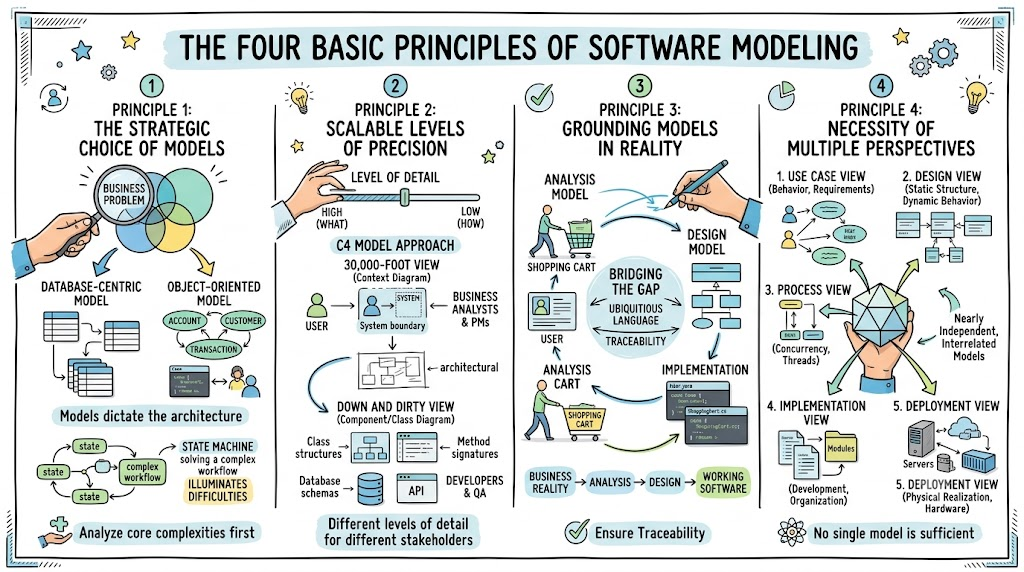
"The choice of what models to create has a profound influence on how a problem is attacked and how a solution is shaped."
A model is not just a reflection of a system; it is a lens through which you view the problem. The models you choose dictate the architecture of your solution.
The Impact of Choice: If you approach a banking system using a strictly database-centric model, your solution will likely be shaped around tables, stored procedures, and data normalization. Conversely, if you approach the exact same problem using an object-oriented model, your solution will be shaped around entities (like Account, Transaction, and Customer) and their behaviors.
Illumination vs. Misdirection: The right models illuminate the most difficult development problems (e.g., using a state-machine model to solve complex order-lifecycle issues). The wrong models will mislead you, causing you to optimize for irrelevant issues while ignoring critical flaws.
Actionable Advice: Before drawing a single diagram, analyze the core complexities of your project. If the system is highly concurrent, choose models that highlight threading and state. If it is highly data-driven, choose models that highlight data flow and storage.
"Every model may be expressed at different levels of precision."
A common mistake in software modeling is creating a single, monolithic diagram that attempts to serve everyone. In reality, different stakeholders require different levels of detail. The best models are scalable.
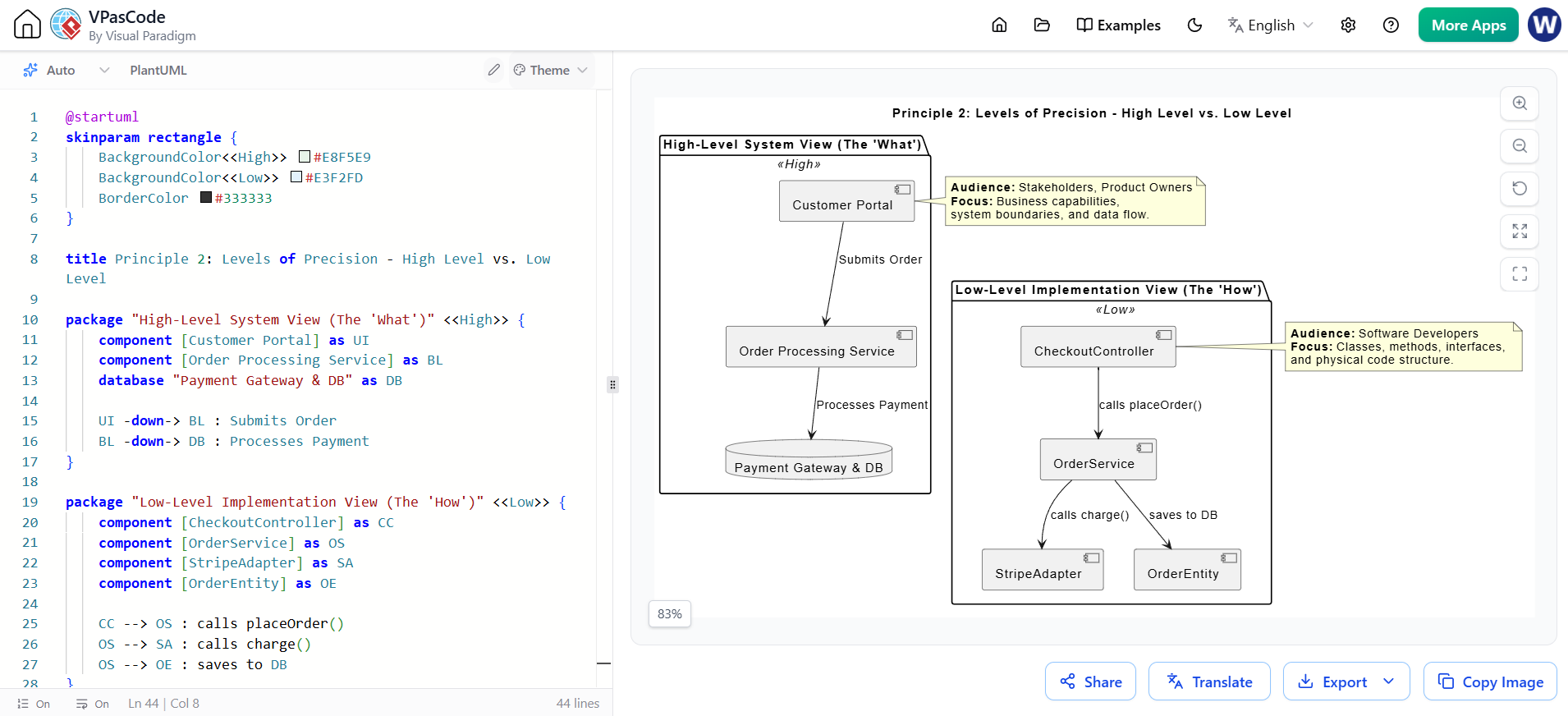
The 30,000-Foot View (The "What"): Business analysts, project managers, and end-users need high-level models. These models focus on business value, system boundaries, and major components. They answer the question: What does the system do?
The "Down and Dirty" View (The "How"): Software developers and QA engineers need granular models. These models focus on class structures, method signatures, database schemas, and API contracts. They answer the question: How do we build it?
Actionable Advice: Adopt a tiered modeling approach (such as the C4 model). Start with Context diagrams for stakeholders, drill down to Container diagrams for architects, and finish with Component/Class diagrams for developers. Never force a developer to read a 50-page business requirements document, and never force a CEO to read a 200-class UML diagram.
"The best models are connected to reality."
All models are simplifications, but they must not be detached from reality. The ultimate goal of a software model is to guide the creation of working software.
The Analysis-Design Chasm: A notorious pitfall in software engineering is the "disconnect" between the analysis model (what the business wants) and the design model (what the developers build). When these two models use different terminologies or structures, the system as conceived inevitably diverges from the system as built. The model becomes "dead documentation."
Bridging the Gap: Object-oriented systems are uniquely suited to solve this problem. Because OO analysis identifies real-world "objects" (e.g., User, ShoppingCart), and OO design implements those exact same objects in code, the semantic gap is closed. The analysis model naturally evolves into the design model, which compiles into the implementation.
Actionable Advice: Ensure traceability. Every element in your design model should trace back to a requirement in your analysis model. Use ubiquitous language (a core tenet of Domain-Driven Design) so that business stakeholders and developers are using the exact same terms in both conversation and code.
"No single model is sufficient. Every nontrivial system is best approached through a small set of nearly independent models."
Software systems are multi-dimensional. Trying to capture the business requirements, the database schema, the network topology, and the user interface in a single diagram is impossible. It results in an unreadable "spaghetti" model.
Nearly Independent, Interrelated Models: You must break the system down into a small set of distinct models. Each model should be simple enough to be understood on its own, but together, they must form a complete picture of the system.
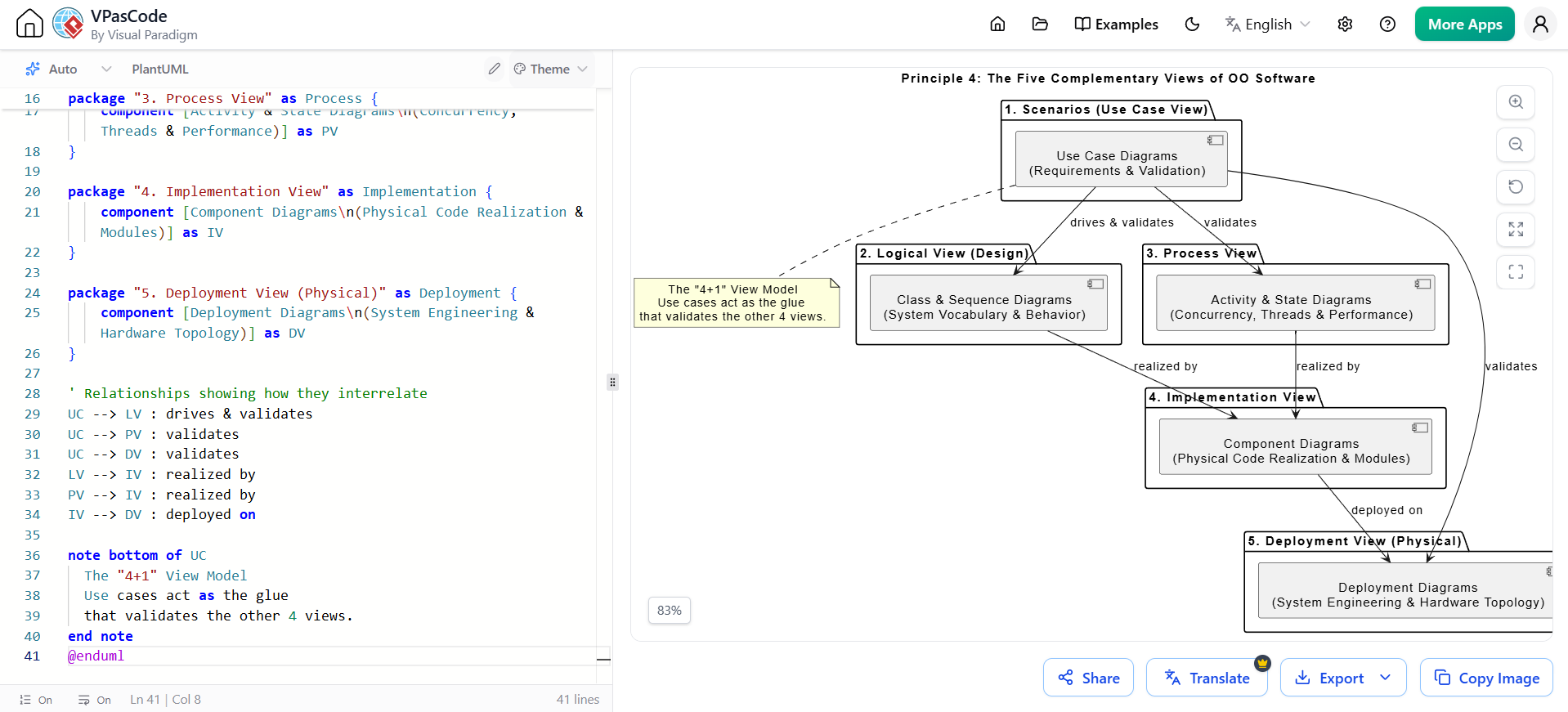
The Five Complementary Views: For object-oriented software, industry best practices (heavily influenced by the 4+1 architectural model) dictate the use of five specific views:
Use Case View (Requirements): Describes the behavior of the system from the user's perspective. It drives the entire design.
Design View (Logical/Vocabulary): Defines the static structure and dynamic behavior of the system's classes and objects.
Process View (Concurrency): Addresses the runtime concerns of the system, including threads, processes, synchronization, and performance.
Implementation View (Physical Realization): Shows how the software is organized in the development environment (modules, layers, source code files).
Deployment View (System Engineering): Maps the software onto the physical hardware, showing network topology, servers, and containers.
To illustrate these principles, below are PlantUML code examples. You can copy and paste these into any PlantUML renderer (like the PlantUML Web Server, VS Code extensions, or IDE plugins) to generate the visual diagrams.
This diagram illustrates how the five independent models interrelate to form a complete architectural picture, with the Use Case view acting as the primary driver.
@startuml
skinparam componentStyle uml2
skinparam shadowing false
skinparam defaultTextAlignment center

title Principle 4: The Five Complementary Views of OO Software

package "1. Scenarios (Use Case View)" as UseCase {
    component [Use Case Diagrams\n(Requirements & Validation)] as UC
}

package "2. Logical View (Design)" as Logical {
    component [Class & Sequence Diagrams\n(System Vocabulary & Behavior)] as LV
}

package "3. Process View" as Process {
    component [Activity & State Diagrams\n(Concurrency, Threads & Performance)] as PV
}

package "4. Implementation View" as Implementation {
    component [Component Diagrams\n(Physical Code Realization & Modules)] as IV
}

package "5. Deployment View (Physical)" as Deployment {
    component [Deployment Diagrams\n(System Engineering & Hardware Topology)] as DV
}

' Relationships showing how they interrelate
UC --> LV : drives & validates
UC --> PV : validates
UC --> DV : validates
LV --> IV : realized by
PV --> IV : realized by
IV --> DV : deployed on

note bottom of UC
  The "4+1" View Model
  Use cases act as the glue
  that validates the other 4 views.
end note
@enduml
This diagram demonstrates how the same system (an E-commerce Checkout) can be modeled at two completely different levels of precision to serve different audiences.
@startuml
skinparam rectangle {
    BackgroundColor<> #E8F5E9
    BackgroundColor<> #E3F2FD
    BorderColor #333333
}

title Principle 2: Levels of Precision - High Level vs. Low Level

rectangle "High-Level System View (The 'What')" <> {
    component [Customer Portal] as UI
    component [Order Processing Service] as BL
    database "Payment Gateway & DB" as DB

    UI -down-> BL : Submits Order
    BL -down-> DB : Processes Payment
}

rectangle "Low-Level Implementation View (The 'How')" <> {
    component "CheckoutController" as CC
    component "OrderService" as OS
    component "StripeAdapter" as SA
    component "OrderEntity" as OE

    CC --> OS : calls placeOrder()
    OS --> SA : calls charge()
    OS --> OE : saves to DB
}

' Visual separation
[Customer Portal] -[hidden]down- [CheckoutController]

note right of UI
  **Audience:** Stakeholders, Product Owners
  **Focus:** Business capabilities,
  system boundaries, and data flow.
end note

note right of CC
  **Audience:** Software Developers
  **Focus:** Classes, methods, interfaces,
  and physical code structure.
end note
@enduml Modeling is not about creating perfect, exhaustive documentation; it is about managing complexity and facilitating communication. By adhering to the four fundamental principles of modeling, software teams can avoid the traps of premature coding and architectural drift.
Choose your models wisely to ensure you are attacking the right problems.
Scale your precision to ensure every stakeholder gets the exact level of detail they need.
Keep your models connected to reality to ensure the blueprint actually matches the building.
Utilize multiple, nearly independent models to capture the multi-dimensional nature of nontrivial software systems.
Ultimately, a well-modeled system is a well-understood system. By investing time in these foundational modeling principles, engineering teams can build software that is not only robust and scalable but also deeply aligned with the real-world problems it was designed to solve.

