
The landscape of systems engineering is undergoing a transformative shift. As complex systems grow more interconnected and demanding, the tools and languages we use to design them must evolve. Enter SysML 2.0—a ground-up redesign of the Systems Modeling Language that moves beyond incremental updates to deliver a fundamentally more powerful, precise, and collaborative modeling experience.
Unlike its predecessor, SysML 2.0 is not merely a profile built atop UML. It is founded on the Kernel Modeling Language (KerML), a purpose-built metamodel designed specifically for systems engineering. This architectural shift unlocks new capabilities: textual modeling alongside diagrams, standardized APIs for tool interoperability, formal semantics that reduce ambiguity, and AI-assisted workflows that accelerate development.
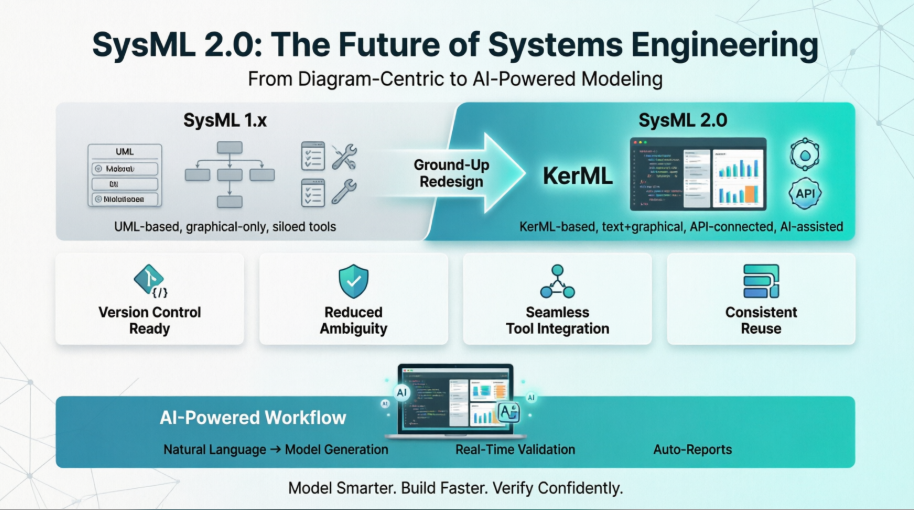
This guide explores the core advancements of SysML 2.0, compares them directly with SysML 1.x, and showcases how modern tooling—like Visual Paradigm's AI-powered SysML v2 Studio—brings these capabilities to life for engineering teams ready to build smarter, faster, and with greater confidence.
Understanding the evolution requires looking at the architectural differences that define each version:
| Feature | SysML 1.x | SysML 2.0 |
|---|---|---|
| Foundation | Built on top of UML as a profile | Built on KerML, a purpose-built metamodel |
| Primary Notation | Graphical only (diagram-centric) | Graphical AND Textual syntax |
| Integration | Tool-specific; often operates in silos | Standard API (REST/OSLC) for seamless interoperability |
| Reuse Model | Implicit "block and property" approach | Formal "definition and usage" pattern for consistent reuse |
| Precision | High flexibility can lead to ambiguity | Formal semantics reduce ambiguity and improve verification |
This table highlights more than feature differences—it reflects a philosophical shift. SysML 2.0 prioritizes precision, interoperability, and developer experience without sacrificing the visual clarity that made SysML valuable in the first place.
Engineers can now define models using a clean, readable textual syntax. This unlocks powerful workflows: version control with Git, meaningful code diffs, automated testing, and scriptable model transformations. Text and diagrams stay in sync, letting teams choose the representation that best fits their task.
For the first time, a standardized API allows requirements management tools, simulation engines, and analysis platforms to connect directly to SysML models. No more custom plugins or fragile integrations—just reliable, vendor-neutral data exchange.
Requirements in SysML 2.0 include formal attributes, constraints, and relationships. This enables quantifiable verification directly within the model, turning requirements from static documents into active, testable specifications.
SysML 2.0 strictly separates the definition of a component (e.g., "Engine Def") from its usage (e.g., "Left Engine"). This pattern promotes consistent reuse across product lines, reduces modeling errors, and clarifies intent for both humans and tools.
SysML v2 Studio is the first web-based environment designed specifically for SysML 2.0, combining AI-powered assistance, real-time synchronization, and professional-grade validation in a single, accessible platform.
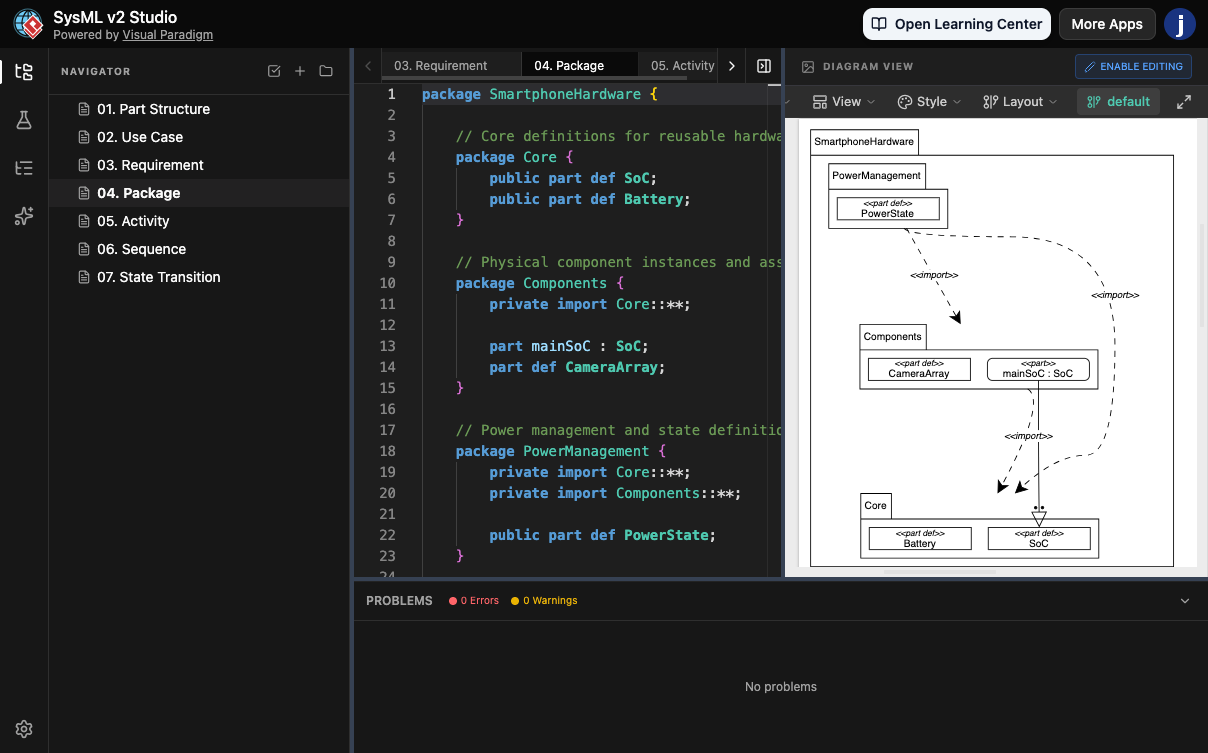
Stop fighting false alarms. SysML v2 Studio's high-precision validation engine highlights only genuine modeling errors. When the tool reports a problem, you can act with confidence—no more second-guessing or manual cross-checking.
Diagrams in SysML v2 Studio are alive. Edit graphics directly or modify the underlying text—changes sync instantly in both directions. Work visually, textually, or both, without losing fidelity or context.
Learn by doing. Access over 500 professional example files covering satellite systems, automotive architectures, medical devices, and more. Explore how experts structure complex models, then adapt those patterns to your own projects.
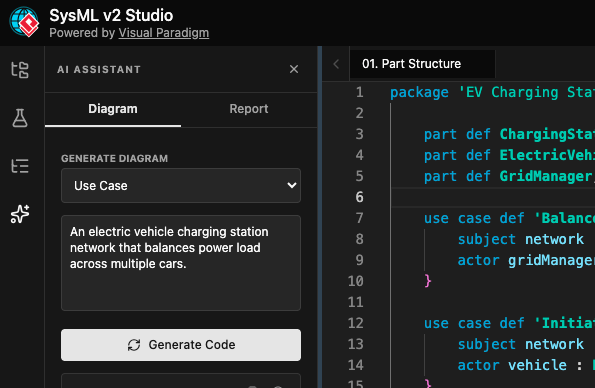
Start from insight, not a blank page. Use natural language prompts to generate complex SysML v2 structures: part hierarchies, requirement trees, activity flows, and more. The AI assistant understands engineering semantics—not just syntax—so generated models are logically sound and ready to refine.
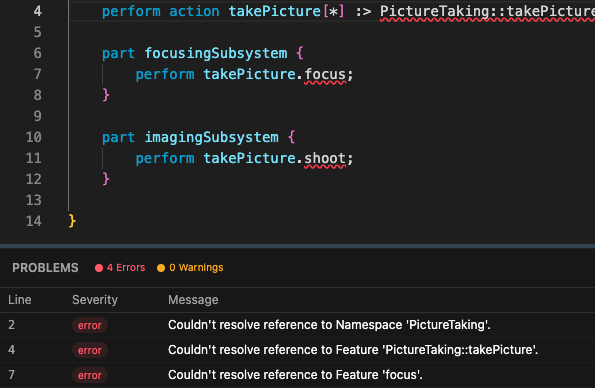
Write cleaner code faster with a built-in SysML v2 compiler that provides real-time error checking and semantic suggestions. Catch namespace conflicts, unresolved references, and constraint violations as you type—ensuring compliance with the latest OMG standards from the start.
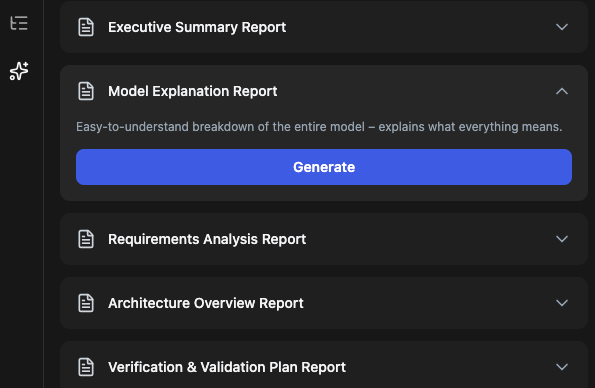
Transform technical models into stakeholder-ready intelligence. Generate AI-powered executive summaries, gap analyses, safety reports, and verification plans with a single click. Bridge the gap between engineering depth and business clarity.
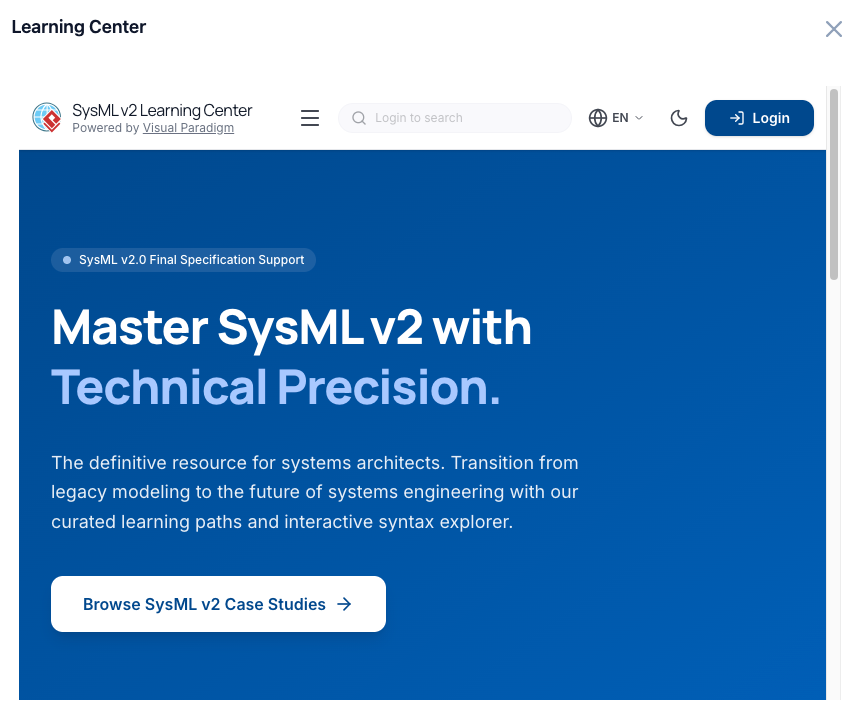
Why toggle between tabs when you can learn where you work? SysML v2 Studio features a fully integrated Learning Center that brings expert guidance directly into your modeling environment.
Explore a deep repository of pre-built SysML v2 projects. Modify complex architectures—like Turbojet Engines or Camera Systems—and see immediate visual results. Learn by experimenting, not just reading.
Access a built-in encyclopedia of AI-powered guides and industry case studies. Master the latest notation standards, modeling patterns, and best practices without ever leaving your workspace.
Design with confidence using tools built for the latest industry standard. All core capabilities for parts, ports, constraints, and requirements are native and ready to use.
Skip manual layout. The Studio automatically transforms your text into organized, professional diagrams that update in real-time as you type.
Type faster with intelligent autocomplete, syntax highlighting, and instant error detection—just like a modern IDE for software developers.
Never get lost in complex projects. Quickly find any component, jump between files, or trace relationships with intuitive navigation tools.
Create publication-quality visuals for reports and presentations. Customize diagram styles and export as crisp PNG, SVG, or PDF.
Stay organized as projects scale. Use familiar folder structures to group models, requirements, and documentation for easy management.
Start from scratch, import an existing model, or use AI-powered setup to jumpstart your design with a natural language description.
Write your model using the smart text editor. Watch diagrams generate and update automatically. Receive real-time feedback to keep your model valid and consistent.
Export high-quality diagrams, generate AI-assisted reports, or share cloud-stored projects with your team for seamless collaboration and review.
What is SysML v2?
It is the latest industry standard for designing complex systems. It uses a modern, precise approach to help engineers visualize and manage everything from aerospace technology to medical devices more efficiently.
Do I need to install any software?
No. SysML v2 Studio is fully web-based. Access it from any modern browser—no installation, no configuration, no maintenance.
How does the AI assistant help me?
The AI assistant understands engineering context. Use natural language to generate model structures, get suggestions for improvements, or automate repetitive modeling tasks.
Can I save and share my work?
Yes. Projects are stored securely in the cloud. Share with teammates, control access permissions, and collaborate in real-time.
Is there a way to organize my files?
Absolutely. Use familiar folder hierarchies, tags, and search to keep large projects organized and navigable.
How do I learn how to use the Studio?
The integrated Learning Center provides interactive tutorials, example projects, and AI-guided walkthroughs—so you learn by doing, right where you work.
SysML 2.0 represents more than a new version—it is a reimagining of how we model complex systems. By combining a purpose-built foundation, textual and graphical flexibility, formal semantics, and standardized interoperability, it addresses the real-world challenges modern engineering teams face.
When paired with intelligent tooling like Visual Paradigm's SysML v2 Studio, these capabilities become immediately actionable. AI assistance accelerates model creation, real-time validation ensures quality, and integrated learning shortens the path to mastery. The result is a workflow that is not only more powerful but also more accessible, collaborative, and resilient.
As systems grow more complex and stakes grow higher, the tools we use must empower precision without sacrificing agility. SysML 2.0, and the ecosystems built around it, deliver exactly that. Whether you are modernizing legacy models or starting a new project from scratch, now is the time to embrace the next generation of systems modeling—and build what's next, with confidence.

