
Enterprise architecture is often heavily focused on the "what" and the "how"—the applications, technologies, and processes that keep a business running. However, the most critical question in architecture is often the "why." Why are we building this? Why are we changing this process? Why does this technology matter?
The ArchiMate Motivation extension provides a standardized way to model the strategic context, intentions, and requirements that drive architectural change. By capturing drivers, goals, and principles, the Motivation layer bridges the gap between high-level business strategy and low-level IT execution.
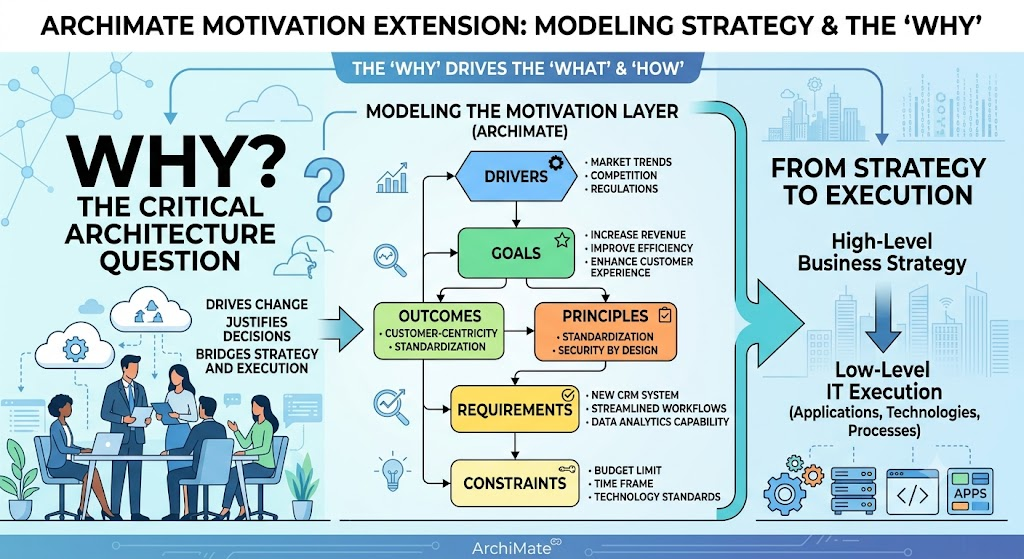
This comprehensive guide will walk you through the core concepts, standard relationships, practical PlantUML diagram examples, and best practices for modeling motivation in ArchiMate.
ArchiMate categorizes motivational concepts into three distinct layers: Influences (the context), Intentions (the desired state), and Realization (the rules and requirements).
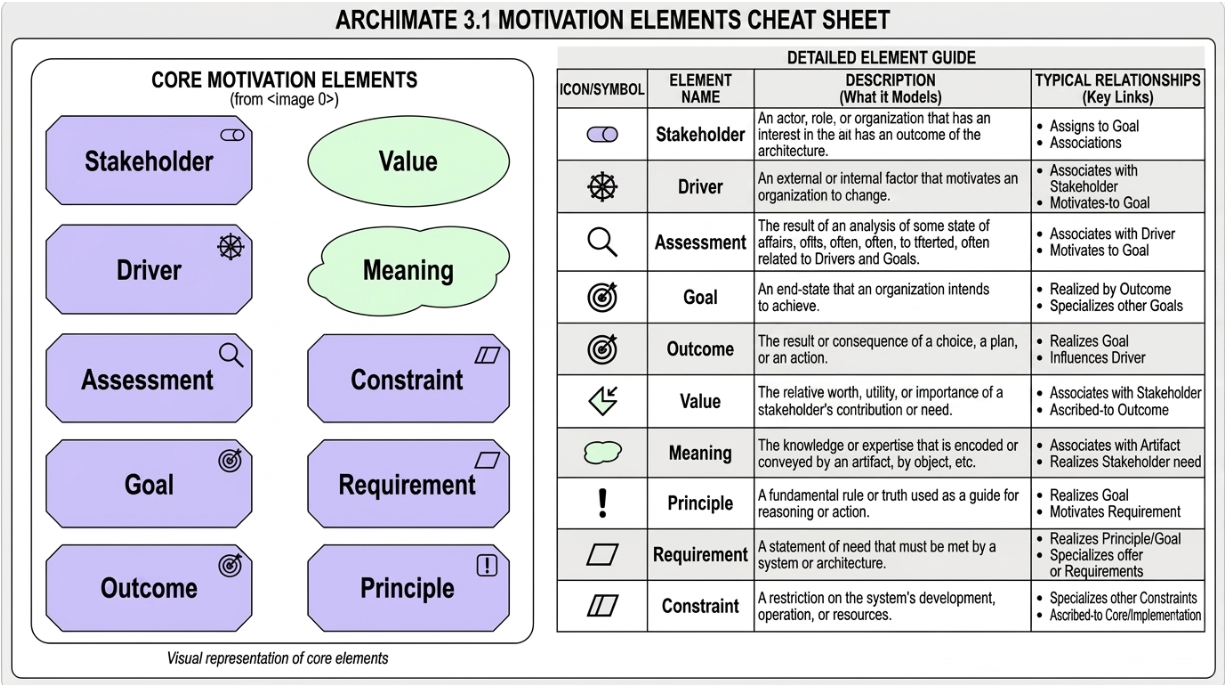
These elements represent the internal and external factors that push an organization to change or adapt.
Stakeholder: An individual, team, or organization that has an interest in the architecture. They are the people affected by or influencing the change (e.g., CEO, Board of Directors, End Customer).
Driver: An internal or external condition that motivates an organization to define or change its goals. Drivers are the root causes of change (e.g., New Regulatory Compliance, Market Competition, Shifting Consumer Trends).
Assessment: The outcome of analyzing a driver. This is often structured as a SWOT analysis (Strengths, Weaknesses, Opportunities, Threats) and defines the current reality (e.g., Legacy systems are limiting our time-to-market).
These elements define what the organization actually wants to achieve as a result of addressing the influences.
Goal: A high-level statement of intent or strategic direction the organization wants to achieve. Goals should be aspirational and time-bound (e.g., Increase profitability by 15% within Q4).
Outcome: An end-result that has been achieved. While a goal is the target, an outcome is used to trace and verify if the goal was actually met in reality (e.g., Cloud-Native Delivery Platform Successfully Deployed).
Value: The relative worth, utility, or benefit that a core element or outcome delivers to a stakeholder (e.g., Convenience, Cost Reduction, Brand Trust).
Meaning: The specific knowledge or interpretation given to a core element in a specific context, often used to differentiate services (e.g., Premium Status, VIP Access).
These elements translate intentions into actionable, enforceable rules for the architecture.
Principle: A general rule, guideline, or foundational belief that informs and governs how an organization achieves its goals (e.g., "Data is a corporate asset," "Buy before Build").
Requirement: A specific statement of need that must be met by the architecture. Requirements are the direct bridge to implementation (e.g., The system must encrypt all patient data at rest).
Constraint: A strict restriction on the freedom of choice regarding the implementation of the architecture. Constraints are non-negotiable limitations (e.g., Must use Oracle databases, Budget cannot exceed $50k).
To build a valid and logical motivation viewpoint, you must connect these elements using standard ArchiMate relationships. The flow typically moves from context to intention, and finally to realization:
Stakeholder $\rightarrow$ associates with $\rightarrow$ Driver (Who cares about the change?)
Driver $\rightarrow$ is analyzed by $\rightarrow$ Assessment (What is the current reality?)
Assessment $\rightarrow$ motivates $\rightarrow$ Goal (What do we want to achieve?)
Goal $\rightarrow$ is realized by $\rightarrow$ Outcome / Requirement / Principle (How will we achieve it?)
Principle $\rightarrow$ is realized by $\rightarrow$ Requirement (What specific rules enforce the principle?)
Requirement $\rightarrow$ is constrained by $\rightarrow$ Constraint (What are our limitations?)
Requirement $\rightarrow$ realizes $\rightarrow$ Core Elements (Business/Application/Technology layers)
Below are two standard motivational patterns expressed in ArchiMate-PlantUML syntax. You can render these directly using any PlantUML server, IDE plugin, or documentation integration.
This diagram traces a high-level market driver down through an assessment to concrete goals and measurable outcomes. It is perfect for executive presentations.
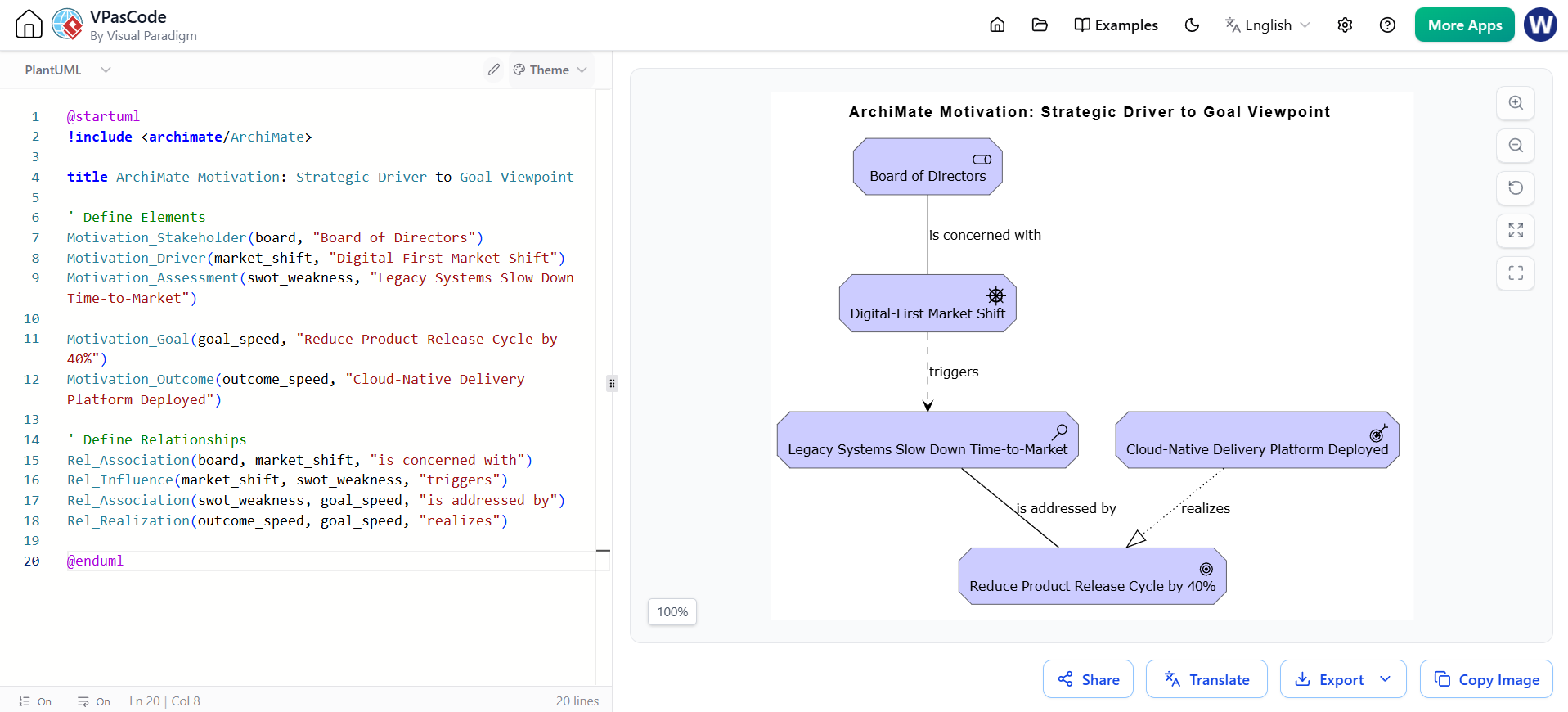
@startuml
!include <archimate/ArchiMate>

title ArchiMate Motivation: Strategic Driver to Goal Viewpoint

' Define Elements
Motivation_Stakeholder(board, "Board of Directors")
Motivation_Driver(market_shift, "Digital-First Market Shift")
Motivation_Assessment(swot_weakness, "Legacy Systems Slow Down Time-to-Market")

Motivation_Goal(goal_speed, "Reduce Product Release Cycle by 40%")
Motivation_Outcome(outcome_speed, "Cloud-Native Delivery Platform Deployed")

' Define Relationships
Rel_Association(board, market_shift, "is concerned with")
Rel_Influence(market_shift, swot_weakness, "triggers")
Rel_Association(swot_weakness, goal_speed, "is addressed by")
Rel_Realization(outcome_speed, goal_speed, "realizes")

@enduml
This diagram demonstrates how high-level architectural principles and specific technical constraints shape concrete requirements before they are handed off to the implementation layers.
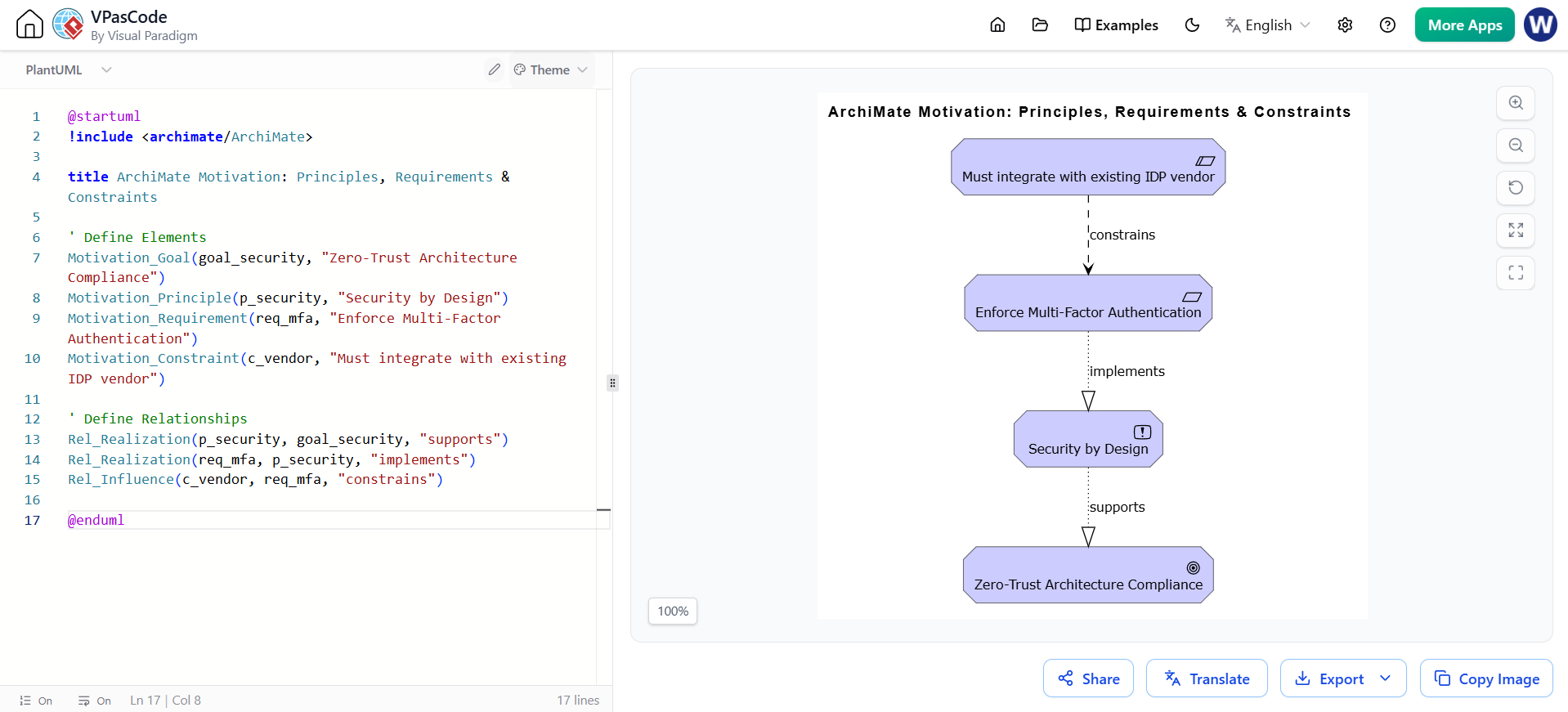
@startuml
!include <archimate/ArchiMate>

title ArchiMate Motivation: Principles, Requirements & Constraints

' Define Elements
Motivation_Goal(goal_security, "Zero-Trust Architecture Compliance")
Motivation_Principle(p_security, "Security by Design")
Motivation_Requirement(req_mfa, "Enforce Multi-Factor Authentication")
Motivation_Constraint(c_vendor, "Must integrate with existing IDP vendor")

' Define Relationships
Rel_Realization(p_security, goal_security, "supports")
Rel_Realization(req_mfa, p_security, "implements")
Rel_Influence(c_vendor, req_mfa, "constrains")

@enduml
To ensure your motivation models are effective, readable, and valuable to stakeholders, adhere to the following best practices:
Keep it Focused and Uncluttered:
Do not mix too many core implementation elements (like specific application services or database nodes) directly into high-level motivation diagrams. Keep motivation views strategic. Use a dedicated "Requirements Realization Viewpoint" to bridge the gap between motivation and the lower execution layers.
Use Measurable Metrics:
Vague goals lead to vague architectures. Ensure that Goals and Requirements contain measurable, testable targets. Instead of modeling "Improve system speed," model "Reduce API latency to under 200ms." This makes it possible to map an Outcome directly to a Goal.
Ensure End-to-End Traceability:
The ultimate value of the Motivation layer is traceability. Every technical component in your Architecture (down to the technology layer) should ideally map back to a Requirement, which maps back to a Principle or Goal. This ensures that all engineering work and IT spending have clear, documented business justification. If a system doesn't map to a goal, ask why it exists.
Modeling the Motivation layer in ArchiMate transforms enterprise architecture from a mere technical blueprint into a strategic business tool. By explicitly defining the Influences that force change, the Intentions that guide the organization, and the Realization requirements that govern execution, architects can ensure that every IT initiative is tightly aligned with business strategy.
Whether you are presenting to the board of directors or handing requirements to an engineering team, a well-crafted motivation model provides the ultimate "golden thread" of traceability—proving not just what you are building, but exactly why it matters.

