
The TOGAF Architecture Development Method (ADM) is the industry-standard framework for developing enterprise architecture. However, its comprehensive nature can be overwhelming, with complex phases, intricate dependencies, and rigorous documentation requirements.
Visual Paradigm addresses this challenge by transforming the TOGAF ADM from a static framework into a dynamic, guided experience. Through its ADM Process Navigator, Visual Paradigm acts as an on-screen tutor, breaking down the methodology into manageable phases, activities, and steps. This guide provides a comprehensive overview of how Visual Paradigm streamlines the ADM lifecycle, complete with key concepts and practical ArchiMate diagram examples to illustrate the modeling process.
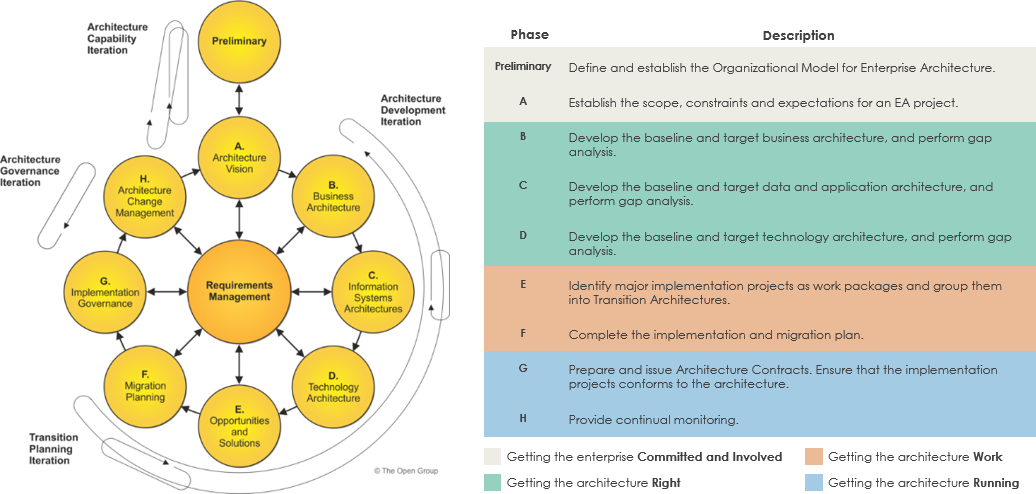
The foundation of the guidance system is a visual, interactive representation of the ADM cycle.
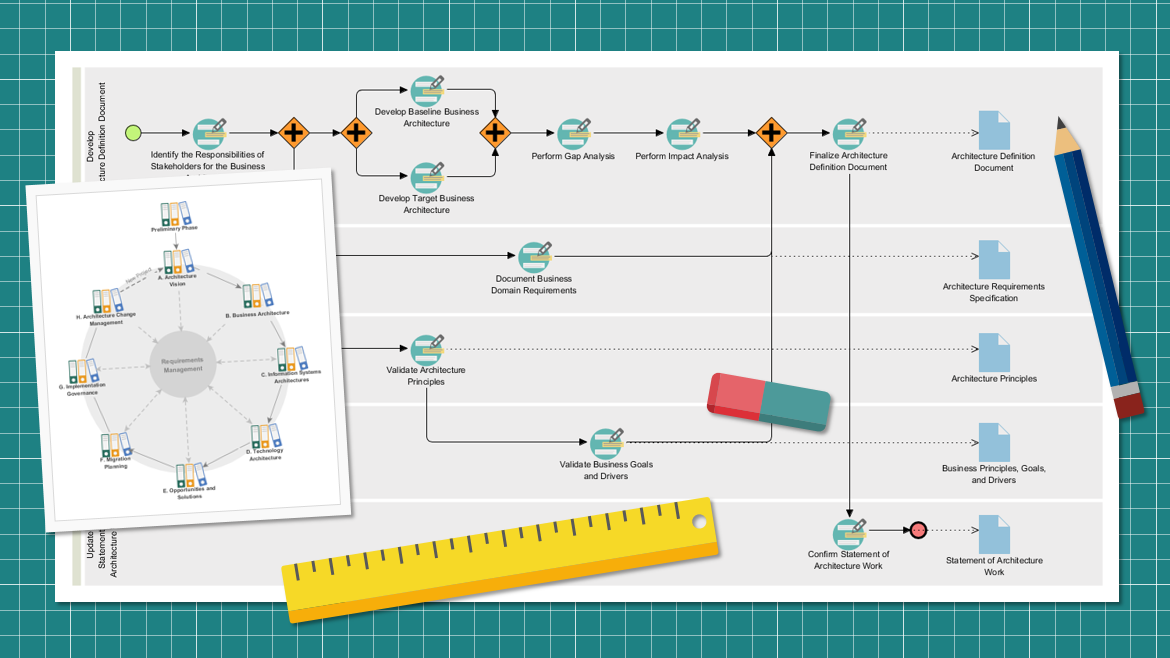
Interactive Drill-Down: Users can double-click on any specific phase (e.g., Preliminary Phase, Phase B: Business Architecture) to reveal its required activities.
Sequential Enforcement: Activities are presented as a series of connected activity shapes in a process diagram, ensuring architects follow the correct, methodologically sound sequence without missing critical steps.
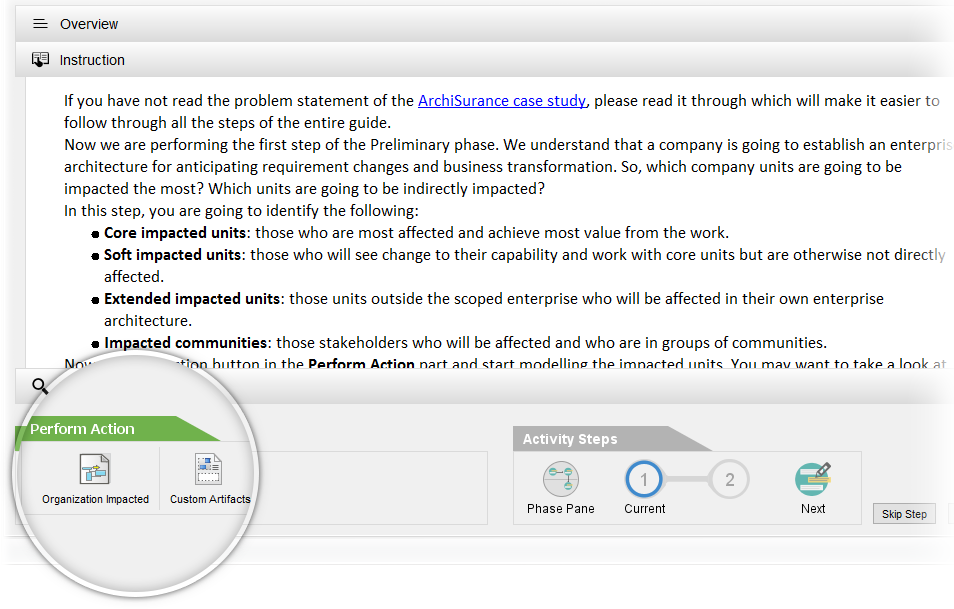
Within each activity, Visual Paradigm provides a dedicated, multi-pane interface designed to guide the user through the necessary work intuitively:
Overview: Lists the specific steps required to complete the activity, with the current step dynamically highlighted in bold.
Instruction Pane: Offers detailed, context-sensitive information on the purpose of the step and the expected outcomes.
View Sample Pane: Provides samples and examples (such as pre-built ArchiMate diagrams or completed forms) to illustrate exactly what the final output should look like.
Perform Action: Contains the actual tools needed to execute the step, featuring direct buttons to open a diagramming editor or a structured data entry form.
Visual Paradigm eliminates the need for disjointed tools by fully integrating guidance with certified ArchiMate 3.1 modeling tools.
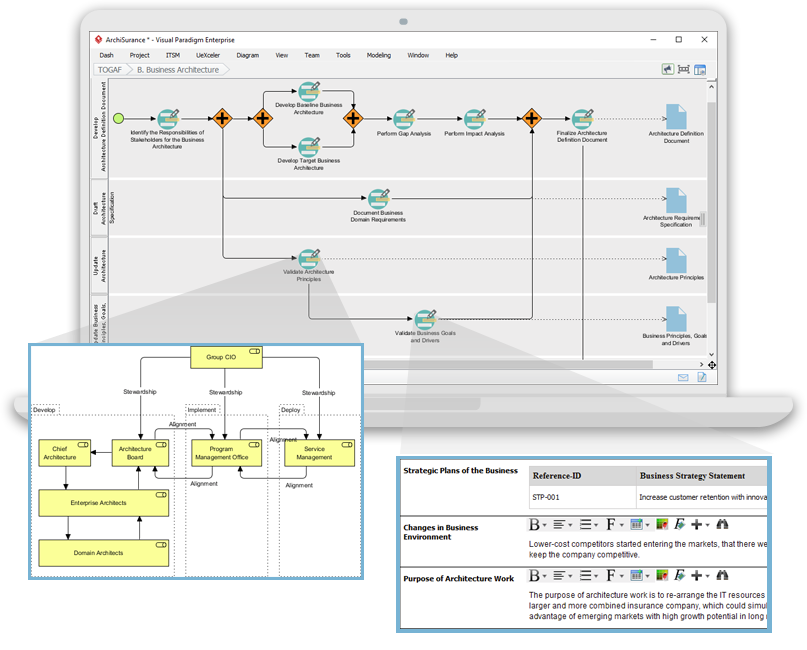
Contextual Actions: Users complete steps by drawing ArchiMate diagrams or filling in forms. The tool inherently "understands" ArchiMate notation and connection rules, preventing invalid architectural relationships.
Incremental Progress: A progress indicator tracks the completion status of phases and activities. Users simply click "Complete Step" to move forward.
Data Transcription: The tool can automatically transcribe data from one step to another. Deliverables created early in the process are carried forward as input references for subsequent steps, ensuring consistency and reducing redundant data entry.
One of the most powerful features is the automation of the output and storage process:
Deliverable Generation: Once all activities in a lane are finished, the user can double-click a document shape to automatically generate the official TOGAF deliverable (e.g., Architecture Definition Document) based on the data and diagrams entered during the guided steps.
Architecture Repository: Generated deliverables are automatically archived in a centralized Architecture Repository, serving as a secure, electronic cabinet for managing, versioning, and retrieving all architectural assets.
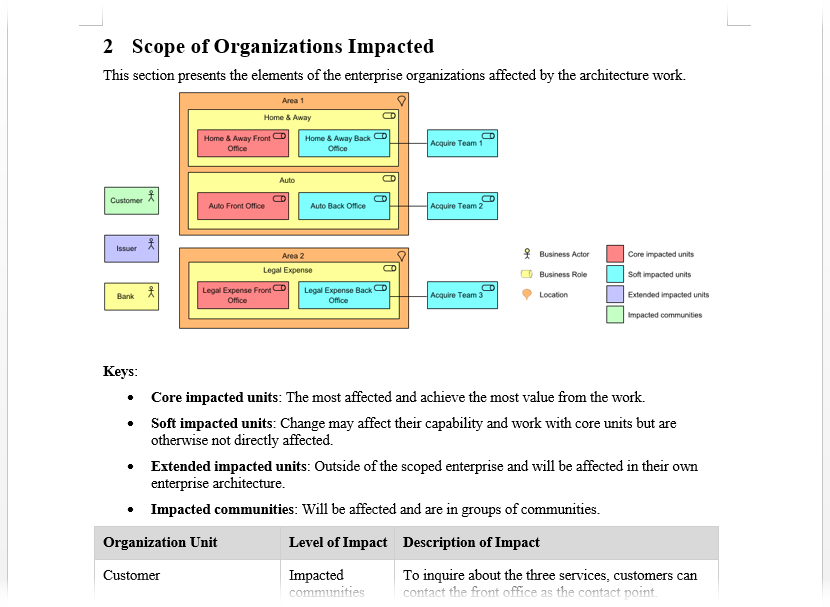
Enterprise architecture is a team effort. The guide-through process supports collaborative workflows by allowing the assignment of activities or deliverables as tasks to different team members. This includes built-in task management features for tracking time schedules, deadlines, and specific user roles.
To visualize how the TOGAF ADM phases translate into actual architectural models, below are examples using the ArchiMate-PlantUML plugin syntax. These examples demonstrate how an architect might model the outputs of Phase A (Architecture Vision) and the transition from Phase B (Business Architecture) to Phase C (Information Systems Architecture).
Note: To render these diagrams, ensure you have PlantUML installed with the ArchiMate standard library included (
!include <archimate/Archimate>). Visual Paradigm also supports PlantUML rendering natively.
This diagram illustrates how high-level business drivers are translated into specific architectural requirements, a core activity in the Preliminary and Phase A stages.
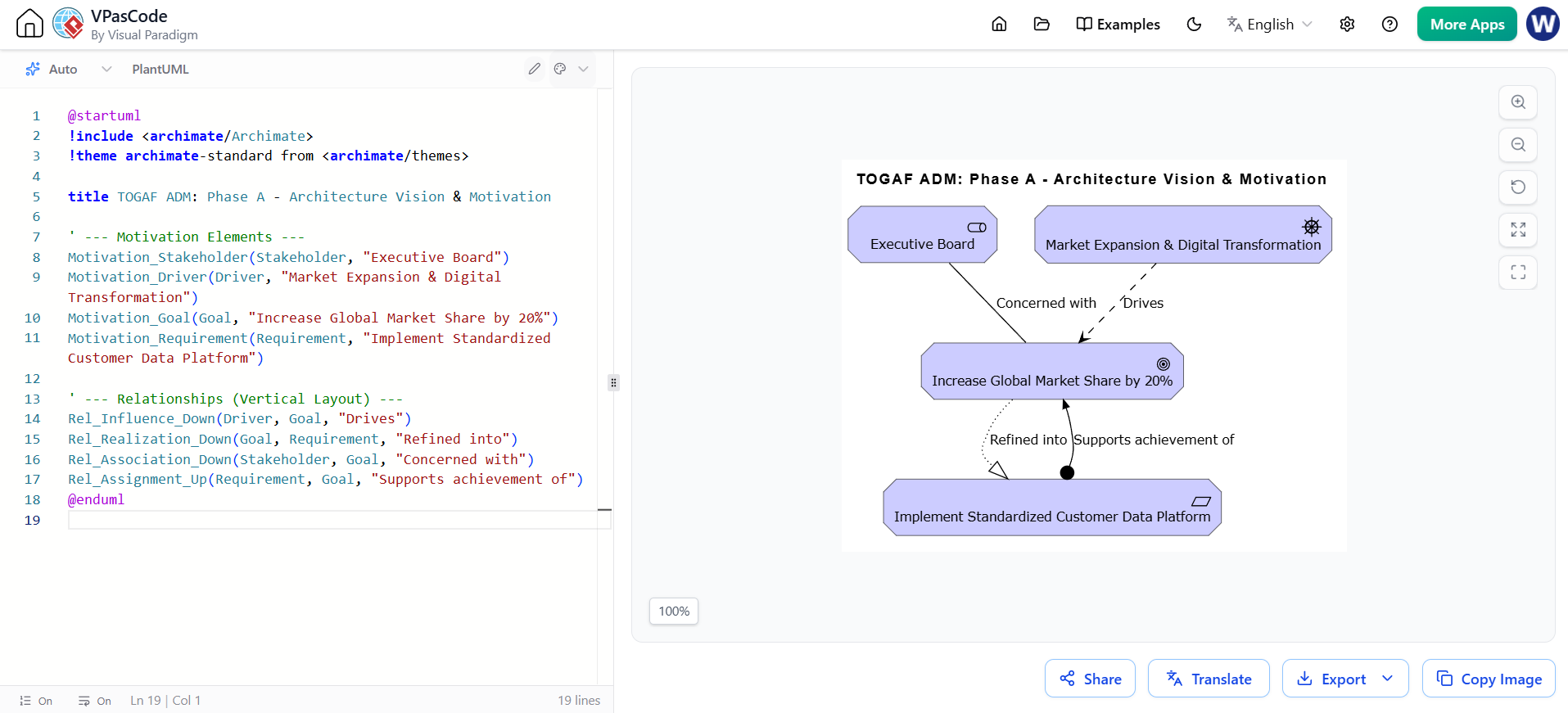
@startuml
!include <archimate/Archimate>
!theme archimate-standard from <archimate/themes>

title TOGAF ADM: Phase A - Architecture Vision & Motivation

' --- Motivation Elements ---
Motivation_Stakeholder(Stakeholder, "Executive Board")
Motivation_Driver(Driver, "Market Expansion & Digital Transformation")
Motivation_Goal(Goal, "Increase Global Market Share by 20%")
Motivation_Requirement(Requirement, "Implement Standardized Customer Data Platform")

' --- Relationships (Vertical Layout) ---
Rel_Influence_Down(Driver, Goal, "Drives")
Rel_Realization_Down(Goal, Requirement, "Refined into")
Rel_Association_Down(Stakeholder, Goal, "Concerned with")
Rel_Assignment_Up(Requirement, Goal, "Supports achievement of")
@enduml
This diagram demonstrates the "Integrated Modeling" concept, showing how a Business Service is realized by underlying Application Components, complete with data access relationships.
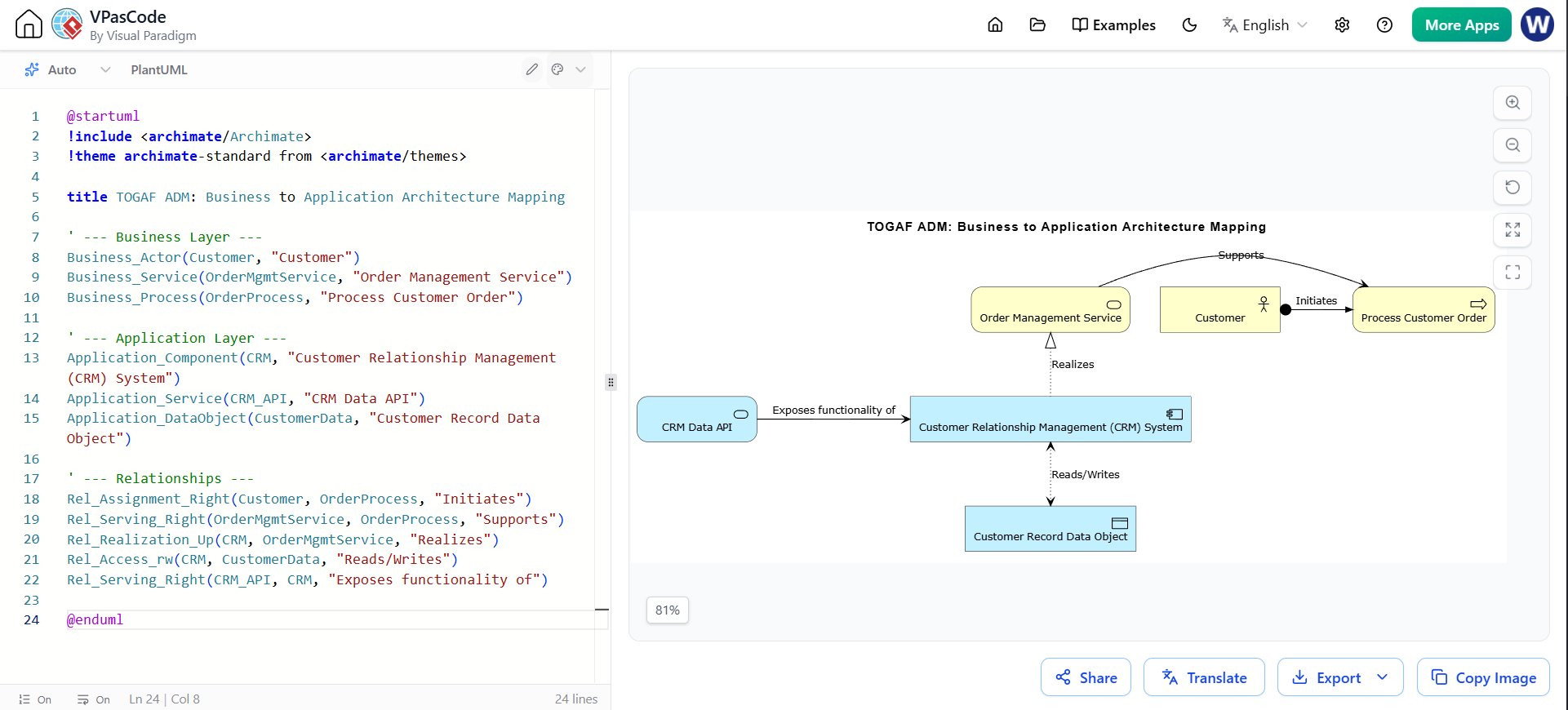
@startuml
!include <archimate/Archimate>
!theme archimate-standard from <archimate/themes>

title TOGAF ADM: Business to Application Architecture Mapping

' --- Business Layer ---
Business_Actor(Customer, "Customer")
Business_Service(OrderMgmtService, "Order Management Service")
Business_Process(OrderProcess, "Process Customer Order")

' --- Application Layer ---
Application_Component(CRM, "Customer Relationship Management (CRM) System")
Application_Service(CRM_API, "CRM Data API")
Application_DataObject(CustomerData, "Customer Record Data Object")

' --- Relationships ---
Rel_Assignment_Right(Customer, OrderProcess, "Initiates")
Rel_Serving_Right(OrderMgmtService, OrderProcess, "Supports")
Rel_Realization_Up(CRM, OrderMgmtService, "Realizes")
Rel_Access_rw(CRM, CustomerData, "Reads/Writes")
Rel_Serving_Right(CRM_API, CRM, "Exposes functionality of")

@enduml
Navigating the TOGAF ADM does not have to be a daunting, manual, or disjointed process. Visual Paradigm’s ADM Process Navigator fundamentally changes the experience by acting as an intelligent, on-screen tutor. By combining a structured, step-by-step interface with certified ArchiMate 3.1 modeling, automatic data transcription, and one-click deliverable generation, it ensures that architects remain focused on designing the enterprise rather than managing the methodology.
Furthermore, with built-in collaboration tools and automated archiving in the Architecture Repository, organizations can maintain a single source of truth, accelerate project timelines, and guarantee compliance with TOGAF standards. Whether you are mapping high-level motivations in Phase A or detailing complex application interactions in Phase C, Visual Paradigm provides the guardrails and automation needed to deliver world-class enterprise architecture.

