A Deep Dive into the Four Critical Deliverables
Introduction
Phase A of the TOGAF Architecture Development Method (ADM), known as Architecture Vision, is arguably the most critical phase in the entire lifecycle. It is where the abstract strategic goals of the organization are translated into a concrete architectural direction. If Phase A fails, the subsequent phases (Business, Data, Application, Technology) will likely build the wrong solution, no matter how technically perfect they are.
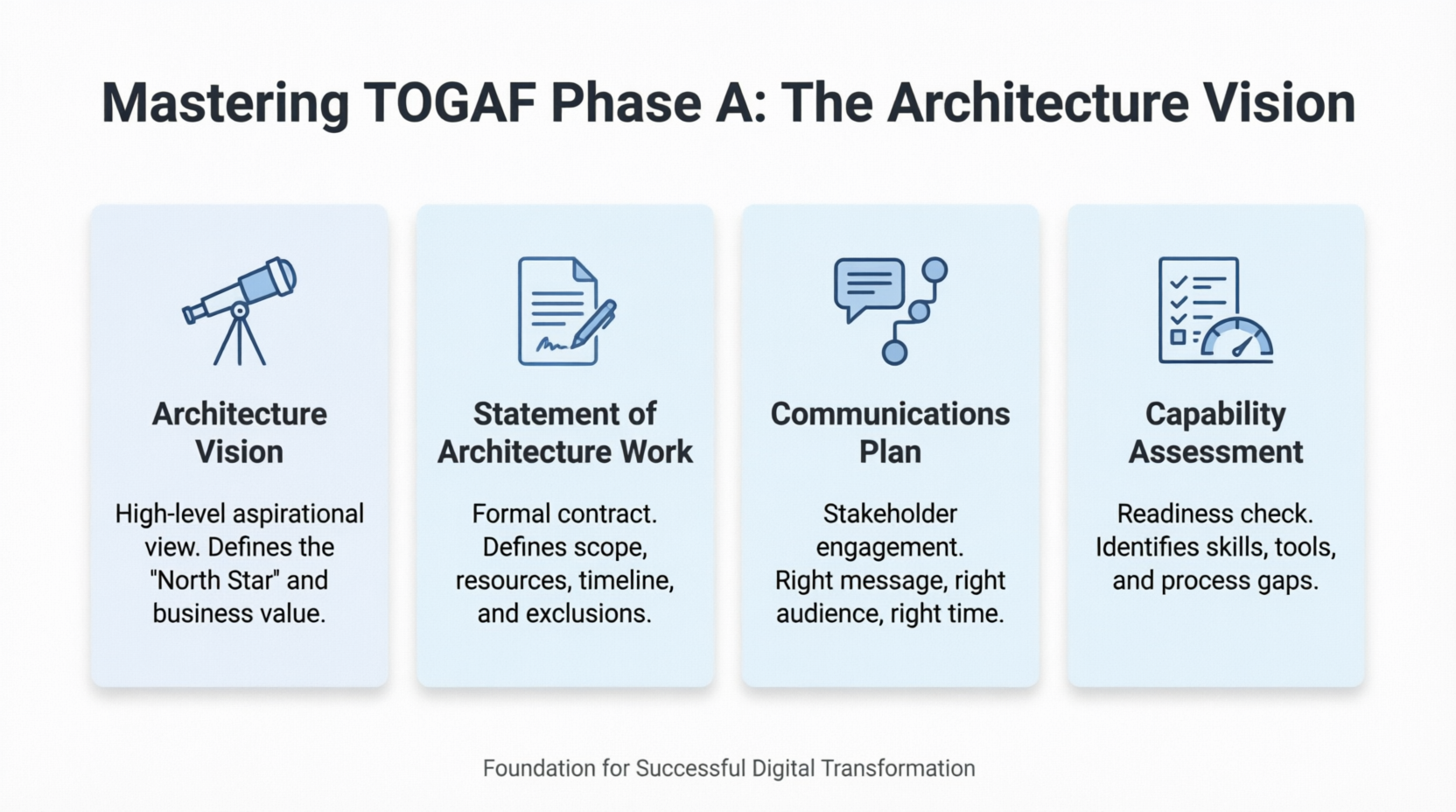
The primary objective of Phase A is to obtain approval for the architecture work. To do this, the Enterprise Architect must produce four specific Deliverables. Unlike artifacts (which are descriptive diagrams), these deliverables are formal work products that secure stakeholder buy-in, define scope, and establish governance.
This guide zooms in exclusively on Phase A, providing a comprehensive breakdown of each deliverable, its purpose, its components, and a practical example based on our continuing case study of GlobalFin Corp.
Deliverable 1: The Architecture Vision
What Is It?
The Architecture Vision is a high-level, aspirational document that describes the target state of the enterprise. It is not a technical specification; rather, it is a business-focused narrative that answers the question: "What will the enterprise look like when this transformation is complete, and why does it matter?"
It serves as the "North Star" for all subsequent architecture work. It must be compelling enough to secure funding and simple enough for non-technical executives to understand.
Key Components
- Problem Statement: Clearly defines the current pain points.
- Vision Statement: A concise summary of the target state.
- Business Value Proposition: Quantifiable benefits (ROI, cost savings, revenue growth).
- High-Level Target Architecture: A simplified diagram showing major capabilities.
- Key Stakeholders: Who benefits from this vision?
Practical Example: GlobalFin Corp
Document Title: Architecture Vision – Project "Digital Horizon"
1. Problem Statement:
GlobalFin currently operates on 12 siloed legacy systems. Customers cannot view their credit card and savings balances in one place. New feature development takes 6–9 months due to rigid mainframe dependencies. Customer churn has increased by 5% YoY.
2. Vision Statement:
"To create a unified, API-led digital banking ecosystem that provides a single view of the customer, enables real-time product personalization, and reduces time-to-market for new features from 9 months to 2 weeks."
3. Business Value Proposition:
-
- Revenue: Increase cross-sell ratio by 15% through unified customer data.
-
- Cost: Reduce IT maintenance costs by 20% by decommissioning 4 legacy servers.
-
- Experience: Achieve a Net Promoter Score (NPS) increase of 10 points.
4. High-Level Target Architecture: [Visual Description]: A central "Customer Data Hub" surrounded by microservices (Loans, Payments, Accounts). Mobile and Web channels connect via an API Gateway. Legacy systems are wrapped in an adaptation layer, gradually being phased out. 5. Key Stakeholders:
-
- Retail Banking Head (Primary Beneficiary)
Best Practices
- Keep it Brief: No more than 5–10 pages.
- Focus on Benefits, Not Features: Executives care about ROI, not Kubernetes clusters.
- Use Visuals: A single, clear diagram is worth a thousand words.
Deliverable 2: Statement of Architecture Work
What Is It?
The Statement of Architecture Work (SoAW) is the formal contract between the architecture team and the project sponsors. While the Architecture Vision sells the idea, the SoAW defines the work. It outlines the scope, resources, timeline, and deliverables expected from the architecture team.
It is crucial for managing expectations. Without a signed SoAW, stakeholders may constantly expand the scope ("scope creep"), leading to project failure.
Key Components
- Scope: What is included and, equally important, what is excluded.
- Objectives: Specific, measurable goals for the architecture project.
- Approach: How the work will be done (e.g., Agile, Waterfall, iterative ADM).
- Deliverables: List of outputs (e.g., Architecture Definition Document, Roadmap).
- Resources & Budget: Who is working on this, and how much will it cost?
- Timeline: Key milestones and dates.
- Sign-off: Formal approval from sponsors.
Practical Example: GlobalFin Corp
Document Title: Statement of Architecture Work – Digital Horizon Phase A-D
1. Scope:
- In-Scope: Retail Banking customer-facing applications (Mobile App, Web Portal), Core Banking API integration, Customer Data Lake.
- Out-of-Scope: Corporate Banking systems, HR internal tools, Branch network hardware upgrades.
2. Objectives:
- Define Baseline and Target Architectures for Retail Banking.
- Identify key technology gaps and risks.
- Produce a detailed Migration Roadmap for the first 18 months.
3. Approach:
- Iterative ADM cycle.
- Weekly workshops with Business Analysts and Lead Developers.
- Use of ArchiMate for modeling.
4. Deliverables:
- Architecture Vision (Completed)
- Business Architecture Definition Document
- Information Systems Architecture Definition Document
- Technology Architecture Definition Document
- Architecture Roadmap v1.0
5. Resources:
- 1 Lead Enterprise Architect (Sarah Chen)
- 2 Solution Architects
- 1 Business Analyst (50% allocation)
- Budget: $150,000 for external consulting tools and training.
6. Timeline:
- Phase A Complete: June 30, 2026
- Phase B Complete: August 30, 2026
- Phase C/D Complete: October 30, 2026
7. Sign-off:
- [Signed] Jane Smith, Head of Retail Banking
Best Practices
- Be Explicit About Exclusions: Clearly state what you are not doing to prevent scope creep.
- Define Success Criteria: How will stakeholders know the architecture work is "done"?
- Get Signatures: Treat this as a legal contract. Verbal agreement is not enough.
Deliverable 3: Communications Plan
What Is It?
Architecture projects often fail due to poor communication, not poor design. The Communications Plan defines how information about the architecture will be shared with different stakeholder groups. It ensures that the right people receive the right information at the right time, in the right format.
Different stakeholders have different needs: Executives want high-level summaries, developers want technical details, and end-users want to know how their jobs will change.
Key Components
- Stakeholder Analysis: Who are the audiences?
- Communication Objectives: What do we want each group to know/feel/do?
- Channels: Email, meetings, portals, newsletters, etc.
- Frequency: Weekly, monthly, ad-hoc.
- Responsibilities: Who creates and sends the messages?
- Feedback Mechanism: How do stakeholders provide input?
Practical Example: GlobalFin Corp
Document Title: Communications Plan – Digital Horizon Project
1. Stakeholder Group: Executive Steering Committee (CIO, CFO, COO)
- Objective: Secure ongoing funding and resolve high-level blockers.
- Channel: Monthly 1-hour Steering Committee Meeting + Executive Summary Deck.
- Frequency: Monthly.
- Owner: Lead Enterprise Architect (Sarah Chen).
- Content: Budget burn rate, milestone achievement, major risks.
2. Stakeholder Group: Engineering Teams (Developers, DevOps)
- Objective: Ensure technical alignment and adoption of new standards.
- Channel: Bi-weekly "Architecture Office Hours" (Open Q&A) + Confluence Wiki Updates.
- Frequency: Bi-weekly.
- Owner: Solution Architects.
- Content: API specifications, coding standards, new tool tutorials.
3. Stakeholder Group: Branch Staff & Customer Service
- Objective: Prepare for changes in workflow and tools.
- Channel: Monthly Newsletter + Town Hall Meetings.
- Frequency: Monthly.
- Owner: Change Management Lead.
- Content: "What’s changing for you," training schedules, benefit highlights.
4. Feedback Mechanism:
- Dedicated Slack channel #digital-horizon-feedback.
- Quarterly survey to assess communication effectiveness.
Best Practices
- Tailor the Message: Never send a 50-page technical document to the CFO.
- Two-Way Communication: Include mechanisms for stakeholders to ask questions and raise concerns.
- Consistency: Stick to the schedule. Irregular communication breeds uncertainty.
Deliverable 4: Capability Assessment
What Is It?
Before building the target architecture, you must understand if the organization is capable of delivering it. The Capability Assessment evaluates the current state of the enterprise’s architecture function, skills, tools, and processes. It identifies gaps that could hinder the project’s success.
This is not just an IT assessment; it includes business readiness, organizational culture, and governance maturity.
Key Components
- Current Maturity Level: Using a model like TOGAF Maturity Model or CMMI.
- Skills Gap Analysis: Do we have the right people?
- Tooling Assessment: Are our current tools adequate?
- Process Gaps: Are our decision-making processes efficient?
- Recommendations: How to close the gaps.
Practical Example: GlobalFin Corp
Document Title: Capability Assessment – Digital Horizon Readiness
1. Architecture Maturity:
- Current State: Level 2 (Managed but reactive). Architecture is done on a project-by-project basis with no reusable assets.
- Target State: Level 3 (Defined). Standardized processes and reusable building blocks.
2. Skills Gap Analysis:
- Gap: Lack of expertise in Cloud-Native Design (AWS/Azure).
- Gap: No dedicated API Management specialists.
- Impact: High risk of designing insecure or inefficient cloud solutions.
- Recommendation: Hire 2 Cloud Architects immediately. Enroll existing senior developers in AWS Certified Solutions Architect training.
3. Tooling Assessment:
- Current: Visio for diagrams, Excel for requirements.
- Gap: No centralized repository for architecture artifacts. No automated compliance checking.
- Recommendation: Implement ArchiMate for modeling and Confluence for the Architecture Repository. Integrate SonarQube for code quality governance.
4. Process Gaps:
- Gap: No formal Architecture Review Board (ARB). Decisions are made ad-hoc by lead developers.
- Recommendation: Establish an ARB with representatives from Security, Infrastructure, and Business units. Meet weekly.
5. Overall Readiness Score: 6/10.
- Verdict: Proceed with caution. Address skills and tooling gaps in Phase A before moving to detailed design in Phase B.
Best Practices
- Be Honest: Acknowledging weaknesses early prevents surprises later.
- Focus on Actionable Recommendations: Don’t just list problems; propose solutions.
- Link to Business Impact: Explain how capability gaps affect project timeline and budget.
Conclusion: The Foundation of Success
Phase A is not merely a bureaucratic hurdle; it is the foundation upon which the entire architecture project rests. By producing these four deliverables, the Enterprise Architect achieves three critical outcomes:
- Alignment: The Architecture Vision ensures everyone agrees on what we are building and why.
- Clarity: The Statement of Architecture Work ensures everyone agrees on how we will build it and who is responsible.
- Readiness: The Communications Plan and Capability Assessment ensure the organization is prepared to execute the work effectively.
Skipping or rushing Phase A is a common mistake that leads to rework, budget overruns, and stakeholder dissatisfaction. By investing time in these four deliverables, GlobalFin Corp—and any organization—sets the stage for a successful, value-driven digital transformation.
Next Steps
With Phase A complete and approved, the architecture team moves to Phase B: Business Architecture, where the high-level vision is decomposed into detailed business processes, organizations, and functions. The deliverables produced in Phase A will serve as the guiding constraints and inputs for this deeper analysis.