Introduction
Phase E of the TOGAF Architecture Development Method (ADM), Opportunities & Solutions, is the critical pivot point where abstract architecture designs transition into concrete implementation plans. While Phases B, C, and D define what the target architecture looks like, Phase E determines how to get there.
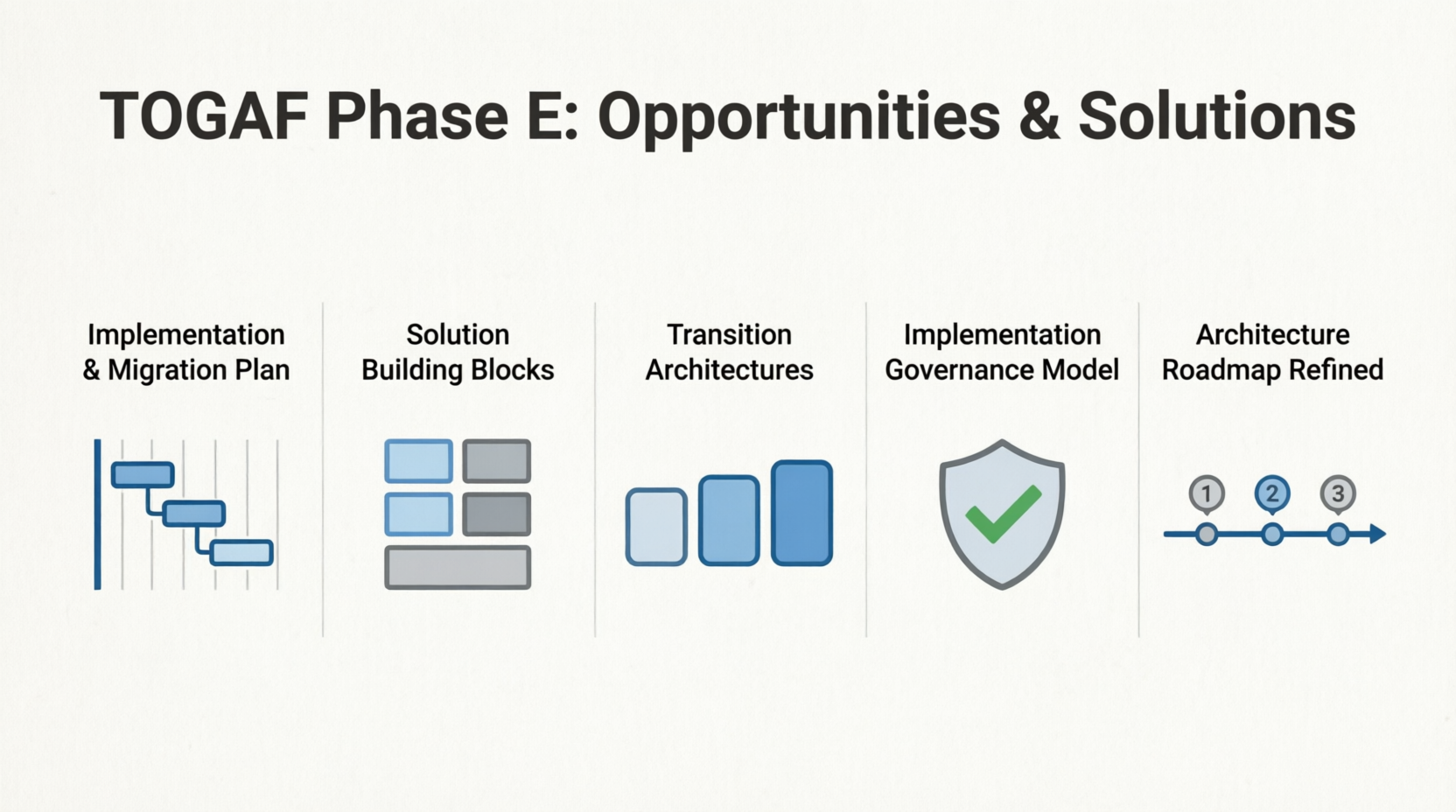
This phase is often where architecture meets project management. The primary goal is to identify major work packages (projects) and determine the best approach for delivering the target architecture. This guide zooms in on the five key deliverables of Phase E, providing detailed definitions, practical examples, and best practices for creating them.
1. Implementation and Migration Plan (Initial)
Definition
The Initial Implementation and Migration Plan is a high-level strategic roadmap that outlines the sequence of projects required to move from the Baseline Architecture to the Target Architecture. It identifies dependencies, major milestones, and resource requirements at a program level.
Key Components
- Work Packages: Groupings of related activities or projects.
- Project Portfolios: Categorization of projects by risk, value, or business unit.
- Dependencies: Logical links between work packages (e.g., "Database migration must precede Application refactoring").
- High-Level Timeline: Quarters or years, not days or weeks.
Practical Example: GlobalFin Corp
Context: Moving from legacy mainframe to cloud-native microservices.
Deliverable Content:
- Work Package 1 (Q1-Q2): "Foundation Layer" – Setup AWS landing zone, implement Identity Management Service.
- Work Package 2 (Q3-Q4): "Customer Data Migration" – Migrate savings account data to new Data Lake.
- Work Package 3 (Q5-Q6): "Loan Module Refactor" – Decompose monolithic loan engine into microservices.
- Dependency: Work Package 2 cannot start until Work Package 1 is complete.
- Resource Estimate: Requires 2 Cloud Architects, 5 DevOps Engineers, and 10 Developers.
Best Practices
- Use the MoSCoW method (Must have, Should have, Could have, Won't have) to prioritize work packages.
- Ensure alignment with the business’s fiscal year and budget cycles.
- Identify "Quick Wins" early to build stakeholder confidence.
2. Solution Building Blocks (SBBs)
Definition
Solution Building Blocks are the specific products, technologies, or custom-developed components that will be used to implement the Architecture Building Blocks (ABBs) defined in earlier phases. While ABBs are logical (e.g., "Customer Identity Service"), SBBs are physical (e.g., "Auth0 Enterprise Plan" or "Custom Java Spring Boot Module").
Key Components
- Product Selection: Specific vendor products or open-source tools.
- Service Definitions: Detailed API specifications or service contracts.
- Procurement Requirements: Information needed for RFPs (Request for Proposals).
Practical Example: GlobalFin Corp
Context: Defining the technology stack for the new digital banking platform.
Deliverable Content:
- ABB: "Event Streaming Engine" → SBB: Apache Kafka (Confluent Cloud Standard Tier).
- ABB: "Frontend Framework" → SBB: React.js with Material UI library.
- ABB: "API Gateway" → SBB: AWS API Gateway with Lambda integration.
- ABB: "Customer Notification Service" → SBB: Twilio API for SMS and SendGrid for email.
Best Practices
- Ensure SBBs comply with the Architecture Principles defined in the Preliminary Phase (e.g., "Cloud-First").
- Consider total cost of ownership (TCO), not just licensing fees.
- Document why specific vendors were chosen over alternatives (decision log).
3. Transition Architectures
Definition
Transition Architectures are intermediate states between the Baseline and Target Architectures. They allow the organization to derive business value incrementally rather than waiting for the entire target state to be completed. Each transition architecture is a stable, usable state.
Key Components
- State Description: What capabilities are available in this transition state?
- Gap Analysis: What is still missing compared to the final target?
- Business Value: What benefit does the business get from reaching this intermediate state?
Practical Example: GlobalFin Corp
Context: The target is a fully unified omnichannel experience.
Deliverable Content:
- Transition Architecture 1 (TA1): "Mobile-First Launch"
- Capabilities: New mobile app launched, but it connects to legacy backend via an API wrapper.
- Value: Customers can check balances and transfer funds on mobile immediately.
- Gap: Loan applications still require branch visits.
- Transition Architecture 2 (TA2): "Digital Loans"
- Capabilities: Loan module migrated to cloud; mobile app now supports loan applications.
- Value: 50% reduction in loan processing time.
-
- Gap: Branch systems still use old interface.
Best Practices
- Limit the number of transition architectures to avoid complexity (usually 2-4).
- Ensure each transition state is technically stable and business-viable.
- Clearly communicate to stakeholders that TA1 is not the final product, managing expectations.
4. Implementation Governance Model
Definition
The Implementation Governance Model defines the structures, processes, and roles responsible for overseeing the implementation of the architecture. It ensures that projects adhere to the architectural standards and decisions made in Phases B-D.
Key Components
- Governance Bodies: e.g., Architecture Review Board (ARB), Steering Committee.
- Review Processes: When and how architecture compliance is checked (e.g., design reviews, code scans).
- Roles and Responsibilities: Who has the authority to approve exceptions?
- Compliance Metrics: KPIs for measuring adherence.
Practical Example: GlobalFin Corp
Context: Ensuring 50+ development teams follow the new cloud standards.
Deliverable Content:
- Architecture Review Board (ARB): Meets bi-weekly. Members: Chief Architect, Security Lead, Lead DevOps.
- Gate Reviews:
- Gate 1 (Design): ARB reviews high-level design before coding starts.
- Gate 2 (Pre-Production): Automated security scan and performance test results reviewed.
- Exception Process: Teams can request an exception if a standard cannot be met, requiring CIO approval.
- Metrics: "% of projects passing Gate 1 on first attempt," "Number of critical security vulnerabilities in production."
Best Practices
- Keep governance lightweight to avoid bottlenecks.
- Automate compliance checks where possible (e.g., Infrastructure as Code scanning).
- Focus on enablement rather than just policing; help teams understand why standards exist.
5. Architecture Roadmap (Refined)
Definition
The Architecture Roadmap is updated in Phase E to include project-level details. While earlier roadmaps were strategic, this version integrates with project management tools and includes specific dates, resource allocations, and risk assessments.
Key Components
- Detailed Timeline: Months or weeks.
- Resource Allocation: Specific teams or individuals assigned.
- Risk Register: Identified risks and mitigation strategies.
- Budget Estimates: Cost per work package.
Practical Example: GlobalFin Corp
Context: Finalizing the plan for executive approval.
Deliverable Content:
- Q1 2024:
- Project: AWS Landing Zone Setup.
- Team: Cloud Infrastructure Team (5 people).
- Budget: $150k.
- Risk: Delay in security clearance for cloud access. Mitigation: Start clearance process in December.
- Q2 2024:
- Project: Identity Service Development.
- Team: Backend Team A (8 people).
- Budget: $300k.
-
- Dependency: AWS Landing Zone must be complete by March 31.
Best Practices
- Use visual tools (Gantt charts, Kanban boards) for clarity.
- Regularly update the roadmap as projects progress (it is a living document).
- Align the roadmap with the organization’s portfolio management processes.
Interdependencies Between Phase E Deliverables
Understanding how these deliverables interact is crucial for success:
- SBBs inform the Implementation Plan: You cannot plan the migration timeline without knowing which technologies (SBBs) are being used and their procurement lead times.
- Transition Architectures shape the Roadmap: Each transition architecture becomes a major milestone in the refined Architecture Roadmap.
- Governance Model oversees SBB Implementation: The governance model ensures that the selected SBBs are implemented correctly and comply with standards.
- Implementation Plan drives Resource Allocation: The refined roadmap uses the implementation plan to assign specific resources to work packages.
Common Pitfalls in Phase E
| Pitfall |
Consequence |
Mitigation |
| Over-detailing too early |
Analysis paralysis; delayed start |
Keep Phase E high-level; leave detailed sprint planning to Agile teams |
| Ignoring organizational change |
Technical success but user rejection |
Include training and communication plans in the Implementation Plan |
| Underestimating dependencies |
Project delays and bottlenecks |
Conduct thorough dependency mapping workshops with all team leads |
| Weak governance |
Architecture drift; non-compliant solutions |
Establish clear ARB roles and automate compliance checks |
Conclusion
Phase E is where the rubber meets the road. By producing high-quality Implementation and Migration Plans, selecting appropriate Solution Building Blocks, defining clear Transition Architectures, establishing a robust Governance Model, and refining the Architecture Roadmap, organizations can ensure a smooth and successful transition from vision to reality.
Remember, the goal of Phase E is not just to plan, but to create a shared understanding among stakeholders about how the transformation will unfold. Clear, well-documented deliverables in this phase reduce risk, secure funding, and set the stage for effective implementation governance in Phase G.