Introduction
Phase F of the TOGAF Architecture Development Method (ADM), Migration Planning, is often where ambitious architecture projects succeed or fail. While Phases B, C, and D define what the target architecture looks like, and Phase E identifies how it might be achieved, Phase F answers the critical question: "How do we get there safely, efficiently, and within budget?"
In this phase, the high-level opportunities identified in Phase E are transformed into a detailed, actionable Implementation and Migration Plan. This plan serves as the primary input for project management and execution. It is not just a timeline; it is a strategic document that balances business value, risk, cost, and resource availability.
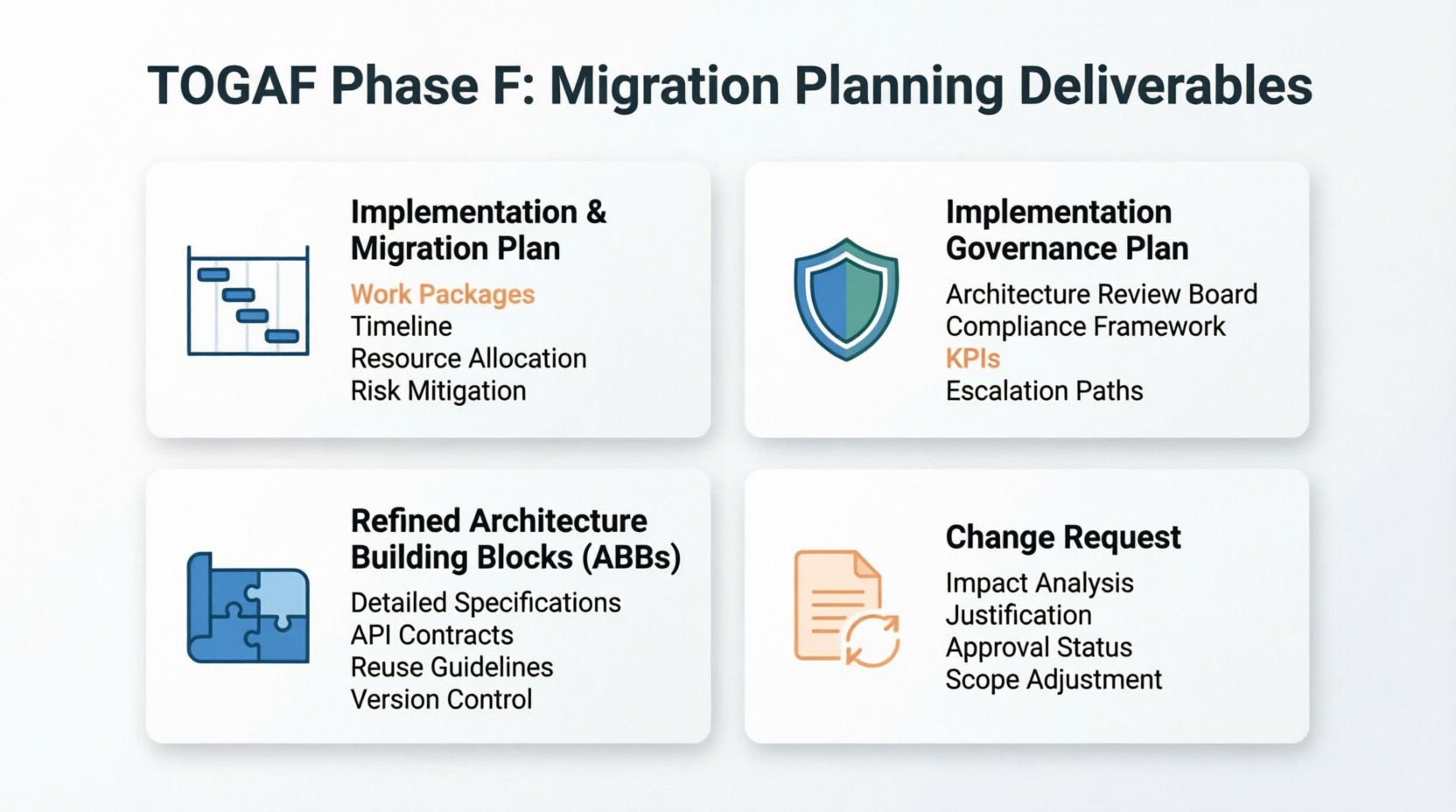
This guide provides a deep dive into the four key deliverables of Phase F, illustrating their purpose, content, and practical application using our continuing case study of GlobalFin Corp.
1. Implementation and Migration Plan (Finalized)
Purpose
The Implementation and Migration Plan is the cornerstone deliverable of Phase F. It details the sequence of projects required to move from the Baseline Architecture to the Target Architecture. It prioritizes work packages based on business value, dependency, and risk.
Key Components
- Work Packages: Groupings of related activities assigned to specific teams.
- Project Portfolio: A list of discrete projects with defined scopes, budgets, and timelines.
- Resource Allocation: Detailed assignment of personnel, budget, and technology resources.
- Timeline & Milestones: A granular schedule (often Gantt chart format) showing dependencies.
- Risk Mitigation Strategies: Specific actions to address identified risks during migration.
GlobalFin Corp Example
Deliverable Excerpt: "Digital Banking Platform Migration Plan v2.0"
Priority 1: Foundation Layer (Months 1-3)
- Work Package WP-01: Establish AWS Landing Zone.
- Resources: 2 DevOps Engineers, $50k Cloud Budget.
- Milestone: Security compliance audit passed by Month 3.
- Work Package WP-02: Build Customer Identity Service (ABB).
- Dependencies: WP-01 must be complete.
- Risk: Legacy data quality issues. Mitigation: Run data cleansing scripts in parallel.
Priority 2: Core Banking Migration (Months 4-9)
- Work Package WP-03: Migrate Savings Account Module.
- Approach: Strangler Fig pattern via API Gateway.
- Business Value: Enables new mobile savings features.
- Work Package WP-04: Migrate Loan Underwriting Engine.
- Dependencies: WP-02 (Identity) and WP-03 (Data Lake integration).
Priority 3: Decommissioning (Months 10-12)
- Work Package WP-05: Shut down legacy mainframe modules for Savings/Loans.
- Cost Saving: $200k/year in maintenance fees.
2. Implementation Governance Plan
Purpose
While the Implementation and Migration Plan tells you what to do, the Implementation Governance Plan defines how you ensure it is done correctly. It establishes the rules, roles, and metrics for overseeing the execution of the migration projects. It ensures that the implemented solutions remain compliant with the Architecture Definition Document.
Key Components
- Governance Structure: Roles such as Architecture Review Board (ARB), Project Sponsors, and Compliance Officers.
- Compliance Framework: Criteria for assessing whether implementations match the design.
- Reporting Mechanisms: Frequency and format of status reports.
- Escalation Paths: Procedures for handling deviations or critical issues.
- Key Performance Indicators (KPIs): Metrics to measure success (e.g., uptime, security incidents, budget variance).
GlobalFin Corp Example
Deliverable Excerpt: "Architecture Governance Framework for Digital Transformation"
1. Architecture Review Board (ARB)
- Composition: Chief Architect, CIO, Head of Security, Lead Product Owner.
- Meeting Cadence: Bi-weekly.
- Authority: Can halt any project found non-compliant with security standards.
2. Compliance Checkpoints
- Design Review: Before coding begins, all microservice designs must be approved by ARB.
- Code Scan: Automated SAST/DAST scans must pass before deployment to staging.
- Performance Test: All APIs must demonstrate <100ms latency under load before production release.
3. Escalation Path
- If a project deviates >10% from budget or timeline, it must be presented to the Steering Committee within 48 hours.
4. KPIs
- Architectural Compliance Rate: Target >95%.
- Security Vulnerabilities: Zero critical vulnerabilities in production.
- Budget Variance: Keep within ±5% of allocated budget per work package.
3. Architecture Building Blocks (Refined and Finalized)
Purpose
In earlier phases, Architecture Building Blocks (ABBs) were conceptual. In Phase F, they are refined into detailed specifications that can be handed off to solution architects and developers. These finalized ABBs serve as the "blueprints" for the Solution Building Blocks (SBBs) that will be built or bought in Phase G.
Key Components
- Detailed Specifications: API contracts, data schemas, interface definitions.
- Reuse Guidelines: Instructions on how and where the ABB should be used.
- Version Control: Clear versioning to manage changes.
- Dependency Maps: How this ABB interacts with other ABBs.
GlobalFin Corp Example
Deliverable Excerpt: "Customer Identity Service ABB Specification v1.5"
1. Overview
- Purpose: Centralized authentication and authorization for all digital channels.
- Owner: Identity Team.
2. Interface Specifications
- API Endpoint:
POST /api/v1/auth/login
- Protocol: OAuth 2.0 / OIDC.
- Response Time: <50ms for token issuance.
3. Data Schema
- User Profile: JSON structure including
userID, email, mfaEnabled, lastLogin.
- Storage: Encrypted in AWS DynamoDB.
4. Reuse Guidelines
- Must be used by Mobile App, Web Portal, and Branch Teller System.
- Do NOT build custom authentication logic in any new service.
5. Dependencies
- Requires access to Active Directory (Azure AD) for employee verification.
- Requires SMS Gateway for MFA codes.
4. Change Request
Purpose
Phase F is often where reality checks occur. As detailed planning happens, stakeholders may realize the scope is too broad, the budget is insufficient, or the timeline is unrealistic. Alternatively, external factors (regulatory changes, market shifts) may necessitate adjustments. The Change Request deliverable formalizes these adjustments, ensuring they are reviewed, approved, and documented.
Key Components
- Change Description: What is being changed?
- Justification: Why is the change necessary?
- Impact Analysis: Effect on cost, timeline, resources, and other deliverables.
- Approval Status: Signed off by relevant stakeholders.
GlobalFin Corp Example
Deliverable Excerpt: "Change Request CR-2024-05: Addition of Cryptocurrency Wallet"
1. Description
- Add support for Bitcoin and Ethereum wallets to the Digital Banking Platform.
2. Justification
- Competitor analysis shows 30% of customers under 35 are interested in crypto assets. Strategic goal to capture younger demographic.
3. Impact Analysis
- Timeline: Delay overall launch by 6 weeks.
- Cost: Additional $150k for specialized blockchain developers and security audits.
- Architecture: Requires new "Crypto Ledger Service" ABB and integration with third-party custody provider.
- Risk: High regulatory uncertainty. Requires legal review.
4. Decision
- Status: Approved with Conditions.
- Condition: Crypto feature will be launched as a "Beta" module in Phase 2, not part of the initial MVP. Budget approved from contingency fund.
Best Practices for Phase F Deliverables
- Iterate with Stakeholders: Don’t create the Migration Plan in a vacuum. Validate timelines and resource needs with project managers and team leads.
- Balance Quick Wins vs. Strategic Goals: Ensure the plan includes some early, high-visibility successes to maintain stakeholder confidence.
- Keep ABBs Living Documents: As technology evolves, update ABB specifications. Use a repository that supports versioning.
- Formalize Change Control: Never allow "scope creep" without a formal Change Request. This protects the architecture team and ensures transparency.
- Link Governance to Reality: Ensure the Governance Plan is practical. Overly bureaucratic processes will slow down implementation and lead to non-compliance.
Conclusion
Phase F is the bridge between architectural vision and operational reality. The Implementation and Migration Plan provides the roadmap, the Implementation Governance Plan ensures quality and compliance, the Refined Architecture Building Blocks give developers clear specifications, and the Change Request mechanism allows for agile adaptation to new realities.
By meticulously crafting these deliverables, organizations like GlobalFin Corp can navigate the complexities of digital transformation with confidence, minimizing risk and maximizing business value. The success of Phase F is measured not by the thickness of the documentation, but by the clarity and executability of the plan it produces.