
When modeling complex software systems, especially those that are reactive, real-time, or highly concurrent, standard object-oriented paradigms often fall short. Standard (passive) objects rely on the control flow of their callers to execute their behavior. However, real-world systems frequently require components that can operate independently, manage their own threads, and react to asynchronous events.
Enter the Active Object in the Unified Modeling Language (UML). An active object is an instance of an active class that plays a specialized role in handling concurrency and asynchronous communication. Unlike passive objects, an active object owns its own thread of control. This guide explores the core characteristics, conceptual roles, and visual representations of active objects in UML, providing you with the knowledge to effectively model concurrent systems.
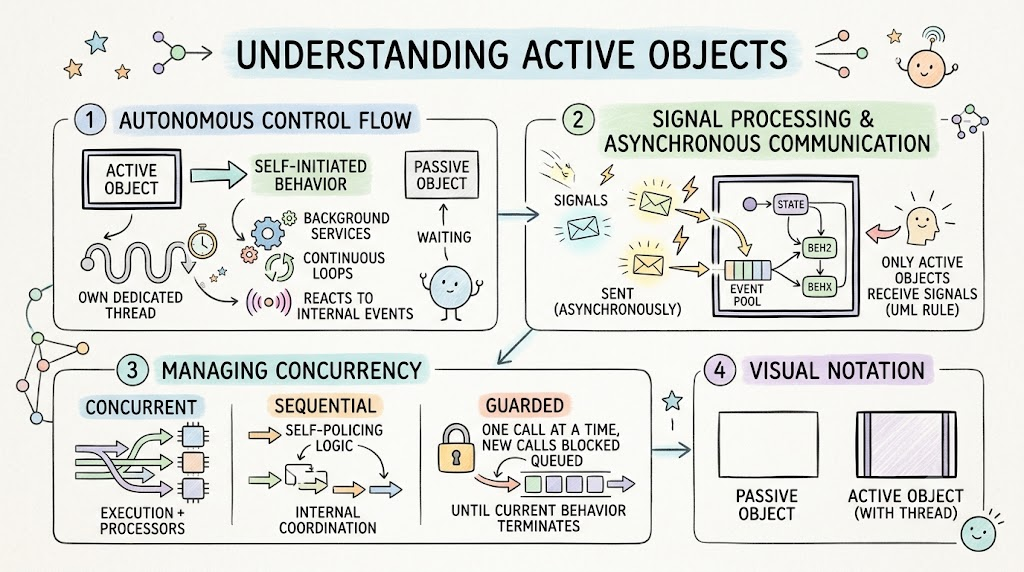
To effectively utilize active objects in your system designs, it is essential to understand their four foundational characteristics:
The defining role of an active object is its ability to respond to events autonomously and independently. Because it possesses its own dedicated thread of control, it does not need to wait for a synchronous method invocation from another object to begin acting. Instead, it can initiate behavior based on its internal state, continuous loops, or external events it receives. This makes them ideal for modeling background services, daemons, and independent hardware components.
In UML, active objects are the cornerstone of asynchronous communication. A strict rule in UML semantics is that only active objects can receive signals.
When a signal is sent to an active object, it is placed in the object's event pool.
The active object is then responsible for selecting and executing the specific behavior (often defined in a state machine) in response to that signal.
This decouples the sender from the receiver, allowing the system to handle asynchronous events gracefully without blocking the caller.
Active objects are heavily utilized in technical, time-critical, and concurrent systems to manage multiple simultaneous processes. When an active object receives multiple concurrent behavior calls or signals, the system must define how these executions are handled. UML categorizes these execution policies into three distinct types:
Concurrent: Multiple calls or behaviors are executed independently and at the exact same time (multi-threaded execution within the object).
Sequential: There is no built-in coordination by the object itself; the instances must "police themselves" using internal logic to manage the order of execution.
Guarded: Execution is strictly mutually exclusive. Only one behavior is called at a time. If a new behavior is triggered while another is running, the new call is blocked or queued until the first behavior terminates, preventing data conflicts and race conditions.
In UML diagrams, clarity is paramount. An active object (and its corresponding active class) is visually distinguished from a passive one through a specific notation: the rectangle representing the class or object is drawn with thick double vertical lines on the left and right sides. This immediate visual cue tells the reader that the element possesses its own thread of control.
Below are PlantUML examples demonstrating how to model active objects, their notation, and their asynchronous behavior.
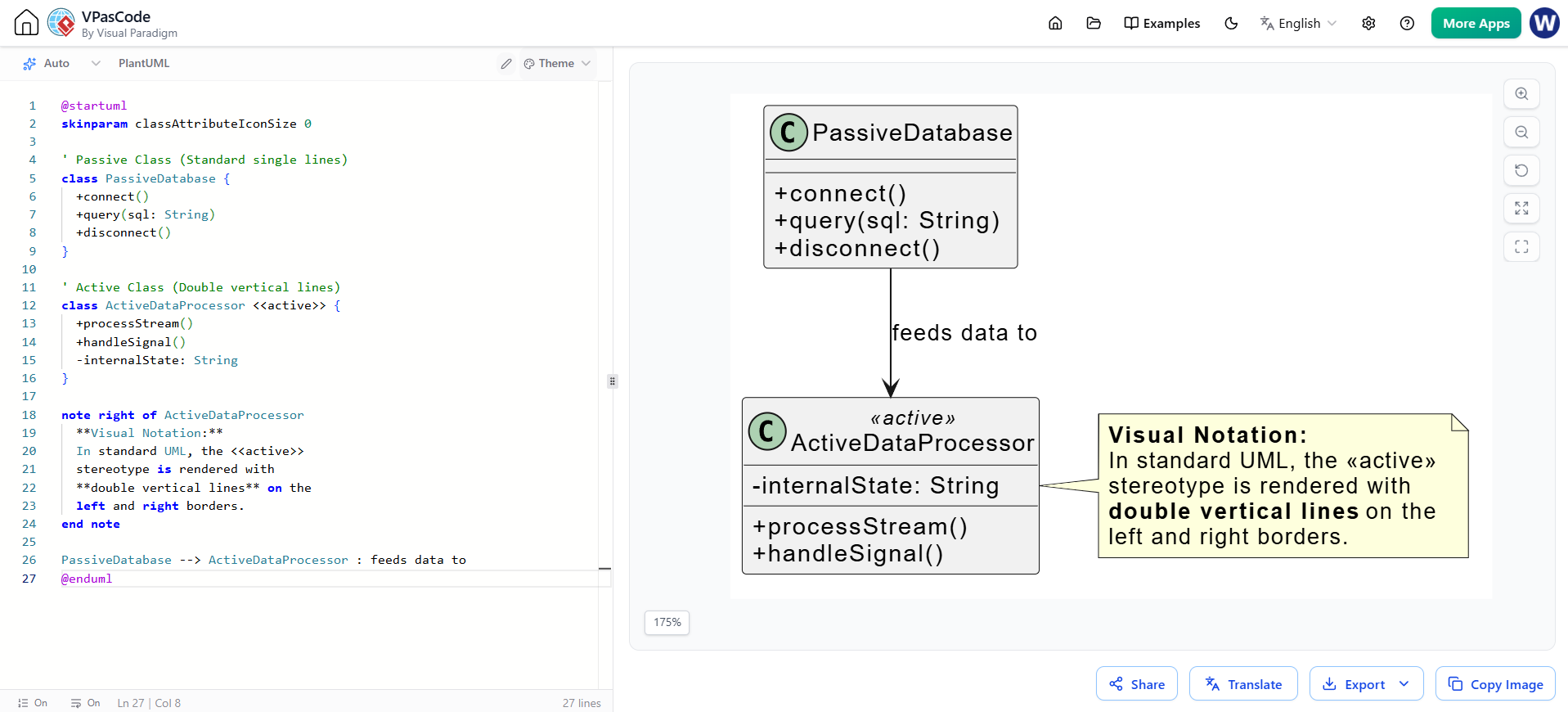
This diagram illustrates the visual difference between a standard passive class and an active class. In PlantUML, the <<active>> stereotype is used, which standard renderers will display with the required double vertical lines.
@startuml
skinparam classAttributeIconSize 0

' Passive Class (Standard single lines)
class PassiveDatabase {
  +connect()
  +query(sql: String)
  +disconnect()
}

' Active Class (Double vertical lines)
class ActiveDataProcessor <<active>> {
  +processStream()
  +handleSignal()
  -internalState: String
}

note right of ActiveDataProcessor
  **Visual Notation:**
  In standard UML, the <<active>>
  stereotype is rendered with
  **double vertical lines** on the
  left and right borders.
end note

PassiveDatabase --> ActiveDataProcessor : feeds data to
@enduml
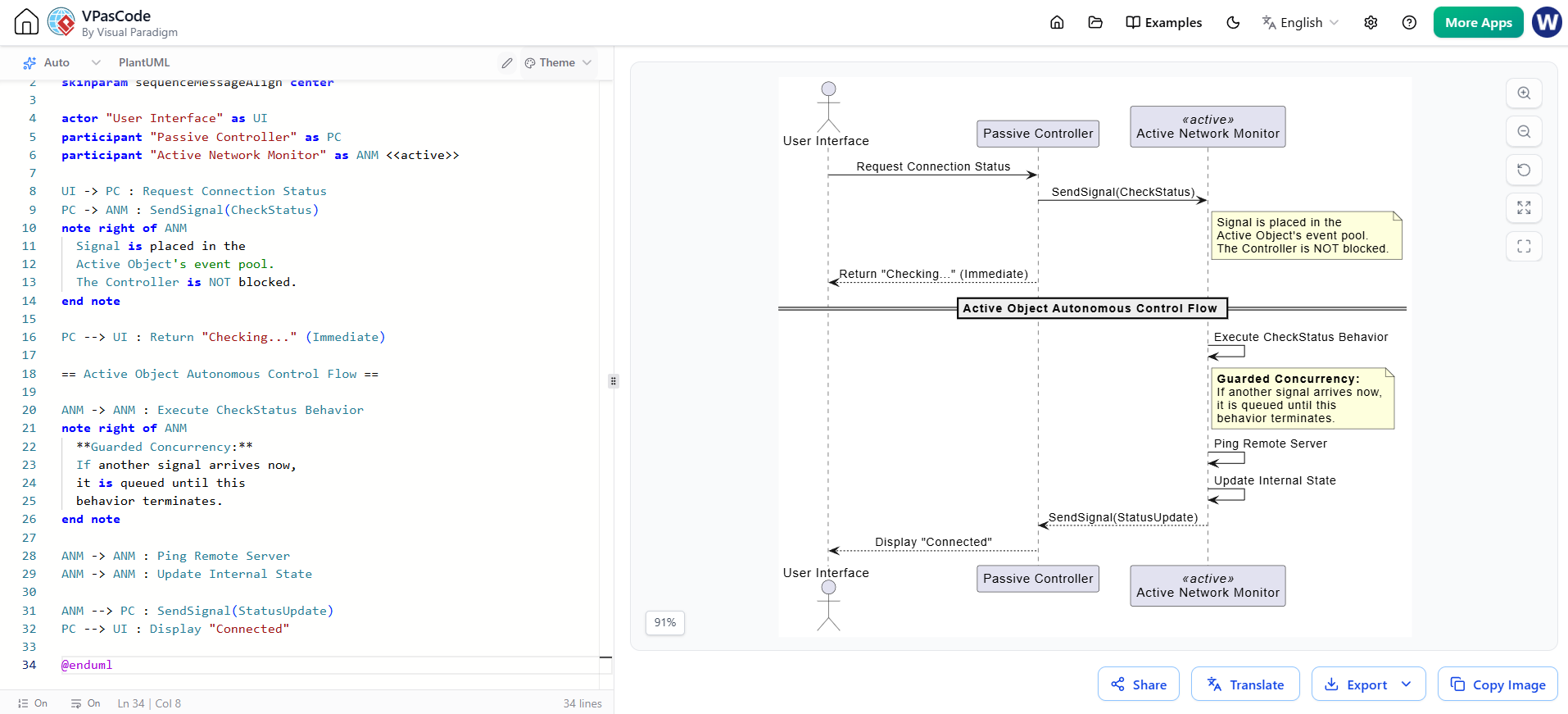
This sequence diagram demonstrates how a passive object sends an asynchronous signal to an active object, and how the active object processes it autonomously without blocking the sender.
@startuml
skinparam sequenceMessageAlign center

actor "User Interface" as UI
participant "Passive Controller" as PC
participant "Active Network Monitor" as ANM <<active>>

UI -> PC : Request Connection Status
PC -> ANM : SendSignal(CheckStatus)
note right of ANM
  Signal is placed in the
  Active Object's event pool.
  The Controller is NOT blocked.
end note

PC --> UI : Return "Checking..." (Immediate)

== Active Object Autonomous Control Flow ==

ANM -> ANM : Execute CheckStatus Behavior
note right of ANM
  **Guarded Concurrency:**
  If another signal arrives now,
  it is queued until this
  behavior terminates.
end note

ANM -> ANM : Ping Remote Server
ANM -> ANM : Update Internal State

ANM --> PC : SendSignal(StatusUpdate)
PC --> UI : Display "Connected"

@enduml
Active objects are an indispensable tool in the UML toolkit for software architects and systems engineers. By transitioning from the passive, caller-dependent execution model to an autonomous, signal-driven paradigm, active objects allow us to accurately model the complexities of modern concurrent and distributed systems.
Understanding their unique characteristics—specifically their autonomous control flow, exclusive ability to process signals, configurable concurrency policies, and distinct double-lined visual notation—ensures that your UML diagrams are not just structurally sound, but dynamically accurate. Whether you are designing a real-time trading system, an IoT network, or a multi-threaded application server, mastering active objects is key to designing robust, responsive, and conflict-free software architectures.

