
The Unified Modeling Language (UML) provides a standardized vocabulary for software engineers and system architects to design, visualize, and document software systems. However, as software engineering has evolved, so too have the specific domains, frameworks, and architectural patterns used to build these systems. A one-size-fits-all modeling language is often insufficient for capturing the nuanced, domain-specific details of modern software.
This is where stereotypes come into play. Stereotypes are the primary extension mechanism in UML. They allow practitioners to customize and specialize class diagrams for specific domains, systems, or processes without altering or redefining the core UML language itself. By "branding" or "marking" existing model elements, stereotypes introduce new types of modeling elements, bridging the gap between generic UML syntax and highly specific domain semantics.
This comprehensive guide explores how stereotypes function, the key concepts behind their application, standard examples, and practical diagrammatic implementations.
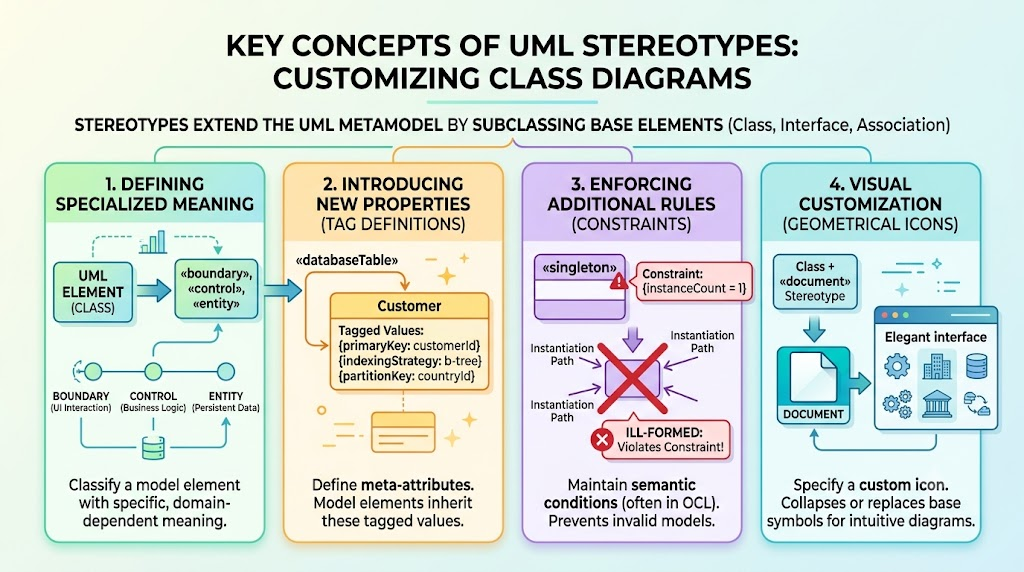
Stereotypes customize class diagrams by extending the metamodel of UML. When you apply a stereotype to a base element (like a Class, Interface, or Association), you are essentially subclassing that metaclass. This customization is achieved through four primary functions:
 \
\
Stereotypes allow you to classify a model element so it can be given a specific, domain-dependent meaning. This is crucial in architectural patterns where the role of a class is just as important as its structure.
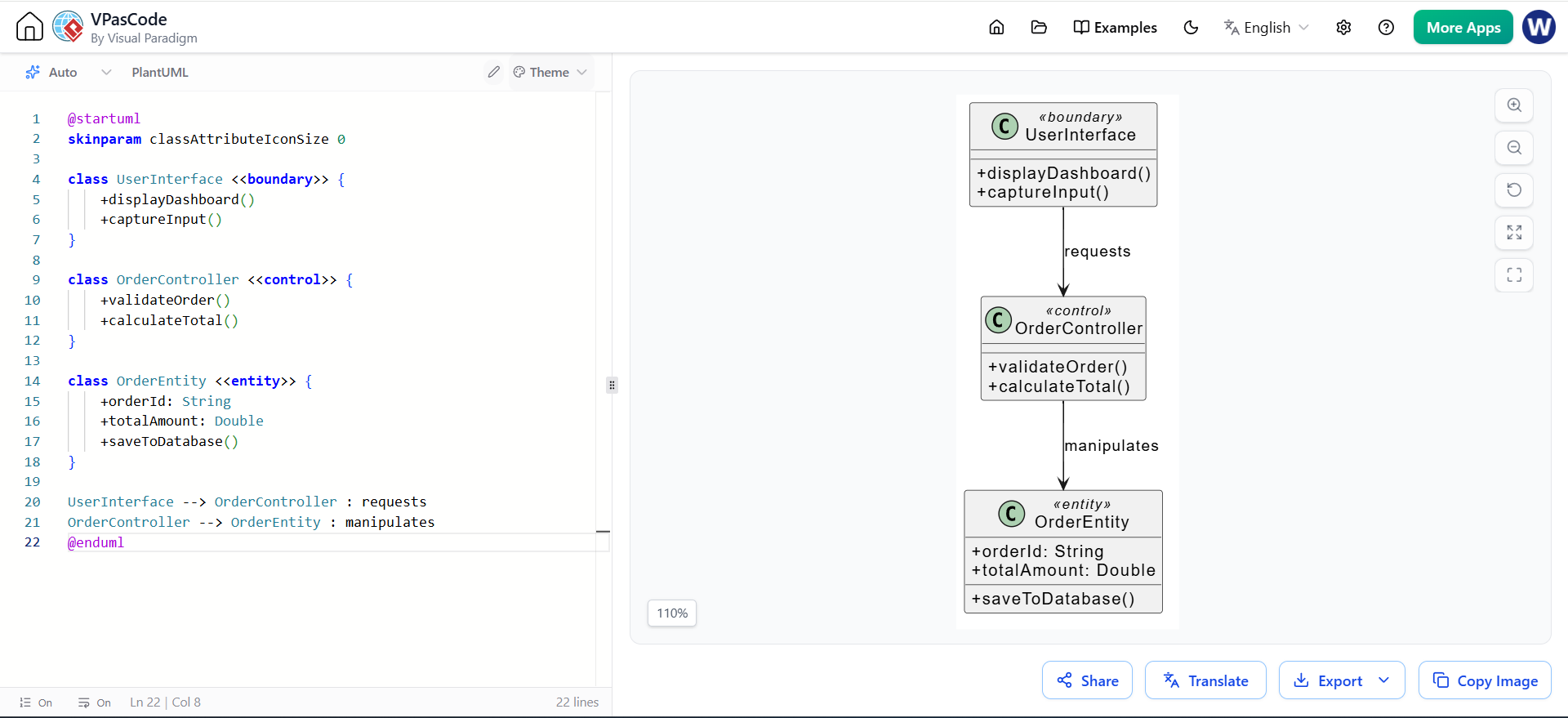
Example (Entity-Control-Boundary Pattern): In structural modeling, stereotypes such as «boundary», «control», and «entity» are used to distinguish the roles of classes. A «boundary» class handles UI interactions, a «control» class manages business logic, and an «entity» class represents persistent data.
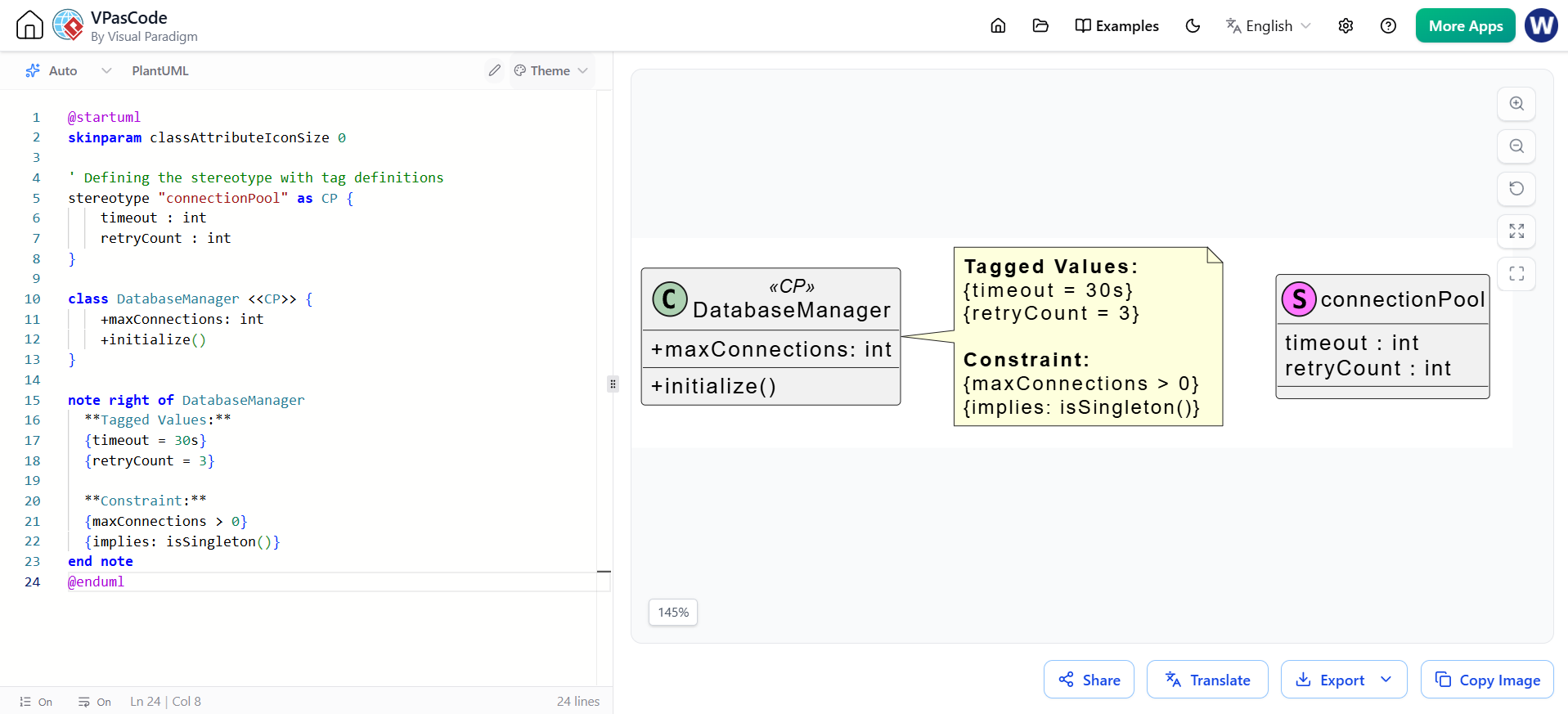
When a stereotype is declared, it can include tag definitions (meta-attributes). When the stereotype is applied to a model element, that element inherits these tagged values, allowing it to hold information specific to its customized role.
Example: If you create a «databaseTable» stereotype, you might define tag definitions for primaryKey, indexingStrategy, and partitionKey. When applied to a Customer class, the class now holds these specific database-related properties.
Stereotypes often carry constraints—semantic conditions (often written in the Object Constraint Language, or OCL) that must be maintained as true for any element bearing that stereotype. If a model element fails to satisfy these constraints, the model is considered "ill-formed" or invalid.
Example: A «singleton» stereotype carries the constraint: {instanceCount = 1}. If a developer attempts to model multiple instantiation paths for a class branded with this stereotype, the model violates the constraint.
A stereotype can specify a custom geometrical icon to represent branded elements. This allows the entire base symbol (like a standard class rectangle) to be collapsed or replaced by a specialized icon, making the diagram highly intuitive for its specific context.
Example: A «document» stereotype might be assigned a custom icon resembling a piece of paper with a folded corner, instantly communicating the class's purpose without needing to read the text.
To properly customize a class diagram using stereotypes, modelers must adhere to standard UML notational rules:
Keyword String: The stereotype name is enclosed in guillemets (« ») (double-angle brackets) and placed above or preceding the name of the element.
Format: <<StereotypeName>>
Multiple Stereotypes: Model elements can be branded by zero or more stereotypes. If multiple are used, they can be depicted vertically stacked or separated by commas. Note: When multiple stereotypes are applied, associated custom icons are typically omitted to avoid visual clutter.
Inheritance of Properties: Once applied, the model element receives or inherits all attributes, associations, operations, and parent classes defined by the stereotype's metaclass extension.
While you can create custom stereotypes, UML defines several standard stereotypes frequently used to customize class diagrams. Understanding these is fundamental to structural modeling:
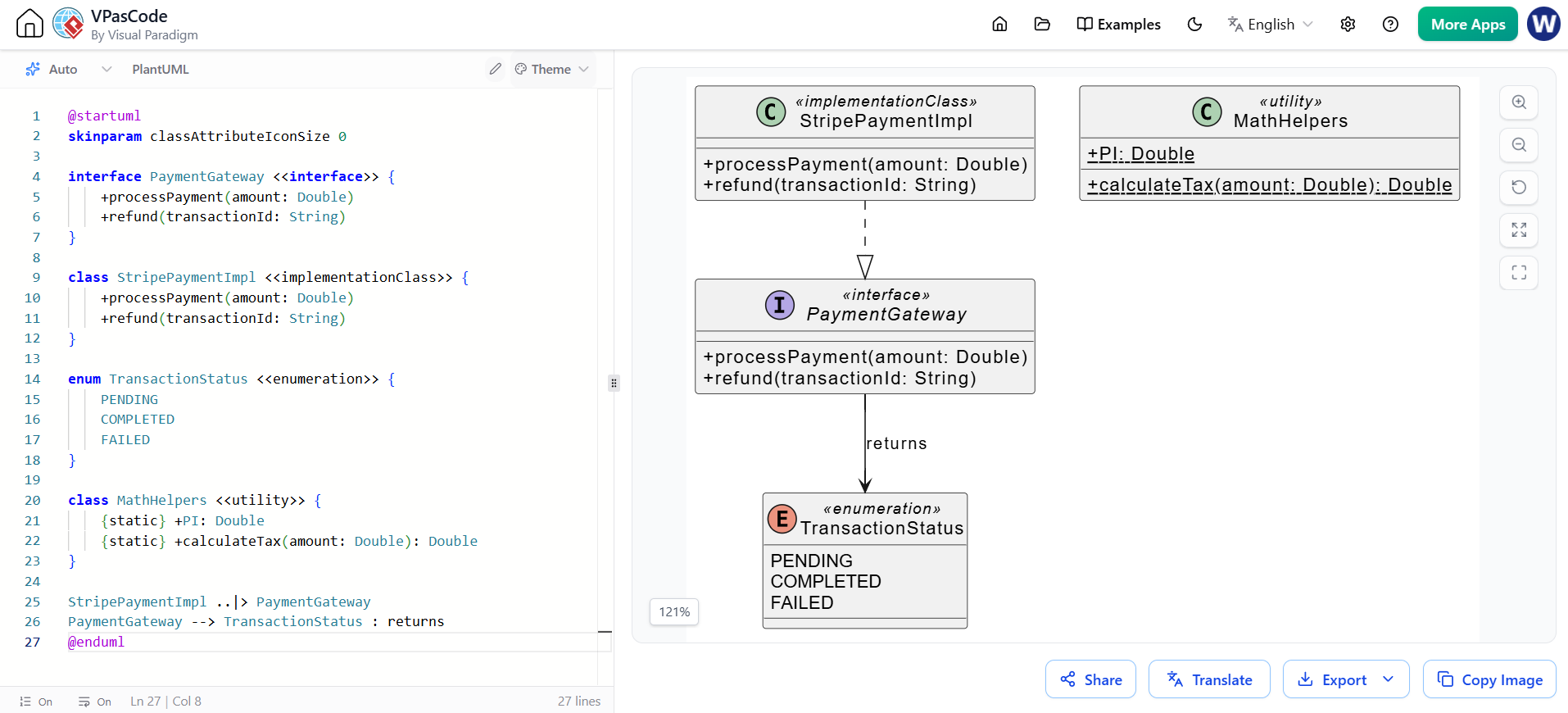
«utility»: Denotes that a class has no instances (it cannot be instantiated) and all its features (attributes and operations) are classifier-scoped (static). Used for mathematical or helper function classes.
«enumeration»: Defines an enumerated data type consisting of a strict list of literal values. It restricts the attribute values to one of the defined literals.
«type»: Focuses on the role a class may play or the signature of its operations without defining its physical implementation or internal structure.
«implementationClass»: Specifies the physical, concrete implementation of a class and its features, contrasting with the abstract «type» stereotype.
«interface»: Characterizes a service as a collection of externally visible operations. It defines a contract without including any structural features (attributes) or implementation details.
Below are practical examples demonstrating how stereotypes are applied in class diagrams, rendered using PlantUML syntax.
This example demonstrates how stereotypes clarify the architectural roles of classes in a system.
@startuml
skinparam classAttributeIconSize 0

class UserInterface <<boundary>> {
    +displayDashboard()
    +captureInput()
}

class OrderController <<control>> {
    +validateOrder()
    +calculateTotal()
}

class OrderEntity <<entity>> {
    +orderId: String
    +totalAmount: Double
    +saveToDatabase()
}

UserInterface --> OrderController : requests
OrderController --> OrderEntity : manipulates
@enduml
This example shows how a custom stereotype introduces new properties (tags) and enforces rules (constraints) on a class.
@startuml
skinparam classAttributeIconSize 0

' Defining the stereotype with tag definitions
stereotype "connectionPool" as CP {
    timeout : int
    retryCount : int
}

class DatabaseManager <<CP>> {
    +maxConnections: int
    +initialize()
}

note right of DatabaseManager
  **Tagged Values:**
  {timeout = 30s}
  {retryCount = 3}

  **Constraint:**
  {maxConnections > 0}
  {implies: isSingleton()}
end note
@enduml
This example illustrates the use of standard UML stereotypes to distinguish between interfaces, implementations, enumerations, and utility classes.
@startuml
skinparam classAttributeIconSize 0

interface PaymentGateway <<interface>> {
    +processPayment(amount: Double)
    +refund(transactionId: String)
}

class StripePaymentImpl <<implementationClass>> {
    +processPayment(amount: Double)
    +refund(transactionId: String)
}

enum TransactionStatus <<enumeration>> {
    PENDING
    COMPLETED
    FAILED
}

class MathHelpers <<utility>> {
    {static} +PI: Double
    {static} +calculateTax(amount: Double): Double
}

StripePaymentImpl ..|> PaymentGateway
PaymentGateway --> TransactionStatus : returns
@enduml
Stereotypes are an indispensable feature of the Unified Modeling Language. By acting as a primary extension mechanism, they allow architects and developers to "brand" standard UML elements with domain-specific semantics, properties, and constraints. This capability ensures that class diagrams remain both standardized and highly expressive, preventing the need to invent entirely new modeling languages for every new domain or architectural pattern. Whether you are defining the strict boundaries of an MVC architecture, enforcing singleton constraints, or mapping classes to database tables, stereotypes provide the exact vocabulary you need.
To effectively design, manage, and visualize these highly customized class diagrams, leveraging robust modeling software is essential. Visual Paradigm is highly recommended for this purpose. As a comprehensive UML tool, Visual Paradigm offers extensive support for creating custom stereotypes, defining tag definitions, applying OCL constraints, and utilizing custom icons. Its intuitive interface and powerful code-generation capabilities ensure that your stereotyped models are not just visually clear, but seamlessly integrated into your actual software development lifecycle.

