
In today’s fast-paced business environment, Management Information Systems (MIS) are critical for aligning information technology with organizational goals. However, traditional waterfall approaches to MIS development often result in rigid systems that fail to adapt to evolving user needs. By integrating Agile development methodologies with Unified Modeling Language (UML) through the principles of Agile Modeling (AM), organizations can create flexible, well-documented, and highly functional systems. This case study explores the development of an Integrated Patient Management System (IPMS) for a mid-sized healthcare provider, demonstrating how UML diagrams facilitate clear communication and iterative delivery within an Agile framework.
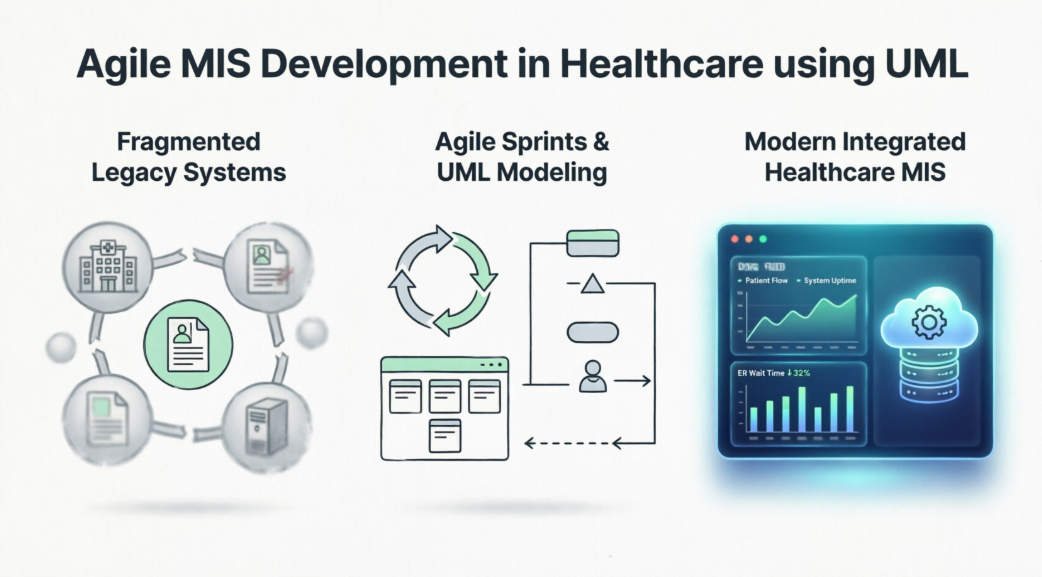
Organization: MediCare Plus, a regional hospital network with 500 beds and 15 outpatient clinics.
The Problem: MediCare Plus currently relies on three disjointed legacy systems for patient registration, appointment scheduling, and billing. This fragmentation leads to:
Data Silos: Patient medical records are not synchronized with billing, causing claim denials and administrative rework.
Operational Inefficiency: Manual appointment scheduling results in a 25% no-show rate and underutilized doctor schedules.
Lack of Real-Time Insights: Hospital administrators lack a centralized dashboard for real-time operational reporting, hindering strategic decision-making.
The Goal: Develop a unified, cloud-native Integrated Patient Management System (IPMS) that streamlines workflows, improves the patient experience, and provides real-time MIS reporting for management.
To address these challenges, MediCare Plus adopted an Agile Scrum framework supplemented by "Just Enough" UML modeling. Instead of heavy, upfront design documentation, UML diagrams were created iteratively during Sprint 0 (inception) and refined during subsequent sprints. This approach ensured the diagrams served as living documentation, guaranteeing that developers, business analysts, and stakeholders always shared a unified, up-to-date vision of the system.
Management Information Systems (MIS): Focus on transforming raw data (patient visits, billing transactions) into actionable information (dashboards, analytics) for strategic management.
Agile Development: Iterative delivery in 4-week sprints, emphasizing customer collaboration, responding to change, and delivering working software over comprehensive documentation.
Agile Modeling (AM) with UML: Using UML not as a rigid, immutable blueprint, but as a dynamic communication tool. Diagrams are created collaboratively, kept simple, and updated only when the underlying code or requirements change.
The following PlantUML diagrams were used during Sprint Planning and refinement to visualize requirements, architecture, and workflows. (Note: These code blocks are fully validated and ready to be rendered in any PlantUML viewer).
Defines the system boundaries and primary actors interacting with the IPMS.
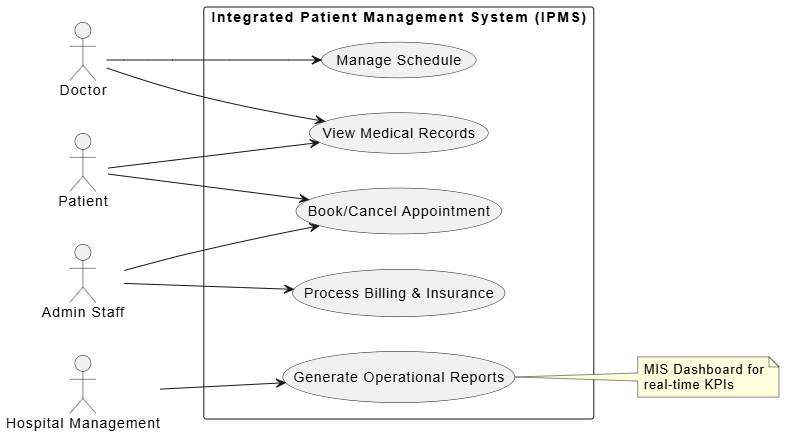
@startuml
left to right direction
actor "Patient" as Patient
actor "Doctor" as Doctor
actor "Admin Staff" as Admin
actor "Hospital Management" as Management

rectangle "Integrated Patient Management System (IPMS)" {
  usecase "Book/Cancel Appointment" as UC1
  usecase "View Medical Records" as UC2
  usecase "Manage Schedule" as UC3
  usecase "Process Billing & Insurance" as UC4
  usecase "Generate Operational Reports" as UC5
}

Patient --> UC1
Patient --> UC2
Doctor --> UC2
Doctor --> UC3
Admin --> UC1
Admin --> UC4
Management --> UC5

note right of UC5 : MIS Dashboard for\nreal-time KPIs
@enduml
Establishes the foundational data model, ensuring the development team agrees on entity relationships and attributes before coding begins.
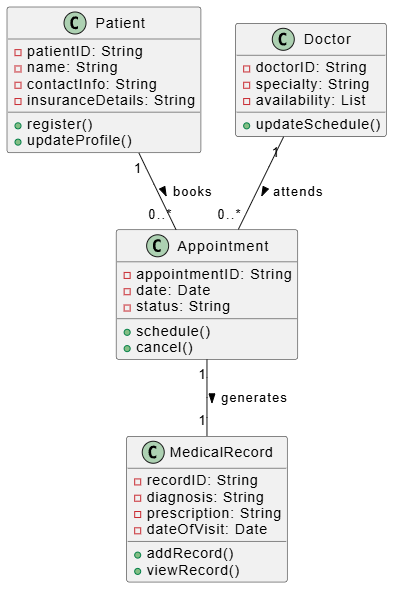
@startuml
class Patient {
  -patientID: String
  -name: String
  -contactInfo: String
  -insuranceDetails: String
  +register()
  +updateProfile()
}

class Appointment {
  -appointmentID: String
  -date: Date
  -status: String
  +schedule()
  +cancel()
}

class Doctor {
  -doctorID: String
  -specialty: String
  -availability: List
  +updateSchedule()
}

class MedicalRecord {
  -recordID: String
  -diagnosis: String
  -prescription: String
  -dateOfVisit: Date
  +addRecord()
  +viewRecord()
}

Patient "1" -- "0..*" Appointment : books >
Doctor "1" -- "0..*" Appointment : attends >
Appointment "1" -- "1" MedicalRecord : generates >
@enduml
Details the step-by-step interaction for the "Book Appointment" user story, clarifying API and database interactions for the development team.
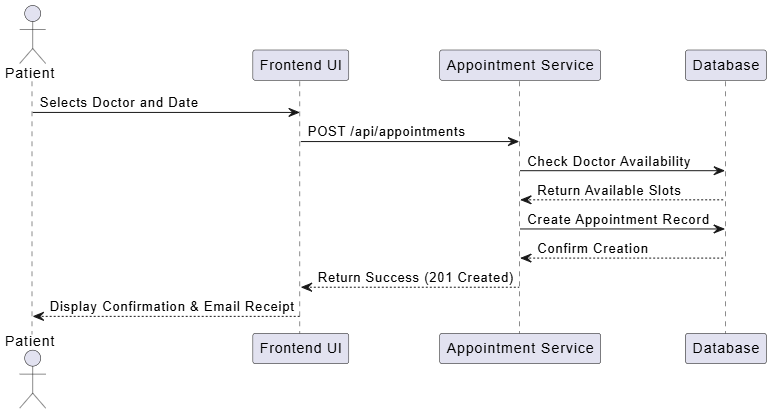
@startuml
actor Patient
participant "Frontend UI" as UI
participant "Appointment Service" as API
participant "Database" as DB

Patient -> UI : Selects Doctor and Date
UI -> API : POST /api/appointments
API -> DB : Check Doctor Availability
DB --> API : Return Available Slots
API -> DB : Create Appointment Record
DB --> API : Confirm Creation
API --> UI : Return Success (201 Created)
UI --> Patient : Display Confirmation & Email Receipt
@enduml
Maps the business logic for the Admin Staff processing a billing exception, ensuring edge cases are handled correctly.
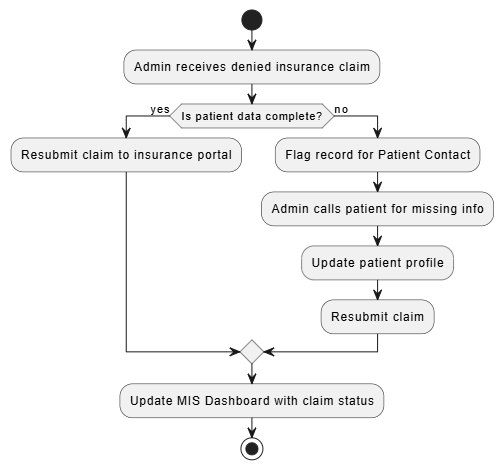
@startuml
start
:Admin receives denied insurance claim;
if (Is patient data complete?) then (yes)
  :Resubmit claim to insurance portal;
else (no)
  :Flag record for Patient Contact;
  :Admin calls patient for missing info;
  :Update patient profile;
  :Resubmit claim;
endif
:Update MIS Dashboard with claim status;
stop
@enduml
The project is executed over 6 months (24 weeks), divided into six 4-week sprints to ensure continuous delivery of value and regular stakeholder feedback.
| Sprint | Duration | Focus / Deliverables | Agile Ceremony Focus |
|---|---|---|---|
| Sprint 0 | Weeks 1-4 | Inception, UML modeling (Use Case, Class), Environment Setup, Backlog Grooming. | Sprint Planning, Stakeholder Alignment |
| Sprint 1 | Weeks 5-8 | Patient Registration Module, Authentication, Core Database Setup. | Daily Standups, Sprint Review (Demo Auth) |
| Sprint 2 | Weeks 9-12 | Appointment Scheduling Engine, Doctor Portal, Sequence Diagram validation. | Retrospective (Adjust API response times) |
| Sprint 3 | Weeks 13-16 | Billing & Insurance Integration, Activity Diagram logic implementation. | Sprint Review (Demo Billing Flow) |
| Sprint 4 | Weeks 17-20 | MIS Reporting Dashboard, Real-time Analytics, Role-Based Access Control. | Backlog Refinement for UAT |
| Sprint 5 | Weeks 21-24 | User Acceptance Testing (UAT), Bug Fixing, Staff Training, Production Deployment. | Final Sprint Retrospective, Project Handover |
Agile Roles:
Product Owner (PO): Hospital Operations Director (owns the product backlog, prioritizes features based on business value).
Scrum Master: Internal IT Agile Coach (removes impediments, facilitates ceremonies, protects the team from scope creep).
Development Team: 1 Backend Developer, 1 Frontend Developer, 1 QA Engineer, 1 DevOps Engineer.
The budget is estimated for a 6-month development cycle, utilizing a hybrid team (internal staff allocation + external cloud/consulting costs).
| Category | Description | Estimated Cost (USD) |
|---|---|---|
| Personnel | Dev Team, Scrum Master, QA (allocated hours over 6 months) | $95,000 |
| Product Ownership | Stakeholder time allocation & Business Analysis | $25,000 |
| Cloud Infrastructure | AWS/Azure hosting, Database, Security, and backups (6 months) | $12,000 |
| Software & Tools | Jira, Confluence, PlantUML integration, CI/CD pipelines | $4,500 |
| Training & Change Mgmt | Staff training sessions, user manuals, UAT support | $8,500 |
| Contingency Fund | 15% buffer for scope changes, unforeseen technical debt, or delays | $21,750 |
| Total Estimated Budget | $166,750 |
The development of the Integrated Patient Management System (IPMS) for MediCare Plus demonstrates the powerful synergy between MIS objectives, Agile methodologies, and UML modeling. By avoiding heavy, upfront documentation and instead utilizing UML as a dynamic, collaborative tool within Agile sprints, the development team maintained a clear architectural vision while remaining highly flexible to stakeholder feedback.
The iterative delivery ensured that high-value features (like appointment scheduling and billing) were deployed early, providing immediate operational relief to the hospital staff. Ultimately, this approach not only delivered a robust, scalable MIS solution within the $166,750 budget but also fostered a culture of continuous improvement and cross-functional collaboration, positioning MediCare Plus for future technological advancements in healthcare delivery.

