
Balancing Certainty and Flexibility in Modern Software Projects
In today's rapidly evolving technological landscape, software development teams face a fundamental challenge: how to plan effectively when requirements shift, markets change, and uncertainty is the only constant. For decades, the industry has grappled with two contrasting philosophies—predictive planning, which seeks to map the entire journey upfront, and adaptive planning, which embraces change as an inherent part of the process.
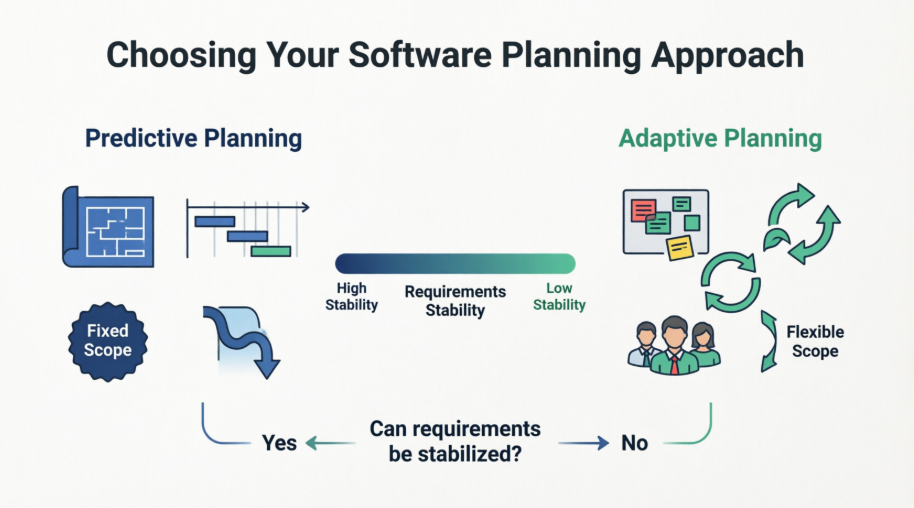
This guide explores the core principles, strengths, and limitations of both approaches. Whether you're a product manager, developer, or stakeholder, understanding when to apply predictive rigor versus adaptive flexibility can mean the difference between project success and costly failure. We'll examine real-world frameworks like the Unified Process and Agile methodologies, analyze contractual implications, and provide actionable advice for choosing the right planning strategy for your context.
By the end of this guide, you'll have a clear framework for evaluating your project's requirements stability, risk profile, and team dynamics to select—and effectively execute—the planning approach that delivers maximum value.
One reason that the waterfall model endures is the human desire for predictability in software development. Nothing is more frustrating than not having a clear idea of:
A predictive approach invests significant effort early in the project to yield greater understanding of what must be done later. This creates a two-stage project structure:
| Stage | Characteristics | Predictability Level |
|---|---|---|
| Planning Stage | Requirements gathering, architecture design, detailed specifications | Low – high uncertainty |
| Execution Stage | Implementation based on established plans | High – plans provide clarity |
Key Insight: Predictability isn't binary. As the project progresses, understanding increases incrementally. Even with solid plans, deviations occur—but they become less significant once foundations are stable.
At the heart of predictive planning lies a critical assumption: requirements can be stabilized. However, software projects uniquely struggle with:
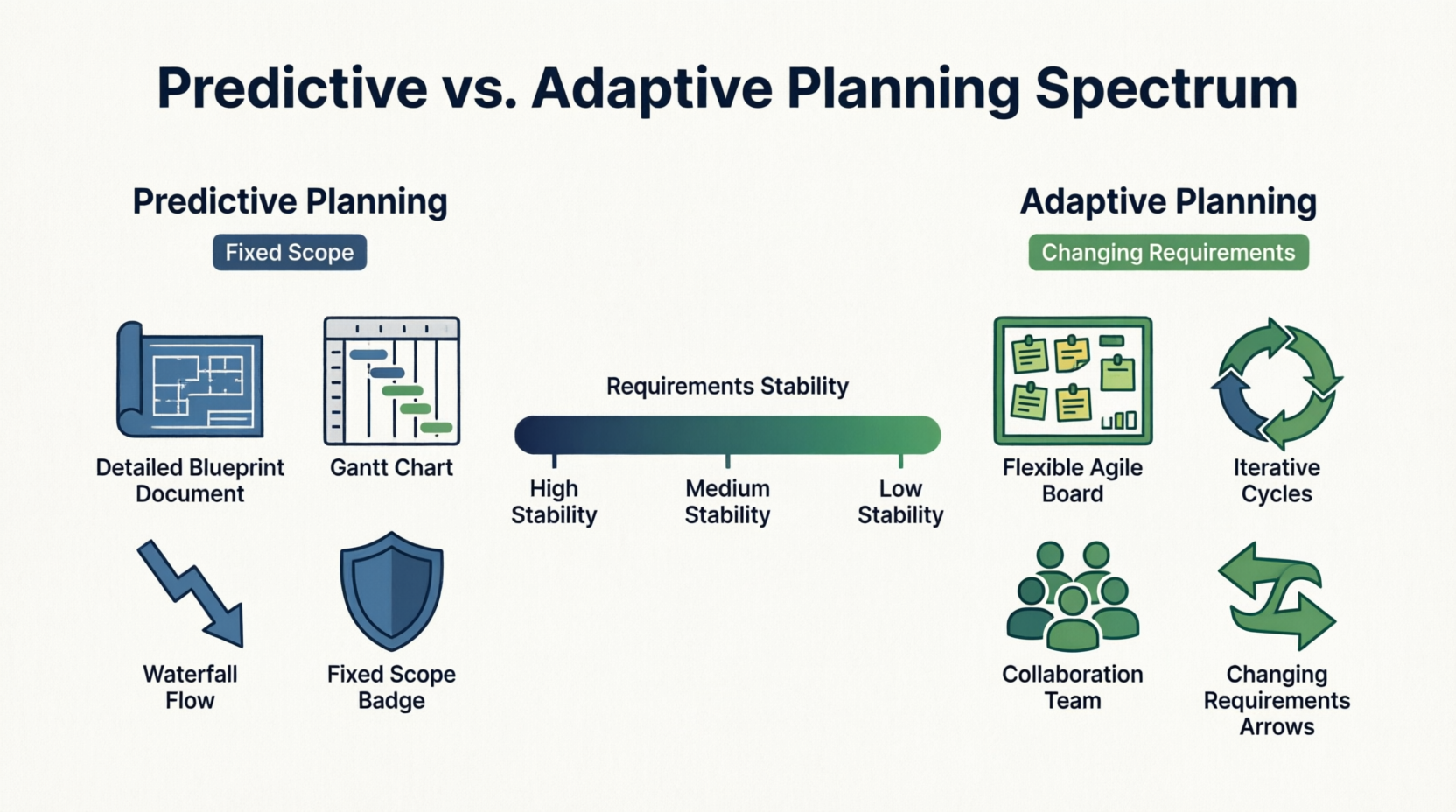
[Figure 1: Predictive vs. Adaptive Planning Spectrum appears here]
This visual illustrates the continuum between predictive and adaptive approaches, highlighting how requirements stability, risk tolerance, and market dynamics influence where your project should land on the spectrum.
graph LR
    A[Predictive Planning] --> B[Freeze Requirements Early]
    B --> C[Reduced Churn]
    B --> D[Risk: System Doesn't Meet User Needs]
    A --> E[Invest Heavily in Requirements Analysis]
    E --> F[More Accurate Requirements]
    E --> G[Still Vulnerable to Market Changes]
When Predictive Planning Works Best:
✅ Well-understood problem domains
✅ Stable regulatory or compliance environments
✅ Projects with minimal user interaction during development
✅ Fixed-scope contractual obligations with clear penalties
A growing school of thought contends that requirements churn is unavoidable due to:
Rather than fighting this reality, adaptive planning treats change as a constant and builds processes to manage it effectively.
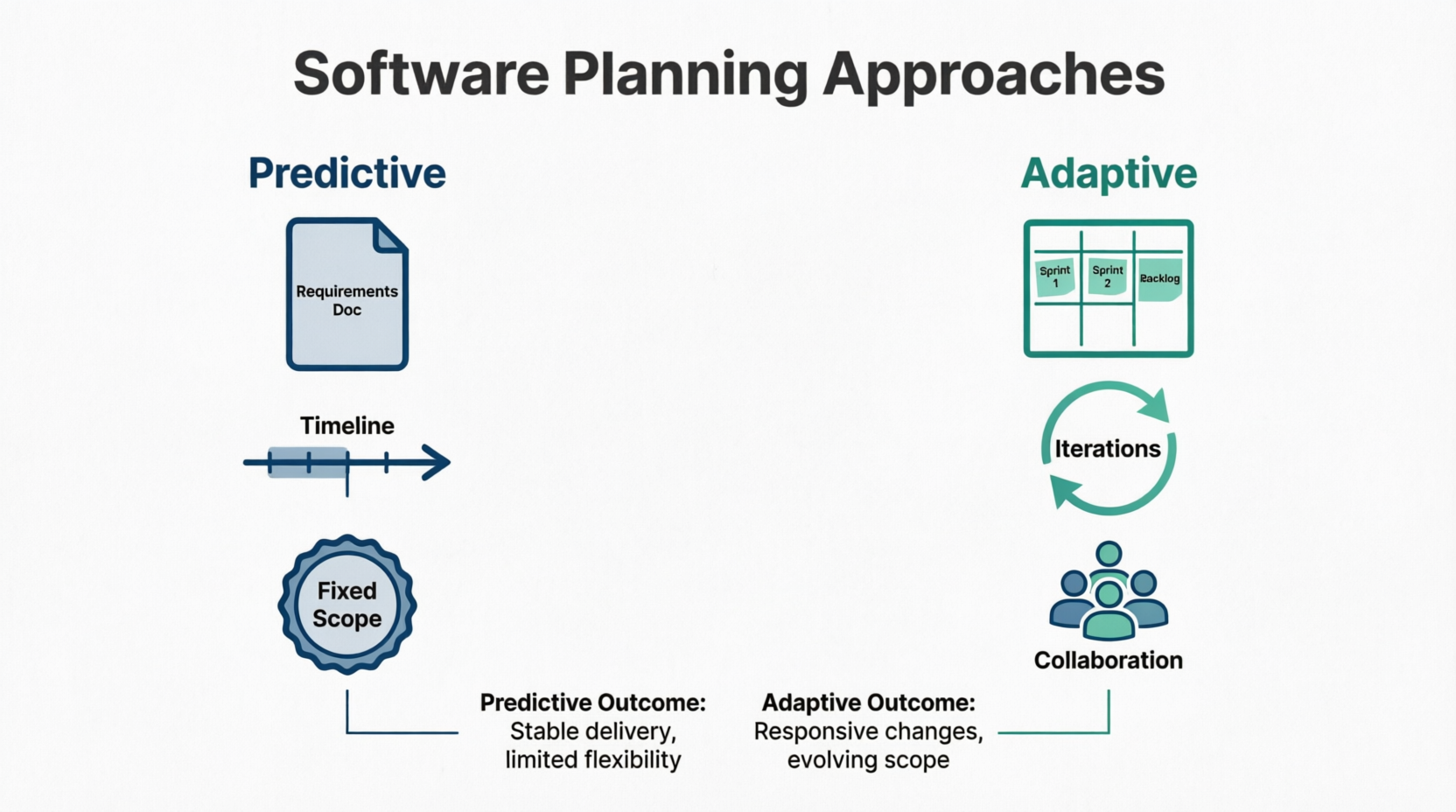
Unlike predictive contracts that fix scope, cost, and timeline, adaptive agreements typically feature:
| Element | Predictive Contract | Adaptive Contract |
|---|---|---|
| Scope | Fixed functionality | Variable, prioritized backlog |
| Budget | Fixed | Often fixed or time-boxed |
| Timeline | Fixed delivery date | Fixed iterations, flexible release scope |
| Change Management | Change requests, penalties | Built-in reprioritization cycles |
| Success Metric | Delivering specified features | Delivering maximum value within constraints |
Critical Note: Adaptive projects can be canceled if progress proves too slow—this built-in off-ramp protects stakeholders from sunk-cost fallacy.
✅ Highly innovative or exploratory projects
✅ Markets with rapid competitive shifts
✅ Products requiring frequent user feedback
✅ Teams with strong collaboration skills and psychological safety
Although often associated with UML, the Unified Process is actually a process framework—providing vocabulary and structure rather than rigid prescriptions.
[Figure 2: Unified Process Four Phases Diagram appears here]
This diagram visualizes the sequential yet iterative nature of UP's four phases, showing how risk reduction and architectural validation occur during Elaboration before full-scale Construction begins.
Important Nuance: UP is inherently iterative. While some teams attempt to overlay waterfall practices onto UP terminology ("waterfall in UP clothing"), this contradicts UP's philosophy. The transition from elaboration to construction sometimes marks a shift toward more predictive planning—but only if requirements have sufficiently stabilized.
Organizations often adopt UP concepts without licensed Rational Software products, creating customized "development cases" tailored to project needs. Success requires:
Agile is an umbrella term for methodologies sharing values from the Manifesto for Agile Software Development, including:
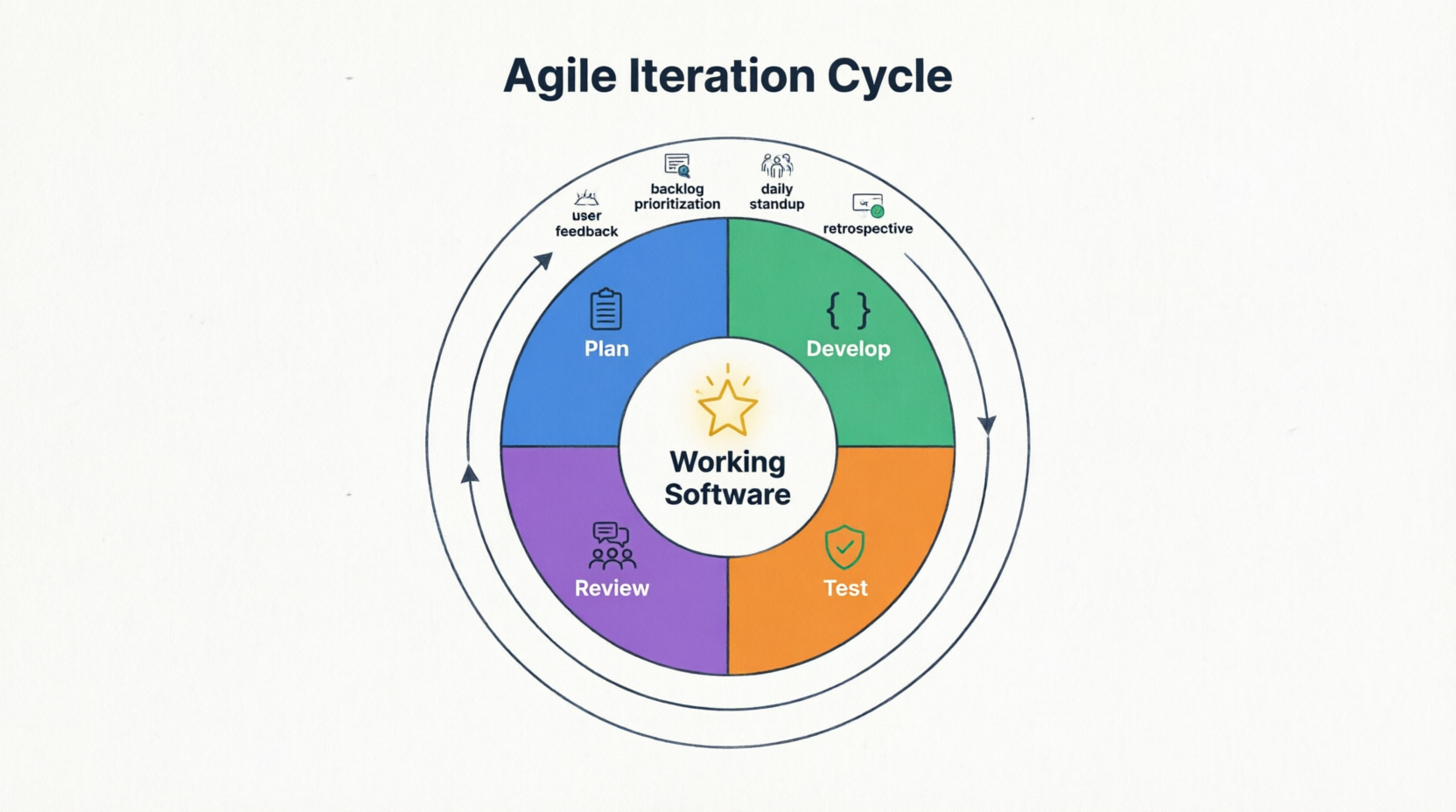
[Figure 3: Agile Iteration Cycle Diagram appears here]
This circular visualization demonstrates how Agile teams continuously cycle through planning, development, testing, and review—delivering working software incrementally while incorporating feedback at every turn.
| Trait | Description | Practical Impact |
|---|---|---|
| People-Oriented | Success depends on team quality and collaboration | Invest in team health over process compliance |
| Short Iterations | Time-boxed cycles (typically ≤1 month) | Frequent feedback, rapid course correction |
| Low Ceremony | Minimal documentation and control points | Faster adaptation, less overhead |
| Sketch-Mode UML | Diagrams for communication, not blueprints | Focus on working software over comprehensive docs |
| Adaptive Planning | Plans evolve with learning | Embrace change as value-creation opportunity |
Clarification: Agile's "lightweight" reputation stems from its adaptivity and people-focus—not from being less rigorous. Discipline shifts from documentation to continuous delivery and feedback.
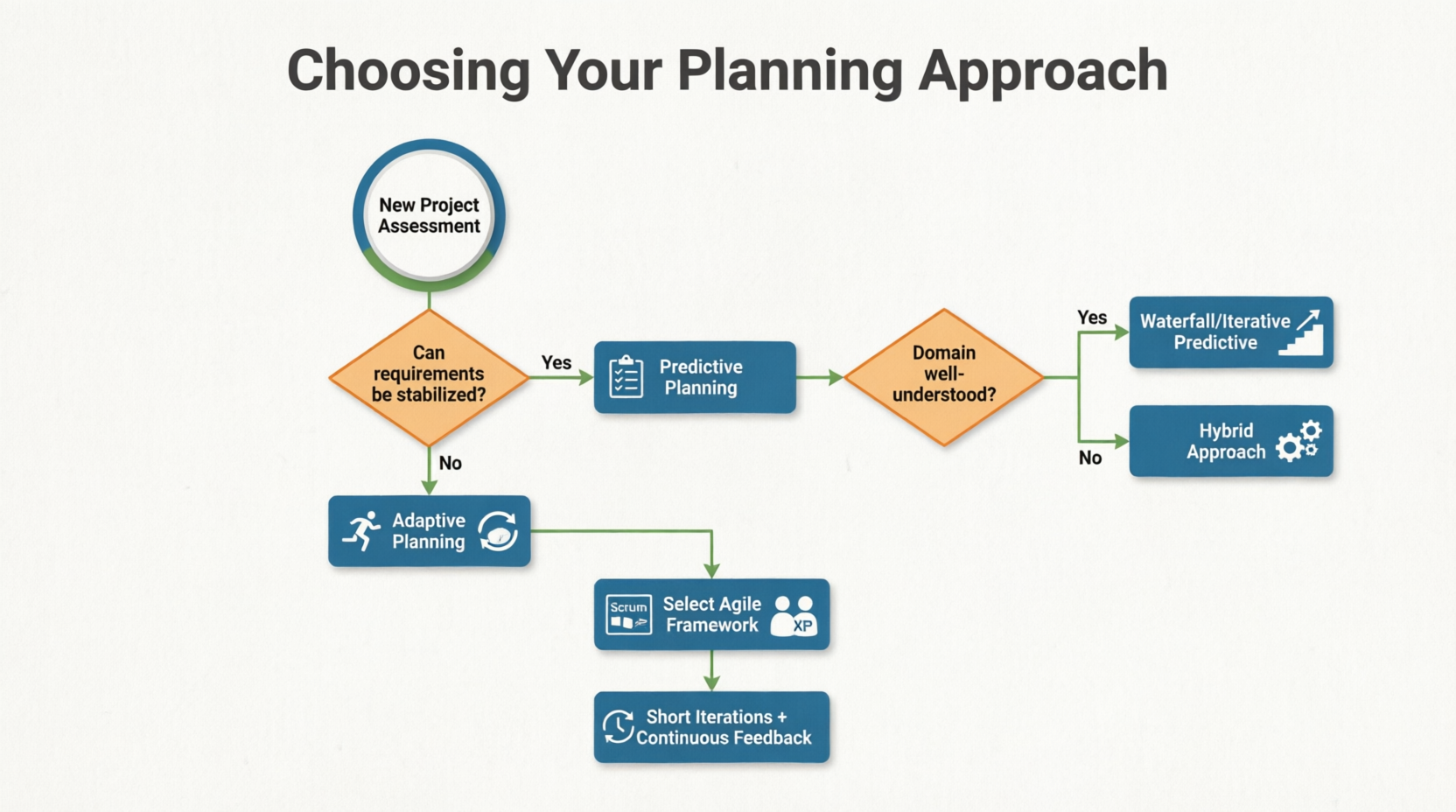
Based on the analysis above, follow these decision principles:
[Figure 4: Planning Approach Decision Guide appears here]
This flowchart provides a practical, step-by-step visual tool to assess your project's characteristics and determine whether predictive, adaptive, or hybrid planning is most appropriate.
Many successful projects blend approaches:
Regardless of approach, ensure alignment on:
The debate between predictive and adaptive planning isn't about which approach is universally superior—it's about matching your planning strategy to your project's reality.
Predictive planning offers comfort through structure but demands stability that many software projects cannot guarantee. Adaptive planning embraces uncertainty but requires disciplined collaboration, transparent communication, and stakeholder trust. The most mature organizations don't choose one forever; they develop the capability to assess each initiative's context and apply the appropriate planning philosophy—or blend them strategically.
As you move forward:
🔹 Audit your requirements stability before locking into a planning style
🔹 Invest in team collaboration skills—they're the foundation of adaptive success
🔹 Treat plans as living artifacts, whether predictive or adaptive
🔹 Communicate your planning approach clearly to stakeholders to set accurate expectations
🔹 Review and adapt your planning strategy as the project evolves
In an industry defined by change, the ultimate competitive advantage isn't perfect prediction—it's the agility to respond intelligently when reality diverges from expectation. By mastering both predictive rigor and adaptive flexibility, you equip your team to deliver value consistently, regardless of what the future holds.

