
In the realm of software engineering, selecting the right development methodology is a critical decision that can dictate the success or failure of a project. At the core of this decision lies a fundamental spectrum of formality, rule density, and philosophical orientation. On one end, we have Heavyweight Methodologies, characterized by rigorous processes and extensive documentation. On the other, Lightweight Methodologies (often synonymous with Agile), which champion human interaction and working code.
However, the industry has increasingly recognized that neither extreme is a silver bullet. This has given rise to the Roadmap Alternative, a scalable, process-independent framework designed to balance the rigor of heavyweight processes with the adaptability of lightweight approaches.
This comprehensive guide explores the key concepts, practical applications, and underlying philosophies of these three paradigms, providing you with the insights needed to navigate the software development spectrum effectively.
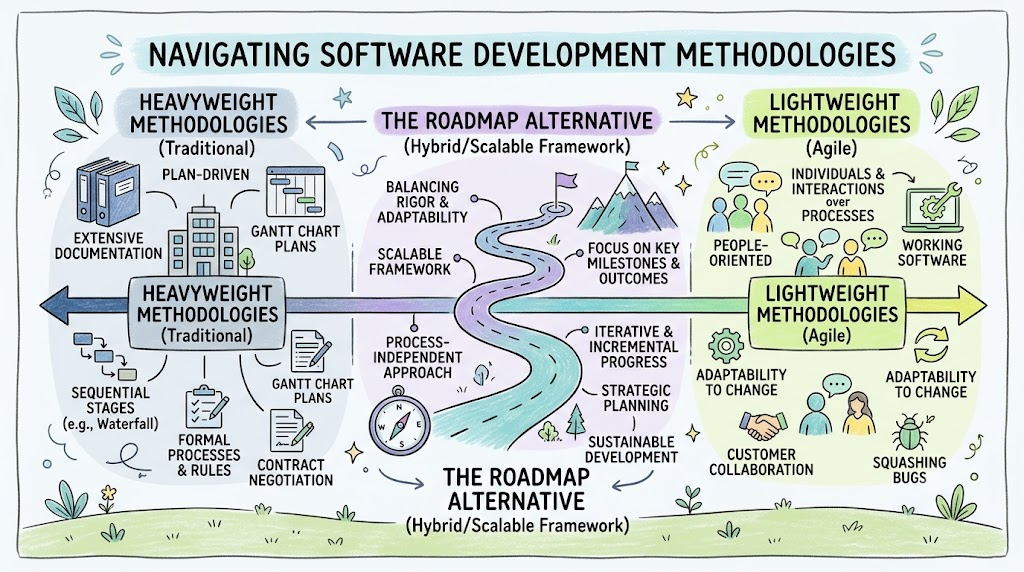
Heavyweight methodologies are built on the premise that software development is a predictable, engineering-driven discipline that requires strict control. They are highly formalized and rely on a significant number of rules and practices reified into detailed process elements.
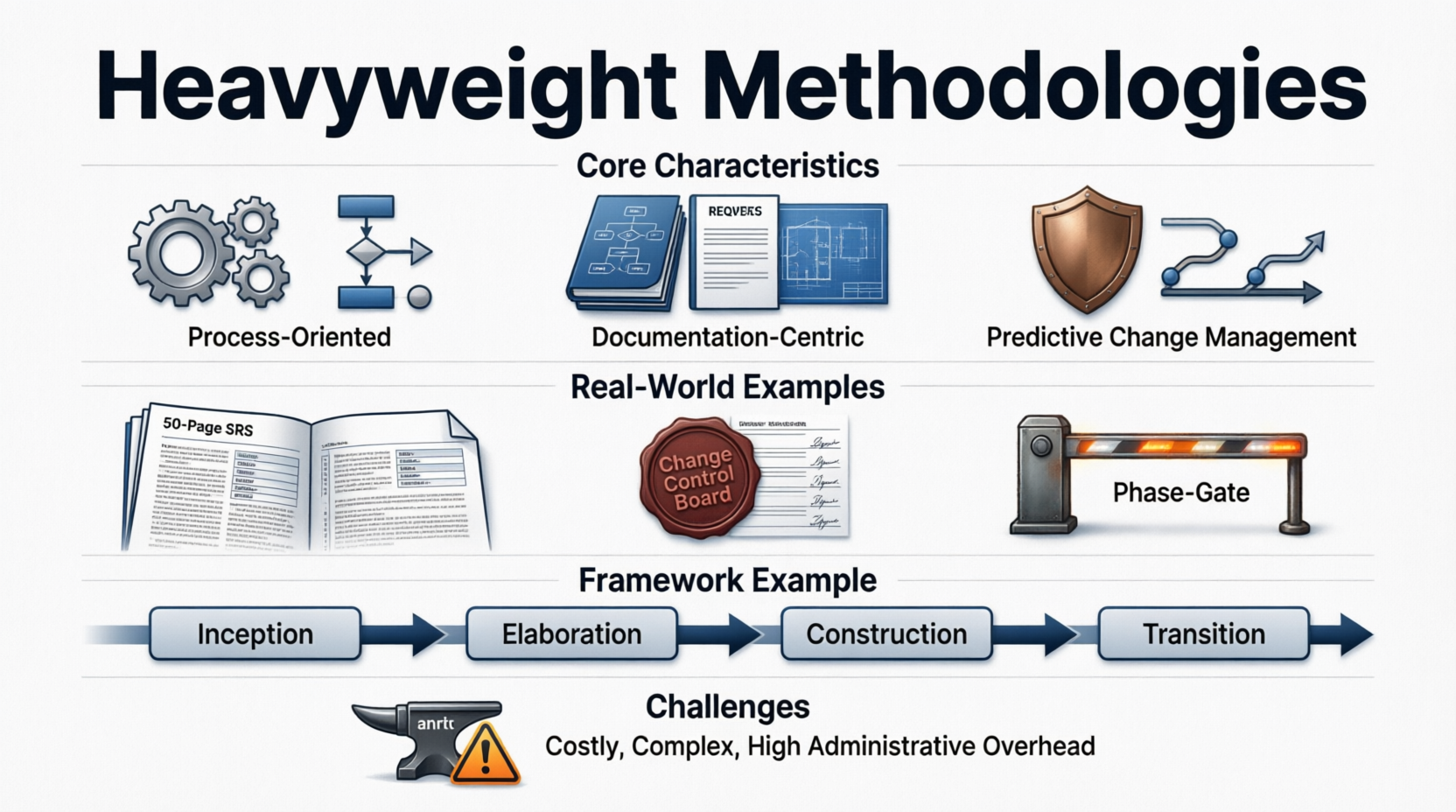
Process-Oriented: The process dictates the workflow. Extensive detail is provided on who (specific roles/workers) does what (specific activities) to which work products.
Documentation-Centric: Communication is leveraged through various formal work products (documents, models, diagrams) rather than direct conversation.
Predictive Change Management: The primary goal is to predictably plan for and prescriptively control change and complexity before it happens.
The 50-Page SRS: Before a single line of code is written, the team spends three months drafting and signing off on a 50-page Software Requirements Specification (SRS) document.
Change Control Boards (CCB): If a client wants to add a minor feature mid-project, the request must be submitted to a formal CCB, undergo a rigorous impact analysis, and receive written approval from five different stakeholders.
Phase-Gate Approvals: The project cannot move from the "Design" phase to the "Implementation" phase until a formal design document is reviewed and signed off by the architecture board.
Framework Example: The Unified Process (UP) (and its popular variant, the Rational Unified Process or RUP) is a classic heavyweight framework that relies on four distinct phases (Inception, Elaboration, Construction, Transition) and nine disciplined workflows.
Organizations often find heavyweight processes costly and complex to adopt. Many abandon them because they underestimate the massive administrative overhead and resources required to maintain the documentation and enforce the rules.
Lightweight methodologies (frequently referred to as "Agile," "Empirical," or "Emergent") operate on the belief that software development is a complex, adaptive endeavor best managed by skilled individuals rather than rigid processes.
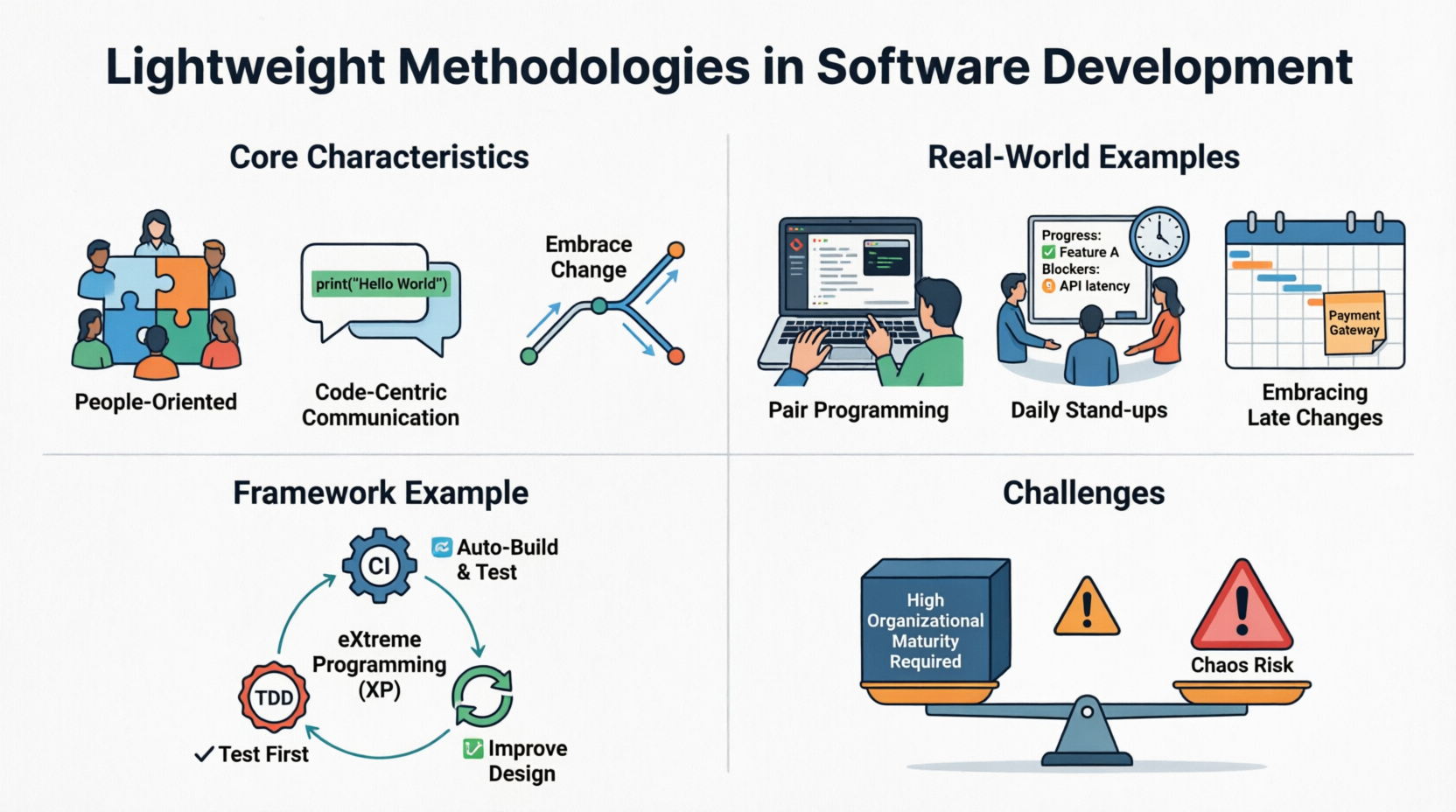
People-Oriented: The methodology relies heavily on the skills, intuition, and collaboration of practitioners rather than strictly defined process elements.
Code-Centric Communication: Face-to-face communication is heavily favored. The system implementation (the code itself) serves as the primary work product, with very little documentation existing beyond the code and automated tests.
Adaptive Change Management: Instead of trying to prevent or strictly control change, lightweight approaches focus on adaptively reacting to change and complexity as it arises.
Pair Programming: Two developers share a single workstation; one writes code (the driver) while the other reviews each line (the navigator), replacing the need for formal peer-review documentation.
Daily Stand-ups: Instead of writing weekly status reports, the team holds a 15-minute face-to-face meeting every morning to discuss progress and blockers.
Embracing Late Changes: A client realizes they need a new payment gateway two weeks before launch. The team welcomes the change, swaps it into the current sprint backlog, and adapts the codebase without requiring a formal change request form.
Framework Example: eXtreme Programming (XP) is a premier lightweight approach that emphasizes technical excellence through practices like continuous integration, test-driven development, and refactoring.
Success with lightweight methodologies requires a high level of organizational, cultural, and personnel maturity. If the team lacks discipline, communication skills, or technical expertise, the lack of formal rules can quickly devolve into chaos and "cowboy coding."
The Roadmap approach emerges as a pragmatic middle ground. It is a tool- and process-independent framework that refuses to choose between the over-engineering of heavyweight processes and the under-engineering risks of lightweight ones.
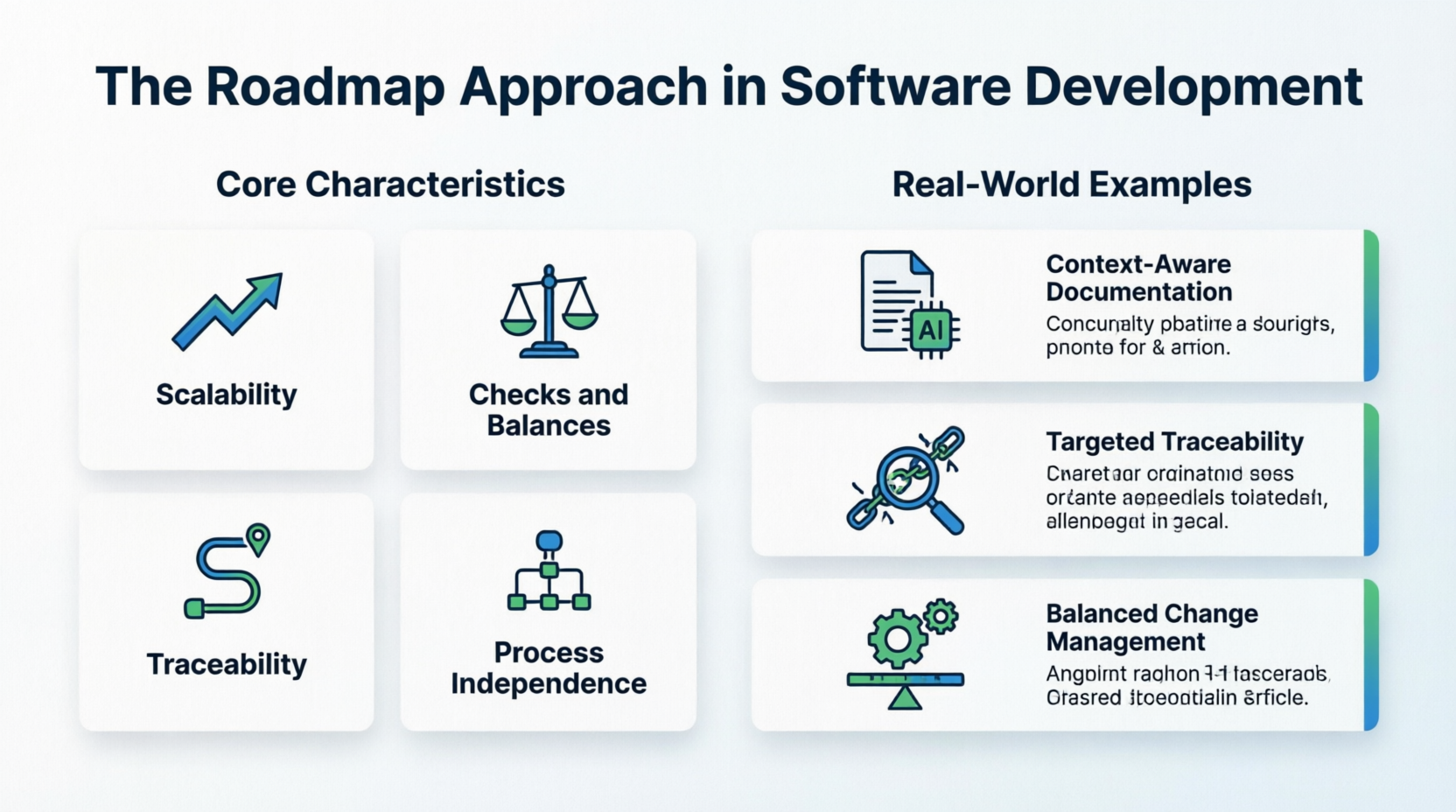
Scalability: It can be scaled to be as lightweight or heavyweight as the specific project requires.
Checks and Balances: It implements targeted governance to ensure quality without stifling agility.
Traceability: It maintains a clear, logical link between business requirements and the final code, ensuring nothing is lost in translation.
Process Independence: It does not mandate a specific set of tools or strict phase-gates, allowing teams to choose the practices that fit their context.
Context-Aware Documentation: For a startup building a mobile game, the Roadmap dictates a lightweight approach (user stories and code). For a medical device software project within the same company, the Roadmap scales up, mandating strict traceability matrices and formal design documents to meet FDA compliance.
Targeted Traceability: Instead of documenting every single function, the team uses an automated tool to link high-level business epics directly to specific code repositories and test cases, ensuring traceability without manual paperwork.
Balanced Change Management: A change request is evaluated not by a massive CCB, but through a streamlined "Impact & Traceability Check" that determines if the change breaks existing business rules, allowing for rapid, yet safe, adaptation.
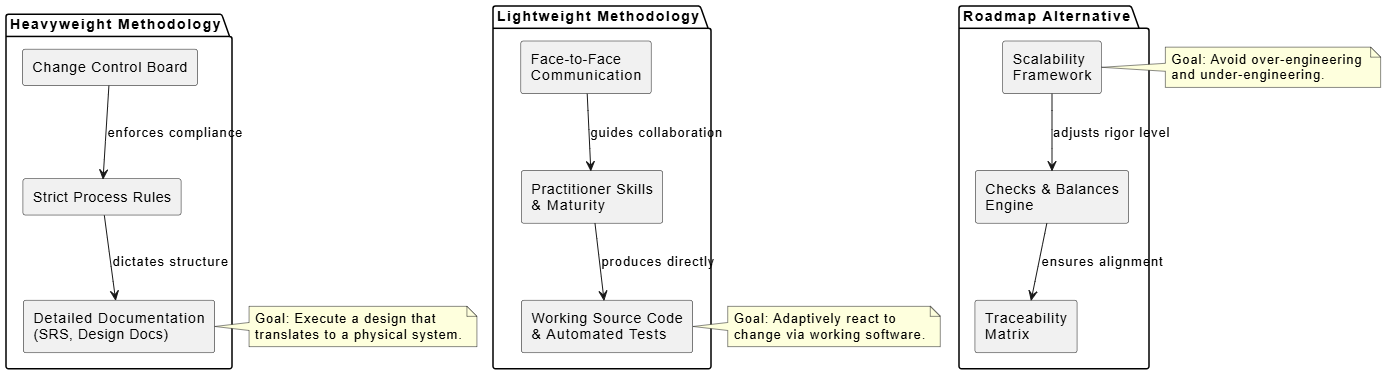
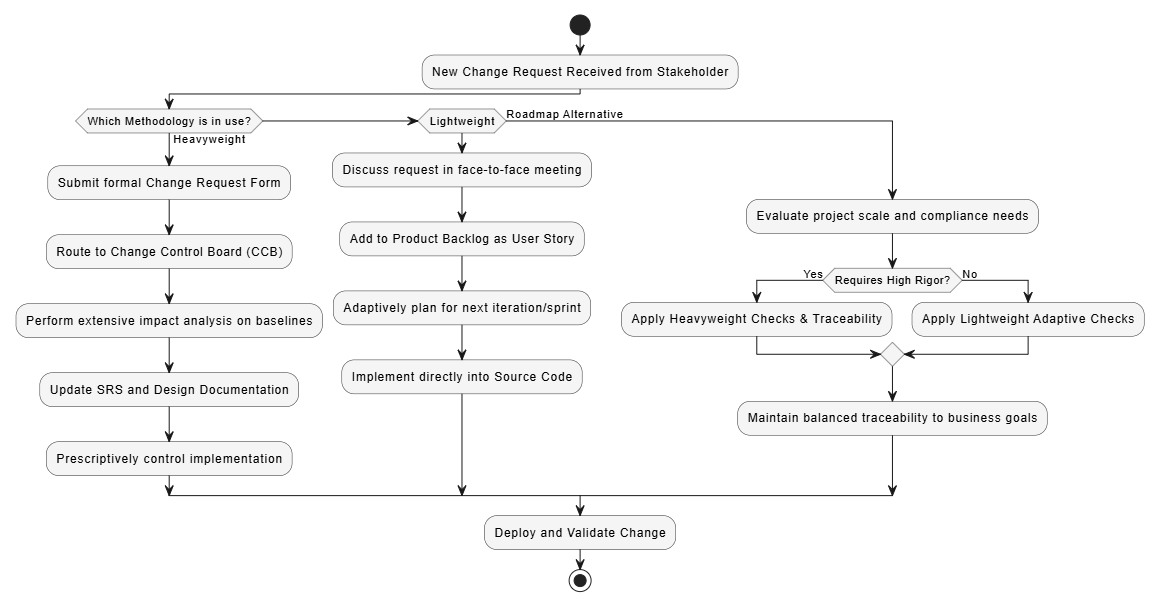
To better understand the structural and philosophical differences between these approaches, below are PlantUML diagrams illustrating their core components and workflows.
This diagram illustrates the primary focus areas and artifacts utilized by each methodology.
@startuml
skinparam componentStyle rectangle
skinparam shadowing false

package "Heavyweight Methodology" {
  [Strict Process Rules] as HW_Rules
  [Detailed Documentation\n(SRS, Design Docs)] as HW_Doc
  [Change Control Board] as HW_CCB
  HW_Rules --> HW_Doc : dictates structure
  HW_CCB --> HW_Rules : enforces compliance
}

package "Lightweight Methodology" {
  [Practitioner Skills\n& Maturity] as LW_Skills
  [Working Source Code\n& Automated Tests] as LW_Code
  [Face-to-Face\nCommunication] as LW_Comm
  LW_Skills --> LW_Code : produces directly
  LW_Comm --> LW_Skills : guides collaboration
}

package "Roadmap Alternative" {
  [Checks & Balances\nEngine] as RM_CB
  [Traceability\nMatrix] as RM_Trace
  [Scalability\nFramework] as RM_Scale
  RM_CB --> RM_Trace : ensures alignment
  RM_Scale --> RM_CB : adjusts rigor level
}

note right of HW_Doc
  Goal: Execute a design that
  translates to a physical system.
end note

note right of LW_Code
  Goal: Adaptively react to
  change via working software.
end note

note right of RM_Scale
  Goal: Avoid over-engineering
  and under-engineering.
end note
@enduml
This diagram demonstrates how each methodology practically handles a mid-project change request, highlighting their differing orientations toward change management.
@startuml
skinparam ActivityBackgroundColor #F5F5F5
skinparam ActivityBorderColor #333333

start

:New Change Request Received from Stakeholder;

if (Which Methodology is in use?) is (Heavyweight) then
  :Submit formal Change Request Form;
  :Route to Change Control Board (CCB);
  :Perform extensive impact analysis on baselines;
  :Update SRS and Design Documentation;
  :Prescriptively control implementation;

elseif (Lightweight) then
  :Discuss request in face-to-face meeting;
  :Add to Product Backlog as User Story;
  :Adaptively plan for next iteration/sprint;
  :Implement directly into Source Code;

else (Roadmap Alternative)
  :Evaluate project scale and compliance needs;

  if (Requires High Rigor?) is (Yes) then
    :Apply Heavyweight Checks & Traceability;
  else (No)
    :Apply Lightweight Adaptive Checks;
  endif

  :Maintain balanced traceability to business goals;
endif

:Deploy and Validate Change;

stop
@enduml
The choice between Heavyweight, Lightweight, and Roadmap methodologies is not merely a technical decision; it is a strategic one that reflects an organization's culture, the project's risk profile, and the team's maturity level.
Heavyweight methodologies offer the comfort of predictability and rigorous control, making them suitable for massive, high-stakes projects where requirements are fixed and documentation is legally or contractually required. However, their rigidity can stifle innovation and incur high administrative costs.
Lightweight methodologies offer unparalleled adaptability and speed, empowering skilled teams to deliver value quickly. Yet, they demand a high degree of discipline and maturity; without it, the lack of structure can lead to technical debt and project failure.
Ultimately, the Roadmap Alternative represents the evolution of software engineering thought. By decoupling the methodology from specific tools and allowing for dynamic scalability, it provides a cost-conscious, maturity-conscious framework. It allows organizations to apply the exact amount of process rigor necessary—ensuring checks, balances, and traceability without falling into the traps of over-engineering or under-engineering.
By understanding the core concepts and practical applications of these three paradigms, engineering leaders can confidently select, tailor, and scale the approach that best fits their unique development landscape.

