
Modern library management systems face the complex challenge of coordinating multiple stakeholders while maintaining efficiency, security, and user satisfaction. The traditional book lending process involves intricate interactions between library members, library staff, and digital database systems. Each stakeholder plays a distinct role, and the seamless coordination of these roles is critical to operational success.
UML (Unified Modeling Language) swimlane activity diagrams provide a powerful visual framework for modeling such multi-actor processes. By clearly delineating responsibilities across different organizational units or roles, swimlane diagrams help identify bottlenecks, clarify workflows, and ensure that all stakeholders understand their specific duties within the process.
This case study examines the implementation of a comprehensive Library Book Lending System using UML swimlane activity diagrams. The study demonstrates how this modeling technique can effectively coordinate the interactions between three key entities: the library member who initiates requests, the librarian who performs verification duties, and the system database that maintains data integrity. Through detailed analysis of the workflow, we illustrate how swimlane diagrams serve as both a design tool and a communication mechanism for optimizing library operations.
The library book lending process represents a critical operational workflow that must balance accessibility with security. The system must ensure that books are actually available before promising them to members, verify member identification to prevent unauthorized borrowing, and maintain accurate digital records of all transactions. Failure in any of these areas can result in inventory discrepancies, security breaches, or poor user experience.
The process involves three primary entities, each with distinct responsibilities:
Member: The library patron who initiates the book search process and requests loans. Members interact with the system primarily through self-service interfaces to search for available books and submit borrowing requests.
Librarian: The library staff member responsible for managing physical verification of member credentials, handling exceptions, and providing human oversight to the automated system. Librarians serve as the bridge between digital records and physical book distribution.
System Database: The backend digital infrastructure that records the current state of books (available, checked out, reserved), validates member accounts, processes transactions, and maintains the integrity of all library records.
The UML swimlane activity diagram for this system organizes the lending process into three distinct horizontal or vertical lanes, each representing one of the key stakeholders. This visualization makes it immediately clear who is responsible for each action in the process.
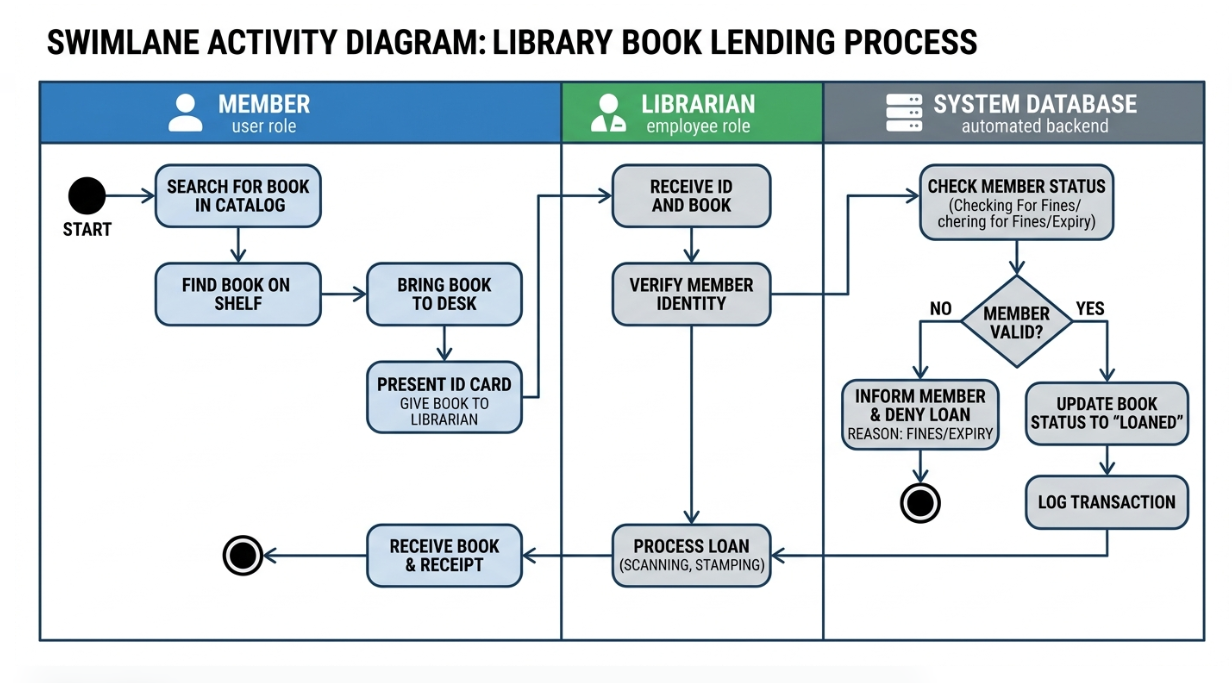
The process begins in the Member swimlane, where the patron initiates a book search through the library's catalog system. The member enters search criteria such as title, author, or subject matter. The system database then processes this query and returns availability information.
A critical decision point occurs at this stage: is the book available? If the book is not available, the workflow loops back to the member, who can either search for an alternative title or place a reservation on the desired book. This looping mechanism prevents unnecessary escalation to library staff and empowers members to resolve simple issues independently.
If the book is available, the process flows forward, and the member submits a formal loan request. This request triggers the transition from the self-service phase to the verification phase.
Once a loan request is submitted with an available book, responsibility shifts from the Member swimlane to the Librarian swimlane. This handoff represents a critical security gate in the process. The librarian receives the loan request and must perform manual verification of the member's identification.
This physical verification step serves multiple purposes:
Confirms the identity of the person borrowing the book matches the account holder
Provides an opportunity to verify the physical condition of the member's library card
Allows the librarian to address any account issues that may not be apparent in the digital system
Creates a human checkpoint to prevent fraud or unauthorized borrowing
The swimlane diagram clearly shows this transition, making it evident that the librarian cannot proceed without first completing the verification step. If verification fails, the process terminates or returns to the member for correction.
Once the librarian successfully verifies the member's identity, the process transitions to the System Database swimlane. Here, automated systems handle the critical task of data integrity and transaction processing.
The system database performs several validation checks:
Confirms the book's availability status has not changed since the initial search
Validates that the member's account is in good standing (no excessive fines, not at borrowing limit)
Checks for any holds or restrictions on the specific book
Verifies that the loan period and renewal policies apply correctly to this member's account type
If all validations pass, the system updates the book's status from "available" to "checked out," records the due date, associates the transaction with the member's account, and generates a transaction log entry. These updates must occur atomically to maintain data consistency.
The swimlane diagram emphasizes that this automated verification occurs after human verification, creating a dual-layer validation system that combines human judgment with computational accuracy.
The final phase brings the process to completion. Once the system database confirms successful transaction processing, control returns to the Librarian swimlane. The librarian physically retrieves the book from the shelves or the holds area and hands it to the verified member.
This physical handoff is crucial: it synchronizes the digital world (where the book is now marked as checked out) with the physical world (where the member now possesses the book). The process only ends when this synchronization is complete, ensuring that inventory records match physical reality.
The member receives the book along with information about the due date, renewal options, and any other relevant borrowing information. The swimlane diagram shows this as the terminal point of the workflow.
The UML swimlane activity diagram provides several significant advantages for modeling this library lending system:
Clear Responsibility Assignment: Each action in the diagram is unambiguously assigned to a specific swimlane, eliminating confusion about who performs each task. This clarity is essential for training staff, developing software systems, and troubleshooting process failures.
Identification of Handoff Points: The diagram makes visible all points where responsibility transfers from one actor to another. These handoff points are potential sources of delay or error, and their visibility allows for targeted optimization efforts.
Parallel Processing Opportunities: The swimlane structure reveals opportunities for parallel processing. For example, while the librarian is verifying one member's identification, the system database could be processing the transaction for a previous member, improving overall throughput.
Exception Handling: The diagram clearly shows decision points and alternative paths, such as what happens when a book is not available or when member verification fails. This explicit modeling of exceptions ensures that edge cases are not overlooked in system design.
Scalability Analysis: By visualizing the workload distribution across swimlanes, library administrators can identify bottlenecks. If the Librarian swimlane contains many more activities than the others, it may indicate a need for additional staff or increased automation.
Implementing a system based on this swimlane activity diagram requires attention to several practical considerations:
Technology Integration: The system database must integrate seamlessly with both the member-facing search interface and the librarian-facing verification interface. Real-time synchronization is critical to prevent situations where a book appears available in the system but is actually checked out.
User Experience Design: The member swimlane activities should be designed for intuitive self-service, minimizing the need for librarian intervention. Clear feedback at each step helps members understand the status of their requests.
Staff Training: Librarians must understand not only their own responsibilities but also how their actions affect the overall workflow. Training should emphasize the importance of the verification step and the proper procedures for handling exceptions.
Performance Monitoring: Key performance indicators should be established for each swimlane. For example, average search time for members, average verification time for librarians, and average transaction processing time for the system database. These metrics enable continuous improvement.
Contingency Planning: The system must include procedures for handling failures in any swimlane. What happens if the system database goes offline? What if a librarian is unavailable? These scenarios require predefined contingency procedures.
Analysis of the swimlane diagram reveals several opportunities for process optimization:
Pre-verification: Members could complete identity verification during account registration or renewal, reducing the verification burden during each loan transaction. This would shift some activities from the Librarian swimlane to an earlier point in the member lifecycle.
Automated Book Retrieval: For high-demand books or in libraries with automated storage and retrieval systems, the book retrieval step could be automated, reducing librarian workload and speeding up the process.
Mobile Integration: Members could complete the search and request phases using mobile devices before arriving at the library, allowing them to proceed directly to verification and pickup upon arrival.
Self-Checkout Stations: For members with verified accounts and low-risk profiles, self-checkout stations could combine the verification and transaction processing steps, allowing members to complete the entire process without librarian intervention.
Predictive Availability: Advanced analytics could predict book availability and demand patterns, allowing the library to proactively manage inventory and reduce the frequency of "book not available" responses.
The Library Book Lending System case study demonstrates the power of UML swimlane activity diagrams as a tool for modeling, analyzing, and optimizing complex multi-actor workflows. By clearly delineating responsibilities across the Member, Librarian, and System Database swimlanes, the diagram provides a comprehensive view of the entire lending process while maintaining clarity about individual roles and responsibilities.
The swimlane approach reveals critical insights that might be obscured in other modeling techniques. The handoff points between swimlanes emerge as natural control points where security, verification, and quality assurance can be implemented. The sequential flow from self-service entry through security handoff, automated verification, and final closure ensures that both efficiency and security are maintained throughout the process.
Beyond its value as a design tool, the swimlane activity diagram serves as a communication mechanism that helps all stakeholders understand their roles in the larger system. Library staff can see how their work fits into the overall workflow, system developers can understand the requirements for each component, and library administrators can identify opportunities for process improvement and resource allocation.
The implementation of this system requires careful attention to technology integration, user experience design, staff training, and performance monitoring. However, the clear structure provided by the swimlane diagram makes these implementation challenges more manageable by providing a shared reference point for all stakeholders.
Looking forward, the swimlane model provides a foundation for continuous improvement. As technology evolves and member expectations change, the diagram can be updated to reflect new processes, additional automation, or modified workflows. The modular nature of swimlane diagrams makes them adaptable to changing requirements while maintaining the clarity and structure that make them valuable in the first place.
In an era where libraries are evolving from simple book repositories to complex community information centers, the ability to model and optimize operational workflows becomes increasingly important. UML swimlane activity diagrams provide the analytical rigor and visual clarity needed to meet this challenge, making them an essential tool for modern library system design and management.

