Introduction
Phase B of the TOGAF Architecture Development Method (ADM) is where strategy meets structure. This phase transforms the high-level Architecture Vision from Phase A into a detailed, actionable Business Architecture that defines how the organization will operate to achieve its strategic objectives.
Business Architecture is the foundation upon which all other architecture domains (Data, Application, and Technology) are built. Without a solid Business Architecture, subsequent phases risk solving the wrong problems or building solutions that don't align with business needs.
This comprehensive guide explores the three critical deliverables of Phase B:
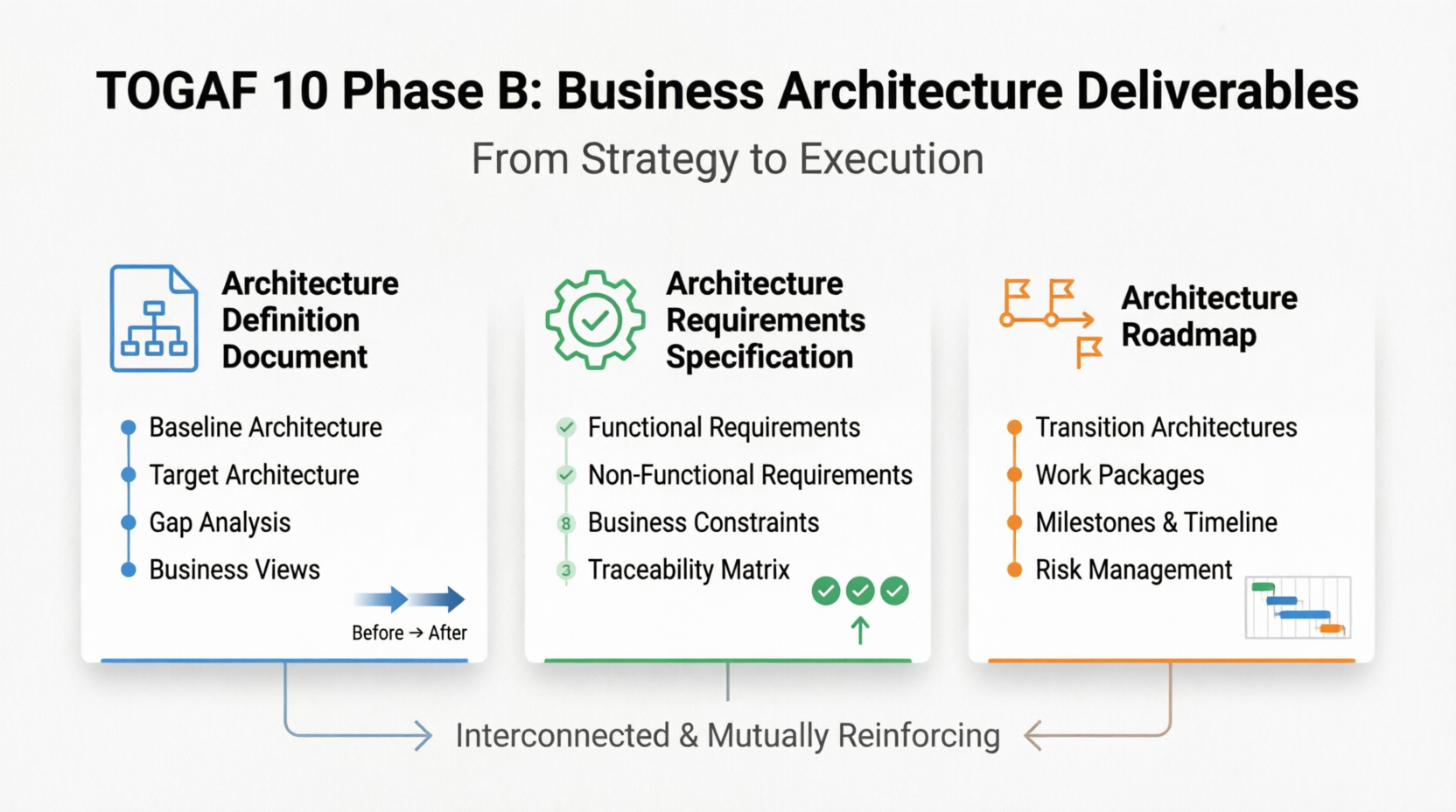
- Architecture Definition Document (Business)
- Architecture Requirements Specification (Business)
- Architecture Roadmap (Business)
Each deliverable is examined in depth with practical examples, templates, and best practices.
1: The Architecture Definition Document (Business)
Overview
The Architecture Definition Document (ADD) for Business Architecture is the cornerstone deliverable of Phase B. It provides a comprehensive view of both the Baseline Architecture (current state) and the Target Architecture (future state), along with the gap analysis between them.
Purpose
- Document the current business operations, processes, and organizational structure
- Define the desired future state aligned with strategic objectives
- Identify gaps that need to be addressed
- Serve as the primary reference for stakeholders throughout the project
Key Components
1. Baseline Business Architecture Description
What it includes:
- Current organizational structure
- Existing business functions and capabilities
- Current business processes and workflows
- Existing stakeholder relationships
- Current business services offered
Example: GlobalFin Corp - Baseline
Organizational Structure:
- Retail Banking Division (450 employees)
- Branch Operations (200 employees across 25 branches)
- Call Center (150 employees)
- Product Management (50 employees)
- Compliance & Risk (50 employees)
Current Business Functions:
- Account Opening: Manual paper-based process, 5-7 days completion
- Loan Processing: Semi-automated, requires manual underwriting review, 10-14 days
- Customer Support: Phone and in-branch only, average wait time 15 minutes
Current Business Processes:
- Customer Onboarding: 12-step manual process involving 4 departments
- Payment Processing: Batch processing overnight, next-day availability
- Complaint Resolution: Escalation through 3 management levels, 7-10 days resolution
2. Target Business Architecture Description
What it includes:
- Future organizational structure (if changes are planned)
- Target business capabilities
- Optimized business processes
- New or enhanced business services
- Revised stakeholder interactions
Example: GlobalFin Corp - Target
Future Organizational Structure:
- Digital Banking Division (new, 80 employees)
- Digital Experience Team (30 employees)
- API & Integration Team (25 employees)
- Data Analytics Team (25 employees)
- Retail Banking Division (restructured, 350 employees)
- Advisory Services (150 employees - former branch staff retrained)
- Automated Operations (100 employees)
- Customer Success (100 employees)
Target Business Capabilities:
- Instant Account Opening: Digital-first, AI-assisted verification, <5 minutes
- Automated Loan Underwriting: AI-driven decisioning, <5 minutes for standard loans
- Omnichannel Customer Support: Mobile app, chatbot, video banking, 24/7 availability
Optimized Business Processes:
- Customer Onboarding: 3-step digital process with real-time verification
- Payment Processing: Real-time processing via API integration
- Complaint Resolution: AI-powered triage, automated routing, 48-hour resolution target
3. Gap Analysis
What it includes:
- Identification of differences between baseline and target
- Classification of gaps (process, capability, organizational, skill)
- Priority ranking of gaps
- Initial remediation recommendations
Example: GlobalFin Corp - Gap Analysis
| Gap ID |
Gap Description |
Type |
Priority |
Impact |
| G-001 |
No digital account opening capability |
Capability |
Critical |
High - blocks digital transformation |
| G-002 |
Manual loan underwriting process |
Process |
Critical |
High - slow time-to-market |
| G-003 |
Lack of data analytics team |
Organizational |
High |
Medium - limits personalization |
| G-004 |
Branch staff lack digital skills |
Skill |
High |
Medium - affects transition |
| G-005 |
Batch payment processing |
Process |
Medium |
Low - customer expectation shift |
4. Business Architecture Views
Recommended ArchiMate diagrams:
- Organization Chart (Baseline vs. Target)
- Business Function Catalog
- Business Process Flow Diagrams
- Value Stream Maps
- Capability Map
Best Practices
- Use Visual Models: Supplement text with ArchiMate diagrams for clarity
- Engage Stakeholders: Validate both baseline and target with business owners
- Be Specific: Avoid vague statements; use measurable metrics
- Link to Strategy: Explicitly connect each target element to strategic objectives
- Version Control: Maintain clear versioning as the document evolves
Common Pitfalls
- ❌ Focusing only on IT systems instead of business operations
- ❌ Skipping baseline documentation (you can't measure progress without a starting point)
- ❌ Creating unrealistic target states not aligned with budget/timeline
- ❌ Not validating with actual business users
Template Structure
1. Executive Summary
2. Scope and Context
3. Baseline Business Architecture
   3.1 Organizational Structure
   3.2 Business Functions
   3.3 Business Processes
   3.4 Business Services
4. Target Business Architecture
   4.1 Future Organizational Structure
   4.2 Target Capabilities
   4.3 Optimized Processes
   4.4 Enhanced Services
5. Gap Analysis
   5.1 Identified Gaps
   5.2 Priority Matrix
   5.3 Initial Recommendations
6. Appendix: Supporting Diagrams and Models
2: The Architecture Requirements Specification (Business)
Overview
The Architecture Requirements Specification (ARS) for Business Architecture captures the detailed functional and non-functional requirements that the target business architecture must satisfy. This document translates strategic objectives into specific, measurable requirements that guide design decisions.
Purpose
- Define what the business architecture must achieve
- Provide clear criteria for evaluating design options
- Establish measurable success metrics
- Serve as input for subsequent architecture phases (C, D)
Key Components
1. Functional Requirements
What it includes:
- Specific business capabilities required
- Business process requirements
- User interaction requirements
- Integration requirements with external entities
Example: GlobalFin Corp - Functional Requirements
FR-001: Digital Account Opening
- System shall allow customers to open savings, checking, and money market accounts entirely online
- System shall perform real-time identity verification using government ID scanning and facial recognition
- System shall provide instant account number generation upon successful verification
- System shall support co-applicants for joint accounts
FR-002: Automated Loan Underwriting
- System shall evaluate loan applications for amounts up to $50,000 without human intervention
- System shall integrate with credit bureaus for real-time credit score retrieval
- System shall apply bank-specific risk models to make approve/decline decisions
- System shall provide explanation codes for declined applications
FR-003: Omnichannel Customer Support
- System shall provide consistent customer context across mobile app, web portal, chatbot, and video banking
- System shall enable seamless handoff between channels (e.g., start in chat, continue via video)
- System shall maintain conversation history accessible to all support agents
FR-004: Real-Time Payment Processing
- System shall process domestic transfers in real-time (<3 seconds)
- System shall support international transfers with same-day settlement
- System shall provide instant confirmation and receipt generation
- System shall integrate with Federal Reserve's FedNow service
2. Non-Functional Requirements (Quality Attributes)
What it includes:
- Performance requirements
- Security requirements
- Compliance requirements
- Usability requirements
- Availability and reliability requirements
Example: GlobalFin Corp - Non-Functional Requirements
NFR-001: Performance
- Account opening process shall complete within 5 minutes for 95% of applications
- Loan decision shall be provided within 5 minutes for standard applications
- Mobile app shall load dashboard within 2 seconds on 4G connection
- Payment confirmation shall be displayed within 3 seconds
NFR-002: Security
- All customer data shall be encrypted at rest using AES-256
- All data in transit shall use TLS 1.3 or higher
- Multi-factor authentication shall be required for all transactions >$1,000
- System shall comply with PCI-DSS Level 1 standards
NFR-003: Compliance
- System shall maintain audit trail of all customer data access for 7 years
- System shall support GDPR "right to be forgotten" requests within 30 days
- System shall comply with Bank Secrecy Act (BSA) reporting requirements
- System shall support PSD2 open banking API standards
NFR-004: Availability
- Core banking services shall achieve 99.99% uptime (≤52 minutes downtime/year)
- Mobile app shall achieve 99.9% uptime (≤8.76 hours downtime/year)
- Disaster recovery RTO (Recovery Time Objective): 4 hours
- Disaster recovery RPO (Recovery Point Objective): 15 minutes
NFR-005: Usability
- Mobile app shall achieve SUS (System Usability Scale) score ≥80
- First-time users shall complete account opening without assistance in 80% of cases
- Accessibility shall meet WCAG 2.1 AA standards
- Support for English, Spanish, and Mandarin languages
3. Business Constraints
What it includes:
- Regulatory constraints
- Budget constraints
- Timeline constraints
- Technology constraints imposed by business decisions
Example: GlobalFin Corp - Business Constraints
BC-001: Regulatory
- Must maintain physical branch presence in all current markets per state banking regulations
- Cannot fully automate loan decisions for amounts >$50,000 (regulatory requirement for human review)
- Must retain paper records for certain transaction types per federal law
BC-002: Budget
- Total technology investment capped at $5M for first year
- Operational cost reduction target: 15% within 18 months
BC-003: Timeline
- MVP (Minimum Viable Product) must launch within 6 months
- Full platform must be operational within 18 months
- Legacy system decommissioning must complete within 24 months
BC-004: Partnership
- Must integrate with existing core banking provider (Fiserv)
- Must use approved vendor list for security-sensitive components
4. Requirement Traceability Matrix
What it includes:
- Links requirements to strategic objectives
- Maps requirements to architecture components
- Tracks requirement status (draft, approved, implemented, verified)
Example: GlobalFin Corp - Traceability Matrix
| Req ID |
Requirement |
Strategic Objective |
Priority |
Status |
Related ADD Section |
| FR-001 |
Digital Account Opening |
Improve customer acquisition by 30% |
Critical |
Approved |
Target Capability 1.1 |
| FR-002 |
Automated Loan Underwriting |
Reduce operational costs by 15% |
Critical |
Approved |
Target Process 2.3 |
| NFR-001 |
Performance Metrics |
Enhance customer satisfaction |
High |
Approved |
N/A |
| NFR-003 |
Compliance Requirements |
Maintain regulatory standing |
Critical |
Approved |
Constraint BC-001 |
Best Practices
- Make Requirements SMART: Specific, Measurable, Achievable, Relevant, Time-bound
- Prioritize Ruthlessly: Use MoSCoW method (Must have, Should have, Could have, Won't have)
- Validate with Users: Ensure requirements reflect actual user needs, not assumptions
- Maintain Traceability: Link every requirement back to business goals
- Review Regularly: Update requirements as business needs evolve
Requirement Prioritization Framework
MoSCoW Method:
- Must Have: Critical for launch; project fails without these
- Should Have: Important but not critical; can defer if necessary
- Could Have: Desirable but not necessary; implement if time/budget allows
- Won't Have: Explicitly excluded from current scope
Common Pitfalls
- ❌ Writing vague requirements ("system should be fast")
- ❌ Not distinguishing between needs and wants
- ❌ Ignoring non-functional requirements until too late
- ❌ Not getting formal sign-off on requirements
- ❌ Failing to update requirements when business context changes
Template Structure
1. Introduction
   1.1 Purpose
   1.2 Scope
   1.3 Definitions
2. Functional Requirements
   2.1 Business Capability Requirements
   2.2 Process Requirements
   2.3 Integration Requirements
   2.4 User Interaction Requirements
3. Non-Functional Requirements
   3.1 Performance Requirements
   3.2 Security Requirements
   3.3 Compliance Requirements
   3.4 Usability Requirements
   3.5 Availability Requirements
4. Business Constraints
   4.1 Regulatory Constraints
   4.2 Budget Constraints
   4.3 Timeline Constraints
   4.4 Technical Constraints
5. Requirement Traceability Matrix
6. Appendix: Detailed Use Cases and User Stories
3: The Architecture Roadmap (Business)
Overview
The Architecture Roadmap for Business Architecture provides a strategic plan outlining how the organization will transition from the baseline to the target business architecture. It identifies key milestones, dependencies, work packages, and timelines, ensuring a structured and manageable transformation journey.
Purpose
- Provide a clear timeline for business transformation
- Identify dependencies between work streams
- Enable resource planning and budget allocation
- Communicate transformation progress to stakeholders
- Manage risks through phased implementation
Key Components
1. Transition Architectures
What it includes:
- Intermediate states between baseline and target
- Business value delivered at each stage
- Key capabilities enabled at each transition point
Example: GlobalFin Corp - Transition Architectures
Transition State 1: Foundation (Month 1-6)
- Capabilities Enabled: Digital account opening, basic mobile app
- Business Value: 15% reduction in branch visits, improved customer acquisition
- Key Changes:
- Launch digital onboarding platform
- Retrain 50 branch staff as digital advisors
- Implement basic mobile banking app (balance check, transfers)
Transition State 2: Automation (Month 7-12)
- Capabilities Enabled: Automated loan underwriting, real-time payments
- Business Value: 25% reduction in operational costs, faster loan approvals
- Key Changes:
- Deploy AI-powered loan underwriting engine
- Integrate with FedNow for real-time payments
- Expand mobile app features (bill pay, deposits)
Transition State 3: Optimization (Month 13-18)
- Capabilities Enabled: Omnichannel support, advanced analytics, personalized offerings
- Business Value: 20% increase in customer retention, 15% cost reduction achieved
- Key Changes:
- Launch video banking and AI chatbot
- Implement customer analytics platform
- Deploy personalized product recommendations
- Decommission legacy branch systems
2. Work Packages
What it includes:
- Discrete units of work required for transformation
- Resources required for each package
- Estimated duration and effort
- Dependencies between packages
Example: GlobalFin Corp - Work Packages
WP-001: Digital Onboarding Platform
- Duration: 4 months
- Resources: 2 Business Analysts, 5 Developers, 1 UX Designer, 1 QA Engineer
- Dependencies: None (foundational)
- Deliverables: Account opening workflow, ID verification integration, compliance checks
WP-002: Staff Retraining Program
- Duration: 3 months (overlaps with WP-001)
- Resources: 2 Trainers, HR team, External training vendor
- Dependencies: WP-001 (need to know new processes)
- Deliverables: Training curriculum, certified digital advisors, updated job descriptions
WP-003: Loan Underwriting Engine
- Duration: 5 months
- Resources: 3 Data Scientists, 4 Developers, 2 Risk Analysts
- Dependencies: WP-001 (customer data infrastructure)
- Deliverables: AI model, decision engine, integration with credit bureaus
WP-004: Mobile App Enhancement
- Duration: 6 months (phased releases)
- Resources: 2 Product Managers, 6 Developers, 2 UX Designers, 2 QA Engineers
- Dependencies: WP-001 (account data), WP-003 (loan status)
- Deliverables: Feature-rich mobile app with biometric login, push notifications
WP-005: Omnichannel Support Platform
- Duration: 4 months
- Resources: 3 Developers, 1 Integration Specialist, Customer Service Manager
- Dependencies: WP-004 (mobile app), WP-001 (customer data)
- Deliverables: Chatbot, video banking platform, unified customer view
3. Milestones and Timeline
What it includes:
- Key dates and deliverables
- Go/no-go decision points
- Major releases and launches
- Review and governance checkpoints
Example: GlobalFin Corp - Milestones
| Milestone |
Date |
Description |
Success Criteria |
| M-001 |
Month 2 |
Architecture sign-off |
ADD and ARS approved by steering committee |
| M-002 |
Month 4 |
Digital onboarding MVP ready |
Internal testing complete, 95% test pass rate |
| M-003 |
Month 6 |
Digital onboarding launch |
Live in production, 100+ successful account openings |
| M-004 |
Month 8 |
Loan underwriting pilot |
50 loans processed automatically, <5% error rate |
| M-005 |
Month 10 |
Real-time payments go-live |
FedNow integration live, <3 second processing |
| M-006 |
Month 12 |
Mobile app v2.0 release |
4.5+ star rating, 50% of customers active monthly |
| M-007 |
Month 15 |
Omnichannel support launch |
Chatbot handles 40% of inquiries, CSAT ≥85% |
| M-008 |
Month 18 |
Full platform operational |
All target capabilities live, legacy decommissioning begins |
4. Resource Plan
What it includes:
- Human resources by role and timeline
- Budget allocation by work package
- External vendor engagements
- Training and change management resources
Example: GlobalFin Corp - Resource Plan
Human Resources (Peak Headcount):
- Business Analysts: 4
- Developers: 15
- UX/UI Designers: 3
- QA Engineers: 4
- Data Scientists: 3
- Project Managers: 2
- Change Management Specialists: 2
Budget Allocation:
- Technology Development: $2.5M
- Vendor Licenses & Tools: $800K
- Training & Change Management: $500K
- Contingency (15%): $562K
- Total: $4.362M (within $5M cap)
External Vendors:
- Cloud Infrastructure Provider (AWS): $400K/year
- Identity Verification Service: $150K/year
- Training Vendor: $200K (one-time)
- Security Audit Firm: $100K (annual)
5. Risk Management Plan
What it includes:
- Identified risks to business transformation
- Mitigation strategies
- Contingency plans
- Risk ownership and monitoring
Example: GlobalFin Corp - Risk Register
| Risk ID |
Risk Description |
Probability |
Impact |
Mitigation Strategy |
Owner |
| R-001 |
Regulatory approval delays |
Medium |
High |
Engage regulators early; build buffer into timeline |
Chief Compliance Officer |
| R-002 |
Staff resistance to digital tools |
High |
Medium |
Comprehensive change management; involve staff in design |
HR Director |
| R-003 |
Integration issues with legacy core |
High |
High |
Early proof-of-concept; dedicated integration team |
Lead Architect |
| R-004 |
Cybersecurity breach during transition |
Low |
Critical |
Enhanced security monitoring; penetration testing |
CISO |
| R-005 |
Budget overrun |
Medium |
High |
Monthly budget reviews; 15% contingency reserve |
CFO |
Best Practices
- Start with Value: Each transition state should deliver measurable business value
- Be Realistic: Build in buffers for unknowns; don't optimize for best-case scenario
- Manage Dependencies: Clearly map dependencies between work packages
- Communicate Visually: Use Gantt charts and roadmaps for stakeholder communication
- Review Regularly: Update roadmap quarterly based on progress and changing conditions
- Balance Speed and Stability: Don't sacrifice quality for speed; technical debt compounds
Roadmap Visualization Tips
- Use color coding for different work streams
- Show dependencies with connecting lines
- Highlight critical path items
- Include milestone markers
- Provide both high-level (executive) and detailed (team) views
Common Pitfalls
- ❌ Creating overly optimistic timelines
- ❌ Not accounting for organizational change management
- ❌ Ignoring dependencies between work packages
- ❌ Failing to define clear success criteria for milestones
- ❌ Not updating the roadmap as conditions change
- ❌ Focusing only on technology, neglecting people and process changes
Template Structure
1. Executive Summary
2. Transformation Strategy
   2.1 Vision and Objectives
   2.2 Guiding Principles
3. Transition Architectures
   3.1 Transition State 1: [Name]
   3.2 Transition State 2: [Name]
   3.3 Transition State 3: [Name]
4. Work Packages
   4.1 WP-001: [Name]
   4.2 WP-002: [Name]
   4.3 WP-003: [Name]
5. Timeline and Milestones
   5.1 Detailed Timeline
   5.2 Key Milestones
   5.3 Decision Points
6. Resource Plan
   6.1 Human Resources
   6.2 Budget Allocation
   6.3 Vendor Engagements
7. Risk Management
   7.1 Risk Register
   7.2 Mitigation Strategies
   7.3 Contingency Plans
8. Appendix: Detailed Gantt Charts and Dependency Maps
Integration: How the Three Deliverables Work Together
The three Phase B deliverables are interconnected and mutually reinforcing:
- Architecture Definition Document provides the "what" - the current and future states
- Architecture Requirements Specification provides the "criteria" - what success looks like
- Architecture Roadmap provides the "how and when" - the plan to get there
Flow of Information:
- ADD informs ARS by identifying capability gaps that become requirements
- ARS informs Roadmap by defining what must be built and to what standard
- Roadmap feeds back to ADD by showing realistic phasing of target architecture
Validation Loop:
- Requirements must be achievable within the roadmap timeline and budget
- Roadmap must deliver capabilities defined in the target architecture
- Target architecture must satisfy all stated requirements
Conclusion
Phase B of the TOGAF ADM is where business strategy becomes architectural reality. The three deliverables—Architecture Definition Document, Architecture Requirements Specification, and Architecture Roadmap—form a cohesive framework for designing and planning business transformation.
Key Takeaways:
- Document Both States: Thoroughly understand your baseline before designing your target
- Be Specific with Requirements: Vague requirements lead to vague solutions
- Plan Realistically: Build roadmaps that acknowledge organizational constraints and change management needs
- Maintain Traceability: Link everything back to strategic objectives
- Iterate and Refine: These are living documents that evolve as understanding deepens
By mastering these three deliverables, enterprise architects can ensure that their organizations' digital transformations are well-founded, well-planned, and well-executed. The Business Architecture created in Phase B becomes the foundation for all subsequent architecture work, making this phase critical to overall success.
Remember: Great architecture doesn't just describe what could be—it provides a clear, actionable path to make it happen.