
In software quality assurance, the gap between requirements and testing is often where critical defects hide. When testers rely solely on textual Use Case descriptions, they are forced to interpret ambiguity, leading to a reliance on intuition rather than systematic analysis. The result is a test suite that covers the "happy path" but misses the complex edge cases that cause production failures. This guide introduces a structured methodology to bridge that gap: The UML Translation Pipeline. By treating UML diagrams not just as design artifacts but as active test derivation tools, teams can transform vague functional requirements into exhaustive, verifiable test scenarios. This approach shifts testing from a reactive guessing game to a proactive engineering discipline, ensuring that structural logic, behavioral flows, and data constraints are validated before a single line of code is executed.
Use Cases define what the system should do (functional requirements).
Test Cases verify that the system does it correctly.
UML Diagrams provide the structural and behavioral context needed to derive accurate, exhaustive test cases.
Without UML, testers guess scenarios. With UML, testers derive scenarios systematically.
| Artifact | Definition | Audience | Key Components |
|---|---|---|---|
| Use Case | A high-level goal of an actor interacting with the system. | Business Analysts, Stakeholders | Name, Actor, Pre/Post Conditions, Basic Flow, Extensions. |
| Use Case Description | The detailed textual specification of the Use Case (the "script"). | Developers, Testers | Step-by-step interactions, business rules, and exception handling. |
| Test Case | A specific set of inputs, execution conditions, and expected results. | QA Engineers | Test ID, Preconditions, Test Steps, Test Data, Expected Results. |
| UML Diagrams | Visual blueprints. | Architects, Designers, Testers | Class (Structure), Sequence (Behavior), State (Lifecycle), Activity (Workflow). |
To convert a Use Case into Test Cases, follow this 4-phase pipeline:
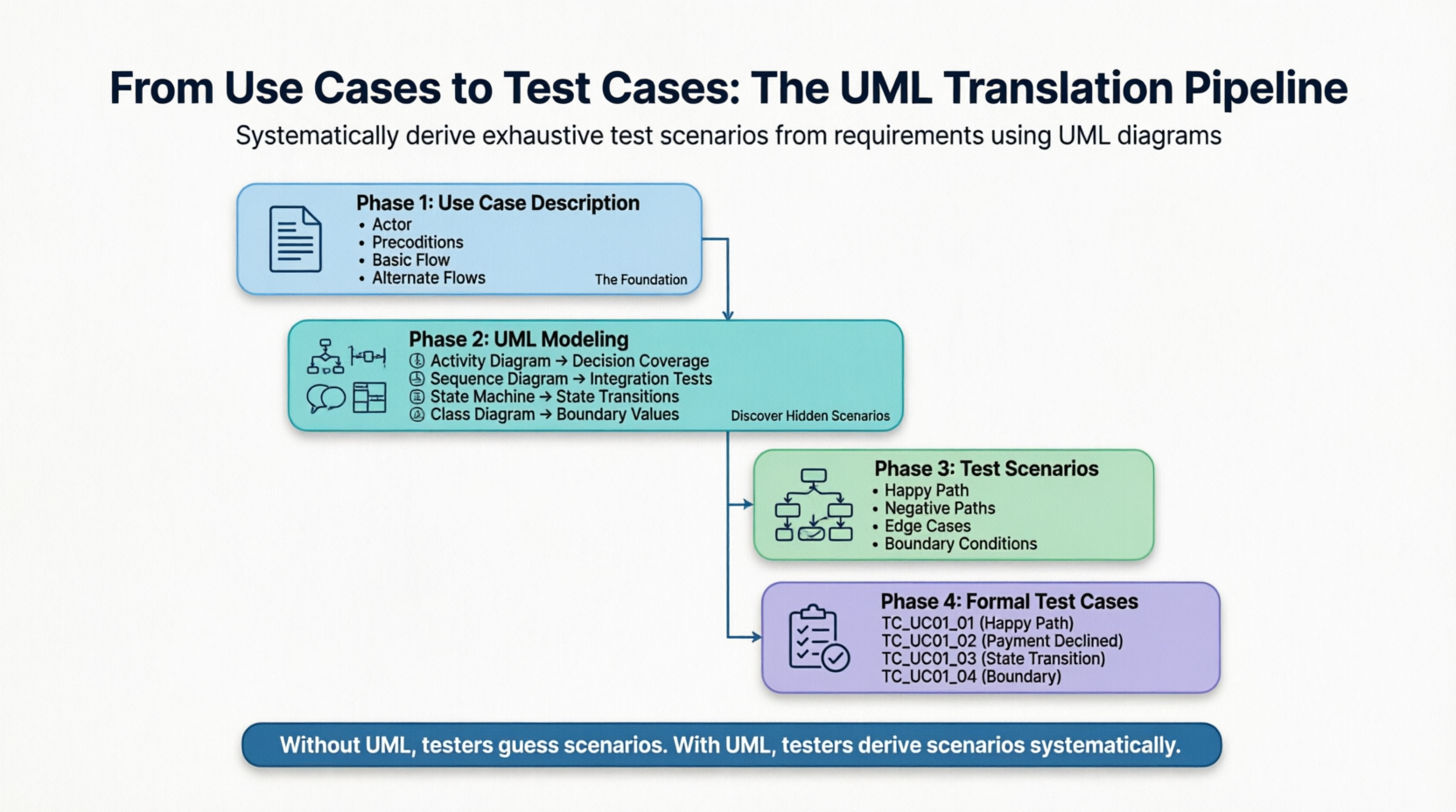
Rule of Thumb: If a Use Case has no extensions (alternate flows), it is incomplete. Real systems have exceptions.
This is the critical step. Text alone misses edge cases. UML catches them.
Order object waiting for a response from PaymentGateway with a timeout (alt fragment).New, Paid, Shipped, Cancelled) and transitions.New or Paid, not from Shipped.1..*, 0..1).Order has a discountCode: String [0..1] (optional) and totalAmount: Double [>0].0.00 (should reject).Use the "Coverage Matrix" to map UML elements to test types.
| UML Diagram | Test Type Derived | Example Derived from "Place Order" |
|---|---|---|
| Activity Diagram | Decision Coverage | Test both "Address Valid" and "Address Invalid" branches. |
| Sequence Diagram | Integration / Interface | Test the interface between Order and Payment when the message order is disrupted (mock failures). |
| State Diagram | State Transition | Test transitioning New -> Paid -> Shipped vs. New -> Cancelled. |
| Class Diagram | Boundary Value Analysis | Test quantity attribute (int, min 1). Test with 0 and -1. |
Now we convert the scenarios into executable Test Cases.
| Use Case Element | Test Case Element | How to translate |
|---|---|---|
| Preconditions | Preconditions | Directly copy. Plus, add database state (e.g., "Product X has stock=5"). |
| Basic Flow (Step 3) | Test Step 3 | "User confirms address" -> "Click 'Confirm Address' button". |
| Basic Flow (Step 6) | Expected Result 6 | "System validates card" -> "Verify 'Payment Successful' modal appears". |
| Alternate Flow (6a) | Negative Test Case | Create a new Test Case specifically for this path. |
Test Case ID: TC_UC01_01 (Happy Path)
Test Case ID: TC_UC01_02 (Alternate Flow 6a - Payment Declined)
Test Case ID: TC_UC01_03 (State Machine Derived - Cancel after Shipment)
Test Case ID: TC_UC01_04 (Class Diagram Derived - Boundary)
maxOrder = 10.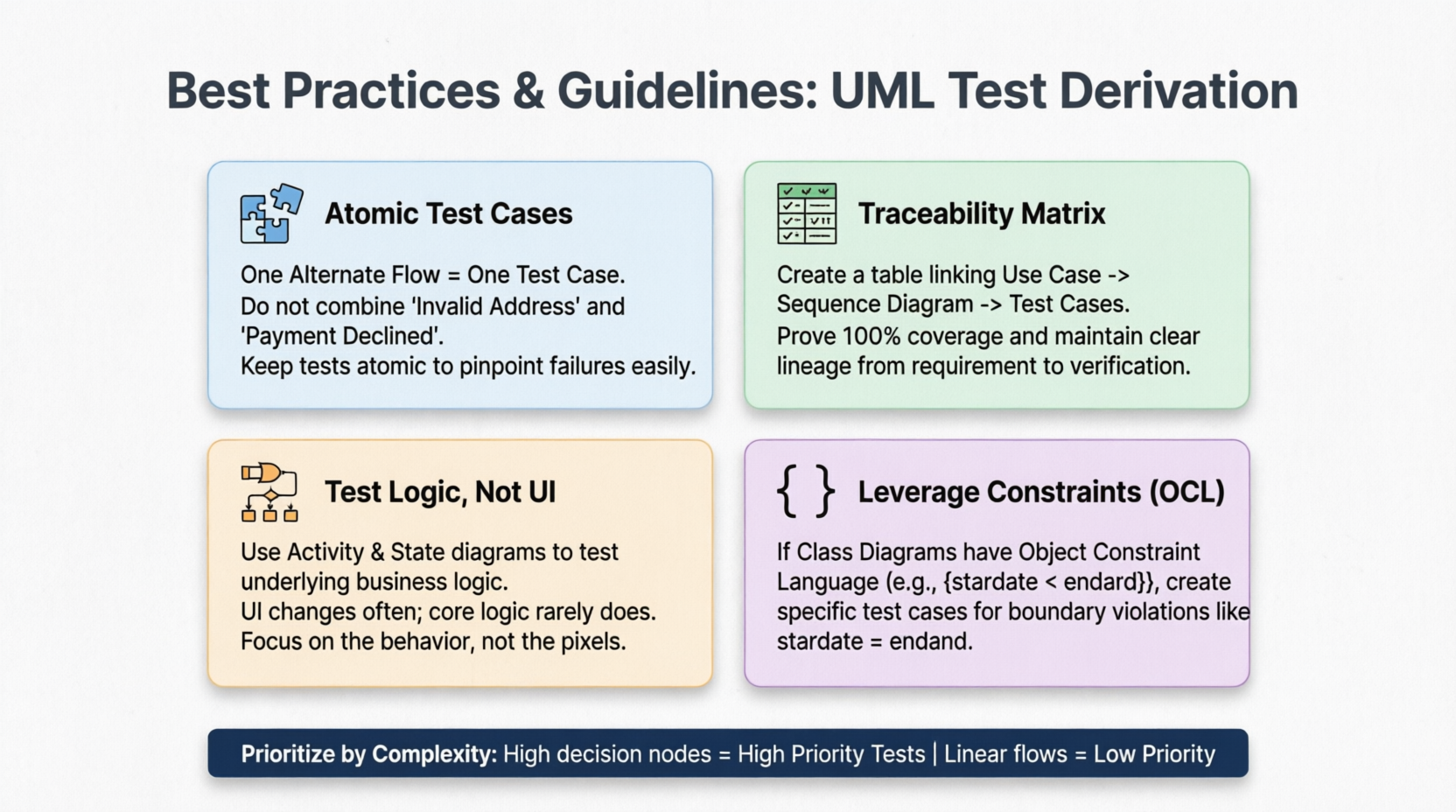
UC-01 -> Sequence Diagram -> Test Cases to prove 100% coverage.{ startDate < endDate }), ensure you have Test Cases for startDate = endDate and startDate > endDate.When handed a new Feature Request:
Order, Ticket, User) to identify illegal transitions.By following this guide, you transform vague requirements into a robust, verifiable software product where 90% of edge cases are caught during design, not production.
Adopting the UML Translation Pipeline fundamentally changes how organizations approach software verification. It moves the discovery of edge cases from the expensive production environment back to the cost-effective design phase. By systematically mapping Activity Diagrams to decision coverage, Sequence Diagrams to integration points, State Machines to lifecycle transitions, and Class Diagrams to boundary values, QA engineers gain a mathematical precision that text-based requirements simply cannot provide. Ultimately, this methodology does more than improve test coverage; it enforces clarity in requirements and alignment between business analysts, architects, and testers. In an era where software complexity is constantly increasing, leveraging UML as a testing blueprint is no longer optional—it is the defining characteristic of high-maturity engineering teams who refuse to leave quality to chance.

