
Agile is not just a set of processes; it is a mindset built on collaboration, adaptability, and delivering continuous value. For Agile frameworks (like Scrum) to function effectively, specific roles must be clearly understood, and artifacts must be meticulously maintained.
This guide provides a deep dive into the Key Roles, Artifacts & Deliverables, complete with summaries, key concepts, structured tables, and abundant real-world examples.
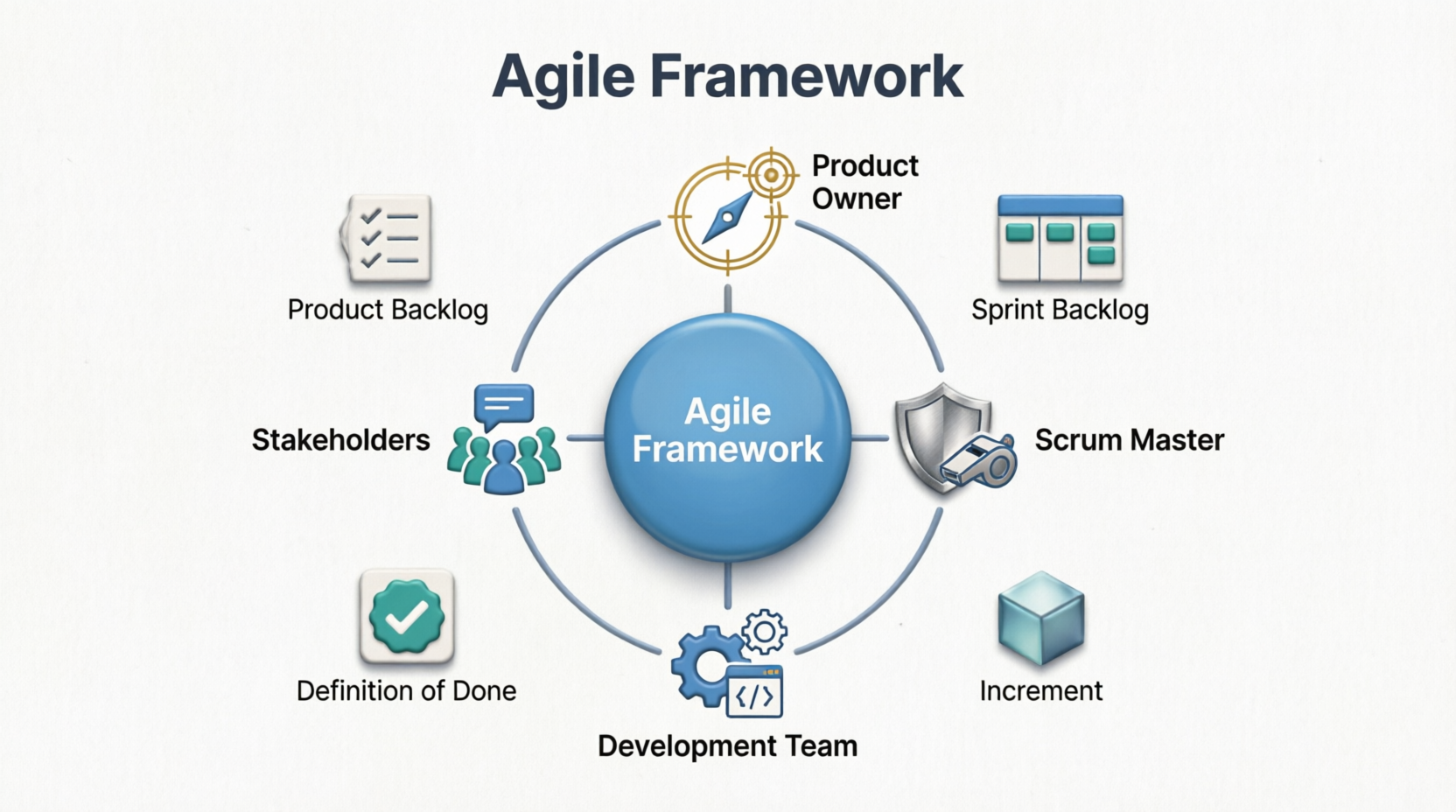
Summary: The Product Owner is the "voice of the customer" and the ultimate decision-maker regarding what gets built. They are responsible for maximizing the value of the product resulting from the work of the Development Team.
Key Concepts:
Value Maximization: Always prioritizing work that delivers the highest business or user value.
The "What" and "Why": The PO decides what needs to be built and why, but leaves the how to the Development Team.
Backlog Ownership: Solely responsible for managing, refining, and ordering the Product Backlog.
Empowered Decision Maker: Must have the authority to say "yes" or "no" to features without needing constant upper-management approval.
Real-World Examples:
E-commerce: The PO decides to prioritize "One-Click Checkout" over "Social Media Sharing" because analytics show cart abandonment is the biggest revenue blocker.
Healthcare App: The PO rejects a developer's suggestion to use a flashy new UI framework because it would delay compliance with HIPAA regulations, prioritizing security over aesthetics.
SaaS Platform: During backlog refinement, the PO clarifies a vague requirement: "Instead of 'make it faster,' the goal is to reduce page load time from 3 seconds to under 1 second."
Summary: The Scrum Master is a "servant-leader" for the Agile team. They do not manage the people; they manage the process. Their goal is to ensure the team adheres to Agile principles, remove obstacles, and foster a high-performing environment.
Key Concepts:
Servant Leadership: Serving the team's needs first, rather than acting as a traditional boss.
Impediment Removal: Proactively identifying and eliminating blockers (technical, organizational, or interpersonal).
Coaching & Facilitation: Teaching the team and stakeholders Agile practices and facilitating ceremonies (Sprint Planning, Daily Standup, Retrospective, Review).
Shielding the Team: Protecting the team from external distractions and scope creep during a Sprint.
Real-World Examples:
Impediment Removal: A developer cannot proceed because they lack access to the production database. The SM immediately contacts the IT security team to expedite the access request.
Coaching: The PO keeps adding new tasks to the Sprint midway through. The SM gently intervenes, reminding the PO of the Sprint Goal and facilitating a conversation about moving the new items to the Product Backlog for the next Sprint.
Facilitation: During a Retrospective, the team is silent. The SM introduces a "Sailboat" retrospective format to make the discussion engaging and uncover hidden frustrations about the CI/CD pipeline.
Summary: A cross-functional, self-organizing group of professionals who do the actual work of delivering a potentially releasable Increment of "Done" product at the end of each Sprint.
Key Concepts:
Cross-Functional: The team possesses all the skills necessary to create the product (e.g., frontend, backend, QA, UX, DevOps).
Self-Organizing: The team decides how to turn Product Backlog items into a working product. No one (not even the SM) tells them how to do their jobs.
Collective Ownership: The team succeeds or fails together. There are no individual silos; members swarm to solve problems.
Sustainable Pace: The team commits to a realistic amount of work to avoid burnout and maintain consistent quality.
Real-World Examples:
Swarming: A critical bug is found two days before the Sprint ends. Instead of the original author fixing it alone, a backend developer and a QA engineer pair-program to resolve and test it rapidly.
Self-Organization: The PO provides a User Story. The team discusses it and decides that to deliver it, they need to break it into three smaller technical tasks (database schema update, API creation, UI implementation) and assign them dynamically.
Pushing Back: The team realizes the Sprint Goal is at risk due to unexpected technical debt. They proactively inform the PO during the Daily Standup and collaboratively descoped a low-priority item to ensure the core goal is met.
Summary: Anyone who has an interest in, is impacted by, or can influence the product. This includes end-users, customers, executives, marketing, legal, and support teams.
Key Concepts:
Feedback Loop: Stakeholders provide crucial feedback, primarily during the Sprint Review.
**Subject Matter Experts **(SMEs) They provide domain knowledge that the PO and team may lack.
Influence vs. Authority: While they have strong opinions and needs, they do not dictate the Sprint Backlog directly; they influence the PO, who then prioritizes the backlog.
Real-World Examples:
Legal/Compliance: A stakeholder from the legal department reviews a new data-collection feature during a Sprint Review and flags a GDPR violation, prompting the PO to create a high-priority backlog item to fix it.
End Users: A group of beta-testers (stakeholders) tries a new mobile app feature and reports that the "Submit" button is hard to find on smaller screens, leading to a UX refinement in the next Sprint.
Sales/Marketing: The VP of Sales asks the PO for a specific reporting feature to help close a major enterprise deal. The PO evaluates this against the current roadmap and adjusts priorities accordingly.
Artifacts represent work or value. They are designed to maximize transparency of key information, ensuring everyone has the same understanding of the artifact.
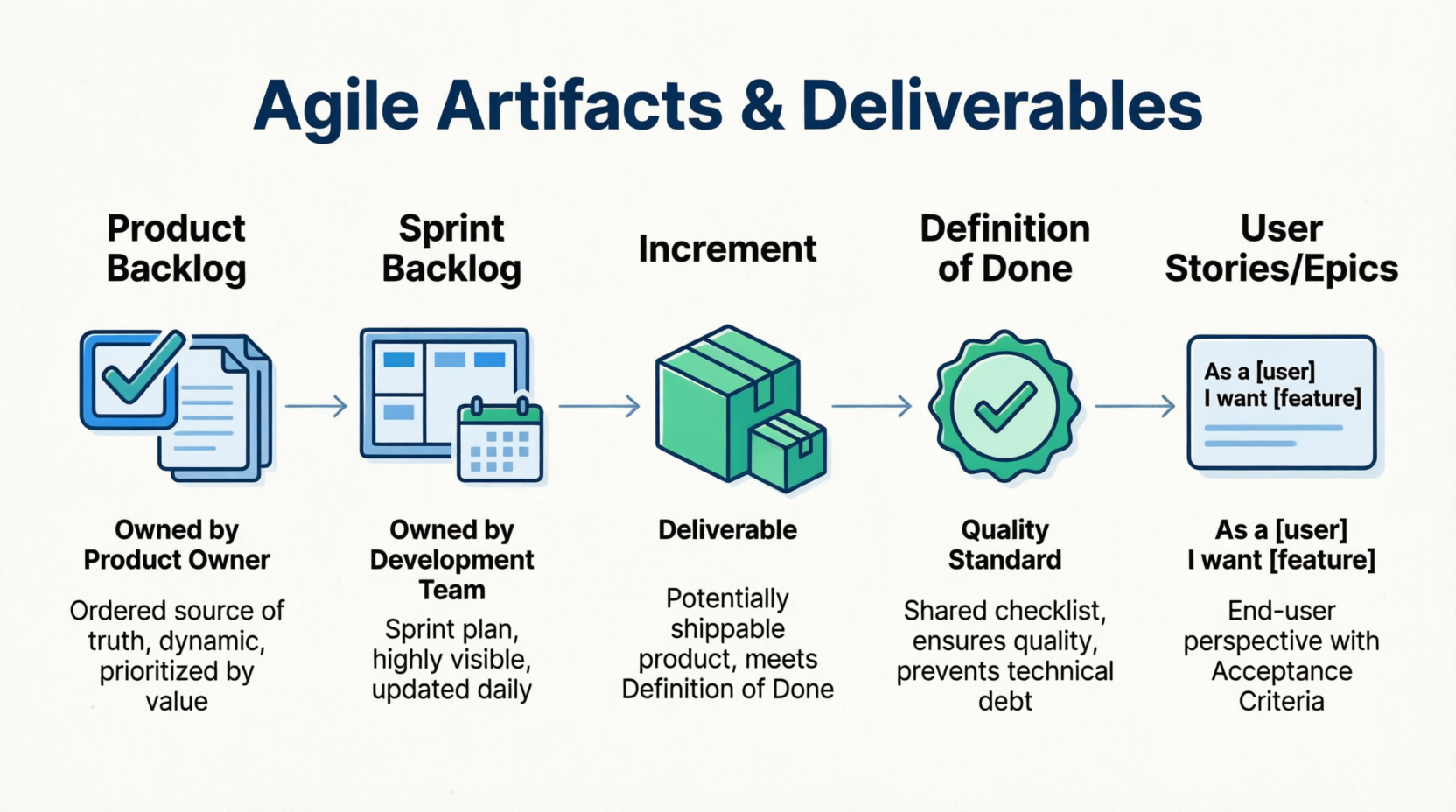
| Artifact / Deliverable | Purpose | Primary Owner / Creator | Key Characteristics |
|---|---|---|---|
| Product Backlog | The single, ordered source of truth for everything needed in the product. | Product Owner | Dynamic, never complete, ordered by value/priority, estimated by the team. |
| Sprint Backlog | The set of Product Backlog items selected for the Sprint, plus a plan for delivering them. | Development Team | Owned by the team, highly visible (e.g., Kanban board), updated daily. |
| Increment (Deliverable) | The sum of all completed Product Backlog items during a Sprint, combined with the value of all previous Sprints. | Development Team | Must meet the Definition of Done (DoD), must be in usable condition. |
| Definition of Done (DoD) | A formal description of the state of the Increment when it meets the quality measures required for the product. | Entire Scrum Team | Creates transparency, prevents "technical debt," applies to all items. |
| User Stories / Epics | A way to express a feature from an end-user perspective. Epics are large; Stories are small. | Product Owner (with team input) | Follows format: "As a [role], I want [feature] so that [benefit]." Includes Acceptance Criteria. |
Concept: It is a living document. Items at the top are small, clear, and ready for development. Items at the bottom are large, vague, and will be refined later.
Examples:
High Priority (Top): "As a registered user, I want to reset my password via email so I can regain access to my account." (Includes detailed Acceptance Criteria).
Low Priority (Bottom): "As a user, I want to invite my friends via social media so we can share our progress." (Vague, needs refinement, targets 100,000 users).
Concept: This is the team's forecast and plan for the current Sprint. It is not a rigid contract, but a highly visible, real-time picture of the team's plan.
Examples:
Visual Board: A Jira board or physical whiteboard with columns: "To Do," "In Progress," "Code Review," "Testing," "Done."
Task Breakdown: A User Story "Add to Cart" is broken down into Sprint Backlog tasks: "Create API endpoint (4 hrs)", "Build React component (6 hrs)", "Write unit tests (2 hrs)".
Concept: The tangible, working output of the Sprint. It must be potentially shippable, meaning the business could release it to users immediately if they chose to.
Examples:
Software: A fully functional, tested, and documented "Guest Checkout" feature deployed to the staging environment.
Hardware: A 3D-printed, fully assembled prototype of a new smart-thermostat casing that has passed drop-testing.
Marketing: A completed, proofread, and approved blog post series ready to be published on the company website.
Concept: A shared checklist that ensures quality. If an item doesn't meet the DoD, it cannot be considered part of the Increment.
Examples:
Code DoD: Code is written, peer-reviewed, passes all automated unit tests (>80% coverage), merged to the main branch, and deployed to the QA environment.
Documentation DoD: User manual is updated, API documentation is generated, and release notes are drafted.
Concept: Stories capture the who, what, and why. Acceptance Criteria (AC) define the boundaries of the story and how it will be tested.
Examples:
Story: "As a frequent flyer, I want to see my loyalty points balance on the homepage so I know if I can book a reward flight."
Acceptance Criteria:
Points balance is visible at the top right of the screen.
Balance updates in real-time after a flight is completed.
If the user is not logged in, display "0 points" with a "Log In" prompt.
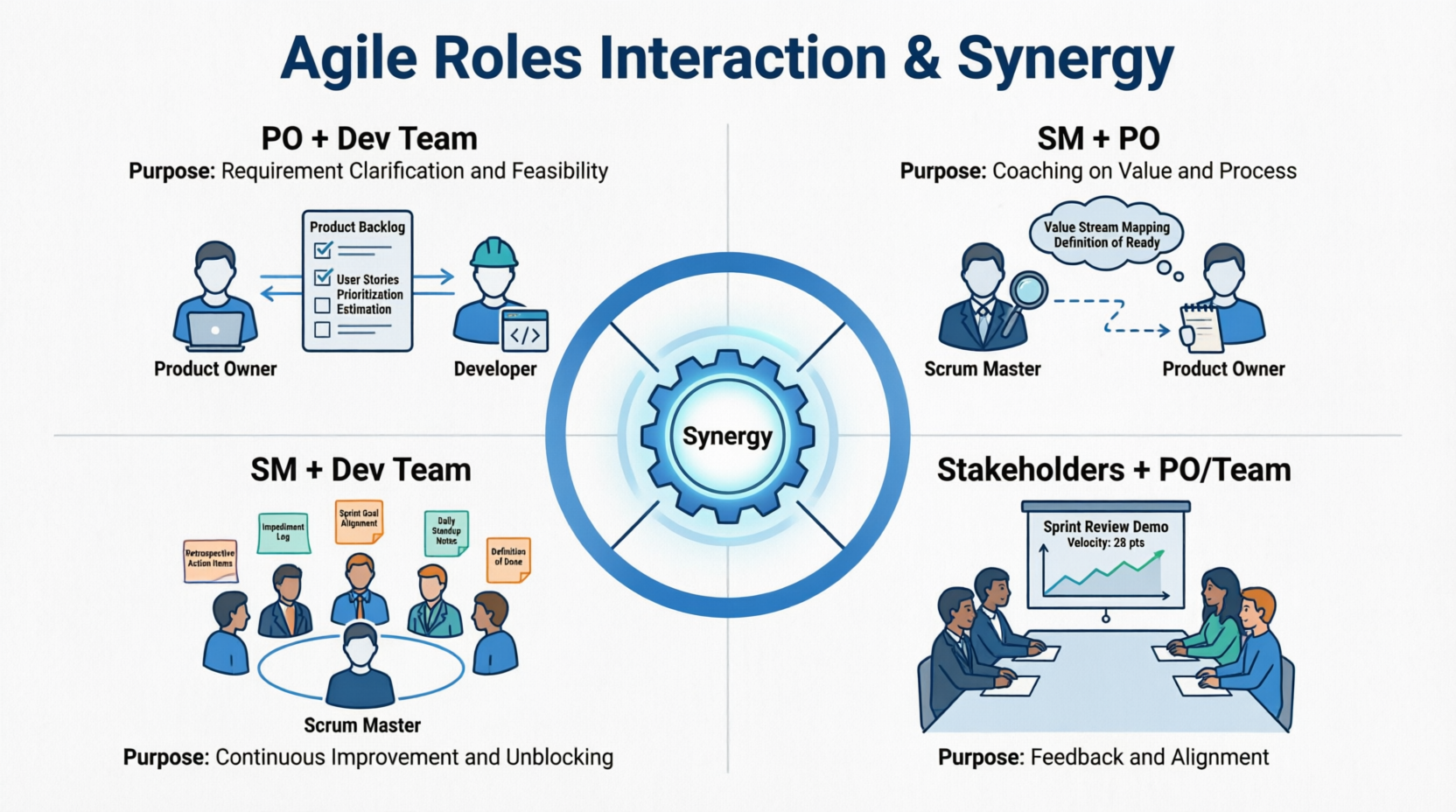
Agile roles do not operate in silos. Their power comes from how they interact.
| Interaction | Purpose | Real-World Scenario |
|---|---|---|
| PO + Dev Team | Requirement clarification and feasibility. | During Backlog Refinement, the Dev Team asks the PO, "What happens if the user loses internet connection during payment?" The PO clarifies the expected behavior, and the team adds it to the Acceptance Criteria. |
| SM + PO | Coaching on value and process. | The PO is overwhelmed and trying to write 50 detailed stories alone. The SM coaches the PO to facilitate collaborative refinement sessions with the Dev Team to share the load and gain technical insights. |
| SM + Dev Team | Continuous improvement and unblocking. | The Dev Team complains that daily standups are turning into hour-long problem-solving sessions. The SM facilitates a change, enforcing the "parking lot" rule to keep standups to 15 minutes. |
| Stakeholders + PO/Team | Feedback and alignment. | During the Sprint Review, stakeholders demo the new feature. They love it but request a minor color change. The PO notes this as a low-priority item for a future Sprint, rather than disrupting the current one. |
Mastering Agile roles is about understanding boundaries while fostering deep collaboration.
The Product Owner ensures the team is building the right thing.
The Development Team ensures the thing is built right.
The Scrum Master ensures the process allows both of those to happen efficiently.
The Stakeholders ensure the product remains aligned with market and business reality.
When these roles respect each other's boundaries but actively collaborate around shared Artifacts (like the Backlog and DoD), the result is a high-performing Agile ecosystem capable of delivering consistent, high-quality value.

