
The Unified Modeling Language (UML) is the industry-standard visual language for specifying, constructing, and documenting the artifacts of software systems. While classes and objects represent the "nouns" of a system, relationships represent the "verbs" and structural connections that bind them together.
Understanding UML relationships is critical for object-oriented design, system architecture, and clear communication among development teams. Choosing the correct relationship ensures that your system's lifecycle, dependencies, and hierarchies are accurately modeled, preventing architectural flaws before a single line of code is written.
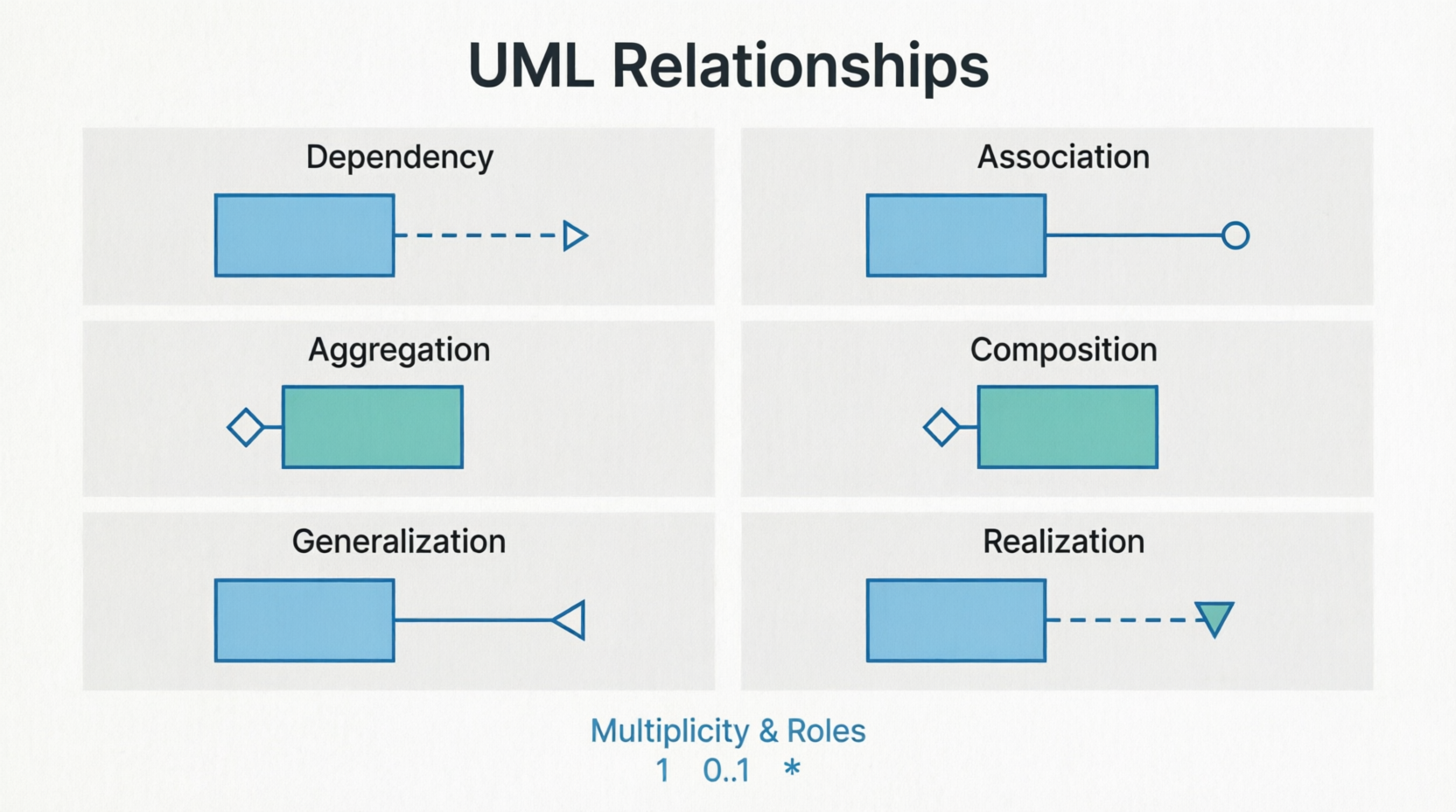
This guide provides a deep dive into the core UML relationships, complete with definitions, visual notations, and multiple real-world and software examples.
Definition: A dependency is the weakest form of relationship. It indicates that a change in one element (the supplier) may affect another element (the client). The client "uses" the supplier temporarily, typically as a method parameter, a local variable, or a static method call, but does not hold a permanent structural reference to it.
UML Notation: A dashed line with an open arrow pointing from the client to the supplier.
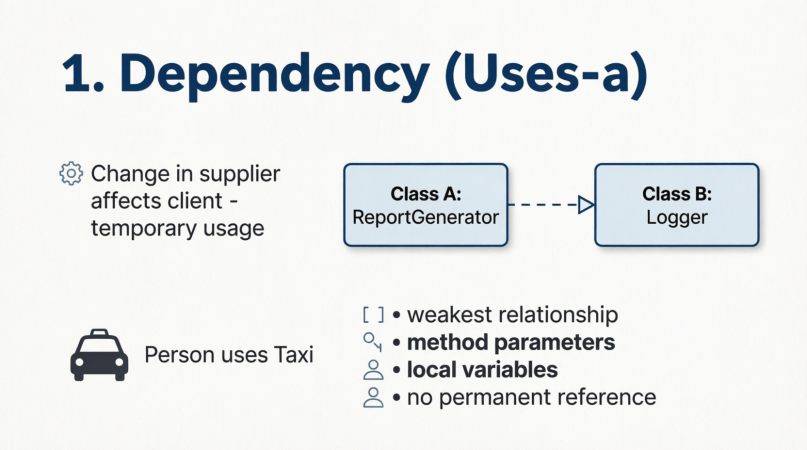
Client - - - - - - - - > Supplier
Examples:
Software: A ReportGenerator class has a method generate(Logger log). The ReportGenerator depends on the Logger interface to function, but it does not store the Logger as a class attribute.
Real-world: A Person depends on a Taxi to get to the airport. Once the ride is over, the relationship ends; the person does not "own" or structurally contain the taxi.
Software: A UserController depends on an EmailService to send a welcome message upon registration. The dependency is transient and method-scoped.
Definition: An association is a structural relationship indicating that objects of one class are connected to objects of another. Unlike a dependency, an association is longer-lived. One class typically holds a reference (attribute) to the other, allowing them to communicate and collaborate over time.
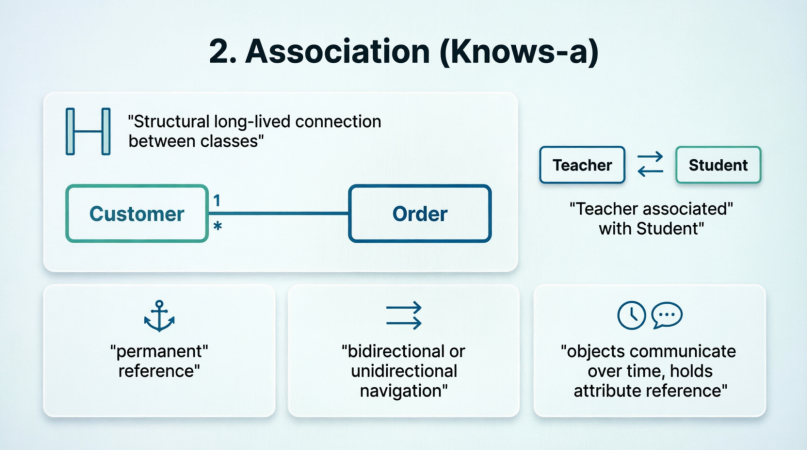
UML Notation: A solid line. An open arrowhead can be added to indicate navigability (which class knows about the other).
Class A ------------------------ Class B
Class A ----------------------> Class B  (A knows about B, but B doesn't know about A)
Examples:
Software: A Customer class has a list of Order objects. The customer "knows" about their orders.
Real-world: A Teacher is associated with a Student. They interact regularly, but neither is a part of the other's physical composition.
Software: A ShoppingCart is associated with a ProductCatalog to look up item details.
Definition: Aggregation is a specialized form of association representing a "whole-part" relationship. The key distinction is that the part can exist independently of the whole. If the whole is destroyed, the part continues to exist.
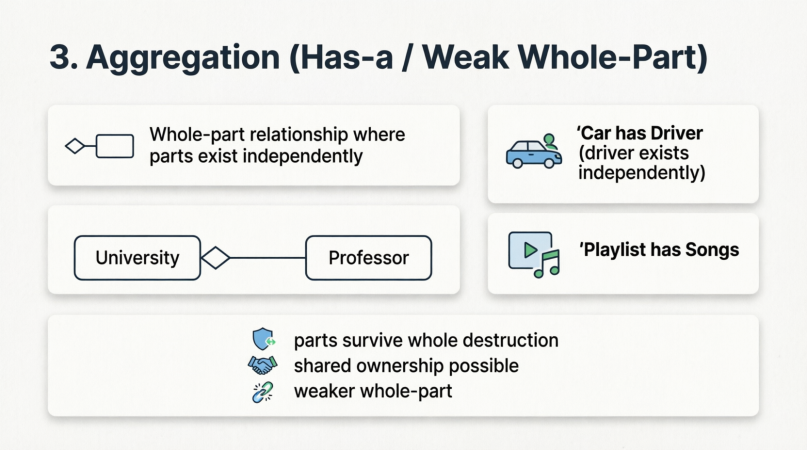
UML Notation: A solid line with an unfilled (hollow) diamond at the "whole" end.
Whole ◇------------------------ Part
Examples:
Software: A University and a Professor. If the university closes down (the whole is destroyed), the professors (the parts) still exist and can work elsewhere.
Real-world: A Car and a Driver. The car "has" a driver, but the driver has an independent lifecycle and can drive other cars.
Software: A Playlist and a Song. Deleting a playlist does not delete the songs from the music library; the songs can belong to multiple playlists.
Definition: Composition is a stronger form of aggregation. It represents a strict "whole-part" relationship where the part's lifecycle is entirely dependent on the whole. If the whole is destroyed, the parts are automatically destroyed with it. A part can usually belong to only one whole at a time.
UML Notation: A solid line with a filled (solid) diamond at the "whole" end.
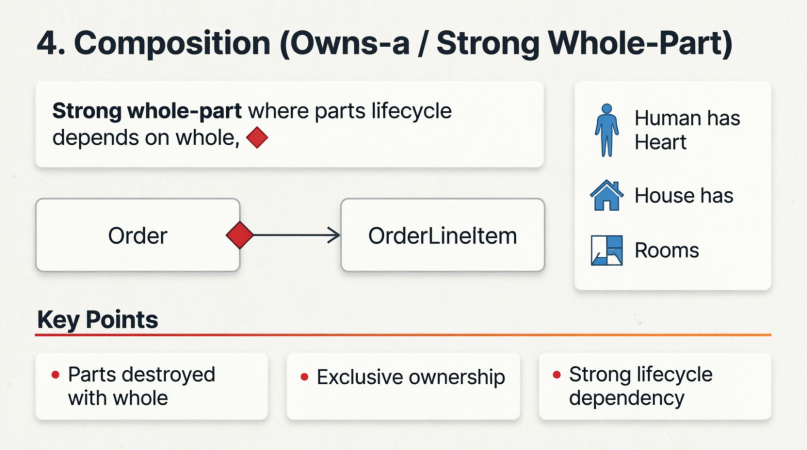
Whole ◆------------------------ Part
Examples:
Software: An Order and an OrderLineItem. If the Order is canceled and deleted from the database, the OrderLineItem records associated with it are also deleted. They have no meaning without the parent order.
Real-world: A Human and a Heart. If the human dies, the heart ceases to function as part of that human. The heart cannot exist independently in this context.
Software: A House and a Room. If the house is demolished, the rooms are destroyed along with it.
Definition: Generalization is a relationship between a more general element (superclass/parent) and a more specific element (subclass/child). The subclass inherits the attributes, operations, and relationships of the superclass and can add its own or override existing ones.
UML Notation: A solid line with an unfilled triangle arrow pointing to the superclass.
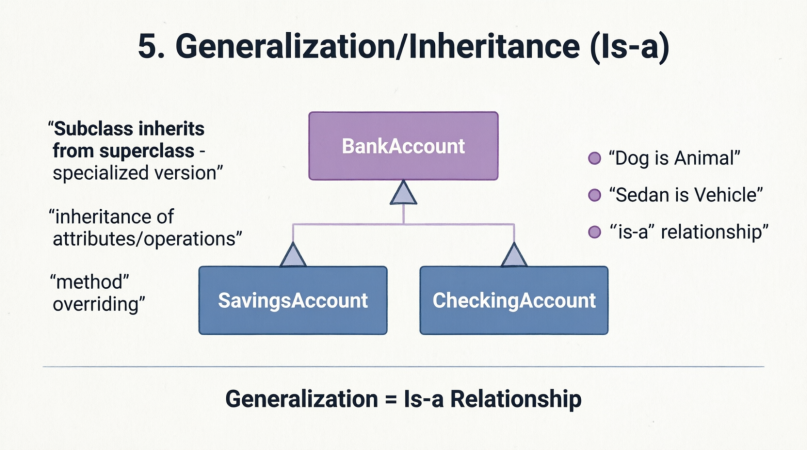
Subclass ----------------------|> Superclass
Examples:
Software: SavingsAccount and CheckingAccount both generalize to BankAccount. They inherit properties like accountNumber and balance.
Real-world: A Dog is an Animal. A Sedan is a Vehicle.
Software: An AdminUser is a User. The AdminUser inherits login capabilities but adds an approvePermissions() method.
Definition: Realization is a relationship between a classifier (like a class) and an interface (or contract). The class promises to provide the implementation for the operations declared in the interface.
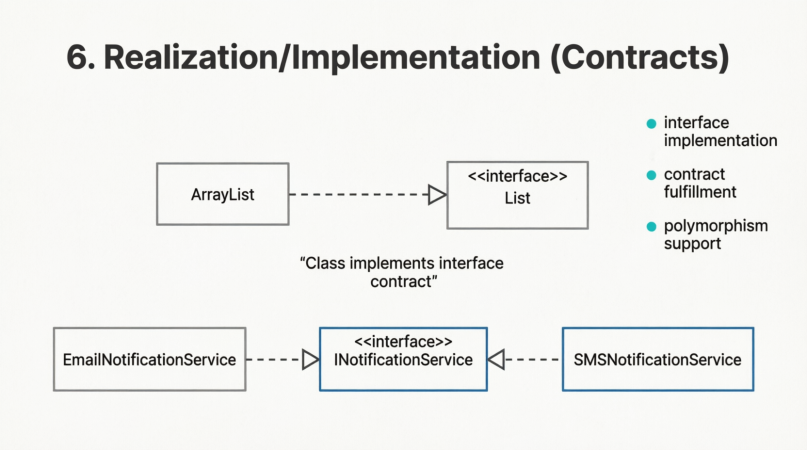
UML Notation: A dashed line with an unfilled triangle arrow pointing to the interface.
ImplementingClass - - - - - - -|> Interface
Examples:
Software: An ArrayList class realizes the List interface in Java. It provides the concrete code for methods like add() and get().
Software: An EmailNotificationService and SMSNotificationService both realize the INotificationService interface, ensuring they both have a send(message) method.
to the PaymentGateway interface.
Real-world (Conceptual): A contractor (class) realizing the terms of a legally binding construction contract (interface).
These concepts are not standalone relationships but are critical modifiers applied primarily to Associations, Aggregations, and Compositions to add precision.
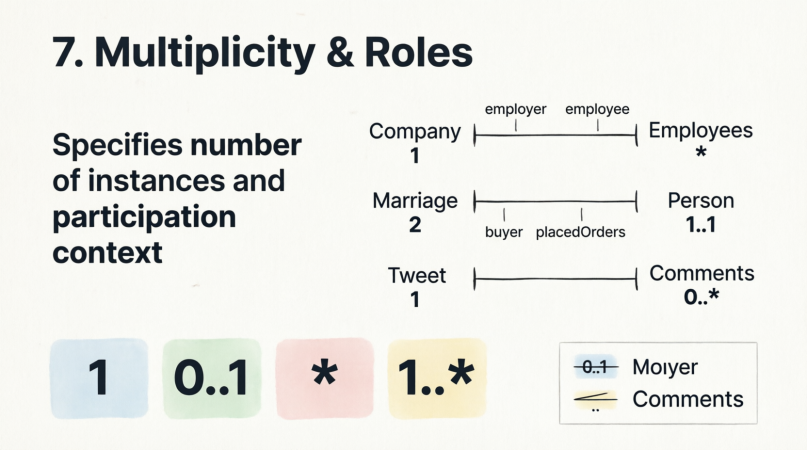
Definition: Specifies the number of instances of one class that can or must be associated with a single instance of another class.
UML Notation: Placed at the ends of the association line.
1 : Exactly one
0..1 : Zero or one (optional)
* or 0..* : Zero or more (many)
1..* : One or more (at least one)
Examples:
A Company (1) employs * (many) Employees.
A Marriage involves exactly 2 Person instances (1..1 to 1..1).
A Tweet (1) can have 0..* Comments.
Definition: The name given to the end of an association, describing the capacity or context in which a class participates in the relationship. It clarifies why the association exists.
UML Notation: Text placed near the association end, next to the multiplicity.
Examples:
In an association between Person and Company, the role at the Company end might be employer, and the role at the Person end might be employee.
In a Customer and Order association, the role at the Order end could be placedOrders, and at the Customer end, buyer.
Choosing the right relationship can be tricky. Use this quick decision guide:
| Question to Ask | Relationship to Use | Notation |
|---|---|---|
| Does Class A temporarily use Class B (e.g., as a method parameter)? | Dependency | - - - - > |
| Does Class A have a permanent reference to Class B, but they are independent? | Association | ----------- |
| Is it a whole-part relationship, but the part can survive without the whole? | Aggregation | ◇----------- |
| Is it a whole-part relationship, and the part dies if the whole dies? | Composition | ◆----------- |
| Is Class A a specialized version of Class B? | Generalization | `----------- |
| Does Class A provide the code for an interface/contract defined by B? | Realization | `- - - - - - |
Mastering UML relationships is foundational to effective software design. Misusing these relationships leads to flawed mental models: treating an Aggregation like a Composition might lead to accidental data deletion, while confusing a Dependency with an Association might result in unnecessary tight coupling and memory leaks.
Best Practices:
Prefer Realization over Generalization: Favor implementing interfaces (composition over inheritance) to keep your systems flexible and loosely coupled.
Be Precise with Multiplicity: Always define cardinality. An association without multiplicity is ambiguous and leaves room for architectural misinterpretation.
Avoid Over-Composition: Use Composition sparingly. If there is any doubt that a part could exist independently or be shared, default to Aggregation or a standard Association.
By applying these concepts rigorously, your UML diagrams will transition from simple drawings into powerful, unambiguous blueprints for robust software architecture.

