
In Agile and Scrum frameworks, delivering value iteratively relies on a clear, structured flow of work. This guide breaks down the three foundational pillars of this flow: User Stories, the Product Backlog, and Sprint Planning. It details their key concepts, how they relate to one another, the step-by-step process, and practical examples.
A User Story is the smallest unit of work in an Agile framework. It is an informal, natural language description of a feature written from the perspective of the end-user or customer.
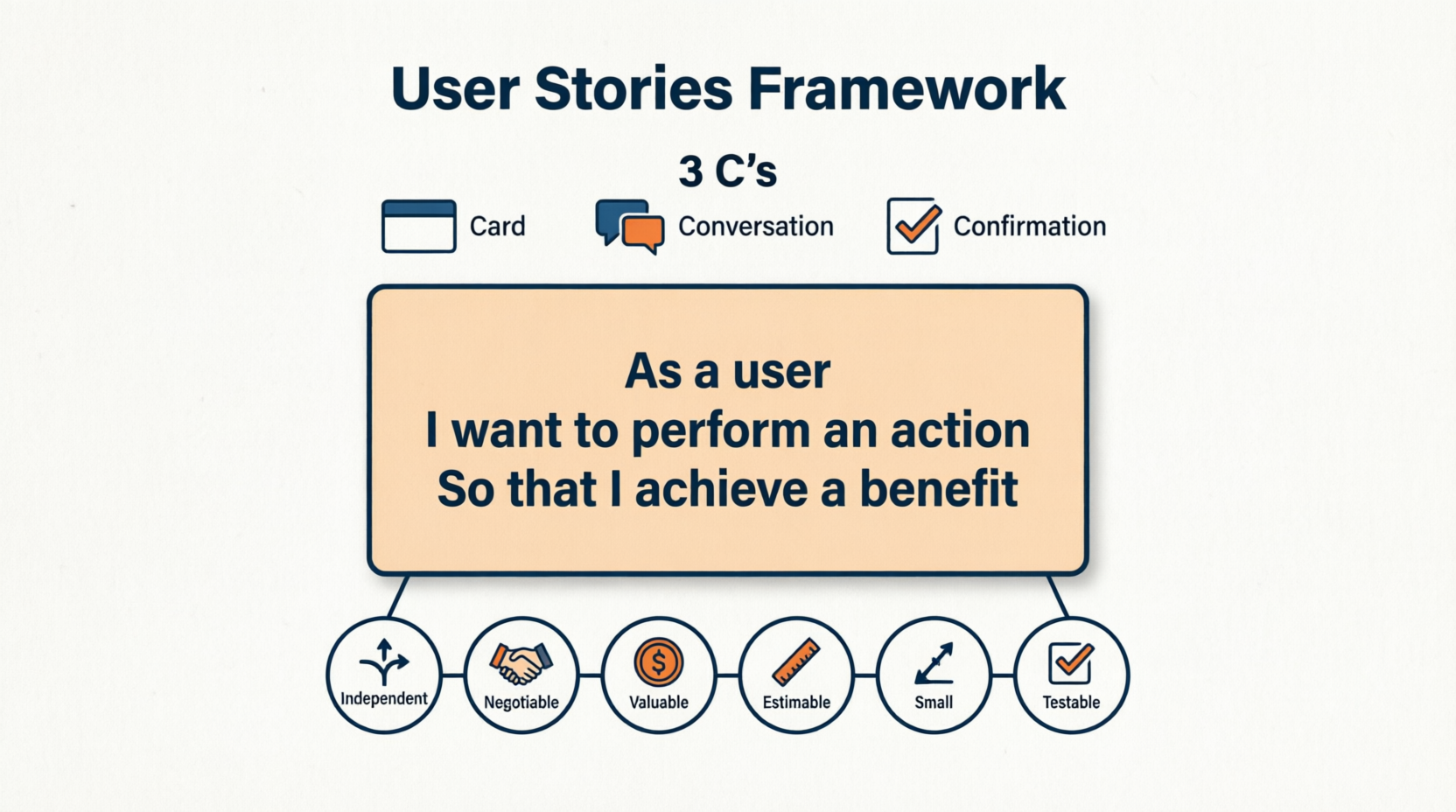
The 3 C’s (Ron Jeffries):
Card: The written text of the story (a placeholder for a requirement).
Conversation: The ongoing dialogue between the Product Owner (PO), developers, and stakeholders to clarify details.
Confirmation: The Acceptance Criteria that define when the story is "Done."
INVEST Criteria (Bill Wake): A checklist for high-quality stories.
Independent: Can be developed and released separately.
Negotiable: Open to discussion, not a rigid contract.
Valuable: Delivers tangible value to the user or business.
Estimable: The team can size it (usually in Story Points).
Small: Can be completed within a single Sprint.
Testable: Has clear acceptance criteria.
Standard Format:
"As a [type of user], I want to [perform an action], so that [I achieve a specific benefit/value]."
Example (E-commerce Platform):
Title: Guest Checkout
Story: As a first-time shopper, I want to check out without creating an account, so that I can complete my purchase quickly and avoid friction.
Acceptance Criteria (Given/When/Then):
Given I have items in my cart, When I click "Checkout", Then I am presented with a "Continue as Guest" option.
Given I am checking out as a guest, When I complete payment, Then my order is processed without prompting for a password.
The Product Backlog is an emergent, ordered list of everything that is known to be needed in the product. It is the single source of work undertaken by the Scrum Team.
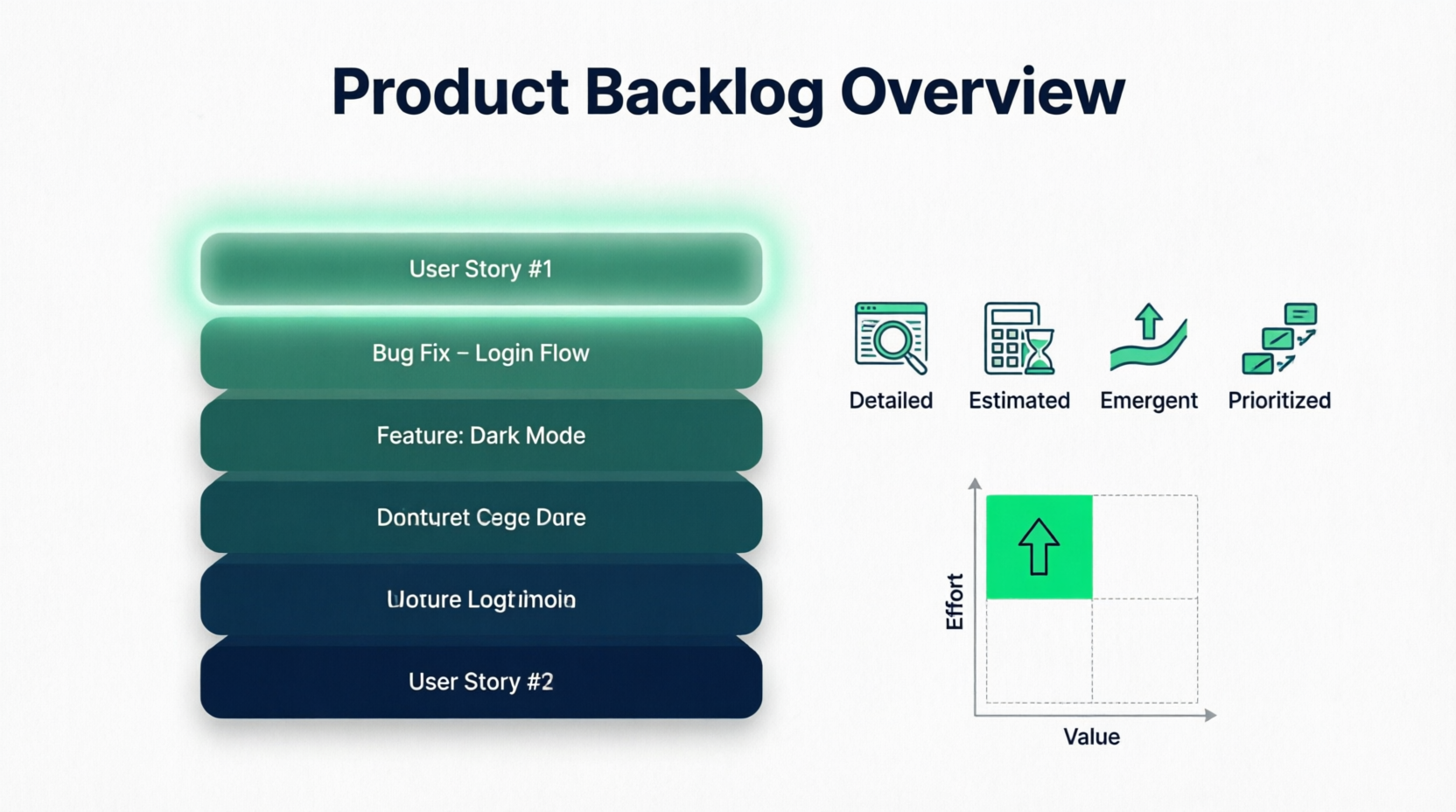
Ordered, Not Just Prioritized: The backlog is strictly ordered by value, risk, and necessity. The items at the top are the most important and most refined.
Product Backlog Refinement (PBR): The ongoing activity of breaking down, estimating, and clarifying backlog items. (Historically called "grooming").
DEEP Characteristics (Mike Cohn):
Detailed appropriately: Top items are highly detailed; bottom items are vague.
Estimated: Roughly sized by the team.
Emergent: Continuously changes as the product and market evolve.
Prioritized: Ordered to maximize value delivery.
MoSCoW: Must have, Should have, Could have, Won't have (this time).
RICE Score: Reach, Impact, Confidence, Effort.
Value vs. Effort Matrix: Plotting stories to find "Quick Wins" (High Value, Low Effort).
ID: PB-104
Item: Guest Checkout (User Story from Part 1)
Priority: 1 (Top of backlog)
Estimate: 5 Story Points
Status: Refined & Ready for Sprint Planning
Sprint Planning is a timeboxed event (max 8 hours for a 1-month Sprint, typically 2-4 hours for a 2-week Sprint) that initiates the Sprint by laying out the work to be performed.
Sprint Planning addresses two primary topics:
Topic One: Why is this Sprint valuable? & What can be Done?
The Product Owner proposes how the product could increase its value and utility in the current Sprint.
The Scrum Team selects items from the top of the Product Backlog to include in the current Sprint.
Output: The Sprint Goal (the single objective for the Sprint).
Topic Two: How will the chosen work get done?
Developers plan the work necessary to create an Increment that meets the Definition of Done. This often involves breaking User Stories into technical tasks (e.g., "Design DB schema," "Write API endpoint").
Output: The Sprint Backlog (the Sprint Goal + selected User Stories + the plan for delivering them).
Before selecting stories, the team calculates capacity:
Total Team Capacity = (Available Days per Developer) × (Focus Factor, typically 0.7-0.8 to account for meetings/PTO)
The team uses historical Velocity (average story points completed in past sprints) as a guide, not a target, to avoid overcommitting.
These three elements do not exist in isolation; they form a continuous, interlocking funnel of value delivery.
Ideation: A stakeholder has an idea or a user pain point is identified.
Drafting: The Product Owner writes a User Story and adds it to the Product Backlog.
Refinement (Ongoing): During mid-sprint, the team discusses the story, clarifies the Acceptance Criteria, and assigns a Story Point estimate. It moves up the backlog.
Sprint Planning:
The PO presents the top, refined User Stories.
The team agrees on a Sprint Goal.
The team pulls the User Stories into the Sprint Backlog based on capacity.
Developers break the User Stories into sub-tasks.
Execution: The team works on the tasks during the Sprint, referencing the User Story's acceptance criteria to ensure they are building the right thing.
Review: At the Sprint Review, the completed User Story is demonstrated to stakeholders for feedback, which may generate new User Stories for the Product Backlog.
[ Stakeholder Needs ]
       ↓
[ User Story ] (As a... I want to... So that...)
       ↓
[ Product Backlog ] (Ordered, Refined, Estimated)
       ↓
[ Sprint Planning ] (Select top items → Define Sprint Goal → Create Tasks)
       ↓
[ Sprint Backlog ] (Committed work for the next 1-4 weeks)
       ↓
[ "Done" Increment ] (Value delivered to the user)
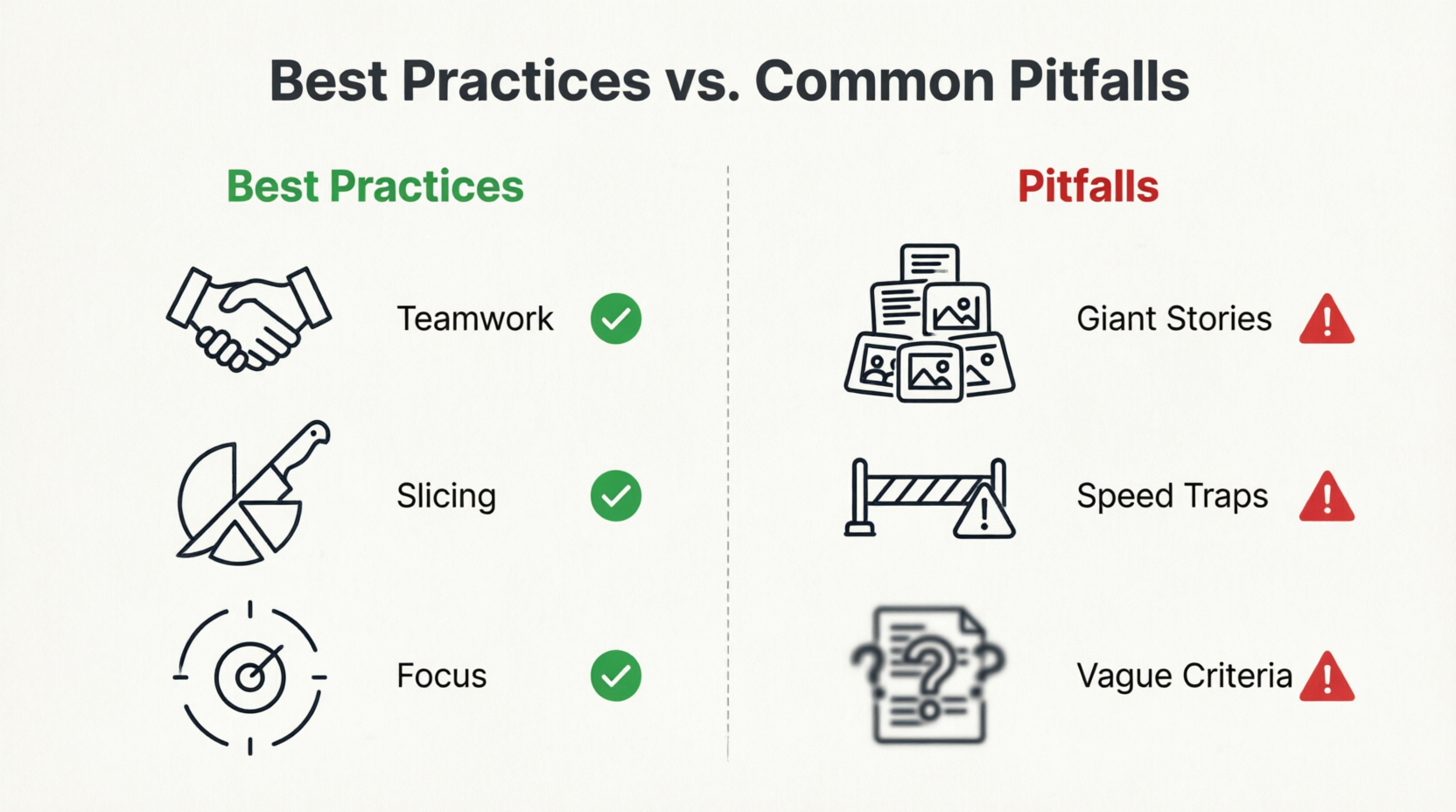
Collaborative Refinement: Don't let the Product Owner write stories in a vacuum. Involve developers and QA early to ensure technical feasibility and testability.
Vertical Slicing: Write stories that cut across all layers of the application (UI, API, Database) to deliver a thin slice of working functionality, rather than "horizontal" technical tasks (e.g., "Build the database").
Definition of Ready (DoR): Agree as a team on what makes a story ready for Sprint Planning (e.g., "Has acceptance criteria, estimated, dependencies identified").
Focus on the Sprint Goal: If the team realizes mid-sprint that a User Story doesn't serve the Sprint Goal, negotiate with the PO to drop or swap it.
"Epic" Stories in Sprint Planning: Pulling in a massive story that cannot be finished in one sprint. Fix: Split it into smaller, independent stories.
Treating Velocity as a Performance Metric: Using story points to measure individual developer productivity destroys psychological safety and leads to point inflation. Velocity is strictly for team forecasting.
Skipping Acceptance Criteria: Writing vague stories like "Make the app faster." Fix: Use measurable criteria: "Reduce homepage load time to under 2 seconds on 4G networks."
The PO Dictating the "How": The Product Owner owns the What and Why. The Developers own the How.
| Artifact / Event | Key Question to Ask | Success Indicator |
|---|---|---|
| User Story | Does this deliver clear value to a specific user? | Passes INVEST criteria; has clear Given/When/Then acceptance criteria. |
| Product Backlog | Is the most valuable work at the top and ready to be pulled? | Top 1-2 sprints worth of work is refined, estimated, and has a clear DoR. |
| Sprint Planning | Do we have a realistic plan and a unifying goal for this Sprint? | Team commits to a clear Sprint Goal and a Sprint Backlog they believe they can achieve. |
By mastering the creation of effective User Stories, maintaining a healthy and ordered Product Backlog, and facilitating focused Sprint Planning, Agile teams can consistently deliver high-value, high-quality software in a predictable and sustainable manner.

