
The Unified Modeling Language (UML) is the industry standard for visualizing, specifying, and documenting the artifacts of a software system. However, while UML diagrams are exceptional at providing a high-level visual structure, they often lack the granularity required to express complex business rules and system logic. This is where the Object Constraint Language (OCL) steps in.
OCL is a formal, text-based language designed to express logic and constraints on UML models that cannot be easily captured by diagrams alone. It acts as the "fine print" of your system's architecture, ensuring that the visual blueprints translate into precise, correct, and reliable implementations. As a core part of the UML 2.0 specification and formalized using the Meta-Object Facility (MOF), OCL is not a visual programming language; rather, it is a declarative language used to define strict contracts that an implementation must obey.
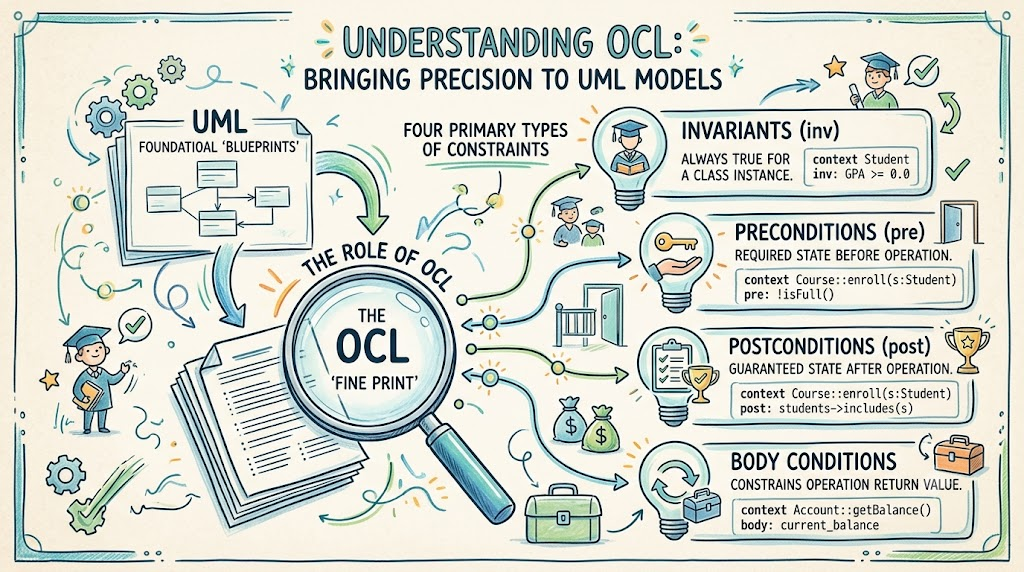
This guide explores the core concepts, syntax, and practical applications of OCL, providing you with the knowledge to add mathematical precision to your UML models.
The foundational rule of OCL is that every expression must have a context. The context identifies the specific model element (such as a class, an attribute, or an operation) to which the constraint applies. Without a context, an OCL expression has no meaning.
Depending on the context, OCL expressions are categorized into four primary types:
Invariants (inv): These are conditions that must always be true for all instances of a class throughout its entire lifecycle. For example, an invariant might dictate that a Student object's GPA must always be greater than or equal to zero.
Preconditions (pre): These capture the required state of the system before an operation can be safely invoked. If a precondition is not met, the operation should not execute.
Postconditions (post): These define guarantees about the state of the system after an operation has successfully executed. They describe the expected outcome of the operation.
Body Conditions: These constrain the return value of an operation. They are particularly useful in object-oriented design, as they allow subclasses to refine or restrict the return values defined in a superclass.
OCL utilizes a specific set of keywords to reference system states, object instances, and return values. Mastering these keywords is essential for writing effective constraints:
self: References the specific object instance that owns the constraint or operation. It is the implicit subject of most invariants.
result: Used exclusively in postconditions to refer to the final value returned by an operation.
@pre: A powerful postfix operator used in postconditions to refer to the value an element or attribute had before the operation started. This allows you to compare the "before" and "after" states.
let and def: Used to declare local variables or define helper operations within a specific constraint. This breaks down complex logic into readable, manageable chunks.
init and derive: Used in attribute contexts. init specifies the initial value of an attribute upon object creation, while derive specifies how an attribute's value is calculated dynamically from other attributes.
One of OCL's most powerful features is its native ability to handle collections of objects (such as Sets, Bags, or Sequences). Instead of writing complex loops, OCL provides elegant, declarative operations to filter and evaluate groups of objects:
select: Returns a subset (a new collection) containing only the objects that meet a specific boolean condition.
reject: The exact opposite of select; it returns a collection with the objects that meet the condition removed.
forAll: Returns true only if every single element in the collection satisfies the given boolean expression.
exists: Returns true if at least one element in the collection satisfies the condition.
isEmpty / notEmpty: Simple boolean checks to verify the presence or absolute absence of elements within a collection.
OCL is strongly typed and supports basic data types including Boolean, Integer, Real, and String.
To handle object-oriented hierarchies, OCL includes casting via the oclAsType operation. This allows you to treat an object as an instance of its superclass or a specific subclass within a generalization hierarchy, enabling you to access subclass-specific attributes in your constraints.
When writing complex expressions, OCL follows a strict order of precedence to ensure predictable evaluation:
@pre (State evaluation)
Navigation operators (dot . for attributes/operations, arrow -> for collections)
Mathematical operators (*, /, +, -)
Logical comparisons (<, >, <=, >=, =, <>)
To see how OCL integrates with UML, below are PlantUML class diagrams demonstrating Invariants, Pre/Postconditions, and Collection navigation. In PlantUML, OCL constraints are typically attached to classes using notes.
This example demonstrates how to enforce rules on a Student class and define a derived attribute.
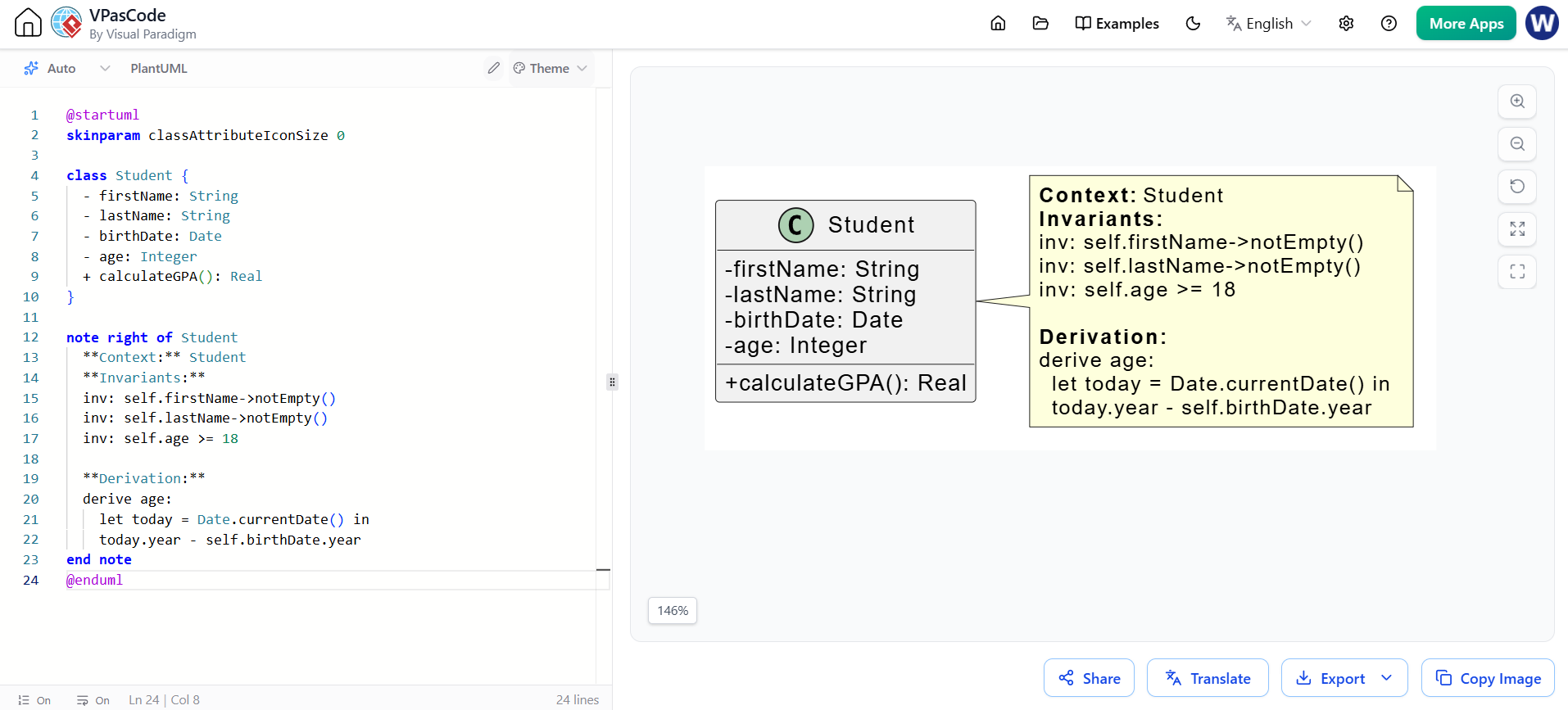
@startuml
skinparam classAttributeIconSize 0

class Student {
  - firstName: String
  - lastName: String
  - birthDate: Date
  - age: Integer
  + calculateGPA(): Real
}

note right of Student
  **Context:** Student
  **Invariants:**
  inv: self.firstName->notEmpty()
  inv: self.lastName->notEmpty()
  inv: self.age >= 18

  **Derivation:**
  derive age:
    let today = Date.currentDate() in
    today.year - self.birthDate.year
end note
@enduml
This example shows a BankAccount class, utilizing @pre and @post to ensure safe financial transactions.
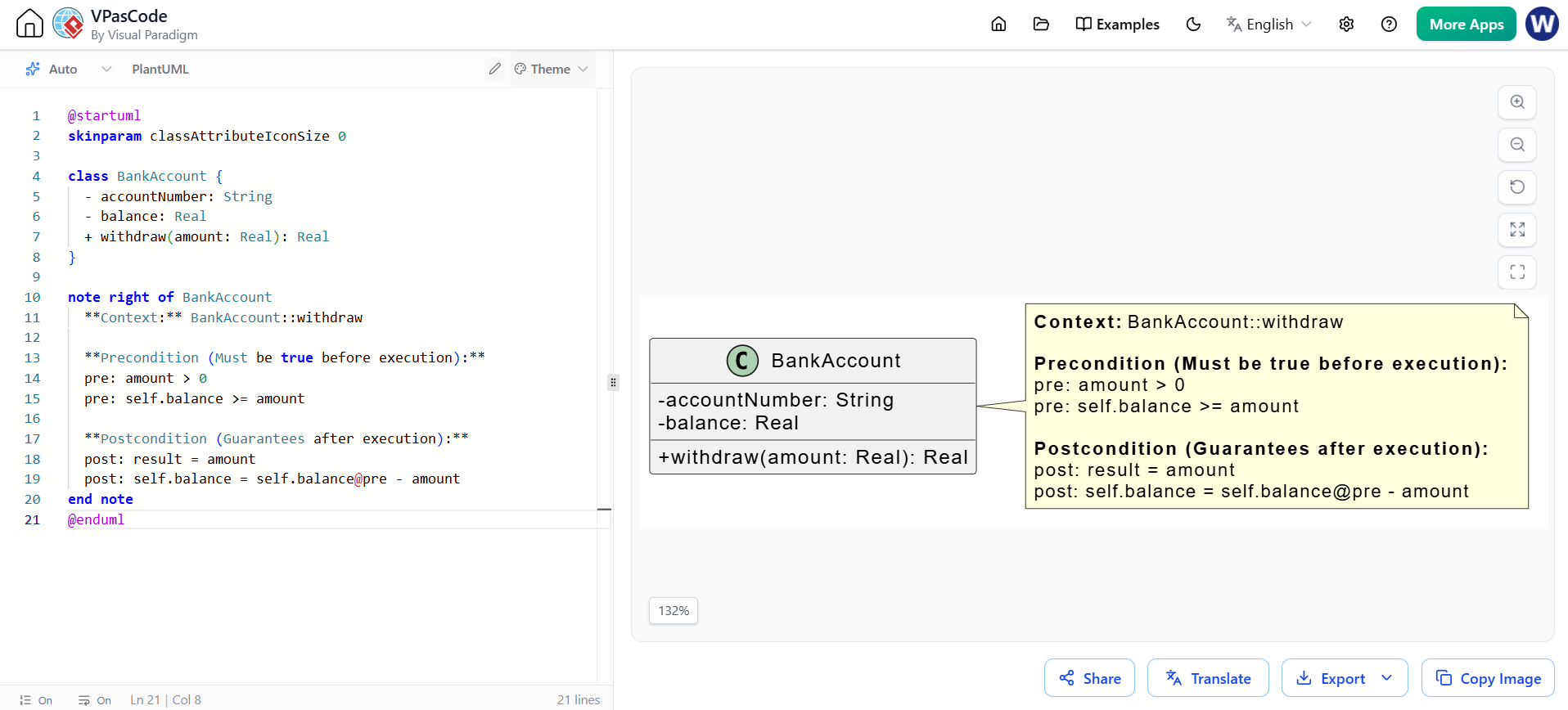
@startuml
skinparam classAttributeIconSize 0

class BankAccount {
  - accountNumber: String
  - balance: Real
  + withdraw(amount: Real): Real
}

note right of BankAccount
  **Context:** BankAccount::withdraw

  **Precondition (Must be true before execution):**
  pre: amount > 0
  pre: self.balance >= amount

  **Postcondition (Guarantees after execution):**
  post: result = amount
  post: self.balance = self.balance@pre - amount
end note
@enduml
This example illustrates a Library class managing a collection of Book objects, utilizing select and forAll.
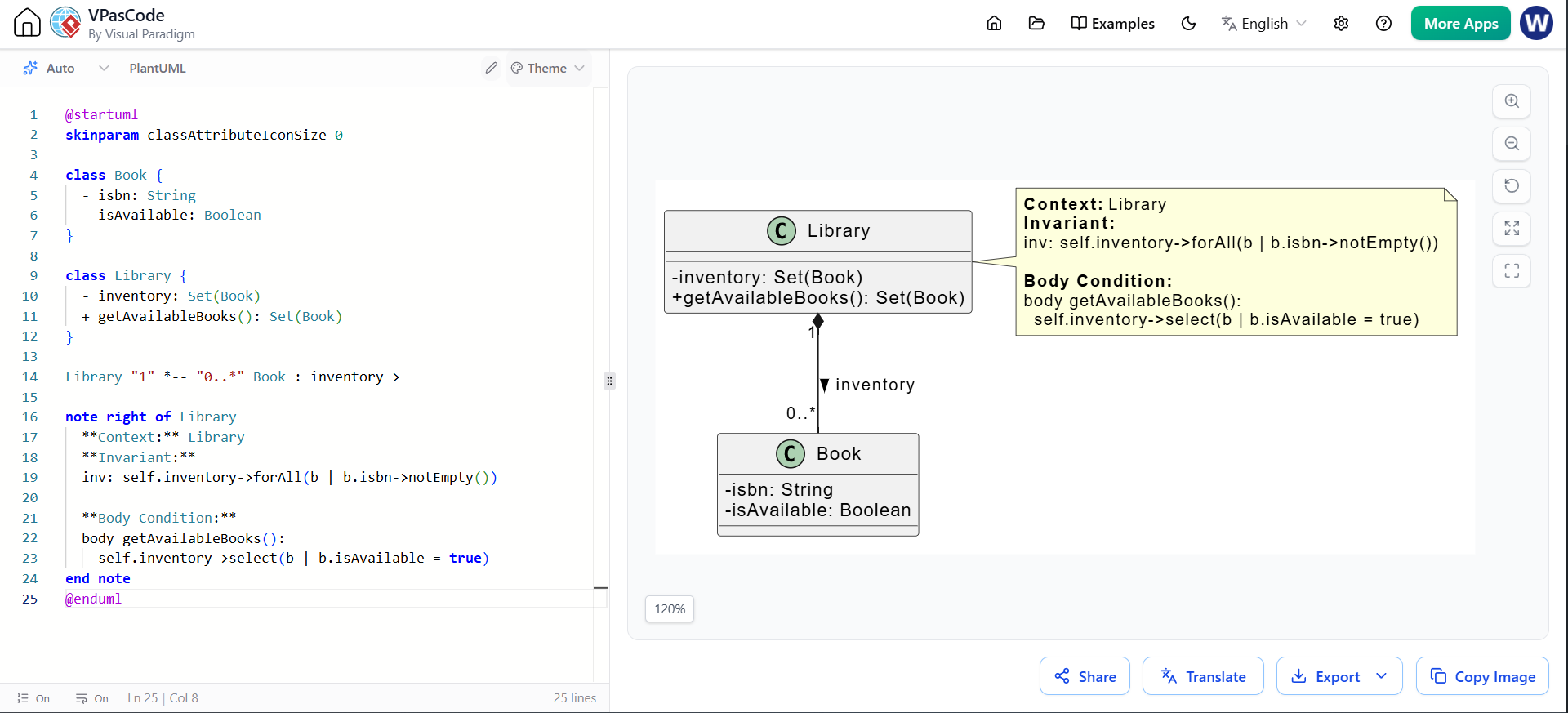
@startuml
skinparam classAttributeIconSize 0

class Book {
  - isbn: String
  - isAvailable: Boolean
}

class Library {
  - inventory: Set(Book)
  + getAvailableBooks(): Set(Book)
}

Library "1" *-- "0..*" Book : inventory >

note right of Library
  **Context:** Library
  **Invariant:**
  inv: self.inventory->forAll(b | b.isbn->notEmpty())

  **Body Condition:**
  body getAvailableBooks():
    self.inventory->select(b | b.isAvailable = true)
end note
@enduml
While OCL is a powerful formal language, applying it in real-world software engineering requires practical consideration:
Prioritize Readability: OCL expressions can easily become dense and complex. The best practice is to keep expressions as simple and meaningful as possible. Use let variables to break down complex logic so that the development team can easily read and verify the constraints.
Evaluate Tool Support: Not all UML modeling tools support OCL natively, and even fewer support automated validation or execution of OCL constraints. If your toolchain or team lacks OCL expertise, it is perfectly acceptable to write constraints in structured plain English within the model's notes.
Leverage Precision for MDA: OCL is highly valuable in Model Driven Architecture (MDA). Because MDA relies on automated tools to transform high-level models into executable code, the mathematical precision of OCL ensures that these transformations are accurate and do not produce "rubbish" or logically flawed code.
The Object Constraint Language (OCL) is the vital bridge between the visual abstraction of UML and the rigorous demands of software implementation. By providing a formal mechanism to define invariants, preconditions, postconditions, and complex collection logic, OCL eliminates the ambiguity that often plagues software design.
While it requires a shift from visual thinking to textual precision, the payoff is immense. Whether you are ensuring data integrity through invariants, guaranteeing safe state transitions with pre/postconditions, or driving automated code generation in an MDA environment, OCL provides the exactitude needed to build robust, reliable, and verifiable software systems. Embracing OCL transforms your UML models from mere sketches into comprehensive, executable blueprints.

