
In the fast-paced world of modern software development, the difference between a chaotic, delayed project and a well-oiled, value-delivering machine lies in the adoption of proven core practices and principles. The days of rigid, months-long "Waterfall" development cycles are largely behind us. Today, successful teams rely on Agile and DevOps methodologies to build software that is adaptable, high-quality, and closely aligned with user needs.
However, knowing the buzzwords is not enough. To truly leverage these methodologies, teams must understand the why and how behind them. This guide provides a deep dive into nine foundational practices: Minimum Viable Product (MVP), Continuous Integration (CI), Continuous Delivery/Deployment (CD), Test-Driven Development (TDD), Pair Programming, Refactoring, Timeboxing, MoSCoW Prioritization, and Planning Poker.
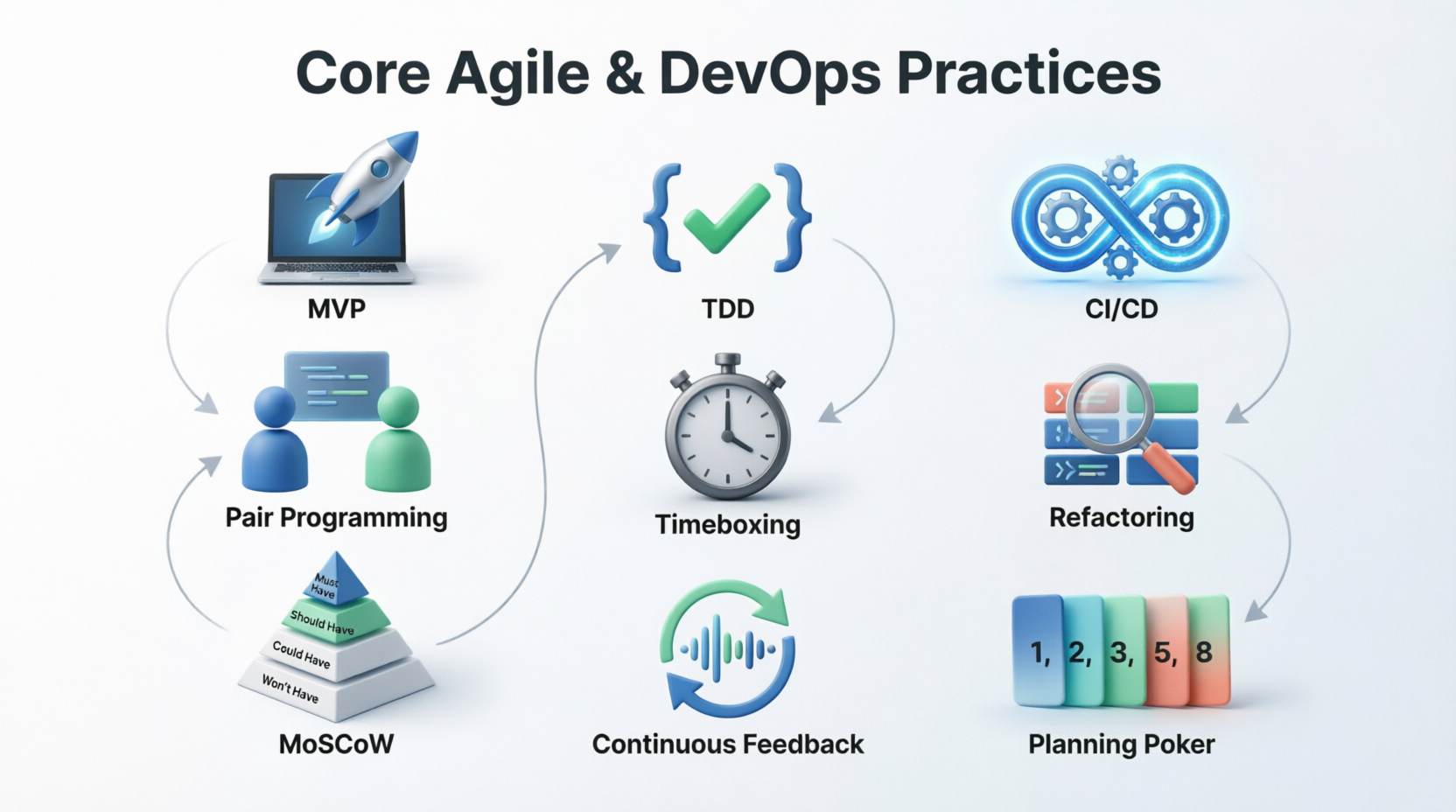
Whether you are a seasoned engineer, a product manager, or an aspiring developer, mastering these concepts will empower you to build better software, faster.
Definition: The earliest version of a product with just enough core features to satisfy early adopters and validate a business idea with minimal effort and resources.
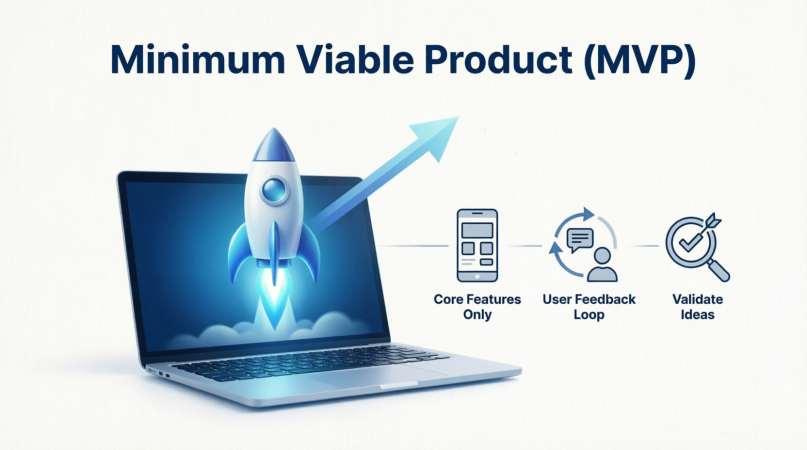
Why it Matters: It prevents teams from spending months or years building a feature-rich product that nobody actually wants. It shifts the focus from "building everything" to "learning as much as possible, as quickly as possible."
How to Implement: Identify the core problem your product solves. Strip away all "nice-to-have" features. Build only what is necessary to test your primary hypothesis with real users.
Real-World Example:
Imagine a team wants to build a complex, AI-driven meal-planning app with grocery delivery integration. Instead of building the AI and delivery APIs first, their MVP is a simple landing page with a manual service: users fill out a Google Form with their dietary preferences, and the founders manually email them a PDF meal plan and a localized grocery list. If users pay for this manual service, the idea is validated, and the team can confidently invest in building the automated app.
Definition: The practice of frequently merging code changes from multiple developers into a shared central repository, accompanied by automated builds and tests.
Why it Matters: It prevents "integration hell"—the nightmare of merging months of divergent code at the end of a project. It catches bugs early, ensures code quality, and provides immediate feedback to developers.
How to Implement: Use tools like GitHub Actions, GitLab CI, or Jenkins. Configure the pipeline to trigger on every pull request or push to the main branch, running linters, static analysis, and unit tests automatically.
Real-World Example:
A team of five developers is building a web application. Developer A finishes a new login feature and pushes the code. Instantly, the CI pipeline kicks in: it installs dependencies, runs 500 unit tests, and checks for security vulnerabilities. If Developer A accidentally broke the password validation, the pipeline fails in 2 minutes, and Developer A gets a Slack notification to fix it immediately, before it impacts anyone else.
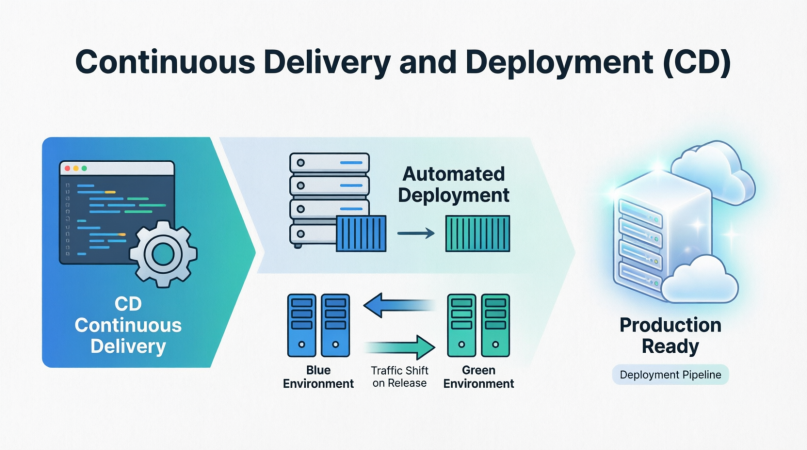
Definition: The automated process of preparing and releasing software to production. Continuous Delivery means the code is always in a deployable state and requires a manual trigger to go live. Continuous Deployment takes it a step further: every change that passes CI is automatically pushed to production without human intervention.
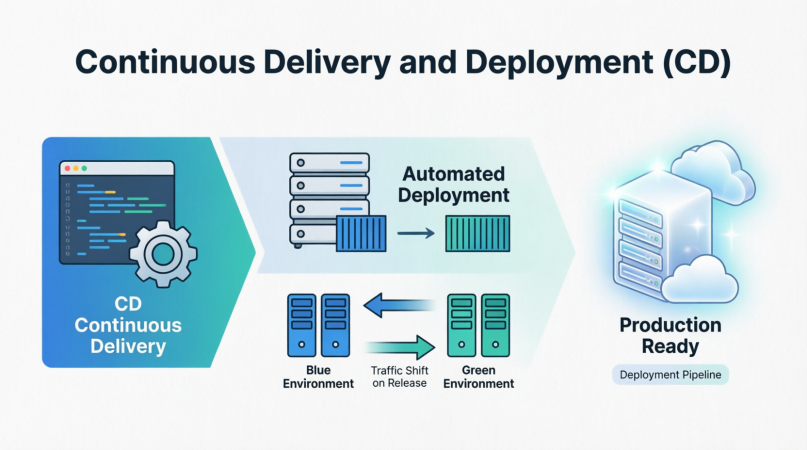
Why it Matters: It drastically reduces the time-to-market, minimizes the risk of large, infrequent releases, and allows teams to gather user feedback on new features in hours or days, not months.
How to Implement: Extend your CI pipeline to include automated packaging, infrastructure provisioning (e.g., via Terraform), and deployment to staging/production environments using strategies like Blue-Green or Canary deployments.
Real-World Example:
After the CI pipeline passes, the CD pipeline automatically builds a Docker image of the application, pushes it to a registry, and deploys it to a staging environment for automated end-to-end testing. In a Continuous Delivery setup, a product manager then clicks an "Approve" button in the pipeline UI to push it to production. In a Continuous Deployment setup, the pipeline automatically rolls it out to 5% of users (Canary), monitors error rates, and if stable, gradually rolls it out to 100% of users.
Definition: A software development approach where tests are written before the actual code. It follows a strict cycle: Red (write a failing test), Green (write the minimal code to make the test pass), Refactor (clean up the code while keeping the test green).
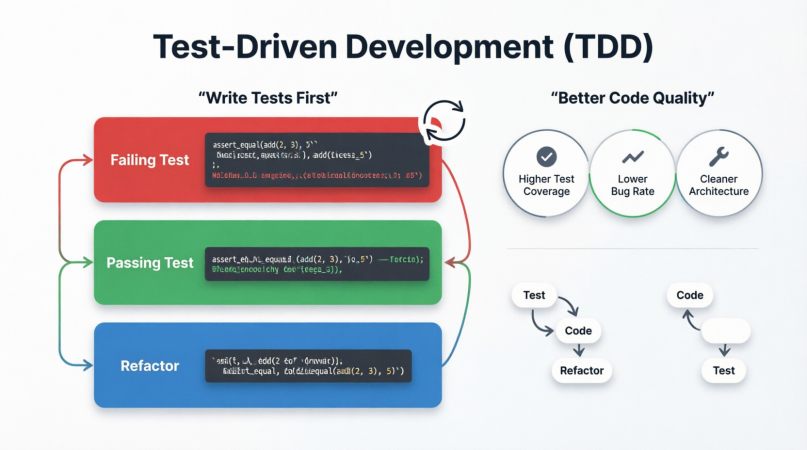
Why it Matters: It ensures high test coverage, forces developers to think about the design and requirements of the code before writing it, and results in highly modular, decoupled code.
How to Implement: Start with a user story. Write a unit test for a specific behavior. Watch it fail. Write the simplest code to pass it. Refactor. Repeat.
Real-World Example:
You need to build a function that applies a 10% discount to shopping carts over $100.
expect(applyDiscount(150)).toBe(135). You run it; it fails because the function doesn't exist.function applyDiscount(total) { return total > 100 ? total * 0.9 : total; }. The test passes.applyDiscount(total, threshold = 100, rate = 0.1), ensuring the original test still passes.Definition: An Agile practice where two developers work together at a single workstation. One is the Driver (typing the code), and the other is the Navigator (reviewing each line, thinking strategically, and catching mistakes).
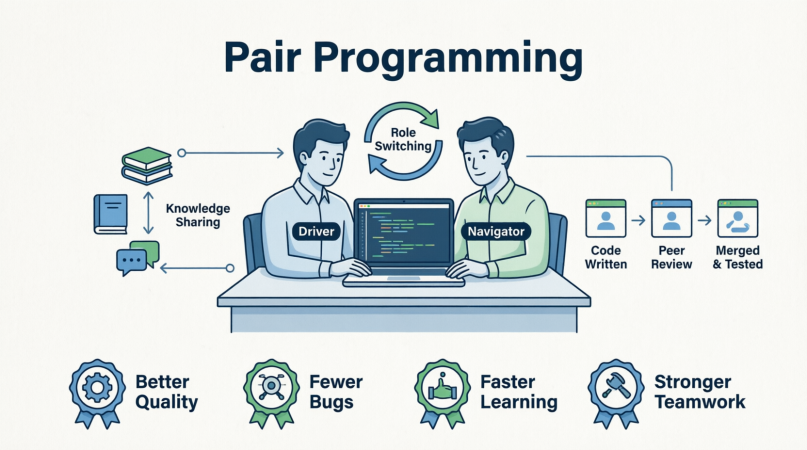
Why it Matters: It improves code quality, facilitates knowledge sharing (onboarding junior developers or spreading domain knowledge), and reduces the likelihood of bugs slipping through.
How to Implement: Schedule dedicated pairing sessions (e.g., 2 hours a day). Use collaborative IDEs (like VS Code Live Share) for remote pairing. Switch roles frequently to keep both developers engaged.
Real-World Example:
A junior developer (Driver) is tasked with building a new API endpoint. The senior developer (Navigator) watches the screen. As the junior types, the Navigator says, "Wait, if the database query returns null, this will throw an unhandled exception. Let's add a guard clause here." The junior adds it. They catch a critical bug before it is even committed, and the junior learns a valuable architectural pattern in the process.
Definition: The process of restructuring existing computer code without changing its external behavior. The goal is to improve non-functional attributes like readability, maintainability, and performance.
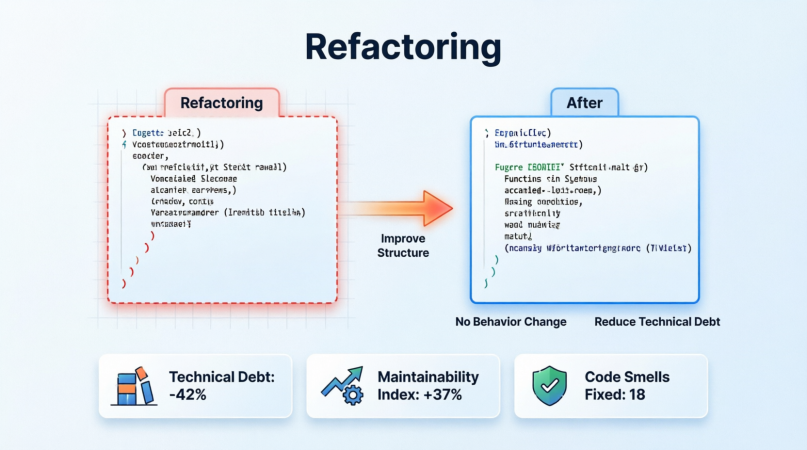
Why it Matters: Code naturally degrades over time (technical debt) as new features are hastily added. Refactoring keeps the codebase clean, making future development faster and less error-prone.
How to Implement: Refactor in small, incremental steps. Never refactor without a safety net of automated tests (like those created via TDD) to ensure you haven't broken existing functionality.
Real-World Example:
A developer encounters a 200-line function called processUserRegistration() that validates input, hashes the password, inserts the user into the database, and sends a welcome email. This violates the Single Responsibility Principle. The developer refactors it into four distinct, well-named functions: validateInput(), hashPassword(), saveUserToDatabase(), and sendWelcomeEmail(). The processUserRegistration() function now simply orchestrates these four steps. The existing test suite passes, proving the behavior hasn't changed, but the code is now vastly easier to read and test.
Definition: The practice of allocating a fixed, maximum unit of time (a "timebox") to a planned activity. When the time is up, the activity stops, regardless of completion.
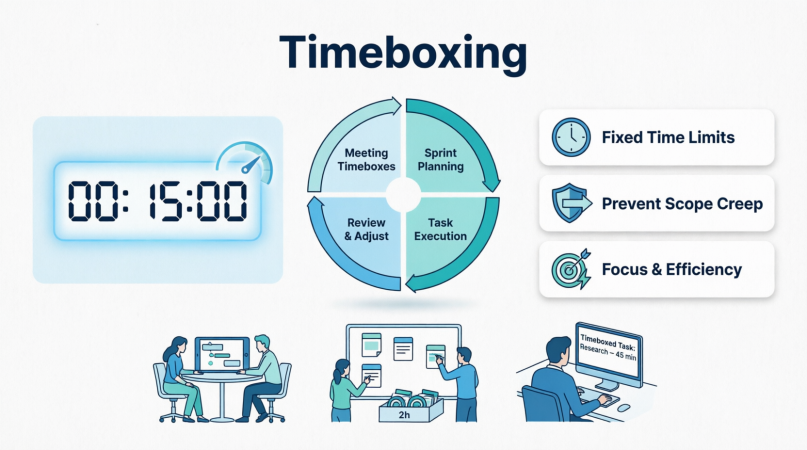
Why it Matters: It combats perfectionism, analysis paralysis, and scope creep. It forces teams to focus on the most critical aspects of a task and make timely decisions.
How to Implement: Use timeboxes for meetings (e.g., 15-minute daily stand-ups), research tasks (Spikes), or debugging sessions. Use a visible timer.
Real-World Example:
A team is debating whether to use PostgreSQL or MongoDB for a new feature. Instead of letting the debate drag on for days, the Scrum Master assigns a 2-hour timebox for a "Spike." Two developers spend exactly 2 hours researching, prototyping, and documenting the pros and cons of each. At the 2-hour mark, they present their findings to the team, and a decision is made based on the available data, preventing endless theoretical discussions.
Definition: A prioritization technique used to reach a common understanding with stakeholders on the importance of delivering each requirement. It stands for:
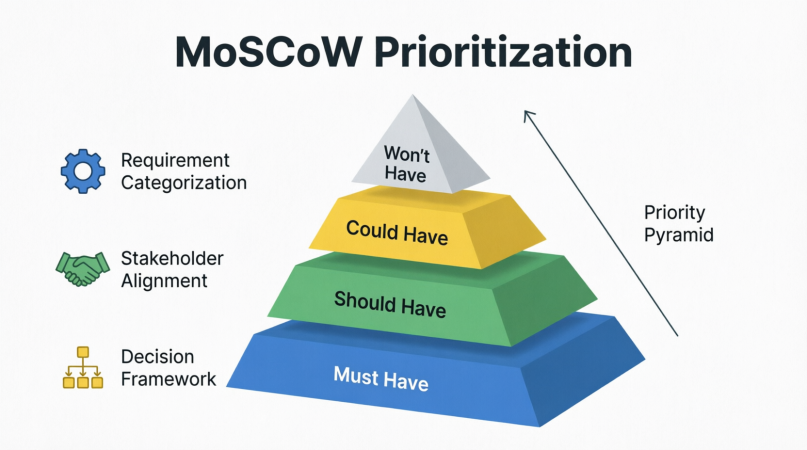
Why it Matters: It provides a clear, shared framework for making tough trade-off decisions when time or budget is constrained.
Real-World Example:
Planning the first release of an e-commerce checkout system:
Definition: A gamified, collaborative technique used by Agile teams to estimate the effort or relative complexity of user stories. Team members use decks of cards with numbers (usually a modified Fibonacci sequence: 1, 2, 3, 5, 8, 13, 21) to vote on a story's size.
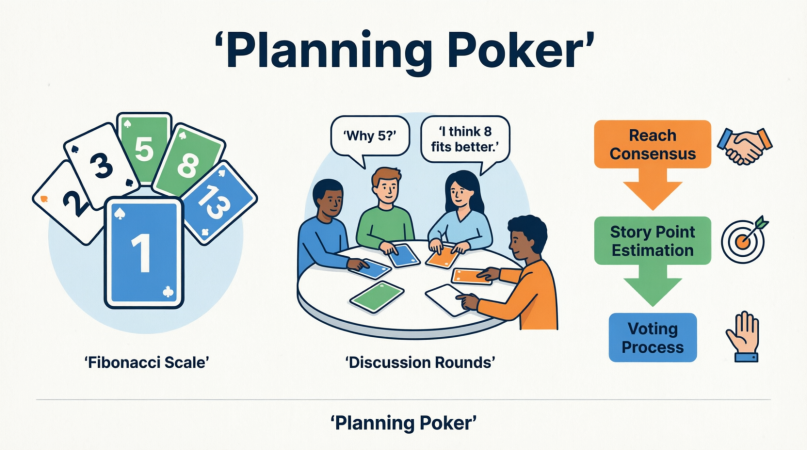
Why it Matters: It prevents anchoring bias (where the first person to speak influences everyone else). It surfaces hidden complexities and differing assumptions among team members, leading to more accurate estimates.
How to Implement: The Product Owner reads a user story. The team discusses it. Everyone privately selects a card representing their estimate. All cards are revealed simultaneously. If estimates vary widely, the highest and lowest estimators explain their reasoning. The team discusses, then re-votes until consensus is reached.
Real-World Example:
The team is estimating the story: "As a user, I want to reset my password via email."
The nine practices outlined in this guide are not isolated tricks or standalone methodologies; they form a deeply interconnected ecosystem for building exceptional software.
Consider how they work together: MoSCoW and Planning Poker help you decide what to build and how much effort it will take. Timeboxing ensures you don't get bogged down in the planning or research phases. You then build an MVP to validate your idea. As you code, TDD and Pair Programming ensure the code is robust and well-designed from day one, while regular Refactoring keeps technical debt at bay. Finally, CI and CD act as the engine room, safely and rapidly delivering your validated, high-quality code into the hands of your users.
Adopting these practices does not happen overnight. Start small. Introduce one or two practices to your team, measure the impact, and iterate. By committing to these core principles, you will transform your development process from a source of stress into a predictable, efficient, and highly rewarding engine for innovation.

