
In the realm of enterprise architecture and systems engineering, there is a critical distinction between modeling the business and modeling the information technology that supports it. Business system modeling is the practice of describing both the dynamic business processes and the static organizational structures that generate economic benefit through the supply of goods and services.
Unlike IT system modeling, which is heavily focused on software requirements, databases, and technical architecture, business system modeling captures the "soul" of the business. It defines what the business does and how it creates value, independent of the technology used. This foundational understanding serves as the bedrock for all subsequent technical models, ensuring that IT investments are perfectly aligned with actual business needs.
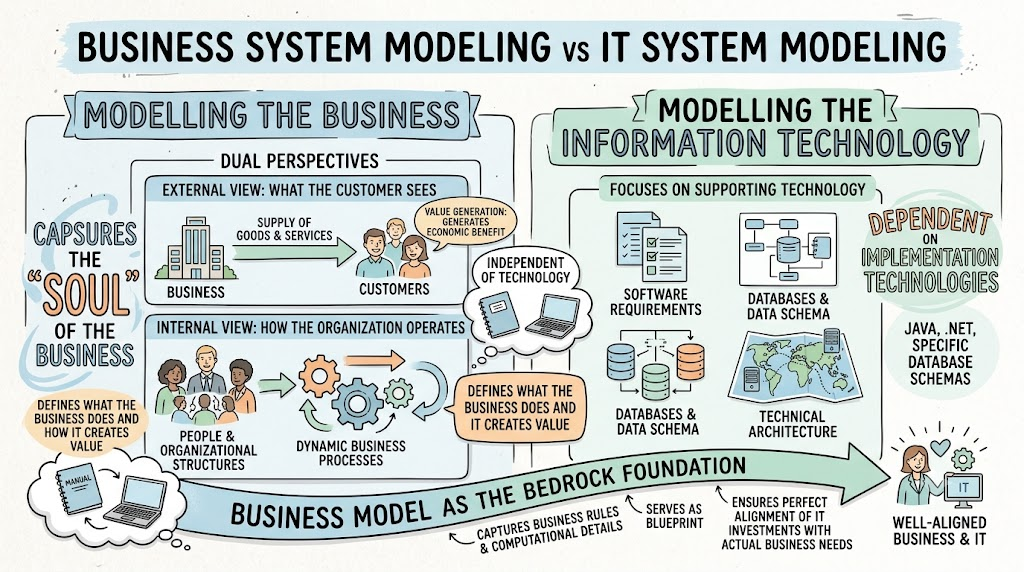
This guide provides a comprehensive overview of business system modeling, exploring its dual perspectives—the external and internal views—and detailing the key concepts, diagrams, and distinctions that separate it from traditional IT modeling.
Before diving into the specific views, it is essential to understand the core pillars of business system modeling:
Value Generation: The primary focus is always on how the system generates economic benefit by supplying goods and services.
Dual Perspectives: A complete business model requires looking at the system from the outside (what the customer sees) and the inside (how the organization operates).
Abstraction from Technology: Business models describe real-world operations. A business system can be entirely manual (e.g., a medieval merchant using pen and ink) or fully automated, but the business model remains conceptually the same.
Foundation for IT: Business models act as the blueprint. They capture business rules and computational details without referencing implementation technologies like Java, .NET, or specific database schemas.
The external view considers the business system from the perspective of an outsider—such as a customer, business partner, or supplier.
In this view, the business system is treated as a "black box." Internal transactions, back-office forms, and internal workflows are completely hidden and irrelevant to the outsider. The focus is strictly on the goods and services provided to external actors.
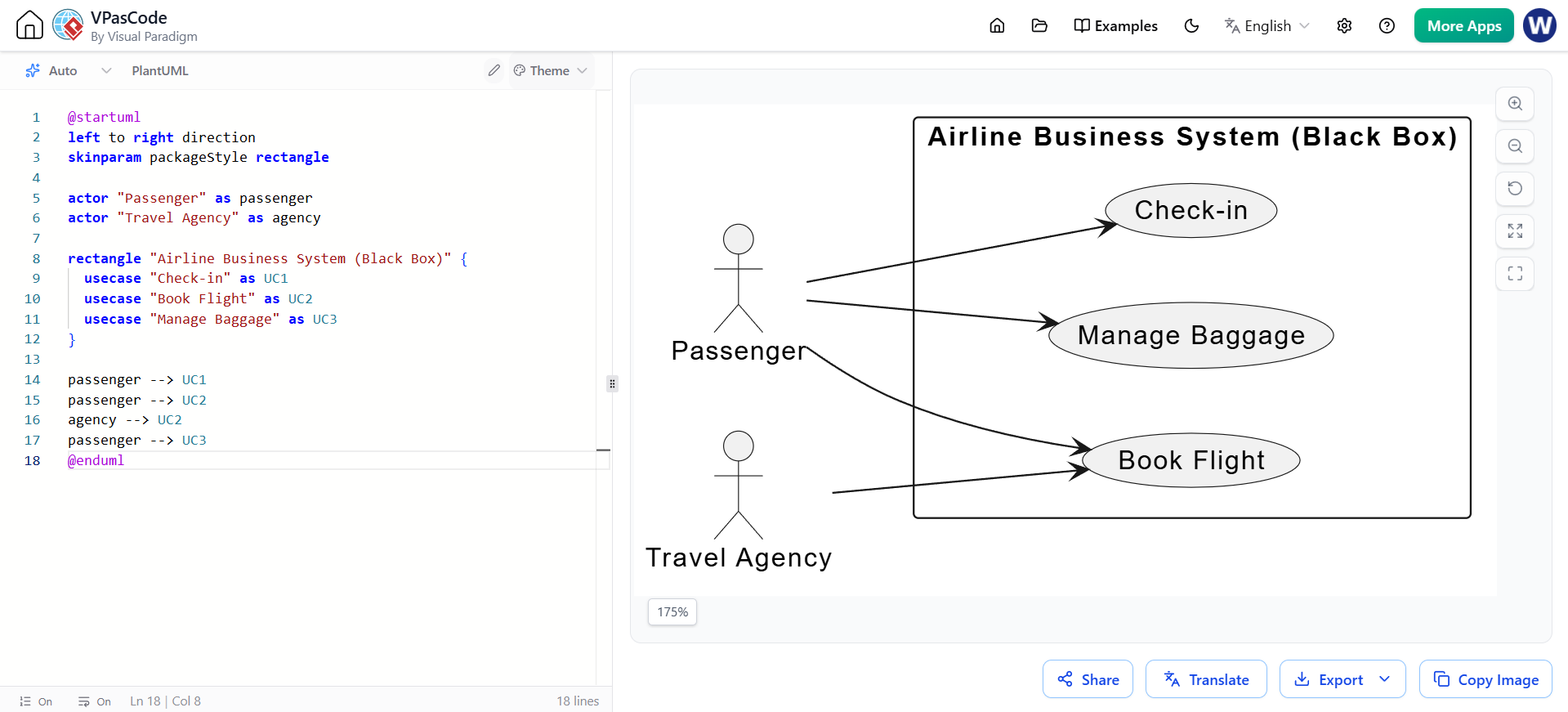
Actors: Roles played by external parties who initiate interactions with the business (e.g., a "Passenger" at an airline).
Business Use Cases: Descriptions of the specific services offered to the actors, viewed entirely from the actor's perspective (e.g., "Check-in" or "Book Flight").
Use Case Diagrams: Visualize actors, business use cases, and their relationships without detailing internal procedures.
Activity Diagrams: Describe high-level interactions between the system and the actor (kept at a low level of detail).
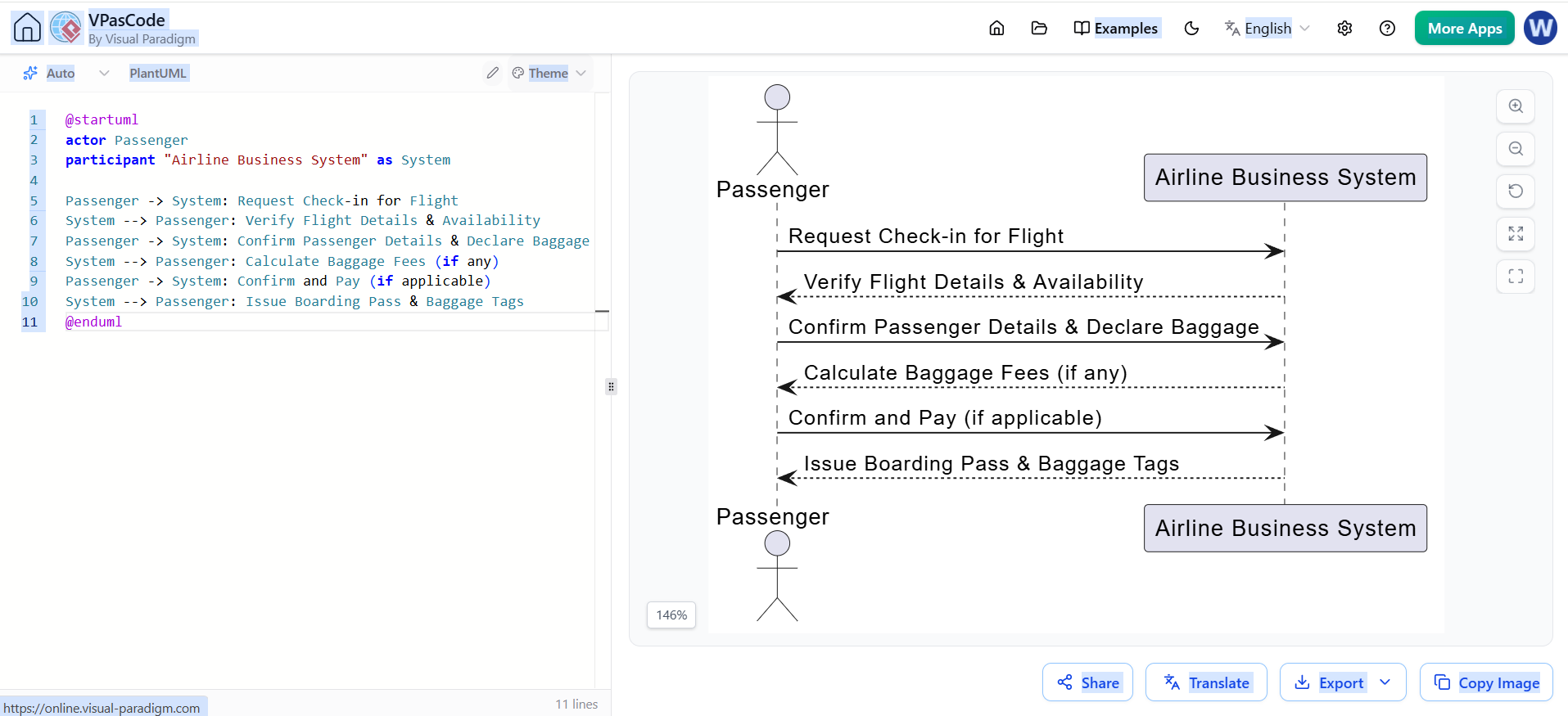
Sequence Diagrams: Show the chronological exchange of information and messages between the actor and the system.
Example 1: Business Use Case Diagram
This diagram shows the external actors and the high-level services (Business Use Cases) the airline provides.
@startuml
left to right direction
skinparam packageStyle rectangle

actor "Passenger" as passenger
actor "Travel Agency" as agency

rectangle "Airline Business System (Black Box)" {
  usecase "Check-in" as UC1
  usecase "Book Flight" as UC2
  usecase "Manage Baggage" as UC3
}

passenger --> UC1
passenger --> UC2
agency --> UC2
passenger --> UC3
@enduml
Example 2: Sequence Diagram
This diagram illustrates the chronological exchange of information between the Passenger and the Business System during the Check-in process.
@startuml
actor Passenger
participant "Airline Business System" as System

Passenger -> System: Request Check-in for Flight
System --> Passenger: Verify Flight Details & Availability
Passenger -> System: Confirm Passenger Details & Declare Baggage
System --> Passenger: Calculate Baggage Fees (if any)
Passenger -> System: Confirm and Pay (if applicable)
System --> Passenger: Issue Boarding Pass & Baggage Tags
@enduml
The internal view reveals how the business system actually fulfills the promises made in the external view.
Here, the "black box" is opened. The focus shifts to defining exactly how internal resources, workflows, structures, and tools are organized to provide the goods and services.
Workers: The specific roles of people (or automated agents) executing the business processes (e.g., "Check-in Employee").
Business Objects: Passive entities handled by workers during the process, such as physical or conceptual items (e.g., "Ticket", "Boarding Pass", "Baggage").
Organization Units: Divisions, departments, or teams (e.g., "Baggage Transportation") responsible for specific activities.
Package Diagrams: Organize workers, business objects, and organizational units into logical, manageable groups.
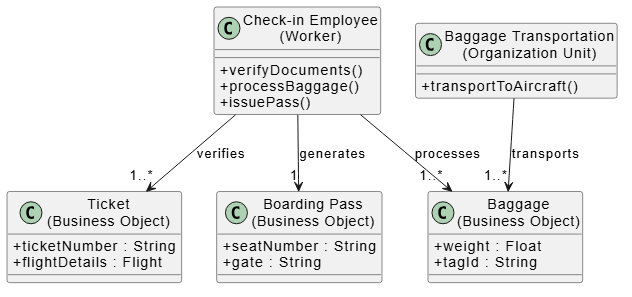
Class Diagrams: Show the static relationships, associations, and connections between internal workers and business objects.
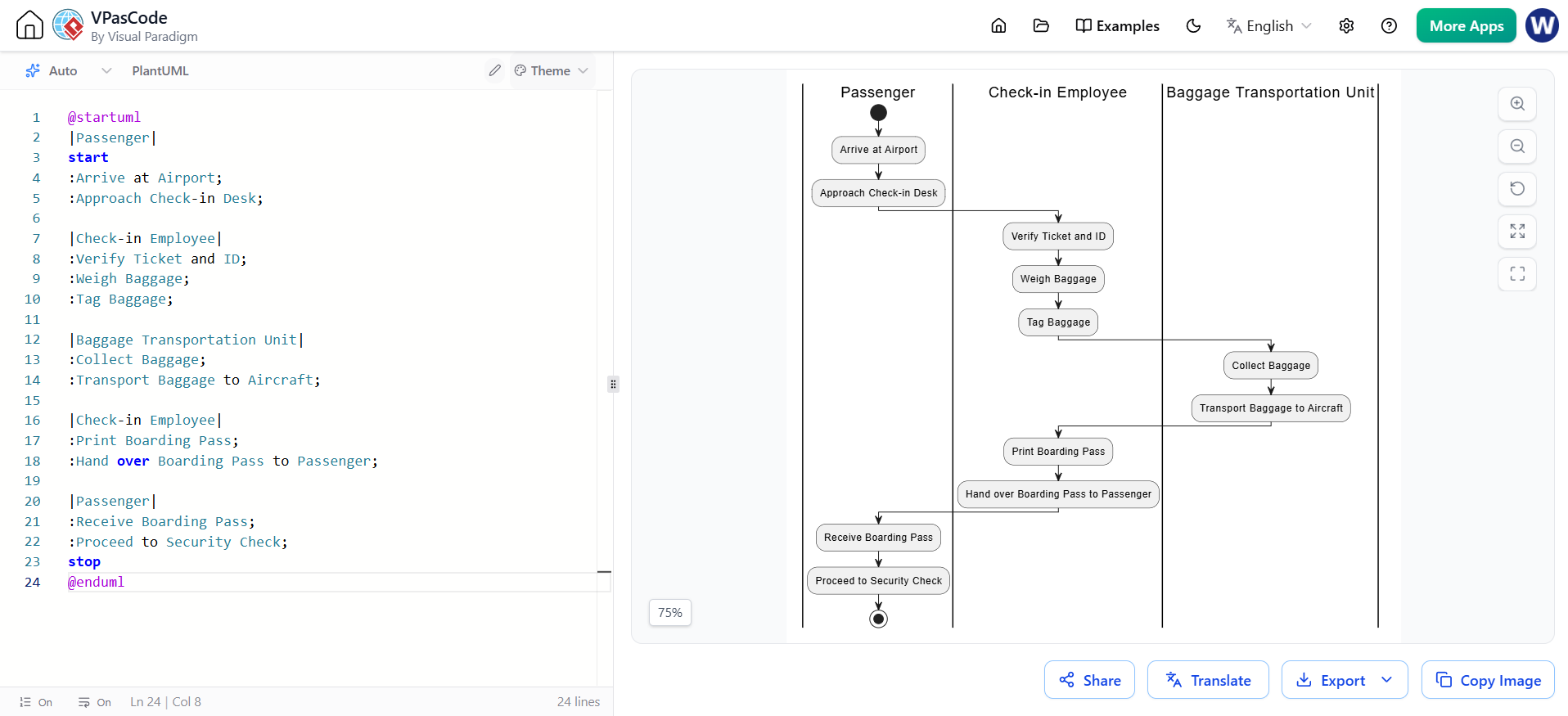
Activity Diagrams (with Swimlanes): Detail internal business processes step-by-step, using swimlanes (partitions) to identify exactly who (which worker or unit) is responsible for each specific action.
Example 3: Activity Diagram with Swimlanes
This diagram opens the "Check-in" black box, showing the exact internal workflow and assigning responsibilities to specific internal roles and departments.
@startuml
|Passenger|
start
:Arrive at Airport;
:Approach Check-in Desk;

|Check-in Employee|
:Verify Ticket and ID;
:Weigh Baggage;
:Tag Baggage;

|Baggage Transportation Unit|
:Collect Baggage;
:Transport Baggage to Aircraft;

|Check-in Employee|
:Print Boarding Pass;
:Hand over Boarding Pass to Passenger;

|Passenger|
:Receive Boarding Pass;
:Proceed to Security Check;
stop
@enduml
Example 4: Class Diagram (Internal Static Structure)
This diagram maps the static relationships between the internal Workers and the Business Objects they manipulate.
@startuml
skinparam classAttributeIconSize 0

class "Check-in Employee\n(Worker)" as Worker {
  +verifyDocuments()
  +processBaggage()
  +issuePass()
}

class "Ticket\n(Business Object)" as Ticket {
  +ticketNumber : String
  +flightDetails : Flight
}

class "Boarding Pass\n(Business Object)" as BoardingPass {
  +seatNumber : String
  +gate : String
}

class "Baggage\n(Business Object)" as Baggage {
  +weight : Float
  +tagId : String
}

class "Baggage Transportation\n(Organization Unit)" as BaggageUnit {
  +transportToAircraft()
}

Worker --> "1..*" Ticket : verifies
Worker --> "1..*" Baggage : processes
Worker --> "1" BoardingPass : generates
BaggageUnit --> "1..*" Baggage : transports
@enduml
To successfully model a business, practitioners must strictly separate business modeling from IT system modeling. The sources highlight several critical conceptual differences:
| Feature | Business System Modeling | IT System Modeling |
|---|---|---|
| Conceptual Foundation | Represents real-world concepts (e.g., a physical Passenger, a paper Ticket). | Represents digital images of those concepts (e.g., a Passenger database record, a Ticket JSON object). |
| Process Independence | Technology agnostic. A business system can be entirely manual (pen and ink) and still be modeled using these exact principles. | Technology dependent. Focuses on software requirements, APIs, databases, and automated workflows. |
| Model Levels (MDA) | Falls into the Computation Independent Model (CIM) or high-level Platform Independent Model (PIM). Captures business rules without referencing tech stacks. | Falls into the Platform Specific Model (PSM). References specific implementation technologies (Java, .NET, AWS, SQL). |
| Vocabulary & Terminology | Uses strict domain terminology. Uses the term "Business Use Case" to describe services. Avoids IT jargon. | Uses technical jargon. Uses the term "Use Case" (or System Use Case) to describe software interactions. |
Business system modeling is an indispensable discipline that bridges the gap between strategic business goals and tactical IT execution. By separating the External View (the black box focusing on actors and business use cases) from the Internal View (the white box focusing on workers, business objects, and organizational units), organizations can achieve a crystal-clear understanding of their operations.
Crucially, by maintaining a strict boundary between business modeling and IT modeling—utilizing Computation Independent Models (CIM) and domain-specific vocabulary—businesses ensure that their core operational logic remains intact, regardless of the underlying technology. Ultimately, capturing the "soul" of the business through rigorous modeling ensures that when the IT systems are finally built, they are perfectly engineered to deliver true, measurable economic value.

