
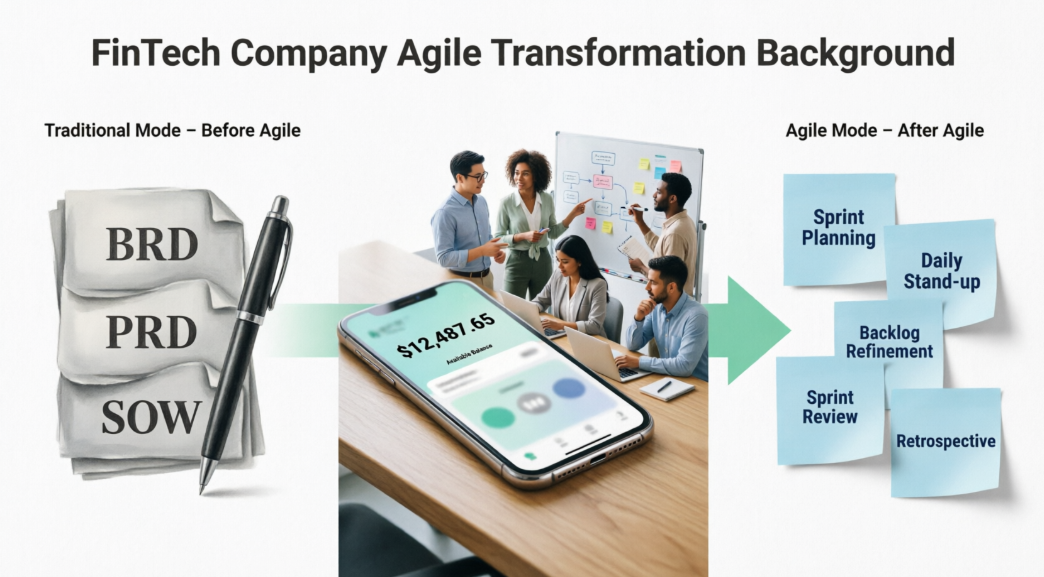
This case study explores how FinTech Innovations Inc., a mid-sized financial technology company, transformed its software delivery process by adopting the 3C’s framework (Card, Conversation, Confirmation) for User Stories. By shifting from rigid, document-heavy requirements to collaborative, conversation-driven Agile practices, the company reduced sprint carryover by 40%, increased team velocity by 25%, and significantly improved stakeholder satisfaction.
Company: FinTech Innovations Inc.
Product: PayEase, a next-generation mobile banking application.
Team Structure: 3 cross-functional Scrum teams (each with 1 Product Owner, 1 Scrum Master, 5 Developers, and 2 QA Engineers).
Initially, the teams struggled with Agile adoption. Product Owners (POs) were writing massive, 10-page requirement documents disguised as "User Stories." Developers would work in silos based on these documents, only to discover missing edge cases during testing. This led to frequent mid-sprint scope changes, frustrated developers, and a high defect leakage rate.
The core issues identified during a Sprint Retrospective were:
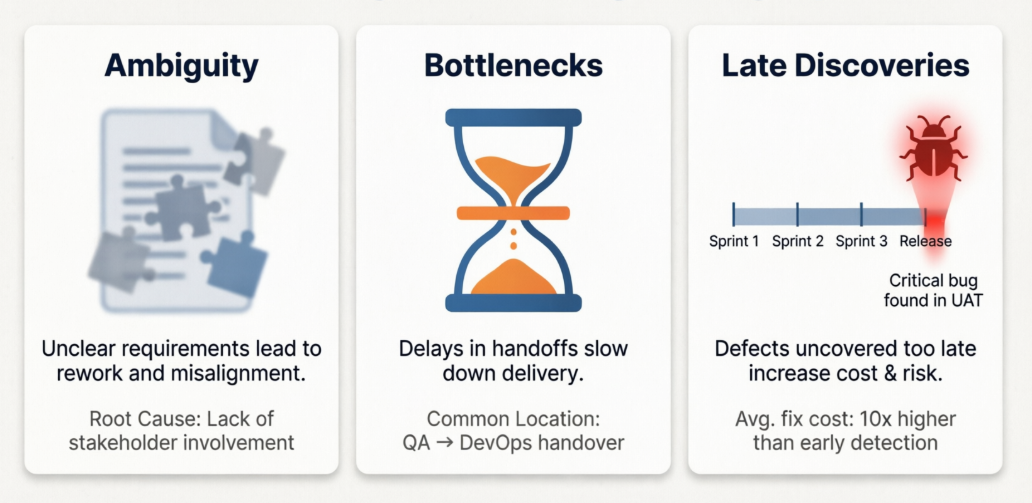
Ambiguity: Stories lacked clear boundaries, leading to "scope creep" during the sprint.
Bottlenecks: Developers waited days for the PO to answer questions, halting progress.
Late Discoveries: QA found critical usability and security flaws only during the final days of the sprint, causing missed Sprint Goals.
The Agile Coach introduced the 3C’s of User Stories (originally formulated by Ron Jeffries) to reframe how the team approached requirements.
The 3C’s framework ensures that a User Story is not a rigid specification, but a placeholder for a conversation that culminates in shared understanding.
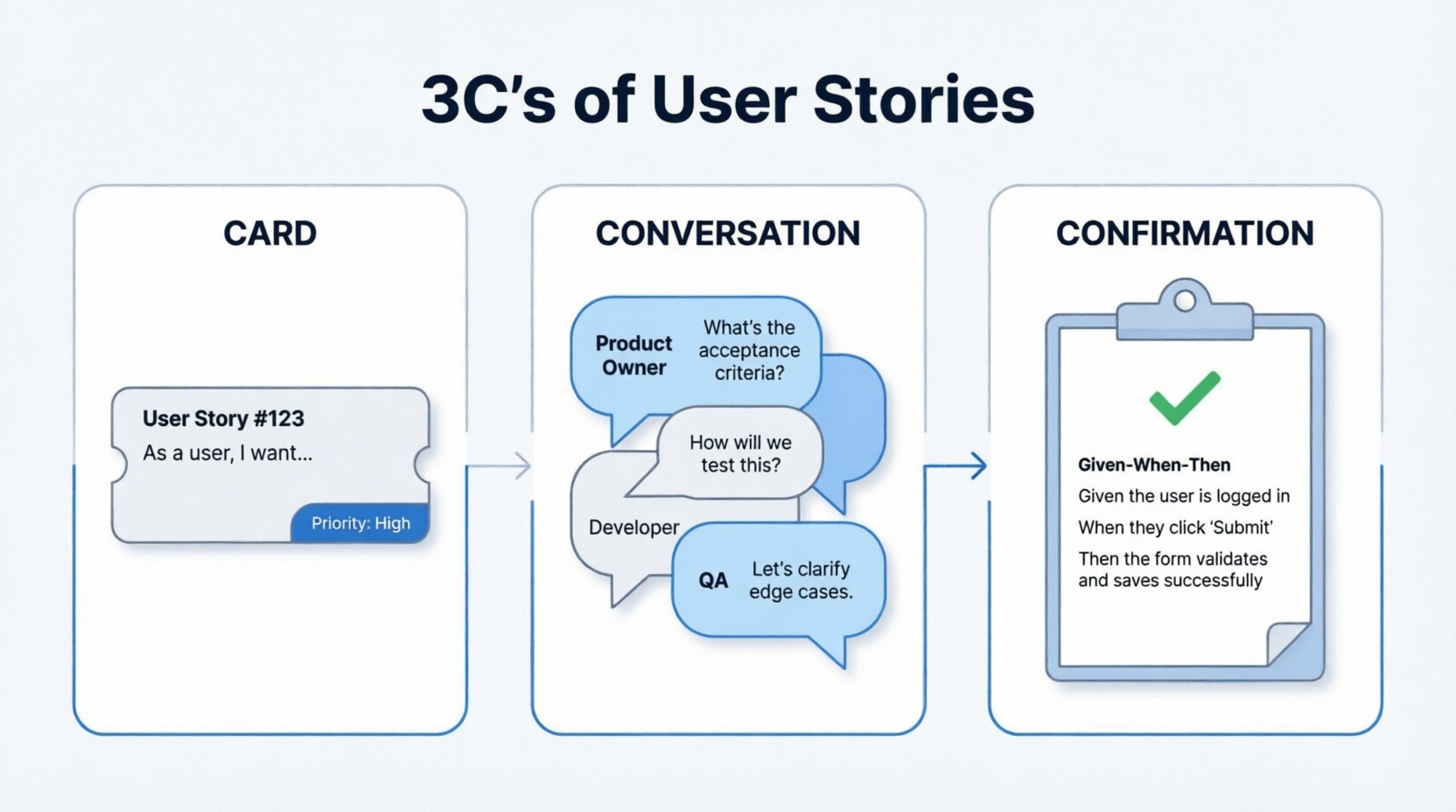
The "Card" is the physical or digital token that represents the user’s need. It is intentionally brief to prevent premature detailing. It follows the standard format:
“As a [type of user], I want to [perform an action] so that [I achieve a goal/value].”
Example Card:
"As a PayEase mobile user, I want to log in using biometric authentication (FaceID/TouchID) so that I can access my account quickly and securely without typing my password."
The "Conversation" is the ongoing dialogue between the Product Owner, Developers, and QA. This is where the real value is created. The team discusses assumptions, edge cases, technical constraints, and design implications.
Example Conversation Topics:
Dev: "What happens if the user’s face is not recognized after 3 attempts?"
PO: "It should fall back to the standard 6-digit PIN entry."
QA: "Do we need to support older devices that don’t have biometric sensors?"
PO: "Yes, the app must gracefully default to PIN login for those devices."
Security: "We must ensure biometric data is never stored on our servers, only validated locally by the OS."
The "Confirmation" is the tangible outcome of the conversation. It defines the conditions that must be met for the story to be considered "Done." It is best written using Behavior-Driven Development (BDD) format: Given-When-Then.
Example Confirmation (Acceptance Criteria):
Scenario 1: Successful Biometric Login
Given the user has enabled biometric login in settings
And the device supports biometric authentication
When the user opens the PayEase app
Then the app prompts for FaceID/TouchID
And grants access to the dashboard upon successful validation.
Scenario 2: Biometric Failure Fallback
Given the user attempts biometric login
When the biometric scan fails 3 consecutive times
Then the app locks biometric login for this session
And prompts the user to enter their 6-digit PIN.
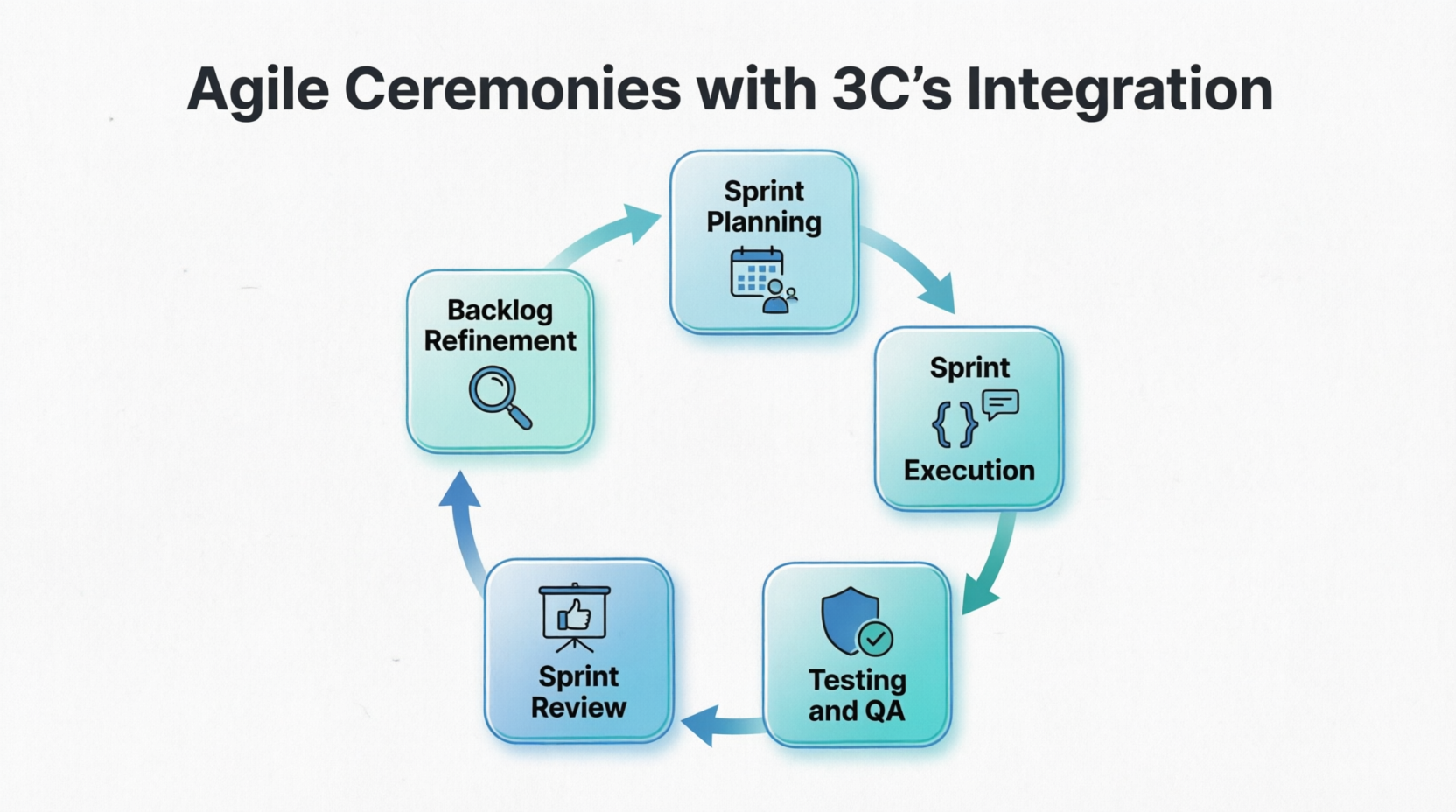
The FinTech team mapped the 3C’s directly to their Scrum ceremonies to ensure consistent application:
| Agile Ceremony | Application of the 3C’s |
|---|---|
| Backlog Refinement | Card & Early Conversation: The PO drafts the Card. The team holds a 30-minute discussion (Conversation) to identify major unknowns, dependencies, and high-level effort. The story is flagged as "Ready" only when the Conversation has yielded clear Confirmation criteria. |
| Sprint Planning | Finalizing Confirmation: The team reviews the Card and Confirmation criteria. Developers and QA ask final clarifying questions (Conversation). The team uses the Confirmation criteria to estimate story points and commit to the Sprint Backlog. |
| Sprint Execution (Daily) | Living Conversation: As developers build the feature, they refer to the Confirmation criteria. If a new edge case arises (e.g., "What if the user denies OS-level biometric permissions?"), they quickly huddle with the PO (Conversation) and update the Confirmation criteria on the digital card (e.g., Jira). |
| Testing & QA | Validating Confirmation: QA engineers write automated and manual test cases directly derived from the Confirmation (Given-When-Then) scenarios. No testing occurs outside the agreed-upon confirmation boundaries without a new conversation. |
| Sprint Review | Demonstrating Confirmation: The team demos the working software to stakeholders, explicitly walking through the Confirmation scenarios to prove the Card’s value has been delivered. |
After three months of strictly applying the 3C’s framework, FinTech Innovations measured the following improvements:
40% Reduction in Sprint Carryover: Clear Confirmation criteria prevented mid-sprint scope creep and misunderstandings.
25% Increase in Team Velocity: Less time was wasted on rework. Developers spent less time waiting for answers because the Conversation happened proactively during refinement.
60% Drop in Post-Release Defects: QA was involved in the Conversation early, allowing them to identify edge cases (like the 3-attempt fallback) before code was even written.
Improved Team Morale: Developers reported feeling more empowered and less frustrated, as the Card acted as a starting point for collaboration rather than a rigid, unchangeable mandate.
For organizations looking to implement the 3C’s, this case study highlights several critical lessons:
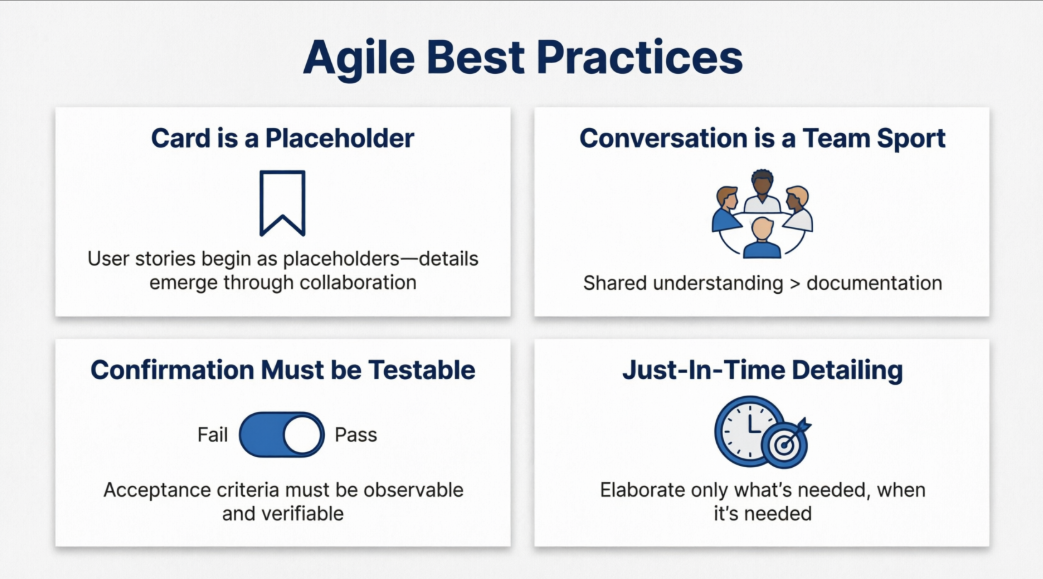
The Card is NOT the Requirement: A common anti-pattern is treating the User Story card as a mini-specification document. The card is merely a reminder to have a conversation.
Conversation is a Team Sport: The Product Owner cannot have the conversation alone. Developers and QA must be active participants to bring technical and testing perspectives to the table early.
Confirmation Must be Testable: Acceptance criteria should be binary (Pass/Fail). Avoid vague language like "the app should be fast." Instead, use "the app must load the dashboard in under 2 seconds."
Embrace Just-In-Time Detailing: Do not try to write perfect Confirmation criteria for stories that are months away in the backlog. Apply the 3C’s fully only to stories that are 1–2 sprints away from development.
The 3C’s framework (Card, Conversation, Confirmation) is not just a formatting trick; it is a fundamental mindset shift in Agile. By treating User Stories as promises of collaboration rather than static contracts, FinTech Innovations transformed its delivery pipeline, proving that shared understanding is the most valuable artifact in Agile software development.

