
In today's rapidly evolving digital landscape, organizations face unprecedented pressure to align business strategy with technology execution. Enterprise Architecture (EA) has emerged as a critical discipline for navigating this complexity, yet traditional EA methodologies often struggle with time-intensive processes, inconsistent outputs, and steep learning curves. The Open Group Architecture Framework (TOGAF®) has long served as the global standard for enterprise architecture, providing a proven methodology for designing, planning, and governing enterprise transformations. However, even the most robust frameworks benefit from intelligent augmentation.
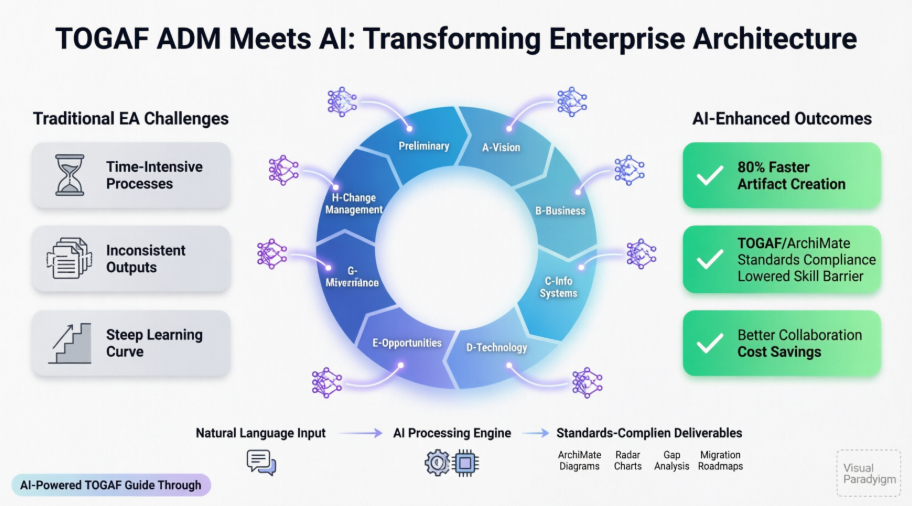
This case study explores the convergence of TOGAF's structured Architecture Development Method (ADM) with Visual Paradigm's groundbreaking AI-powered TOGAF Guide Through. We examine how artificial intelligence is transforming enterprise architecture practice—accelerating artifact creation, enhancing consistency, and democratizing access to TOGAF expertise. Through a detailed exploration of TOGAF fundamentals, ADM workflows, and AI-enhanced capabilities, this article demonstrates how modern organizations can achieve faster, higher-quality architecture outcomes while reducing resource overhead. Whether you are an experienced enterprise architect or leading your organization's first TOGAF initiative, this case study offers actionable insights into leveraging AI to unlock the full potential of enterprise architecture.
TOGAF®, introduced by The Open Group, is a proven enterprise architecture methodology and framework used by the world's leading organizations to improve business efficiency. It is an enterprise architecture standard, ensuring consistent standards, methods, and communication among enterprise architecture professionals, so that we can conduct our enterprise architecture work in a better way, including:
An iterative process model supported by best practices
A re-usable set of existing architecture assets
Methods and tools for the planning, development, implementation, and maintenance of an enterprise architecture
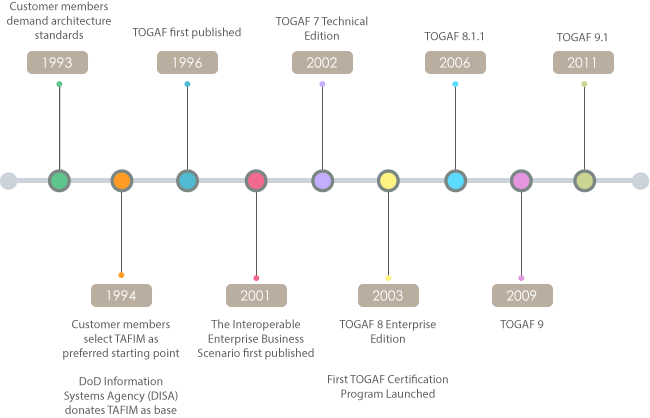
First published in 1995, TOGAF was based on the US Department of Defense Technical Architecture Framework for Information Management (TAFIM). From this foundation, The Open Group Architecture Forum has developed successive versions of TOGAF at regular intervals.
"The fundamental organization of a system, embodied in its components, their relationships to each other and the environment, and the principles governing its design and evolution." TOGAF embraces and extends this definition. In TOGAF, "architecture" has two meanings depending upon the context:
A formal description of a system, or a detailed plan of the system at a component level to guide its implementation
The structure of components, their inter-relationships, and the principles and guidelines governing their design and evolution over time.
Enterprise architecture (EA) is a well-defined practice for conducting enterprise analysis, design, planning, and implementation, using a holistic approach at all times, for the successful development and execution of strategy. Enterprise architecture applies architecture principles and practices to guide organizations through the business process, Data & information, and technology changes necessary to execute their strategies. These practices utilize the various aspects of an enterprise to identify, motivate, and achieve these changes, which include the effort to understand the strategic intent of a business and then have everything from business processes, to supporting technology, to partner relationships, to infrastructure of all sorts, to hiring and training, and anything else important work in alignment to achieve better business performance.
The TOGAF content is divided into 7 parts:
Introduction
Architecture Development Method
ADM Guidelines and Techniques
Architecture Content Framework
Enterprise Continuum & Tools
TOGAF Reference Models
Architecture Capability Framework
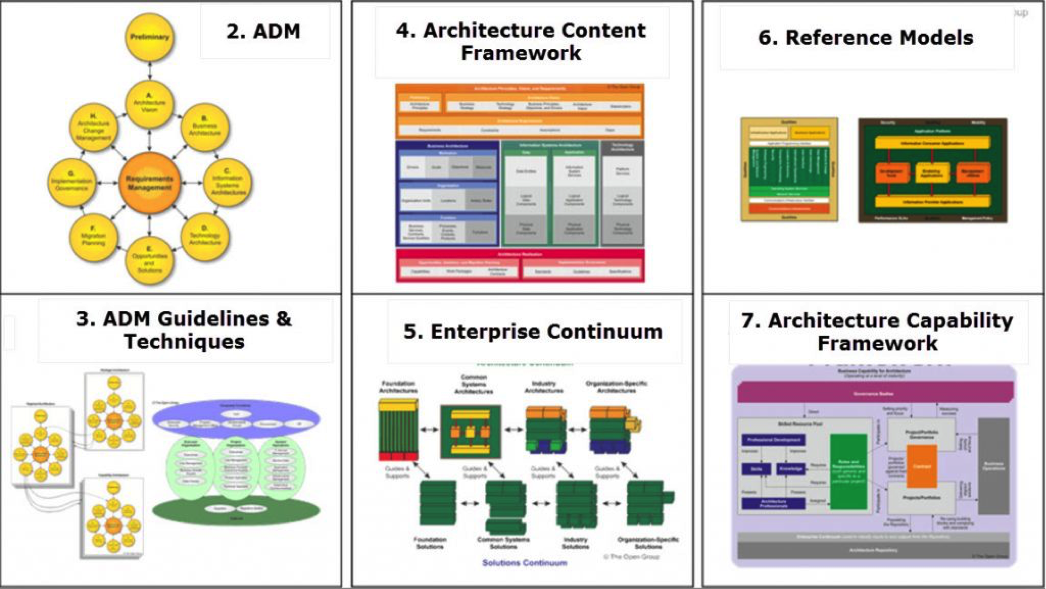
The brief description for each of the seven parts are listed as following:
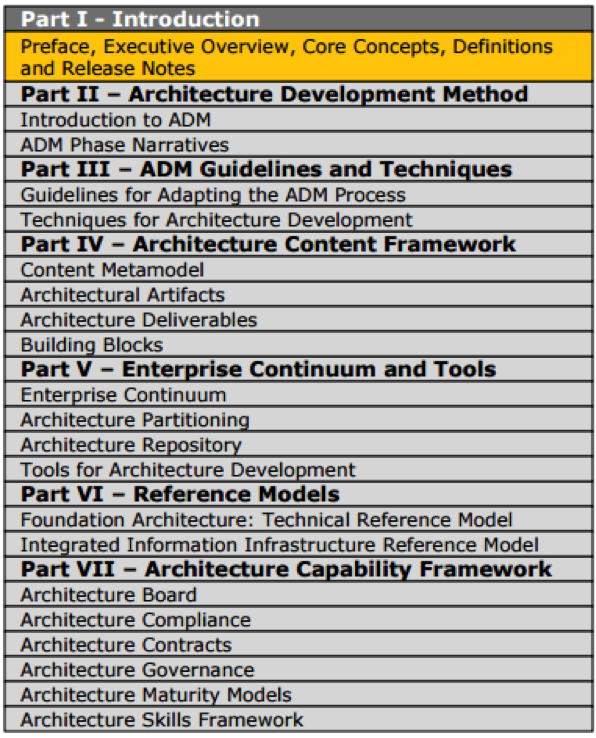
As show in the table, this part provides a high-level introduction to the key concepts of enterprise architecture and, in particular, to the TOGAF approach. Now let's explore the core concepts for each of these parts:
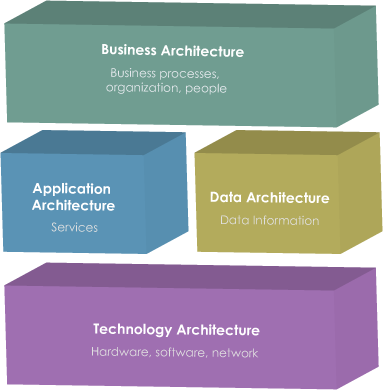
Business Architecture - The business strategy, governance, organization, and key business processes.
Data Architecture - The structure of an organization's logical and physical data assets and data management resources.
Application Architecture - A blueprint for the individual applications to be deployed, their interactions, and their relationships to the core business processes of the organization.
Architecture Technology Architecture - The logical software and hardware capabilities that are required to support the deployment of business, data, and application services. This includes IT infrastructure, middleware, networks, communications, processing, and standards.
Note That: Information Systems Architecture = Data Architecture + Application
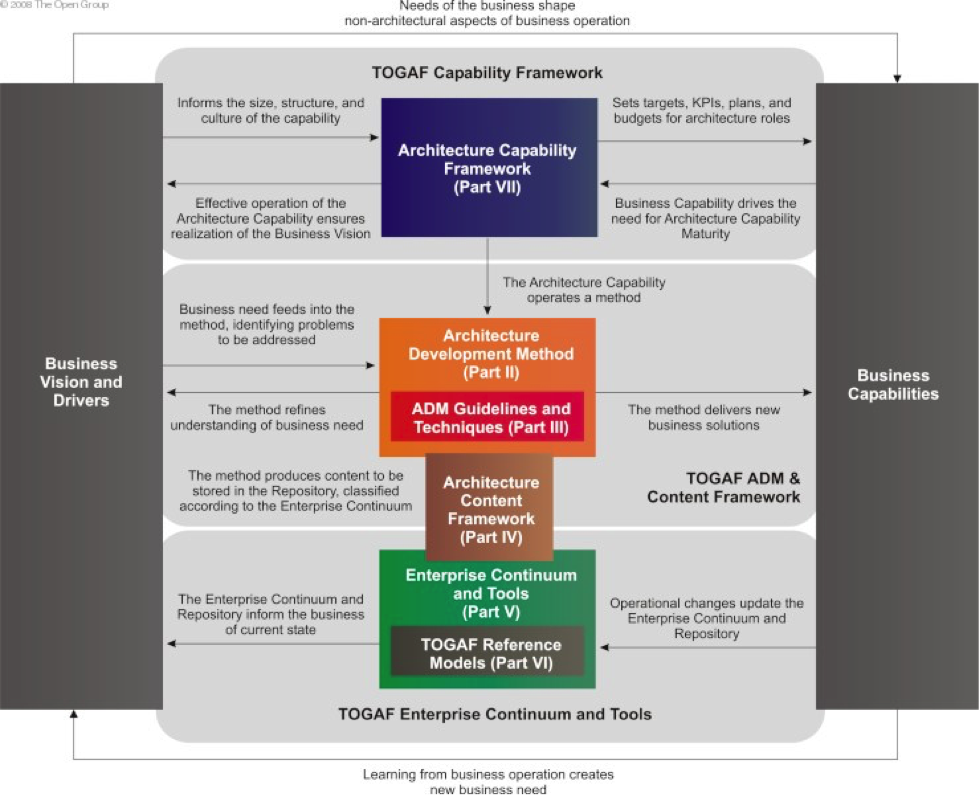
Part II – the Architecture Development Method (ADM) is Central Part of TOGAF
Part VII – The Architecture Capability operates the ADM.
Part III – The ADM is supported by a number of Guidelines and Techniques
Part IV – Contents such as: Deliverables, artifacts and building blocks are produced and stored in the Architecture Repository
Part V – they are classified according to the Enterprise Continuum
Part VI – The repository is initially populated with the TOGAF Reference Models
This is the famous circle called the Architecture Development Methods (ADM). Each phase contain set of steps one has to undertake. It provides a tested and repeatable process for developing architectures.
Preliminary Phase
Phase A: Architecture Vision
Phase B: Business Architecture
Phase C: Information Systems Architectures Phase D: Technology Architecture
Phase E: Opportunities & Solutions
Phase F: Migration Planning
Phase G: Implementation Governance
Phase H: Architecture Change Management
Requirements Management
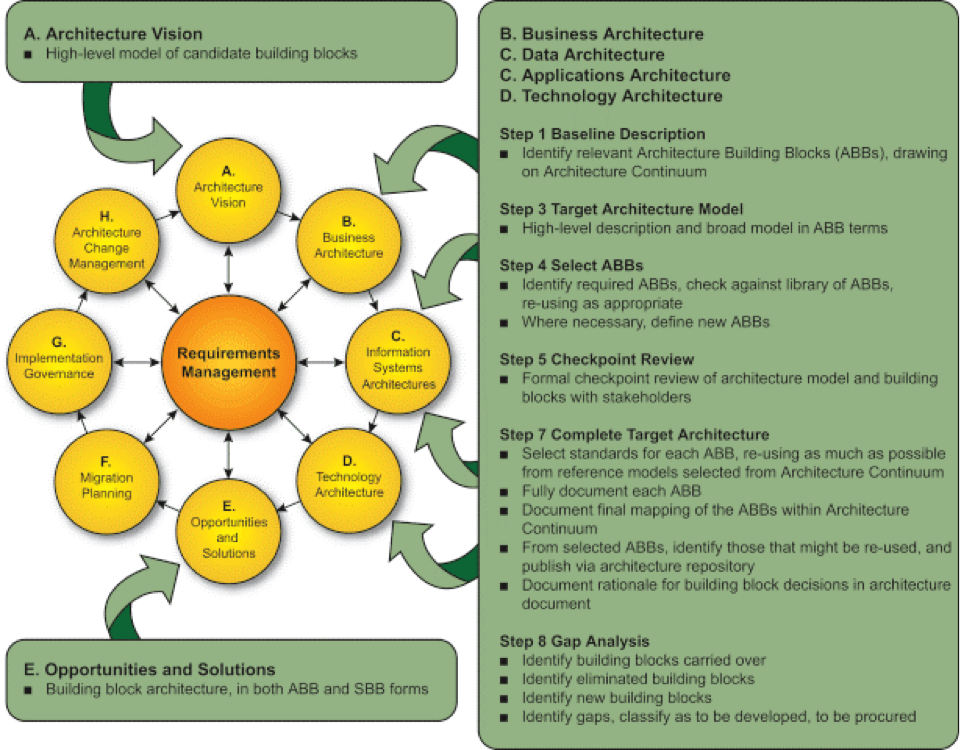
In the architecture phase B, C and D of TOGAF, the same steps (step 1-8) have to be conducted
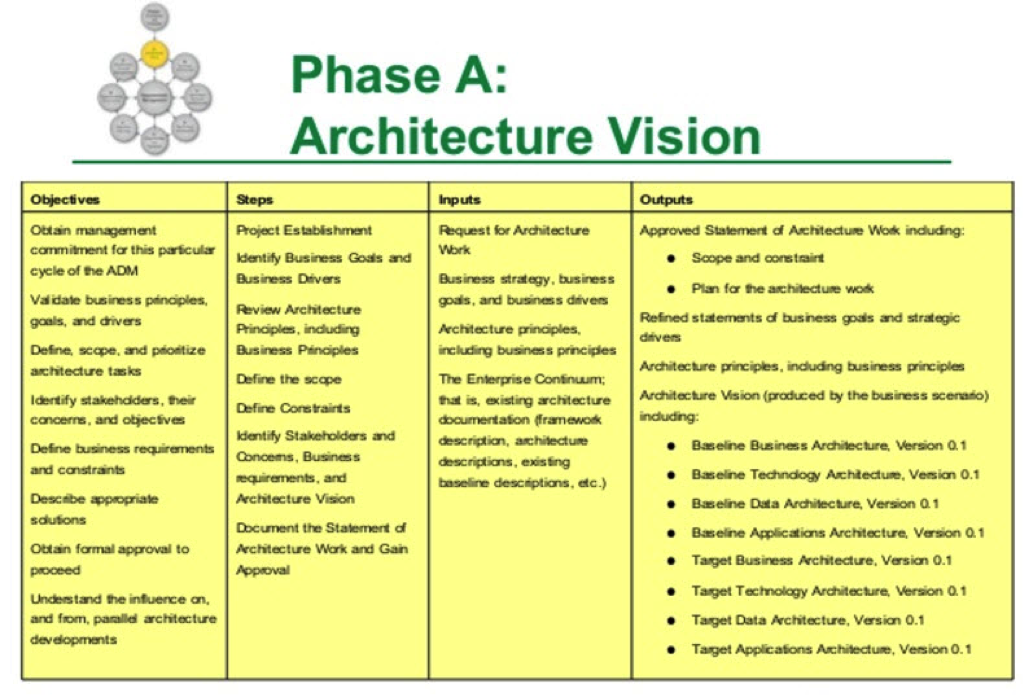
Each of the development phases in TOGAF, comes with four major sections to guide as described of phase A in the Figure below:
A set of guidelines and techniques to support the application of the ADM. The guidelines help to adapt the ADM to deal with different scenarios, including different process styles (e.g. the use of iteration) and also specific requirements (e.g. security). The techniques support specific tasks within the ADM (e.g. defining principles, business scenarios, gap analysis, migration planning, risk management, etc). These are the topics covered in ADM Guidelines & Techniques:
Iteration in ADM
Architecture Landscape
Security Architecture
SOA
Architecture Principles
Stakeholder Management
Architecture Patterns
Business Scenarios and Business Goals
Gap Analysis
Migration Planning Techniques
Interoperability Requirements
Business Transformation Readiness Assessment
Risk Management
Capability-based Planning
This part describes the TOGAF Content Framework (New for TOGAF 9). It describes:
A significant addition to TOGAF
It provides a detailed model of architectural work products
It drives for greater consistency in the outputs of TOGAF
The content framework provides a structured model of building block types, relationships and attributes which can be used informally, or as the basis for configuration of an Enterprise Architecture modelling tool. Through, building blocks continue to be the basic elements of the architecture within TOGAF, the content framework features a core and extension concept, with optional building block types, in order to support lightweight and detailed architectures. It has the following benefits added to TOGAF:
It provides a comprehensive checklist of architecture outputs.
It promotes better integration of work products if adopted across an enterprise
It provides a detailed open standard for how architectures should be described
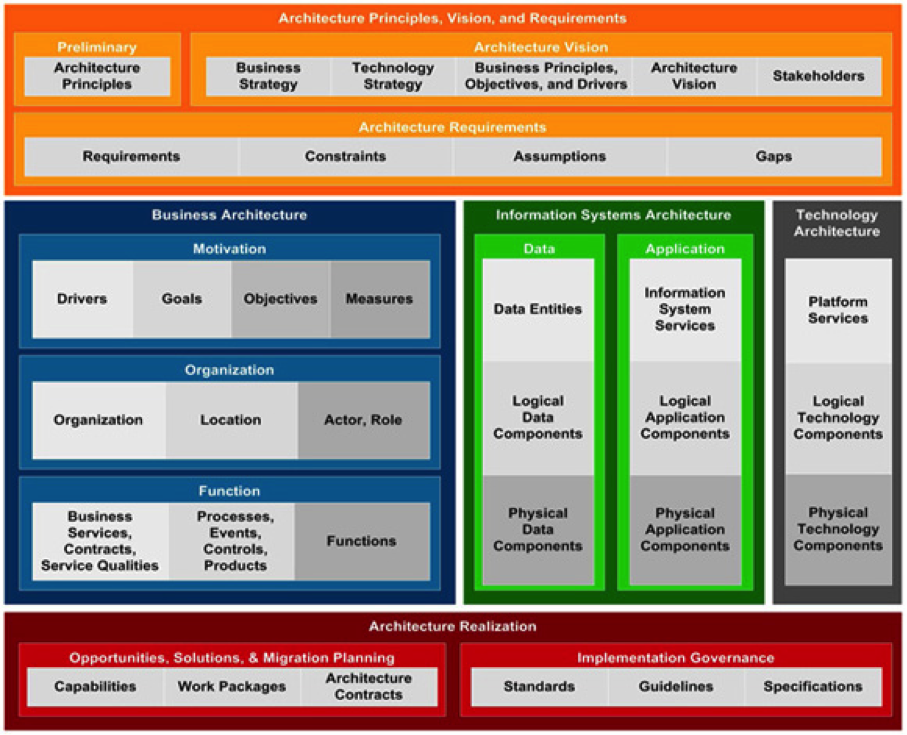
Deliverables is used for work products that are required to be produced and will be formally reviewed, agreed and signed off by the stakeholders. The output of the projects are usually under the deliverables category and are in documentation form which will be archived at the completion of the project or moved to Architecture Repository as a reference model, standard or snapshot of the architecture Landscape.
Architecture Content Framework uses three different categories to categorize the type of output developed during ADM process. The three different TOGAF Architecture Content Framework categories are:
Deliverables
Artifacts
Building Blocks
Artifacts are used for work a product that describes an aspect of the architecture. Artifacts are classified as below:
Catalog - Used to show a list of things
Matrices - Used to show relationships between things
Diagrams - Pictures of things
A building block is package of functionality defined to meet the business needs across an organization. Building blocks are often used in different levels. We can use it to represent conceptual business capabilities such as, customer relation management (CRM) in early analysis. We can also refine the conceptual capability into functionalities such as, customer master data and then further detailing it into: manager appointment, manage customer contacts etc.
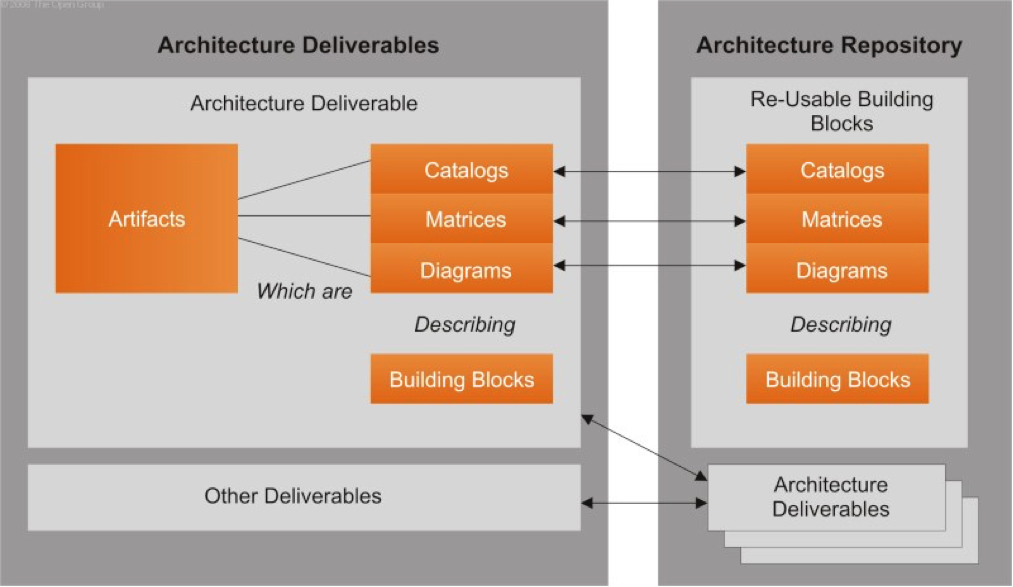
A Model for Structuring a Virtual Repository and Methods for Classifying Architecture and Solution Artifacts. It has the following changes in TOGAF 9:
Substantially revised
New content added on Architecture Partitioning and the Architecture Repository
The Standard Information Base (SIB) is removed
In the upper part of Figure, it describe the logical picture of the architecture (Architecture Continuum) and in the lower port, it mentions the physical realization of the architecture (Solutions Continuum)
Also the Diagram is structured from the left "more generic" architecture, to the right "more specific" architecture, that allows us refine our architecture from "logical" to "physical", and from more generic to more specific as we progress from the problem initially, and to the solution eventually.
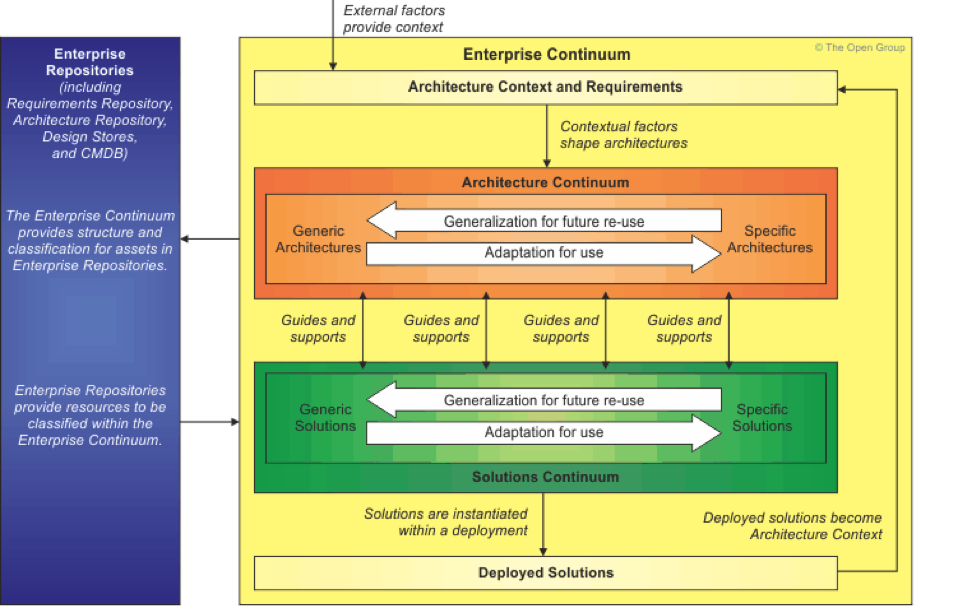
Architecture Partitioning allows for management of costs and complexity by dividing up the Enterprise and assigning appropriate roles and responsibilities to each partition. This Figure demonstrates the need of a meta-architecture in federated organizations that provides an integration framework for the individual architects of the different business units.
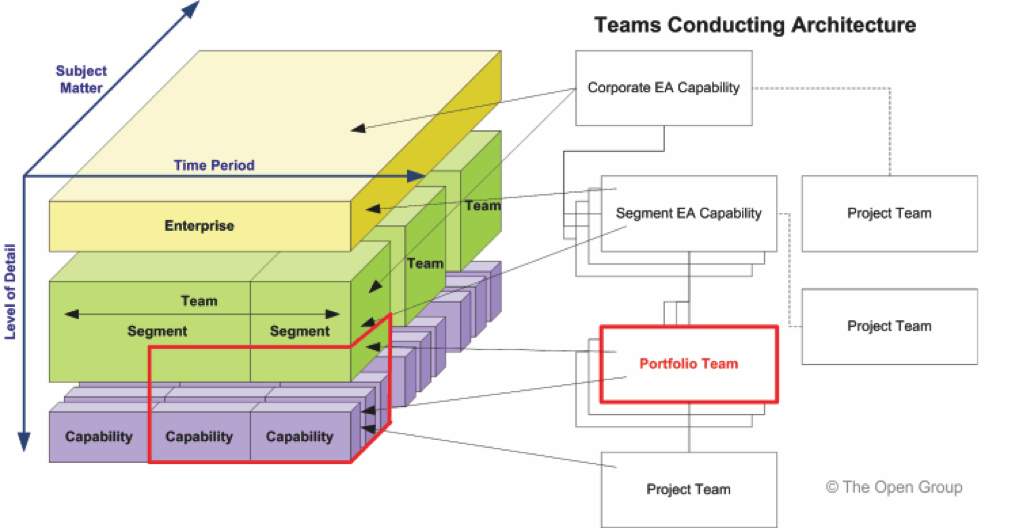
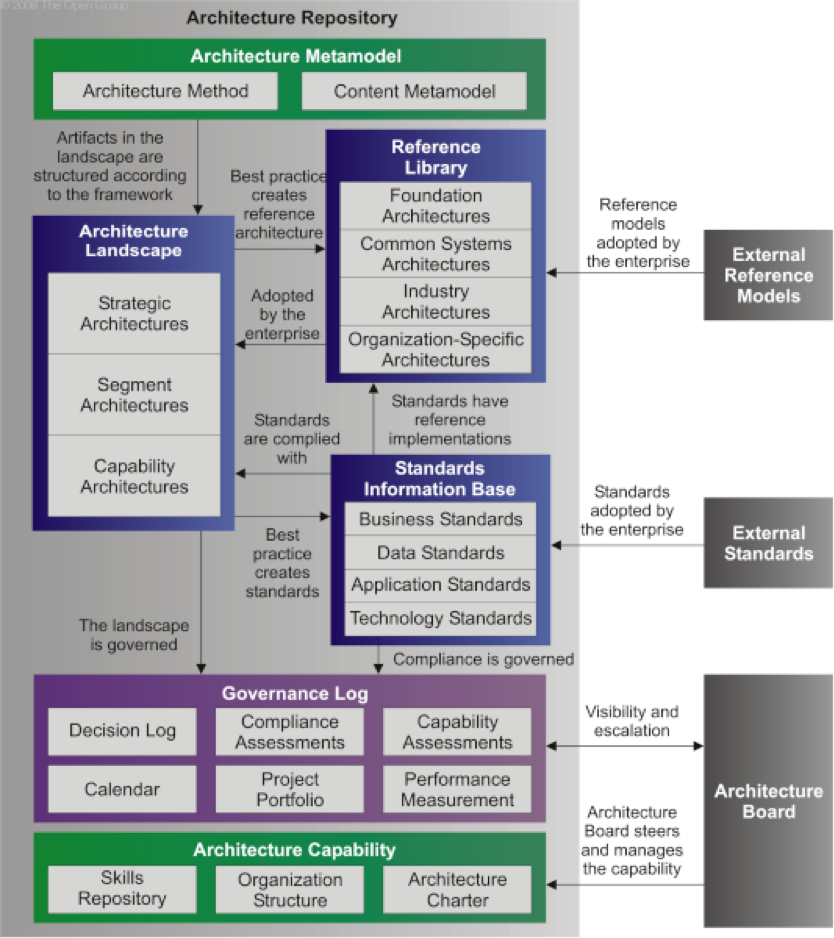
Architecture Repository is a logical place to organize reference material and results of architecture work. Some or all of it may be archived in physical repository tool such as VP's documentation cabinet. It is also a conceptual model which defines what kind of things are stored. The major components within an Architecture Repository are as follows:
The Architecture Metamodel describes the organizationally tailored application of an architecture framework, including a metamodel for architecture content.
The Architecture Capability defines the parameters, structures, and processes that support governance of the Architecture Repository.
The Architecture Landscape shows an architectural view of the building blocks that are in use within the organization today (e.g., a list of the live applications). The landscape is likely to exist at multiple levels of abstraction to suit different architecture objectives.
The Standards Information Base (SIB) captures the standards with which new architectures must comply, which may include industry standards, selected products and services from suppliers, or shared services already deployed within the organization.
The Reference Library provides guidelines, templates, patterns, and other forms of reference material that can be leveraged in order to accelerate the creation of new architectures for the enterprise.
The Governance Log provides a record of governance activity across the enterprise.
The definition of the Reference Models are substantially revised in TOGAF 9. There are two reference models are provides:
Technical Reference Model (TRM) - A Foundation Architecture which serves as a model and a taxonomy of generic platform services.
Integrated Information Infrastructure Model (III-RM) - A model for business application and infrastructure application
Architecture Continuum is composed of four states. The underlying process is to discover architectural requirements, analyze and understand architectures that are already in place in the organization, from foundation architectures (i.e. TRM), through common systems architectures III-RM), industry standard architectures, (i.e. SOA), and to an organization's own architecture. The Figure below is an illustration of an architectural process based on four states:
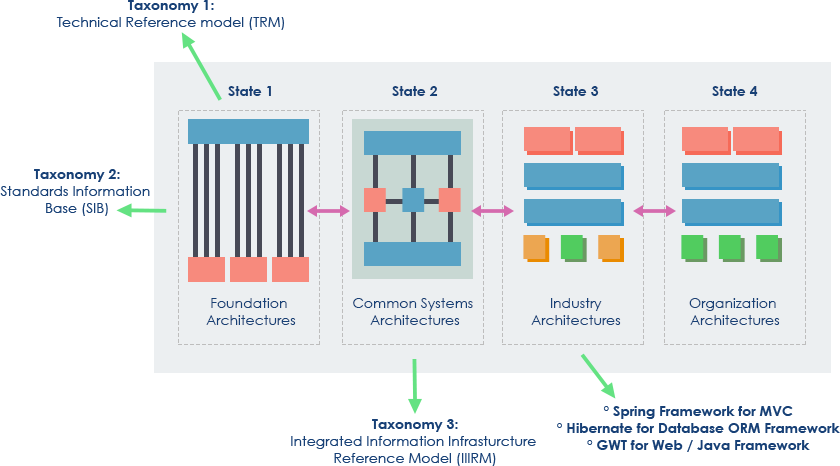
Foundation architectures (TRM)
Common system architectures (III-RM)
Industry architectures
Organization architectures
Architectural changes made to states at the left will migrate to states at the right. The left-to-right direction implies a logical progression in organizing an enterprise architecture implementation.
This part discusses the organization, processes, skills, roles, and responsibilities required to establish and operate an architecture practice within an enterprise. It is a new part in TOGAF 9 and derived based on the 8.1.1 Resource Base
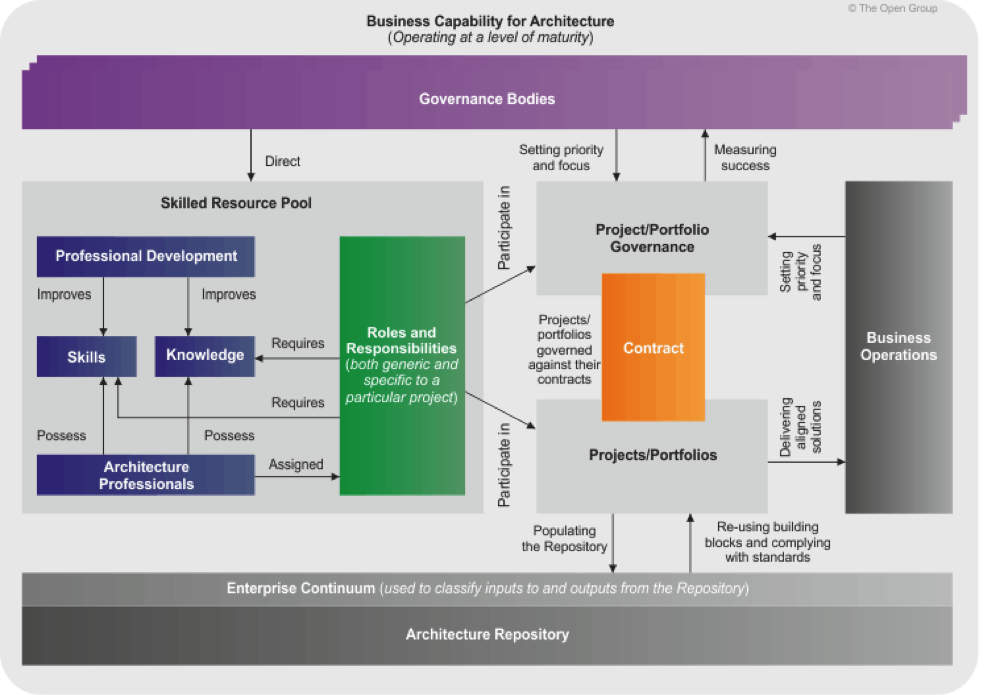
An enterprise architecture development involve the generation of business capability, planning and managing architecture in the organization on all levels through different development phases. The enterprise needs to identify of the governance bodies which is responsible to make architecture decisions as shown on the top of the Figure below.
In the middle of the right-hand side, TOGAF specifies the architecture pool of skills which records the definition of the maturity of the organization and its improvement. Therefore, it contains the architecture professionals' skills, knowledge and professional development strategies. These knowledge enables the definition of the roles and responsibilities for the architecture work, in other words, who is responsible for what?
On the right of the skilled pool, the Project/Portfolio Governance send contracts of architecture work to the Project/Portfolio, which should in sync with priority and focus of the business operations.
Deliverables, Artifacts, logs or policy papers can be drawn from the enterprise continuum and architecture repository
The general idea is to evolve the capability of the organization to develop architecture which will result of increasing business capability.
Architecture Board - The Board oversees implementation of the governance strategy, which comprises of representative stakeholders responsible for review and maintenance of architecture
Architecture Compliant - A key relationship between the architecture and the implementation lies in the definitions of the terms compliant for ensuring the compliance of individual projects with the enterprise architecture.
Architecture Contracts - Joint agreements between development partners and sponsors on the deliverables, qualify and fitness-for-purpose of an architecture
Architecture Maturity Models - they are employed as a means for businesses to evaluate their current position, and therefore, better understand when it's the right time to move forward and how to do so
Architecture Skills Frameworks - provide a view of the competency levels required for specific roles.
January 19, 2026
EDITION REQUIRED|DESKTOPEnterprise
Visual Paradigm is thrilled to announce the release of our groundbreaking AI-enhanced TOGAF Guide Through feature. This major update positions Visual Paradigm as the premier AI TOGAF tool, AI TOGAF software, and AI enterprise architecture software on the market, empowering enterprise architects to complete complex TOGAF ADM projects faster and more accurately than ever before.
For years, our TOGAF Guide Through has provided step-by-step guidance through the entire TOGAF Architecture Development Method (ADM). Now, with powerful AI integration, this AI-powered TOGAF Guide Through becomes your intelligent co-pilot, automatically generating professional artifacts from simple natural-language descriptions. Whether you're a seasoned architect or new to TOGAF, this AI enterprise architecture tool dramatically reduces time, effort, and complexity.
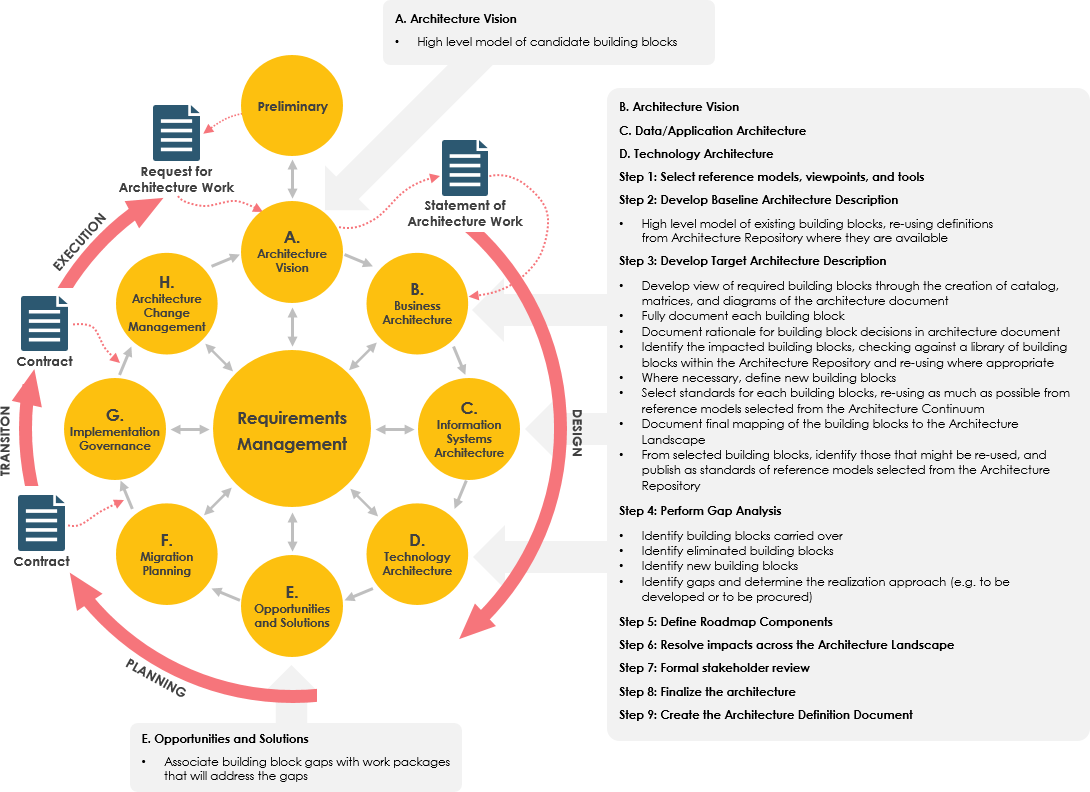
The TOGAF ADM Cycle – Now Fully Supported by AI in Visual Paradigm
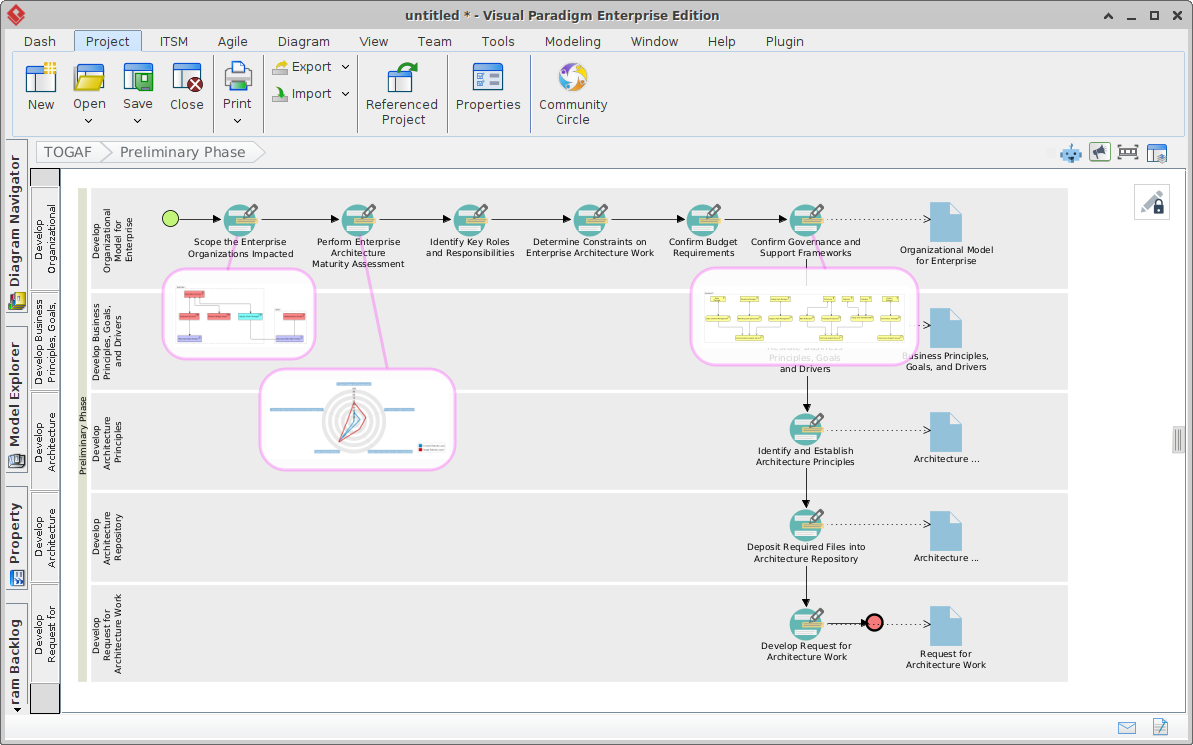
The AI-powered TOGAF Guide Through is an intelligent, interactive wizard that guides you through every phase of the TOGAF ADM. You navigate clickable ADM diagrams, complete activities one by one, and let AI handle the heavy lifting of artifact creation. This AI TOGAF software understands your project context and instantly produces standards-compliant deliverables such as ArchiMate diagrams, radar charts, gap analysis models, work breakdown structures, and migration roadmaps.
No more starting from blank canvases. Simply describe your business challenge, current capabilities, or desired outcomes, and the AI TOGAF tool does the rest – while keeping everything fully editable for your expert review.
Using the AI-enhanced TOGAF Guide Through is incredibly simple:
Launch the Guide Through from Visual Paradigm and select your TOGAF ADM project.
Navigate the interactive ADM diagram to the current activity.
Access the AI Tool via the side bar on the right.
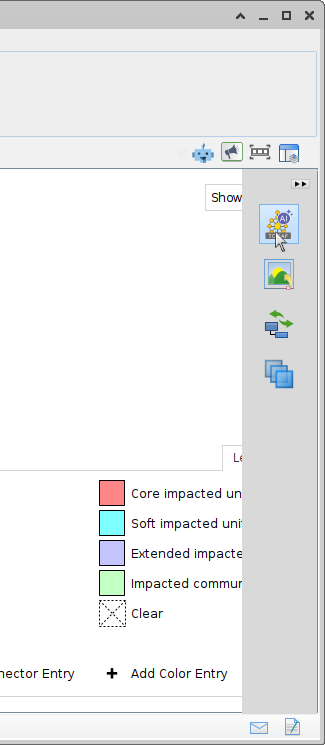
Provide a brief natural-language problem description.
Click "OK" – watch the AI enterprise architecture software create diagrams, charts, and plans in seconds.
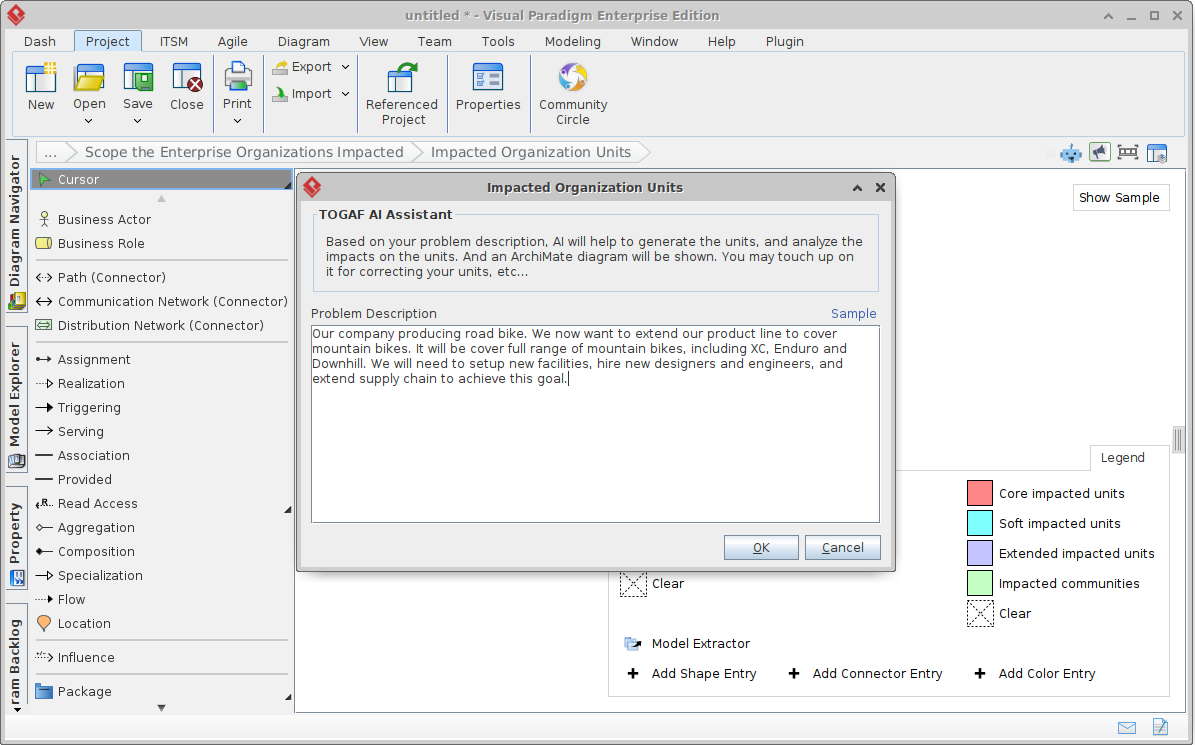
Review, edit, and refine the output directly in the built-in editors.
Proceed to the next step – previous AI outputs automatically carry forward for consistency.
This seamless workflow makes Visual Paradigm the most user-friendly AI TOGAF tool available, perfect for solo architects, large teams, and consulting firms.
The AI integrates deeply into all phases of the TOGAF ADM, delivering targeted support exactly where you need it most:
Kick off your project confidently with AI-generated organization impact analysis, maturity radar charts, governance structure diagrams, and high-level project schedules – all from a single description.
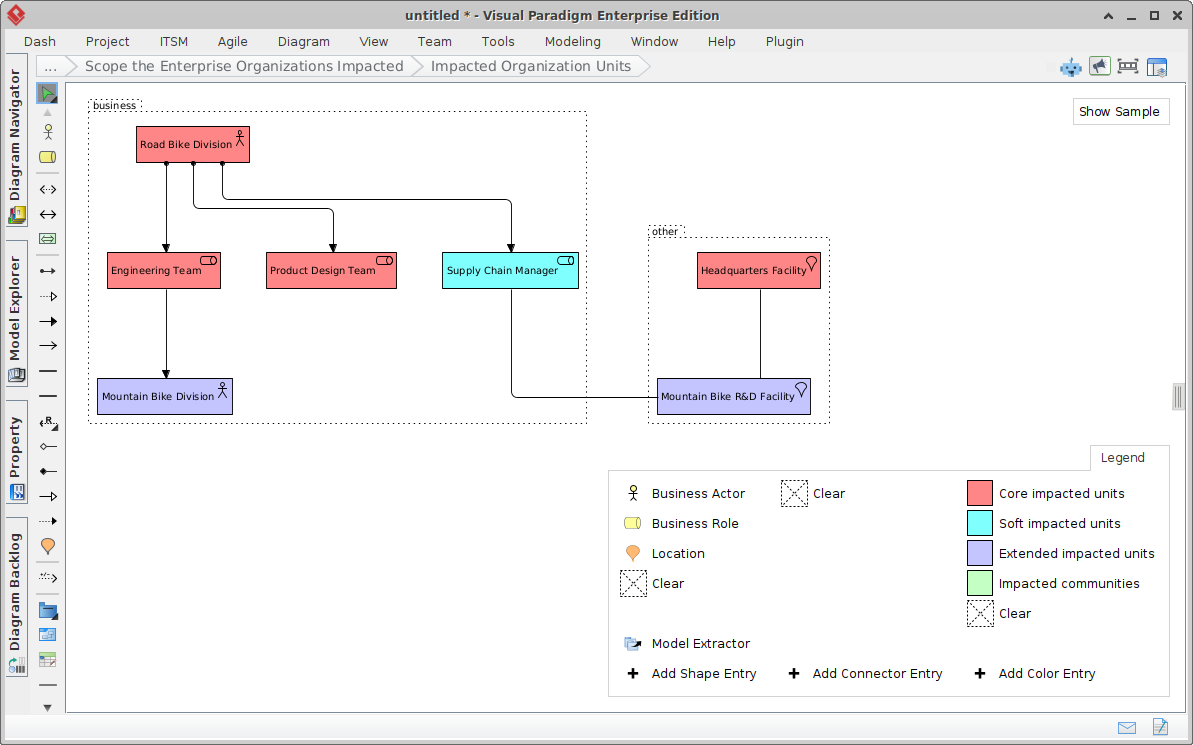
AI-Generated ArchiMate Diagram for the EA Organization Impacted Units, by Visual Paradigm's TOGAF ADM Tool
Quickly define your vision with AI-created solution concept diagrams and business/IT capability assessment radar charts. The AI TOGAF software even reviews and updates maturity assessments automatically.
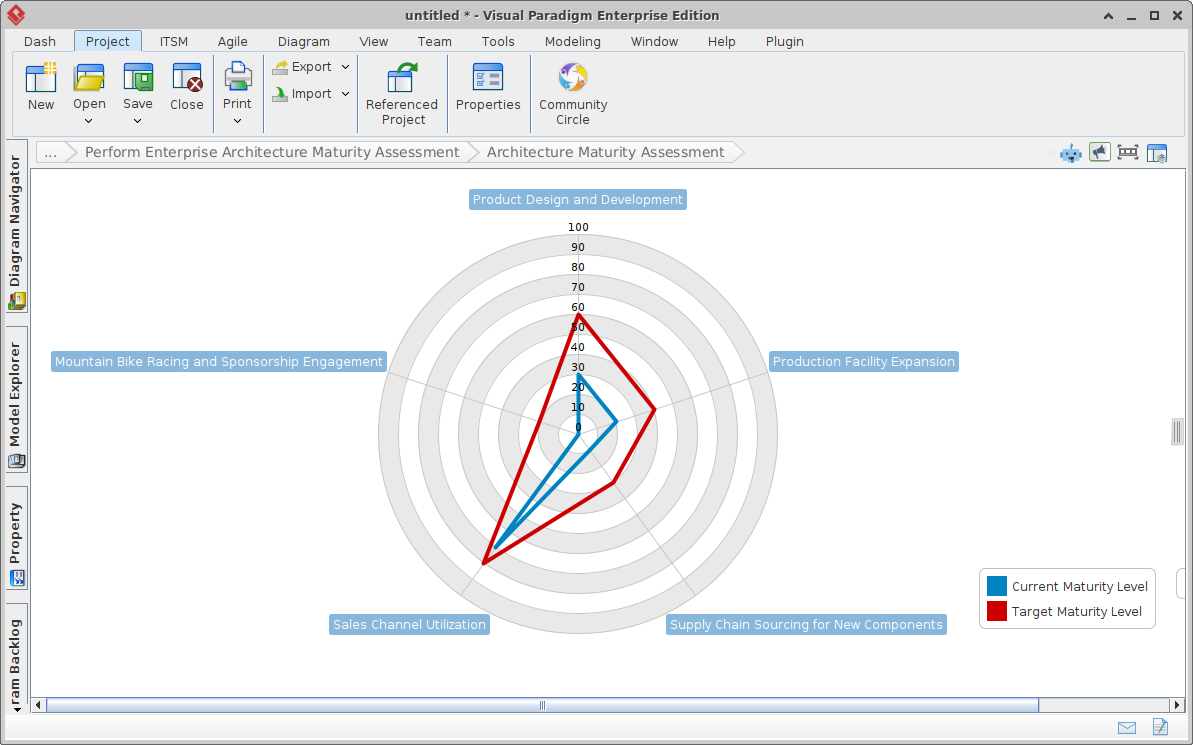
Example of an AI-Generated Architecture Maturity Assessment Radar Chart
Develop baseline and target business architecture models in ArchiMate instantly. The AI enterprise architecture tool also visualizes business domain gaps clearly for stakeholder presentations.
Get complete baseline and target models for both data and application architectures, plus precise gap analysis diagrams – all generated by the AI TOGAF tool in moments.
Build current and future technology architecture models and identify technology gaps effortlessly with AI assistance.
Let AI organize major work packages into a clear Work Breakdown Structure (WBS), model transition architectures, define architecture states, and create a visual migration timeline.
Refine and confirm everything from Phase E with updated AI suggestions, ensuring your migration roadmap is realistic and actionable.
Organizations worldwide are choosing this AI-powered TOGAF Guide Through because it delivers real, measurable advantages:
Faster Project Delivery: Reduce artifact creation time by up to 80% with instant AI generation.
Higher Quality Outputs: Every diagram and chart follows TOGAF and ArchiMate standards automatically.
Lower Skill Barrier: Junior architects can produce expert-level work with AI guidance.
Better Collaboration: Share polished, AI-generated models with stakeholders instantly.
Cost Savings: Complete TOGAF projects with fewer hours and less consulting support.
Scalability: Handle small initiatives or enterprise-wide transformations with ease.
Continuous Learning: Built-in samples and AI suggestions help teams master TOGAF over time.
These benefits make Visual Paradigm the top choice for anyone searching for a reliable AI TOGAF tool or comprehensive AI enterprise architecture software.
This feature is ideal for:
Enterprise architects leading digital transformation
IT consultants delivering TOGAF-based engagements
Architecture teams in banking, retail, government, and manufacturing
Organizations assessing or improving architecture maturity
Anyone adopting TOGAF for the first time
Global Retail Corp, a multinational retailer with operations across 25 countries, embarked on a digital transformation initiative to unify its fragmented IT landscape and align technology investments with strategic business goals. The organization selected TOGAF ADM as its enterprise architecture framework but faced challenges: lengthy artifact development cycles, inconsistent documentation quality, and difficulty onboarding new team members to the methodology.
The architecture team needed to:
Develop a comprehensive target architecture covering Business, Data, Application, and Technology domains
Produce standards-compliant deliverables for executive review within aggressive timelines
Ensure consistency across multiple workstreams and geographic teams
Reduce dependency on external TOGAF consultants
Global Retail Corp adopted Visual Paradigm's AI-powered TOGAF Guide Through to accelerate their ADM implementation:
Phase 1: Preliminary & Vision (Weeks 1-2)
Used AI to generate organization impact analysis and governance structure diagrams from executive strategy documents
Created architecture maturity radar charts to baseline current capabilities
Defined Architecture Vision deliverables with AI-assisted stakeholder mapping
Phase 2: Business Architecture (Weeks 3-5)
Described current and target business processes in natural language; AI generated ArchiMate models instantly
Visualized gaps between legacy and target operating models for leadership workshops
Automated creation of business capability maps aligned to strategic objectives
Phase 3: Information Systems Architectures (Weeks 6-9)
AI assisted in modeling data entities and application portfolios across regional subsidiaries
Generated gap analysis matrices highlighting integration opportunities and redundancies
Produced standardized catalogs and matrices for data governance committees
Phase 4: Technology Architecture (Weeks 10-12)
Defined target infrastructure patterns using AI-suggested cloud migration strategies
Created technology standards catalogs aligned with security and compliance requirements
Visualized migration dependencies through AI-generated transition architecture diagrams
Phase 5-6: Opportunities, Solutions & Migration Planning (Weeks 13-16)
AI organized work packages into a coherent Work Breakdown Structure
Generated migration roadmaps with timeline visualizations for portfolio planning
Enabled iterative refinement of plans through natural-language feedback loops
| Metric | Before AI Adoption | After AI Adoption |
|---|---|---|
| Artifact Creation Time | 3-5 days per deliverable | 4-8 hours per deliverable |
| Team Onboarding | 6-8 weeks to proficiency | 2-3 weeks to proficiency |
| Documentation Consistency | Variable across teams | 95%+ standards compliance |
| Stakeholder Engagement | Limited due to draft quality | High engagement with polished visuals |
| External Consultant Dependency | 40% of effort | <10% of effort |
Natural Language Interface: Business stakeholders could contribute requirements without learning modeling syntax
Standards Enforcement: AI ensured all outputs adhered to TOGAF and ArchiMate specifications automatically
Iterative Refinement: Teams could rapidly prototype, review, and revise architectures in collaborative sessions
Knowledge Retention: AI suggestions served as just-in-time learning, building internal TOGAF competency
Start with well-scoped pilot phases to demonstrate value before enterprise rollout
Maintain human oversight: AI accelerates creation but expert review ensures strategic alignment
Invest in training teams to craft effective natural-language prompts for optimal AI output
Leverage AI-generated artifacts as living documents, not final deliverables, to support agile evolution
The convergence of TOGAF's rigorous methodology with Visual Paradigm's AI-powered capabilities represents a paradigm shift in enterprise architecture practice. As demonstrated through the Global Retail Corp case study, AI augmentation does not replace architectural expertise—it amplifies it. By automating repetitive artifact creation, enforcing standards compliance, and lowering barriers to entry, AI-enabled tools allow architects to focus on high-value activities: strategic thinking, stakeholder engagement, and innovative solution design.
Organizations adopting this integrated approach gain tangible advantages: faster time-to-value, improved documentation quality, enhanced team scalability, and reduced reliance on external expertise. Moreover, the continuous learning embedded within AI-assisted workflows helps build sustainable internal architecture capabilities—a critical asset in an era of relentless digital change.
For enterprise architects, the message is clear: embrace AI not as a threat to professional relevance, but as a powerful co-pilot that elevates the impact and reach of your work. For organizations, the opportunity lies in investing in tools that democratize architecture excellence while preserving the strategic judgment that only experienced professionals can provide.
As TOGAF continues to evolve as the global standard for enterprise architecture, and as AI capabilities mature in sophistication and accessibility, the synergy between framework and intelligence will define the next generation of architecture practice. Visual Paradigm's AI-powered TOGAF Guide Through offers a compelling glimpse into that future—one where structured methodology and adaptive intelligence combine to turn architectural vision into business reality, faster and more effectively than ever before.
Professional TOGAF ADM tool that features a guided process: Visual Paradigm's TOGAF ADM tools provide a guided process for enterprise architecture development, supporting the full Architecture Development Method lifecycle with intuitive interfaces and standards-compliant outputs.
What is TOGAF ADM?: A comprehensive tutorial explaining the TOGAF Architecture Development Method, its phases, deliverables, and how Visual Paradigm supports practitioners in implementing ADM effectively.
Try Visual Paradigm FREE: Download a free trial of Visual Paradigm to experience its enterprise architecture modeling capabilities, including TOGAF ADM support, ArchiMate modeling, and AI-powered assistance features.
AI-Enhanced TOGAF Guide Through Feature Page: Detailed overview of Visual Paradigm's AI-powered TOGAF Guide Through, showcasing how artificial intelligence accelerates artifact creation, ensures standards compliance, and simplifies enterprise architecture workflows.

