
In modern software engineering, managing complexity is the defining challenge. The Unified Modeling Language (UML) addresses this by providing a precise, standardized framework that bridges the gap between abstract requirements and concrete implementation. Rooted in the object-oriented paradigm, UML aligns naturally with human cognition: it models software as a society of autonomous, interacting entities rather than as a rigid sequence of procedural steps.
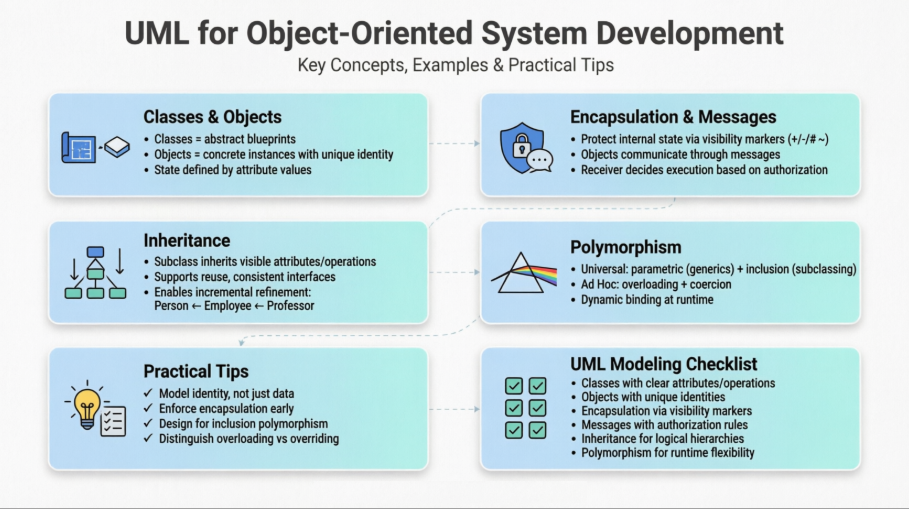
By examining core concepts such as classes, objects, encapsulation, message passing, inheritance, and polymorphism, and pairing them with concrete examples and practical modeling strategies, this article equips you with the theoretical clarity and tactical know-how required to create UML models that are not merely visual sketches, but rigorous, unambiguous blueprints for maintainable software systems.
Definition: Abstract blueprints that describe the attributes (data) and operations (behavior) of a set of similar objects.
Purpose: Group common features, define permitted behaviors, and avoid redundancy.
UML Role: Forms the structural backbone of class diagrams.
Definition: Concrete instances of a class. Each object possesses a unique identity, a state (determined by current attribute values), and behavior (triggered via operations).
Distinction from Values: Unlike primitive values (e.g., the number 1), objects retain identity even if all attributes match another object.
Definition: Protection of an object's internal state from unauthorized access. Access is strictly controlled through a well-defined interface.
Mechanism: Achieved via visibility markers (public, private, protected, package) that dictate who can read or modify attributes and invoke operations.
Definition: The primary mechanism for object communication. A message is a request to execute a specific operation.
Execution Logic: The receiving object autonomously decides whether and how to execute the request based on:
Sender authorization (visibility rules)
Availability of a suitable implementation
Overloading Support: The same message name can trigger different behaviors depending on parameter types (e.g., + for arithmetic vs. string concatenation).
Definition: A derivation mechanism where a subclass inherits all visible attributes and operations from a superclass.
Subclass Capabilities:
Define new attributes/operations
Overwrite inherited operation implementations
Extend inherited operations with additional code
Outcome: Creates class hierarchies (e.g., A ← B means B is a subclass of A) that promote reuse, consistent interfaces, and incremental refinement.
Definition: The ability of an element to take on multiple forms at runtime.
Types:
Universal Polymorphism:
Parametric (Genericity): Uses type parameters (e.g., Java generics).
Inclusion: Operations apply to a class and all its direct/indirect subclasses.
Ad Hoc Polymorphism:
Overloading: Same operation name, different parameter signatures.
Coercion: Implicit/explicit type conversion.
Dynamic Binding: Attributes declared with a superclass type can dynamically bind to subclass instances at runtime.
| Concept | Example from Text | UML Modeling Insight |
|---|---|---|
| Class | Person (name, address, SSN), Course (ID, title), LectureHall (name, location) |
Define compartments for attributes and operations. Use singular nouns for class names. |
| Object & State | lh1 (Lecture Hall 1) vs lh2. State: free or occupied. |
Objects have identity. State is modeled via attribute values. UML object diagrams capture snapshots. |
| Encapsulation | private dob, public getName(), protected access for subclasses |
Use +, -, #, ~ in UML class diagrams to enforce interface boundaries. |
| Inheritance | Person ← Employee ← Professor |
Draw hollow triangular arrows from subclass to superclass. Enables progressive specialization. |
| Polymorphism/Overloading | + operator: 1 + 1 = 2 (integers) vs "a" + "b" = "ab" (strings) |
Model operations with identical names but distinct parameter lists in the class diagram. |
| Message Exchange | reserve(lectureHall, date) triggered by a student object |
Model as operation calls or interaction arrows. Receiver validates visibility before execution. |
Model Identity, Not Just Data
Tip: When designing classes, ensure entities that require distinct lifecycle tracking (e.g., LectureHall, Student) are modeled as objects, not primitive values. Objects retain identity even with identical attribute values.
Why: Prevents logical errors where two distinct real-world entities are incorrectly merged by the system.
Enforce Encapsulation Early in UML
Tip: Always assign visibility markers (+, -, #) during the design phase. Default to private for attributes and expose only necessary public operations.
Why: Information hiding reduces coupling and protects internal state, making future refactoring safer.
Leverage Inheritance for Incremental Development
Tip: Use inheritance to extract common features into abstract superclasses. Allow subclasses to specialize behavior through overriding or extension.
Why: Eliminates redundancy, ensures interface consistency across hierarchies, and supports step-by-step refinement from general to specific concepts.
Design for Inclusion Polymorphism
Tip: Declare variables, parameters, and return types using superclass or interface types rather than concrete subclass types.
Why: Enables dynamic binding. The system can seamlessly handle new subclasses introduced later without modifying existing code/models.
Distinguish Overloading from Overriding
Tip: Use overloading (ad hoc polymorphism) when the same action logically applies to different data types. Use overriding (via inheritance) when a subclass needs to alter or specialize superclass behavior.
Why: Clarifies intent in UML diagrams and prevents implementation conflicts during code generation.
Model Messages as Requests, Not Commands
Tip: Remember that a message only requests behavior. The receiving object evaluates visibility and implementation availability before acting.
Why: Aligns UML interaction diagrams with true OO principles, avoiding rigid, procedural-style coupling.
Avoid "Method War" Notation Conflicts
Tip: Stick to standardized UML syntax for visibility, inheritance arrows, and operation signatures. UML consolidates decades of OO best practices into a single, tool-agnostic notation.
Why: Ensures interoperability, reduces ambiguity, and allows models to be translated into any OO language (Java, C#, etc.) predictably.
Have I abstracted real-world entities into Classes with clear attributes and operations?
Do my Objects have unique identities and well-defined states?
Is Encapsulation enforced via appropriate visibility markers?
Are inter-object communications modeled as Messages with clear authorization rules?
Have I used Inheritance to reuse common features and create logical hierarchies?
Does my design leverage Polymorphism (especially inclusion/genericity) for runtime flexibility?
Is the model language-agnostic but easily translatable to target OO programming languages?

